A private equity waterfall calculation takes one distribution and pours it through the tiers of the fund's limited partnership agreement in order: first the limited partners' unreturned capital, then their preferred return, then a catch-up that brings the general partner up to its share of the profits, then the carried interest split, usually 80/20. In the example below, an illustrative buyout fund distributes $105,000,000: $60,000,000 returns capital, $39,772,594 pays the 8% preferred return compounded annually, and the remaining $5,227,406 goes to the GP as catch-up, which is not completed, so the split is never reached. Botminds' Distribution Waterfall Calculation runs the same tiers for every distribution from the agreement and the capital accounts, independently of the administrator's spreadsheet, and explains any difference tier by tier.
The tiers are easy to name and easy to get wrong, because the answer depends on inputs that most textbook examples skip: whether fees count as contributed capital, how the preferred return compounds, from which dates, and the catch-up percentage. Every figure in the worked example is illustrative arithmetic on an invented fund; the screens later on show the solution on sample data for a fictional manager, Quillfield Capital.
One $105 million distribution, four tiers: the split is never reached
What is a waterfall in private equity?
A waterfall is the order in which a closed-end fund's distributions are paid out between its investors and its manager, written into the limited partnership agreement. Robinson and Sensoy, who read the terms of 837 buyout and venture funds, describe the standard version in one sentence: "The typical management contract calls for GPs to first return to LPs all contributed capital (including that for management fees), plus in the case of buyout funds an 8% preferred return, before carried interest is earned" (NBER Working Paper 17942).
Each tier has to be full before money flows to the next, which is where the name comes from. The tiers are cumulative, not per distribution: every new distribution is calculated against everything called and paid since the fund began. That is why a waterfall cannot be checked by looking at one distribution notice. The preferred return owed today depends on every contribution date since the first close, and the catch-up owed depends on every preferred return payment made before.
This page works a whole-fund, or European, waterfall. A deal-by-deal, or American, waterfall runs the same tiers on one investment at a time, which changes when the GP is paid; American vs European waterfall in private equity compares the two on the same fund.
The example fund: what was called and what came back
Every waterfall starts from the capital accounts: what the LPs paid in, when, and what they have already received. The illustrative fund has $100 million of commitments. Its agreement, like the typical contract above, treats management fees and fund expenses paid through capital calls as contributed capital that must come back before carry.
The inputs a waterfall calculation needs before the first tier
| Date | Cash flow | Amount | Unreturned capital after it |
|---|---|---|---|
| January 1, 2020 | Capital call (investments, fees, expenses) | $40,000,000 | $40,000,000 |
| January 1, 2021 | Capital call | $30,000,000 | $70,000,000 |
| January 1, 2022 | Capital call | $20,000,000 | $90,000,000 |
| January 1, 2024 | Distribution, all return of capital | $30,000,000 | $60,000,000 |
| January 1, 2026 | Distribution being calculated | $105,000,000 | to be calculated |
Two numbers come straight from this table. Unreturned capital before the new distribution is $60 million: $90 million called less the $30 million already returned. And the preferred return clock started on each call date, not at the first close, because the example's agreement runs the return on each contribution from the date it was made. The sample agreement in the solution's screens uses the same words, "from the date each Capital Contribution was made until the date it is returned", and they are worth reading closely in any real clause.
How to calculate a waterfall distribution, tier by tier
To calculate a waterfall distribution, fill each tier in turn with whatever is left, never more than the tier is owed. The six steps below take the $105 million from the first dollar to the last; every figure can be re-performed with a calculator.
Private equity waterfall calculation example: six steps
| Step | Calculation | Result |
|---|---|---|
| 1. Unreturned capital owed to the LPs | $90,000,000 called − $30,000,000 returned | $60,000,000 |
| 2. Tier 1, return of capital | Lower of $105,000,000 available and $60,000,000 owed | $60,000,000 to LPs; $45,000,000 left |
| 3. Preferred return owed | 8% a year, compounded each January 1, on unreturned capital plus unpaid preferred return (table below) | $39,772,594 |
| 4. Tier 2, preferred return | Lower of $45,000,000 left and $39,772,594 owed | $39,772,594 to LPs; $5,227,406 left |
| 5. Tier 3, GP catch-up target | With a 100% catch-up to 20%: $39,772,594 × 20 ÷ 80 | $9,943,149 needed; $5,227,406 available |
| 6. Tier 4, 80/20 split | Nothing left after a catch-up that is not complete | $0 |
Step 5 is the one most examples get wrong. The catch-up does not pay the GP 20% of this distribution. It pays the GP 100% of each further dollar until the GP's carry equals 20% of all the profit distributed so far, which is the preferred return plus the catch-up itself. If the catch-up is C and the preferred return paid to date is P, the condition is C = 0.20 × (P + C), so C = P × 20 ÷ 80, a quarter of the preferred return paid. Here that is $9,943,149. Only $5,227,406 is left, so the GP takes all of it and the split waits for the next distribution.
Had the fund distributed $110 million instead, the catch-up would have completed at $9,943,149, and the last $284,257 would have been split $227,406 to the LPs and $56,851 to the GP. The GP's total would then be $10,000,000, exactly 20% of the $50 million profit to date. That identity, carry equal to 20% of cumulative profit once the catch-up is complete, is the quickest reasonableness check on any finished waterfall.
Tier two in detail: the preferred return, year by year
The preferred return is the largest number in this example and the one built from the most inputs. Compounded annually, each year's 8% is calculated on unreturned capital plus the preferred return still unpaid at the start of that year, so unpaid preferred return earns its own 8%. The schedule below rebuilds the $39,772,594 one year at a time.
Preferred return owed at each January 1, compounded annually
| Year | Base for the year | 8% for the year | Owed at the end of the year |
|---|---|---|---|
| 2020 | $40,000,000 capital | $3,200,000 | $3,200,000 |
| 2021 | $70,000,000 capital + $3,200,000 unpaid | $5,856,000 | $9,056,000 |
| 2022 | $90,000,000 + $9,056,000 | $7,924,480 | $16,980,480 |
| 2023 | $90,000,000 + $16,980,480 | $8,558,438 | $25,538,918 |
| 2024 | $60,000,000 (after the $30M return) + $25,538,918 | $6,843,113 | $32,382,032 |
| 2025 | $60,000,000 + $32,382,032 | $7,390,563 | $39,772,594 |
Two choices made silently in that schedule are worth naming. The $30 million paid in 2024 went to capital, as the tier order requires, so the unpaid preferred return kept compounding. And the 2024 distribution reduced the capital base from the day it was paid. A model that applied it to the preferred return first, or forgot to reduce the base, would owe a different amount. Preferred return calculation, compounded annually shows how far apart five common conventions land on one set of dates.
GP catch-up calculation: full catch-up and 80% catch-up
A full catch-up gives the GP 100% of the distributions after the preferred return until it has caught up to its carry percentage; a partial catch-up gives it a smaller share, often 80%, with the LPs taking the rest, so it takes more money to get there. Both end in the same place, the GP holding 20% of cumulative profit, but a partial catch-up gets there more slowly, which matters whenever a distribution lands inside the catch-up tier, as this one does.
The GP catch-up in four terms
Preferred return paid to date
P = $39,772,594
All tier 2 payments since the fund began, including this distribution.
Tier 2
Full catch-up target
C = P × carry ÷ (1 − carry)
At 20% carry: $39,772,594 ÷ 4 = $9,943,149, paid 100% to the GP.
Tier 3
80% catch-up
Dollars needed = P × carry ÷ (catch-up % − carry)
$39,772,594 × 0.2 ÷ 0.6 = $13,257,531, of which 80% to the GP and 20% to the LPs.
Tier 3
Check once complete
GP carry = 20% × cumulative profit
Profit = everything distributed − everything contributed. If the GP is above this line, something is wrong.
Reviewer
On this distribution, an 80% catch-up gives the GP $4,181,924 and the LPs $1,045,481 of the $5,227,406 left after the preferred return. With no catch-up at all, an arrangement in which carry is paid only on profit above the hurdle, the remaining $5,227,406 is split 80/20 and the GP receives $1,045,481. The SEC calls the second design a "hard hurdle", "under which the performance fee is calculated only on returns in excess of the threshold", and the catch-up version a "soft hurdle", "which permits the adviser to earn a performance fee on all profits once the threshold is cleared" (SEC proposal, 91 FR 63676, October 6, 2026). The proposal concerns registered funds and is open for comment until December 7, 2026, but it calls preferred returns and hurdles "well-established features of private fund performance fee arrangements".
Which inputs change a waterfall calculation the most?
On a distribution that ends inside the catch-up tier, almost every input moves money between the LPs and the GP. Change one convention at a time and keep the rest of the example as it is, and the GP's share of the same $105 million ranges from about $1.0 million to $10.6 million.
The same $105 million, five agreements: what the GP receives
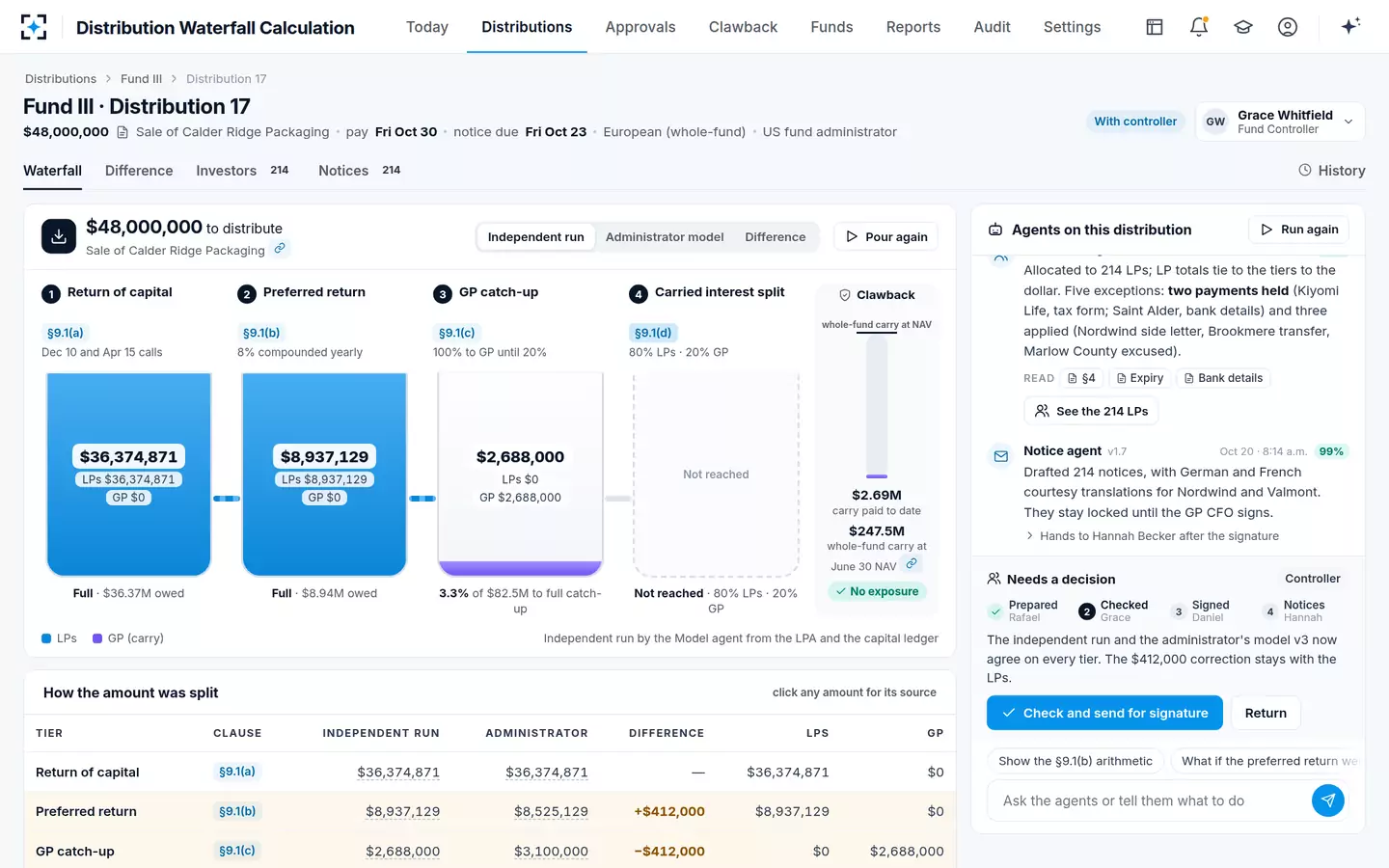
The last two bars are not choices a fund accountant gets to make: they are what the agreement says, and a model that departs from it moves money the agreement does not allow. Both are also conventions that disappear into a spreadsheet. A preferred return that should compound but does not looks exactly like one that should not, until the arithmetic is re-performed from the clause. In the sample data the solution runs on, the fictional Quillfield Fund III's administrator modelled its preferred return as a simple accrual on capital, where the agreement compounds unpaid preferred return each December 31; the difference on one $48 million distribution was $412,000, moved from the GP's catch-up back to the LPs before payment.
Distribution Waterfall Calculation: one distribution poured through its four tiers
From the fund to each LP: allocation, side letters and rounding
The waterfall produces fund-level totals; each LP's share is a second calculation. In a simple fund every LP takes its pro rata share of each tier by commitment. Real funds add exceptions that change both the tiers and the shares: an LP excused from one investment does not share in its proceeds, a transferee steps into a seller's capital account partway through the fund's life, and a side letter can set a lower carry rate, which gives that LP its own catch-up target and a larger share of the split.
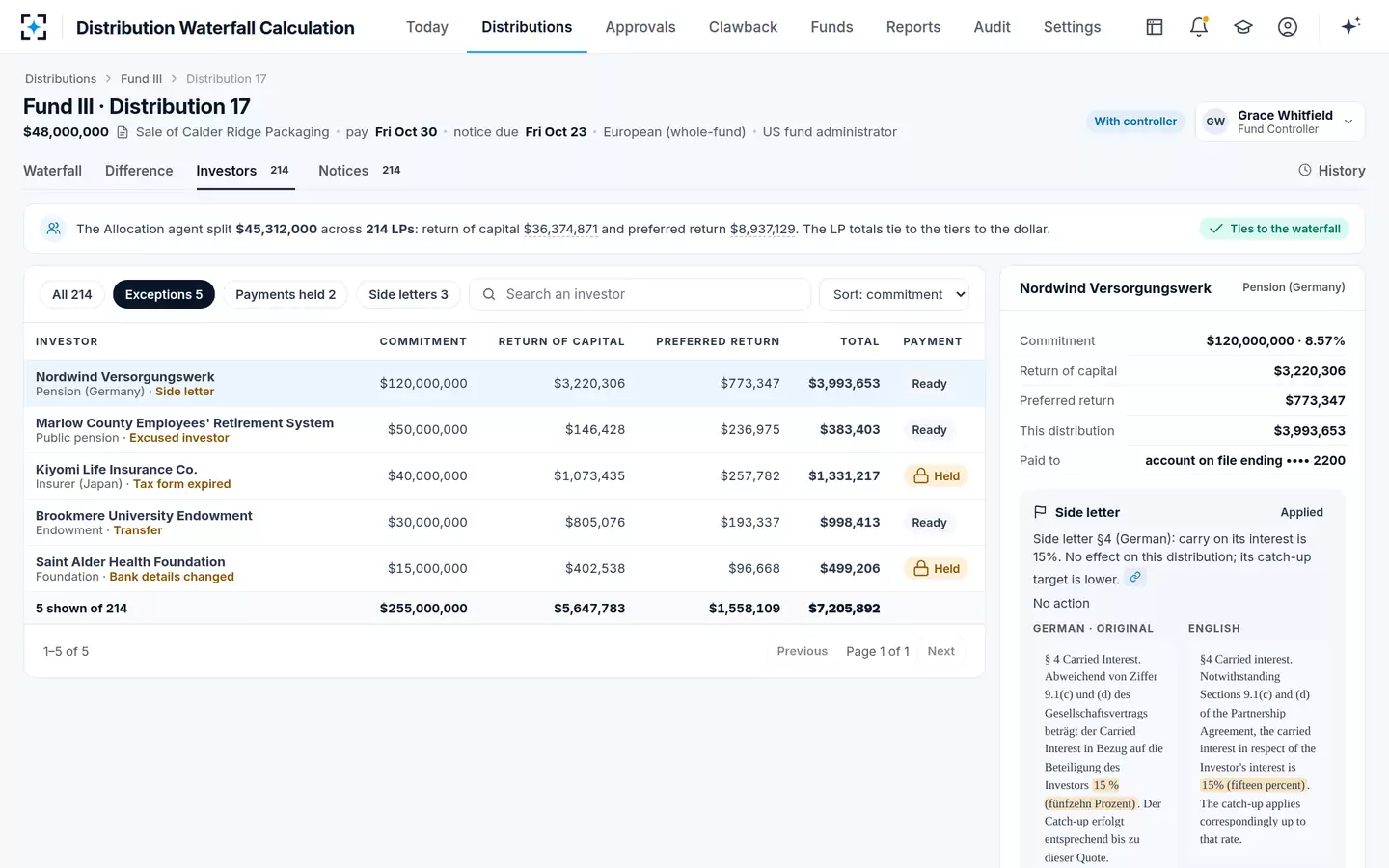
Rounding is the last input. Allocating $105 million across a few hundred LPs to the cent produces fractions that have to land somewhere, and the method, such as largest remainder, decides which LPs gain a dollar. The total paid to LPs must still tie to the tiers to the dollar. In the sample data, the fictional Fund III's $45,312,000 to LPs is split across 214 investors, with one German pension fund on a 15% carry side letter, one excused investor and one transfer, and the LP totals tie to the tiers exactly.
The fund-level tiers split across every LP, exceptions first
How Distribution Waterfall Calculation re-performs a distribution
Distribution Waterfall Calculation re-performs each distribution the way this page did, from the agreement rather than from the administrator's spreadsheet. The Terms agent reads the waterfall clause, amendments and side letters into a term table with every term cited: the waterfall type, what counts as contributed capital, the preferred return rate, compounding and day count, the catch-up percentage and the split. The Model agent runs the tiers from those terms and the capital accounts alone, per LP, and the Diff agent sets the result beside the administrator's model and explains each difference with the clause, the cell and the arithmetic.
Six checks on any finished waterfall calculation
- Capital ties to the capital accounts
Unreturned capital equals every call less every return of capital, including the calls that paid fees and expenses if the agreement returns them.
- The preferred return can be rebuilt year by year
From each contribution date, with the agreement’s compounding and day count, and with earlier distributions applied in tier order.
- The catch-up target is a quarter of the preferred return paid (at 20% carry, 100% catch-up)
If the catch-up paid exceeds it, money has been taken from the split.
- Once the catch-up is complete, the GP has 20% of cumulative profit
Everything distributed less everything contributed, times the carry rate. A GP above the line has been overpaid.
- LP totals tie to the tiers to the dollar
After side letters, excused investors, transfers and rounding.
- Every number points to its clause
A waterfall nobody can trace to the agreement cannot be defended to an LP, an auditor or an examiner.
People keep the decisions. Fund finance decides each explained difference with a reason code, the fund controller checks, the GP CFO signs any distribution that pays carry, and investor relations releases the notices. To see the same tiers on a live distribution, start from Distribution Waterfall Calculation.
Questions people ask
What are waterfall calculations in private equity?
They are the calculations that split each distribution between the limited partners and the general partner under the fund's agreement: return of capital, the preferred return, the GP catch-up and the carried interest split, in that order. Each tier is calculated cumulatively from the start of the fund, so a new distribution is always checked against everything contributed and paid before it.
Is the waterfall calculated on each distribution or cumulatively?
Cumulatively. The capital owed, the preferred return owed and the catch-up target are all running totals from the fund's first contribution, and each distribution is poured into whatever those totals still require. In the example, the 2026 distribution owes preferred return accrued since the first call in 2020.
Does return of capital include management fees?
Usually, but the agreement decides. Robinson and Sensoy describe the typical contract as returning "all contributed capital (including that for management fees)". In the example, leaving the $8 million of fees and expenses out of returnable capital would raise the GP's share of the same distribution from $5,227,406 to $10,600,000.
What does a full catch-up mean in private equity?
A full, or 100%, catch-up sends every dollar after the preferred return to the GP until its carry equals its percentage of cumulative profit, at 20% carry a quarter of the preferred return paid. After that, distributions are split 80/20. A partial catch-up, such as 80%, reaches the same end point more slowly.
Why is the GP's share of this distribution below 20%?
Because the distribution ran out inside the catch-up tier. The GP holds 11.6% of the profit distributed so far; the next distribution will complete the catch-up first and only then reach the split, at which point the GP will hold exactly 20% of cumulative profit.
Can a private equity waterfall be calculated in Excel?
Yes, and most are, but a spreadsheet hides its conventions in formulas. Testing one by planting the errors that matter, such as fees left out of capital or a simple accrual where the clause compounds, is covered in testing a private equity waterfall model in Excel.