The accounting treatment of carried interest depends on whose books you are keeping. In the fund, a partnership, carried interest is not an expense: it is a share of the fund's profit allocated to the general partner's capital account out of the limited partners'. Each quarter the fund accountant runs the distribution waterfall as if the fund sold every investment at its reported NAV and distributed the proceeds, a hypothetical liquidation, and the carry that liquidation would pay the GP, less any carry already paid, is the accrued carried interest. Because the calculation runs on marks, it rises and falls with every valuation, and it can reverse. In the manager's books, the same carry is accounted for either as revenue from a contract with a customer or as an ownership interest in the fund, a question the FASB's transition group examined in 2016. Botminds' Distribution Waterfall Calculation runs that whole-fund hypothetical liquidation each quarter from the fund's own agreement and NAV, the same calculation that supports the accrual and the clawback test.
The worked example is illustrative arithmetic on an invented fund, and the account names are examples; a fund's auditors and its own policies decide the exact presentation. The screens show the solution on sample data for a fictional manager, Quillfield Capital.
Accrued carry on one fund through 2025: a 12.5% fall in NAV erases 99% of it
Is carried interest equity or an expense of the fund?
At the fund it is equity: carried interest is an allocation of partnership profit to the GP, so it moves amounts between the partners' capital accounts rather than reducing the fund's net assets as a fee would. The SEC described the distinction in its October 2026 proposal on performance fees: "carried interest is a preferential profit allocation that is attainable in funds structured as partnerships", while in registered funds, which are generally corporations or trusts, profits "cannot differ within the same share class", so a performance fee there accrues as a liability instead (91 FR 63676; a proposal, comments due December 7, 2026).
For the same reason, accrued carry changes what each LP's capital account is worth without changing the fund's total NAV. The fund's net assets are what they are; the waterfall decides how much of them belongs to the GP. An LP's statement that shows its capital account after accrued carry is showing its share of a hypothetical liquidation, which is exactly what it would receive if the fund were wound up at those marks.
For the manager the answer is less settled. The GP entity's carried interest can be treated as revenue for services or as an investment in the fund, and the choice changes when it appears in the manager's income, as the section on the manager's books below explains.
How accrued carried interest is calculated: a hypothetical liquidation each quarter
Accrued carried interest is calculated by running the fund's distribution waterfall on a hypothetical liquidation: assume the fund sold all its investments at their reported fair values on the reporting date, settled its liabilities and distributed what was left through the waterfall. The carry that would reach the GP, less carry already distributed, is the accrued carry. The idea appears in tax law too. A 2005 Treasury proposal defined the liquidation value of a partnership interest as the cash its holder would receive "if, immediately after the transfer of the interest, the partnership sold all of its assets (including goodwill, going concern value, and any other intangibles associated with the partnership's operations) for cash equal to the fair market value of those assets, and then liquidated" (70 FR 29675, a proposed rule).
The FASB staff described the manager-side version in the same terms. Under what practice called Method 2, incentive fees, including carry, "are measured on the basis of the amount that would be due from the customer (calculated using a prescribed formula), assuming the contract was terminated at the reporting date (that is, liquidation value)" (FASB TRG staff paper 50, April 18, 2016). At the fund and at the manager, then, accrued carry is the waterfall run on today's marks.
The hypothetical liquidation behind each quarter's accrued carry
| Quarter end | NAV distributed | Return of capital | Preferred return owed | GP catch-up | Accrued carry |
|---|---|---|---|---|---|
| March 31, 2025 | $100,000,000 | $60,000,000 | $34,229,673 | $5,770,327 (incomplete) | $5,770,327 |
| June 30, 2025 | $112,000,000 | $60,000,000 | $36,077,313 | $9,019,328, then split | $10,400,000 |
| September 30, 2025 | $98,000,000 | $60,000,000 | $37,924,954 | $75,046 (incomplete) | $75,046 |
| December 31, 2025 | $118,000,000 | $60,000,000 | $39,772,594 | $9,943,149, then split | $11,600,000 |
The third quarter is the lesson. A fall in NAV from $112 million to $98 million, 12.5%, cut accrued carry from $10,400,000 to $75,046, because the fund dropped from beyond the catch-up back into it, where every dollar of value is a dollar of carry. Accrued carry is a leveraged claim on the marks. A fund near its hurdle will see its carry accrual swing far more than its NAV, and a reader of its financial statements should expect that.
Carried interest journal entry examples: the fund's books
In the fund, each quarter's journal entry moves the change in accrued carry between the LPs' and the GP's capital accounts. Nothing leaves the fund until carry is actually distributed. The entries below use the illustrative fund; account names differ between funds and administrators.
Carried interest accounting entries at the fund, quarter by quarter
| Date | Entry | Amount | Why |
|---|---|---|---|
| March 31, 2025 | Debit LPs’ capital; credit GP’s capital, carried interest allocation | $5,770,327 | Hypothetical liquidation at NAV $100M pays the GP $5,770,327 of catch-up. |
| June 30, 2025 | Debit LPs’ capital; credit GP’s capital, carried interest allocation | $4,629,673 | Accrued carry rises to $10,400,000. |
| September 30, 2025 | Debit GP’s capital, carried interest allocation; credit LPs’ capital | $10,324,954 | Reversal: NAV falls to $98M; accrued carry is $75,046. |
| December 31, 2025 | Debit LPs’ capital; credit GP’s capital, carried interest allocation | $11,524,954 | Accrued carry rises to $11,600,000. |
| When carry is paid | Debit GP’s capital; credit cash | the amount distributed | Accrued carry becomes realized: it leaves the fund through the waterfall. |
Unrealized carried interest journal entry: reversals and carry already paid
An unrealized carried interest journal entry is simply one of the first four lines: an allocation of value the fund has not yet realized. It can reverse, as the September entry does, and it must, because the next hypothetical liquidation starts from the new marks. A fund that books accrued carry once a year, or only when it changes by more than a threshold, can show its LPs capital accounts that no liquidation would produce.
The harder case is carry already paid in cash that a later hypothetical liquidation no longer supports. The GP's capital account cannot simply be debited back below what the agreement allows; the excess is a potential clawback, governed by the agreement's clawback clause, its tax limit and its escrow. How that clause works, and how much of an excess it really returns, is the subject of how a clawback provision in private equity pays out.
Carried interest accounting at the manager: revenue or ownership interest?
At the manager, carried interest has been accounted for in more than one way, and the FASB has said so. A 2016 staff paper for the revenue standard's transition group described the starting point: "for private equity or real estate funds that are limited partnerships, the asset manager generally receives incentive-based fees via an allocation of capital from the fund’s LPs" (FASB TRG staff paper 50). Before the revenue standard, it explained, managers used two methods the SEC staff accepted: Method 1, recognizing incentive fees only once all contingencies are resolved, and Method 2, recognizing them each period at liquidation value and reversing them when returns fall short.
The FASB staff's ten-year example: the same $28,000 of carry under two methods
| Year | Fund return above benchmark | Method 2: recognized or reversed | Method 1: recognized |
|---|---|---|---|
| 1 | $100,000 | $20,000 | $0 |
| 2 | $50,000 | $10,000 | $0 |
| 3 | $10,000 | $2,000 | $0 |
| 4 | ($50,000) | ($10,000) | $0 |
| 5–7 | $20,000 a year | $4,000 a year | $0 |
| 8 | ($70,000) | ($14,000) | $0 |
| 9 | $80,000 | $16,000 | $0 |
| 10 | ($40,000) | ($8,000) | $28,000 |
| Total | $140,000 | $28,000 | $28,000 |
The paper then set out three views of how the revenue standard, Topic 606, applies. View A: carried interest is revenue for services and in scope, so it is recognized only when "it is probable that a significant reversal in the cumulative amount of revenue recognized will not occur". View B: it is an ownership interest, outside Topic 606, accounted for under other guidance such as the equity method. View C: either, depending on the substance of the arrangement. "The staff’s view is that incentive-based capital allocations are within the scope of Topic 606." The paper itself warns that its comments "do not purport to set out acceptable or unacceptable application of U.S. GAAP", and a manager's auditors will expect a clear policy and disclosure whichever view it follows.
Carried interest at the manager: the two treatments the FASB staff described
Revenue under Topic 606 (View A): Variable consideration for managing the fund.
Ownership interest, other guidance (View B): A return on the GP’s interest in the partnership, a financial asset.
Revenue under Topic 606 (View A): Only to the extent a significant reversal is not probable; preparers using Method 2 told the FASB staff this would defer revenue “significantly longer than current practice”.
Ownership interest, other guidance (View B): As the GP’s share of the fund’s value changes from period to period.
Revenue under Topic 606 (View A): Performance fee revenue, constrained.
Ownership interest, other guidance (View B): Income from an investment; the paper notes it might not be acceptable to call changes in carry revenue.
Revenue under Topic 606 (View A): Lower: the constraint holds revenue back.
Ownership interest, other guidance (View B): Higher: accruals and reversals follow the marks.
What is carried interest allocation, and why marks drive it
A carried interest allocation is the amount of the fund's profit allocated to the GP's capital account under the waterfall, whether accrued on a hypothetical liquidation or realized in a distribution. The SEC's 2023 definition of performance-based compensation, which "captures, without limitation, carried interest, incentive fees, incentive allocations, or profit allocations", treats allocations and payments alike (88 FR 63206; the rules adopted there were vacated in 2024). For an allocation that has not been paid, the only input that changes from quarter to quarter is value.
Accrued carry rests on Level 3 marks
$6,396B
of private equity fund assets classified Level 3 on Form PF, fourth quarter of 2025
86%
of private equity fund assets reported in the fair value hierarchy (our arithmetic: $6,396B of $7,445B)
99%
of the illustrative fund’s accrued carry erased by a 12.5% fall in NAV
That is why examiners connect valuation and carry. The SEC's 2020 risk alert reported advisers whose failure to value holdings in line with their disclosed process led to overcharged carried interest (OCIE risk alert, June 23, 2020, staff observations, not a rule). An overstated mark inflates the accrual first and, if a distribution follows, the cash carry. The accrual is therefore a useful early warning: a sharp rise in accrued carry without a matching rise in realizations is worth a second look at the marks behind it.
Tax and accrued carry: allocations taxed before they are paid
Carried interest allocated for tax can create a tax bill before any carry is distributed, because partners are taxed on income allocated to them, not on cash received. Agreements handle the mismatch with tax distributions or advances. The SEC described the purpose of such an advance as enabling advisers and their people "to pay taxes derived from their interest in a fund (e.g., taxes associated with performance fees or carried interest that have been allocated to the affiliated general partner)" (88 FR 63206). In the fund's books a tax distribution is an advance against carry, credited against later carry distributions under the agreement's terms.
Two tax rules shape the figures the fund accountant hands to the tax team. Gains allocated as carry need a holding period of more than three years for long-term capital gain treatment under section 1061 of the Internal Revenue Code, so the realized carry has to be traced to the holding periods of the assets sold. And the GP's tax capital account is reported to it on its K-1 like any partner's; both belong to the partnership's tax work, and the carry holder's K-1 and its Section 1061 worksheet shows how the holding periods reach the holders.
Quarter-end checks on accrued carried interest
- Run the full waterfall, not a percentage of gains
Accrued carry inside the catch-up is not 20% of anything; only the hypothetical liquidation gives the right number.
- Use the agreement’s preferred return to the reporting date
Compounding, day count and contribution dates as the clause sets them, accrued to the quarter end.
- Deduct carry already distributed, including tax distributions
Accrued carry is what a liquidation would pay beyond what the GP already has.
- Book reversals
A fall in accrued carry is an entry, not an omission; skipping it overstates the GP’s capital.
- Compare carry paid with the whole fund’s support
If carry already paid exceeds what the liquidation supports, the excess is clawback exposure to report.
- Reconcile to the distribution model
The same terms must drive the accrual and the next distribution, or the accrual is a different calculation.
How Distribution Waterfall Calculation supports the quarterly accrual
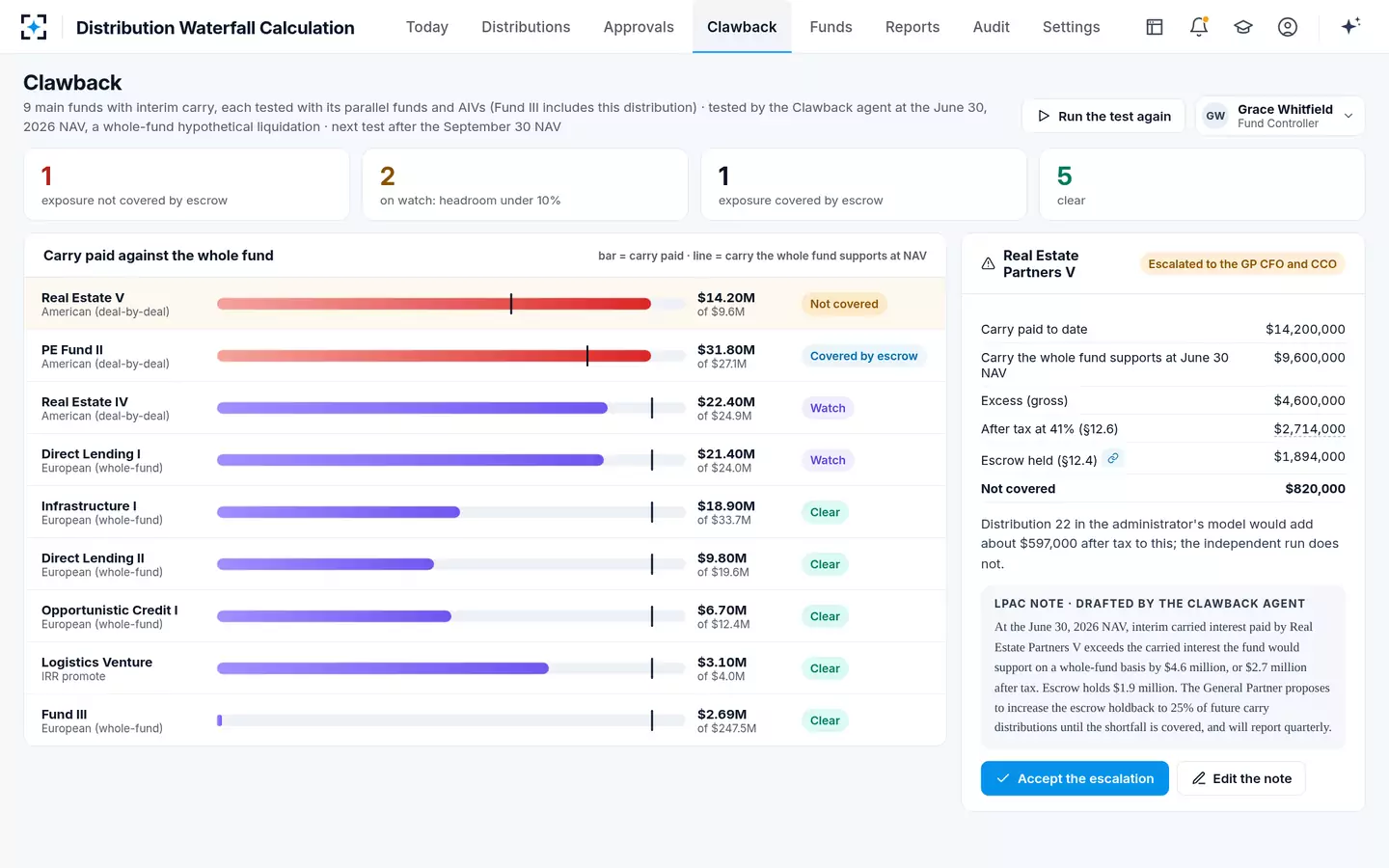
Distribution Waterfall Calculation runs the calculation the accrual needs. Each quarter its Clawback agent takes every vehicle, applies a whole-fund hypothetical liquidation at the latest NAV through the fund's own approved terms, the same term table that drives every distribution, and compares the carry the liquidation supports with the carry already paid, after the agreement's tax limit and escrow. The output gives the fund accountant an independent figure for the accrual and the CFO a quarterly view of clawback exposure.
Distribution Waterfall Calculation: carry paid against the whole fund's carry at NAV
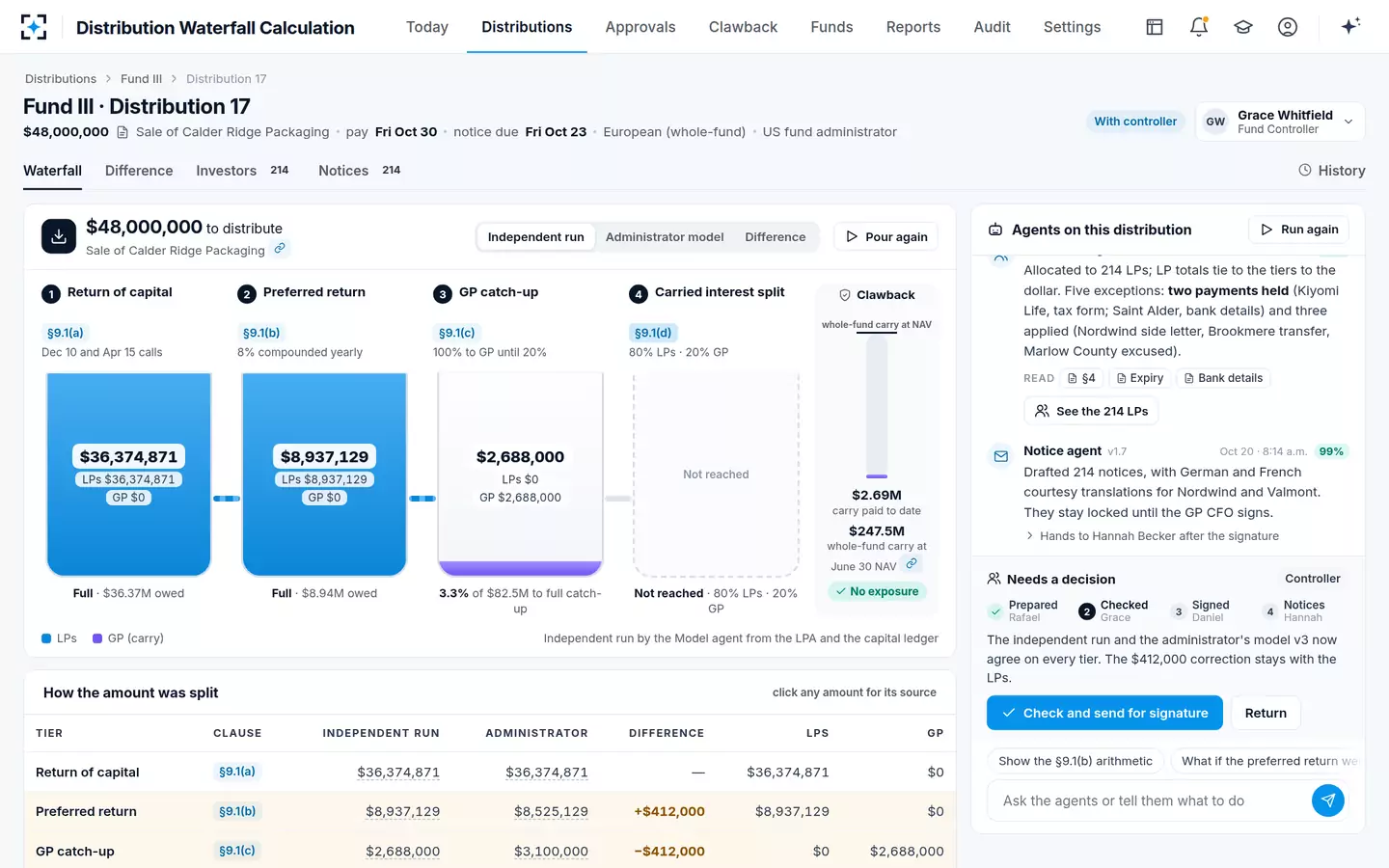
The solution does not post the journal entries or decide the manager's accounting policy; those stay with the fund's accounting platform, its controller and its auditors. What it adds is the independent waterfall run on the agreement's own terms, kept with its sources, so the accrual, the next distribution and the clawback test all rest on one reading of the agreement. The quarterly test across nine funds in the sample is shown in American vs European waterfall in private equity, and the whole sequence from Distribution Waterfall Calculation.
Every fund that has paid carry, tested against a hypothetical liquidation each quarter
Questions people ask
What are the carried interest accounting entries at a fund?
Each quarter: debit the LPs' capital and credit the GP's capital for an increase in accrued carry, and the reverse for a decrease. When carry is paid: debit the GP's capital and credit cash. The fund's total net assets change only on the payment.
Is accrued carried interest included in the fund's NAV?
The fund's total NAV is the same either way, because accrued carry moves value between partners. What changes is each LP's share: an LP's capital account after accrued carry is what it would receive if the fund were liquidated at that NAV.
When does a manager recognize carried interest as revenue?
Under Topic 606, only when a significant reversal is no longer probable; managers who applied Method 2 told the FASB staff this would defer revenue "significantly longer than current practice". Managers that treat carry as an ownership interest recognize their share of the fund's value as it changes. The FASB staff's 2016 paper set out both views and a third, and a manager's policy and disclosures say which it follows.
Can accrued carried interest be negative?
The accrual itself falls to zero at worst, when a hypothetical liquidation pays the GP nothing. But if carry has already been paid in cash and the liquidation no longer supports it, the excess is a potential clawback: an amount the GP may owe back under the agreement.
Why does accrued carry move so much more than NAV?
Because between the preferred return and the end of the catch-up, every dollar of value goes to the GP. In the illustrative fund a 12.5% fall in NAV erased 99% of the accrual, and a 20% rise in the following quarter restored it.