Private equity waterfall software calculates how each distribution from a closed-end fund is split between the limited partners and the general partner: return of capital, the preferred return, the GP catch-up and the carried interest split, under the terms of the fund's limited partnership agreement. Most tools in the category are calculation engines or spreadsheet templates that a person configures from the agreement and feeds from the books. Agentic software adds the steps around the calculation that used to be manual: reading the clause, assembling the inputs, re-running the waterfall independently of the administrator's model, and explaining each difference with the clause, the cell and the arithmetic. What it must not add is authority. Botminds' Distribution Waterfall Calculation uses seven agents, each with written limits: none of them pays, signs, sends a notice, changes an approved term or moves escrow.
That combination, wide reach and narrow authority, is what an evaluator should test for. The figures and screens below come from the solution running on sample data for a fictional manager, Quillfield Capital, whose funds, investors and people are invented.
Distribution Waterfall Calculation: what each agent does, and what it may never do
| Agent | What it does | What it may never do | Who decides instead |
|---|---|---|---|
| Terms agent | Reads LPAs, amendments and side letters, in any language, into a term table: waterfall type, preferred return, compounding, day count, catch-up, split, offsets, write-downs, clawback, escrow. | Change an approved term. Guess an ambiguous clause: below 95% confidence a person confirms, and an ambiguity goes to counsel. | Fund finance prepares the term table; the controller approves each version. |
| Model agent | Runs each distribution from the approved terms and the capital accounts, per LP and per tier, with day counts and compounding. | Read the administrator’s model. Overwrite a run: a what-if is a separate, labelled scenario. | Nobody needs to: the run is evidence, not a decision. |
| Diff agent | Compares the run with the administrator’s model tier by tier, reads its formulas, explains each gap and drafts the query; looks across other vehicles. | Edit the administrator’s model. Send a query without the controller’s approval. | Fund finance decides each difference with a reason code; the controller approves the query. |
| Allocation agent | Splits each distribution across every LP: commitments, excused investors, side letters, transfers, tax forms, bank detail checks. | Pay. Change LP bank details. | Investor relations confirms changed details with a call to the contact on file. |
| Notice agent | Drafts each LP notice with the tier breakdown, payment date and account ending, and courtesy translations. | Send. Notices release only after the GP CFO signs. | Investor relations releases notices after the signature. |
| Clawback agent | Tests interim carry against a whole-fund hypothetical liquidation each quarter, with the tax limit and escrow; drafts the note for an uncovered exposure. | Move or release escrow. Contact LPs. | The GP CFO and the CCO; escrow release needs both. |
| Evidence agent | Keeps a chained history of every run, difference, decision, signature and notice, and exports the distribution file. | Edit any entry. | Auditors, the LPAC and examiners read it; nobody edits it. |
What does private equity waterfall software do?
At minimum, private equity waterfall software takes a fund's terms and cash flows and produces the tier-by-tier split of a distribution, for the fund and for each LP. Beyond that, products differ in where the terms come from, who maintains them, and whether the software is the fund's system of calculation or a check on someone else's. Three shapes are common, and naming them is more useful than naming products.
Three kinds of waterfall software, and what each is for
Calculation engine or model template: A person reads the LPA and configures the tiers, often once, at launch.
Independent check layer: The agreement itself, read into cited terms that a person approves, and re-read when it is amended.
Calculation engine or model template: Inputs keyed or imported from the books.
Independent check layer: The capital accounts directly, with each figure linked to its entry.
Calculation engine or model template: Nothing: it is the calculation.
Independent check layer: The administrator’s or the fund accounting platform’s model, tier by tier.
Calculation engine or model template: Its own outputs.
Independent check layer: Why two calculations differ: the clause, the cell and the arithmetic.
Calculation engine or model template: A team that runs its own books and its own model.
Independent check layer: A team that relies on an administrator or a platform and must re-perform before it signs.
The difference matters because of what the SEC called the nature of the subject. In its 2023 private fund release the Commission observed that "any waterfall arrangements governing fund adviser compensation may be complex and opaque" (88 FR 63206; the rules adopted there were vacated in 2024). Software that only calculates inherits that complexity from whoever configured it. Software that checks has to be able to show where each number came from.
Can software read the LPA waterfall clause?
Yes, with a person accountable for what it reads. A language model can read a waterfall clause and its amendments and propose structured terms: the waterfall type, the preferred return rate, compounding and day count, the catch-up, the split, the offsets, the write-down rules, the clawback and the escrow. What it cannot do is decide what an ambiguous clause means, and waterfall clauses, drafted and amended over years, can be ambiguous.
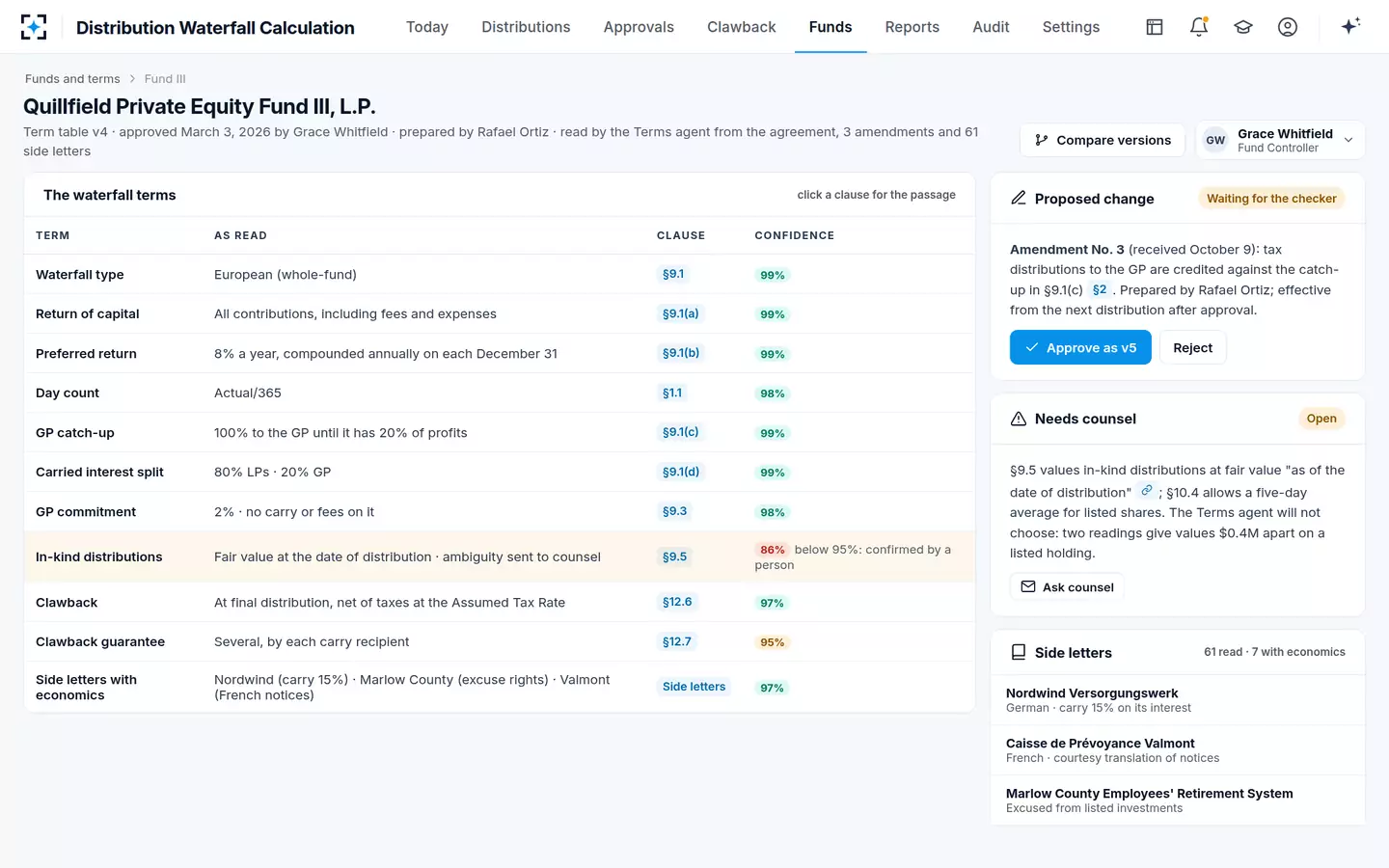
The solution's Terms agent reads each term with a citation to its clause and page and a confidence. Below 95% a person confirms the reading; an ambiguity goes to fund counsel with the question drafted, never a guess. In the sample data, the fictional Fund III's in-kind distribution clause read at 86%: one section values in-kind distributions at fair value "as of the date of distribution", another allows a five-day average for listed shares, and the two readings give values $0.4 million apart on one holding. The agent did not choose. The term table is approved by the controller before any run uses it, and each version is kept.
The waterfall terms read from the agreement, each with its clause and confidence
Why the limits are the design, not a setting
The limits exist because a distribution pays the firm's own people. Carried interest is compensation to the GP's partners, decided by a calculation the GP's staff prepare, so the controls that matter are separation and evidence: the person who calculates is not the person who checks, neither holds carry in the fund, and every figure can be traced to the agreement. An agent that could approve its own calculation would remove the separation; an agent whose reasoning could not be traced would remove the evidence.
Regulators frame the same risks in general terms. ESMA's 2024 statement on AI in investment services warns that firms and clients may lean on AI for decisions at the expense of human judgment, and that many AI systems are "black boxes" whose decision-making processes "would not be understandable by firm staff at all levels" (ESMA public statement, May 30, 2024; written for retail investment services under MiFID II, its reasoning is general). The SEC's examination priorities for fiscal year 2027 use the term "super intelligence (SI)" for the same technologies and say examiners will look at how they shape outcomes and whether firms still meet obligations that apply whatever the technology (SEC Division of Examinations, October 23, 2026).
“Many AI systems are often ‘black boxes’ and their decision-making processes would not be understandable by firm staff at all levels (from control functions to senior management).”
ESMA, public statement on AI in investment services, May 30, 2024
Technology-neutral is the point for a distribution waterfall. The fiduciary duty, the agreement and the evidence an examiner asks for are the same whether a spreadsheet, an administrator or an agent did the arithmetic. Limits that keep payment, signature, release and term changes with named people are how the same obligations are met when software does more of the work.
Why the Model agent never reads the administrator's model
An independent check is only independent if the second calculation cannot see the first. A reviewer who starts from the administrator's spreadsheet tends to accept its structure and check its arithmetic, and the arithmetic is rarely where the error is; seeding a waterfall model with known errors shows how much that kind of review misses. The Model agent therefore runs each distribution from the approved terms and the capital accounts alone; only afterwards does the Diff agent open the administrator's model, read every formula and set the two side by side.
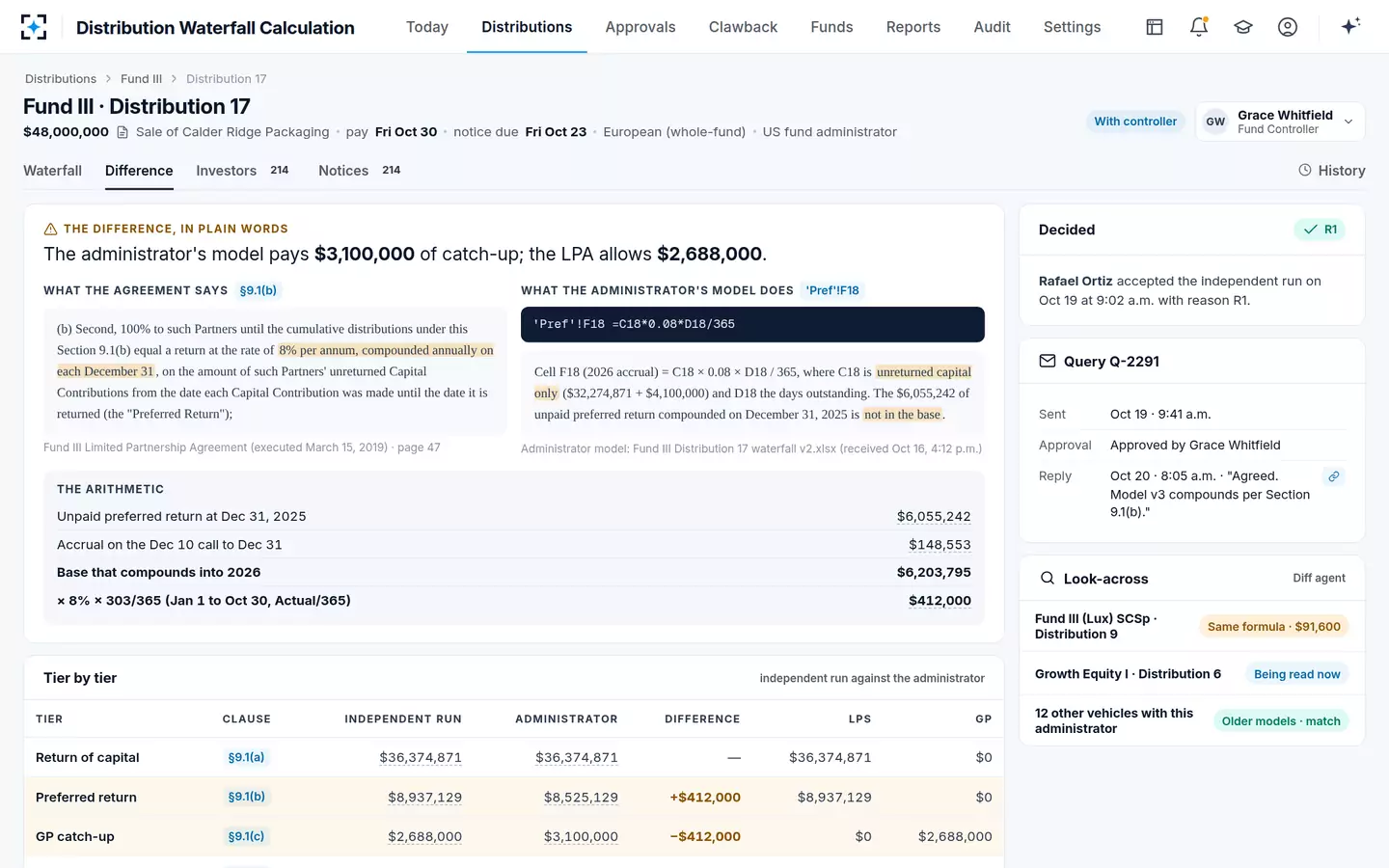
The sample shows why the separation pays. The administrator's model computed the preferred return with one formula, 'Pref'!F18 = C18*0.08*D18/365, a simple accrual on capital. Internally it was consistent. Against the clause, which compounds unpaid preferred return each December 31, it was $412,000 short, and that $412,000 had gone to the GP's catch-up. The Diff agent put the clause beside the formula, showed the arithmetic, drafted the query, and found the same formula on the fund's Luxembourg parallel vehicle, $91,600.
Distribution Waterfall Calculation: the clause, the formula and the arithmetic side by side
One distribution through agents and people
The workflow alternates: agents prepare, people decide. Each person step is a decision someone signs with a reason, and each agent step leaves its sources attached for the next person to check.
A distribution from the administrator's model to released notices
Agent
Terms agentReads the agreement, amendments and side letters into cited terms.
Never: Never changes an approved term.
A person decides
ControllerApproves the term table version before any run uses it.
Agent
Model agentRuns the distribution from the terms and capital accounts, per LP and tier.
Never: Never reads the administrator’s model.
Agent
Diff agentCompares with the administrator’s model, explains each gap, drafts the query.
Never: Never sends without approval.
A person decides
Fund finance managerDecides each difference with a reason code.
Agent
Allocation and Notice agentsSplit the distribution across LPs, hold exceptions, draft notices.
Never: Never pay; never send.
A person decides
Controller, then GP CFOCheck, then sign; neither holds carry in the fund.
A person decides
Investor relationsReleases the notices; the payment file goes to treasury.
The waterfall method in private equity, as software has to model it
The waterfall method in private equity is not one method, and software that handles only the textbook European waterfall will fail on a real portfolio. The sample manager's 40 vehicles include European (whole-fund) and American (deal-by-deal) waterfalls, IRR promotes, deal-level co-investments, MOIC-tiered continuation funds and incentive allocation. Each needs different inputs: realized losses and write-downs for deal-by-deal, cash-flow dates for an IRR promote, multiples for a MOIC tier.
The conventions inside each type matter as much as the type. In the sample manager's third quarter, 11 differences between the independent runs and the administrators' models moved $2.41 million of carry or preferred return before payment. The largest causes were write-downs left out of deal-by-deal waterfalls ($1.39 million across two distributions) and preferred return compounding or base ($0.81 million across three), followed by accrual start dates, the order of fee offsets, an IRR hurdle dated at quarter end and one rounding difference over tolerance. American vs European waterfall in private equity explains why the deal-by-deal causes cluster where they do.
How to evaluate private equity waterfall software
Evaluate waterfall software on your own documents and your own past distributions, with questions that can fail. Demonstrations on a vendor's sample fund prove the arithmetic, which is the easy part.
Questions for any private equity waterfall software, that a weak answer fails
- Show me where this term came from
Each preferred return, catch-up and split should open the clause and page it was read from.
- What happens when a clause is ambiguous?
The right answer is a person or counsel decides, with the question written down; not a default.
- Re-run three of our past distributions from the agreement
Include one deal-by-deal fund with write-downs and one distribution that ends inside the catch-up.
- Explain a difference with the administrator’s model
Down to the cell and the arithmetic, in words a controller can check.
- Who can approve, sign, pay and release?
Named people only; the software should block carry holders from deciding on their own fund.
- What does the software never do?
Ask for the list in writing. Payment, signature, notices, term changes and escrow should be on it.
- What is kept, and can it be changed?
Every run, difference, decision and signature, in a history nobody can edit.
- How is a new version tested?
In parallel on last quarter’s distributions, with the result approved before it goes live.
Where Distribution Waterfall Calculation fits, and where it does not
Distribution Waterfall Calculation is an independent check and preparation layer. It fits a manager whose waterfalls are calculated by a fund administrator or a fund accounting platform and who must re-perform them before the GP CFO signs, across enough vehicles and distributions that re-performance by hand is a recurring cost; the sample manager runs about 300 distributions a year across 40 vehicles and two administrators. It reads the documents in their original language, connects to the fund accounting platform, the document store, the administrators' file drops, the investor register, the investor portal and the treasury payment system, and leaves each of them in place.
It is not a replacement for the books. It does not keep the general ledger, calculate NAV or prepare partnership tax returns; the partnership's K-1s are a separate solution, K-1 Preparation, which also prepares the Section 1061 information carry holders need. It is not built for structured-finance waterfalls such as CLO payment priorities. And it does not remove judgment from the agreement: a fund whose clauses are ambiguous will still need counsel, now with the question drafted. A manager with one simple fund and a trusted model may not need it at all; the value grows with the number of vehicles, the variety of waterfall types and the cost of a carry error discovered at audit or at wind-down. To try it on your own agreements and past distributions, start from Distribution Waterfall Calculation.
Questions people ask
What is distribution waterfall software?
It is software that calculates how a fund's distributions are split between investors and the manager under the fund's waterfall: return of capital, preferred return, catch-up and carried interest. Some products calculate; others, like Distribution Waterfall Calculation, re-perform an administrator's calculation independently and explain each difference.
What is a private equity waterfall model?
It is the calculation, usually a spreadsheet, that applies a fund's waterfall terms to its cash flows to split a distribution between LPs and the GP, tier by tier and investor by investor. Its accuracy depends less on the arithmetic than on whether its conventions match the agreement.
Can AI calculate carried interest correctly?
The arithmetic is not the hard part; reading the terms and the inputs correctly is. Agents can read clauses and rebuild inputs with their sources, but the reading of an ambiguous clause, and the decision on each difference, should stay with accountable people, which is how the solution's limits are set.
Does waterfall software replace the fund administrator?
Not this kind. The administrator keeps the books and prepares the model; the software re-performs the model from the agreement before the GP signs. The administrator stays in place and receives queries, approved by the controller, when the two disagree.
How is waterfall software tested before it goes live?
By re-running past distributions whose outcomes are known, including deliberately difficult ones, and comparing tier by tier. The solution runs each new agent version in parallel on the last quarter's distributions, and the controller approves the result before it goes live.
Who is responsible if the software gets a waterfall wrong?
The general partner remains responsible for distributions made under its agreement, whoever calculated them. That is why the solution keeps the signature with the GP CFO and gives the people who sign the clause, the inputs and the arithmetic behind every figure.