Waterfall calculation software, a spreadsheet and a fund administrator are three ways to do the same job: split each distribution from a private fund between the limited partners and the general partner under the fund's limited partnership agreement, through return of capital, the preferred return, the GP catch-up and the carried interest split. All three can get the arithmetic right. They differ on three things that decide whether the answer is right: who reads the agreement and keeps its terms current, whether anyone independent re-performs the calculation before carry is paid, and what evidence remains when an auditor, an LP or an examiner asks why. Botminds' Distribution Waterfall Calculation is software of the checking kind: it reads the agreement itself, re-runs every distribution independently of the administrator's or the in-house model, and explains each difference before the GP CFO signs.
The choice is not between the three so much as how to combine them. Most of what follows is a decision method you can apply to your own funds; the figures that come from the solution are sample data for a fictional manager, Quillfield Capital, whose funds and people are invented.
Three ways to run a distribution waterfall, and what each leaves open
| In-house spreadsheet | Fund administrator | Waterfall software as an independent check | |
|---|---|---|---|
| Who reads the agreement | The model builder, once, at launch; amendments by hand. | The administrator’s onboarding team; amendments when notified. | The software reads the agreement, amendments and side letters; a person approves each version. |
| Who calculates | Fund finance. | The administrator, in its own model. | The software, independently of the other model. |
| Who re-performs before carry is paid | Usually a second person on the same workbook. | The manager’s fund finance team, by hand, if time allows. | Built in: the two models are compared tier by tier. |
| What a convention error looks like | A consistent formula nobody revisits. | A consistent formula in someone else’s workbook. | A difference, with the clause, the cell and the arithmetic. |
| Evidence for an auditor or LP | The workbook and emails. | The administrator’s model and its sign-off. | Every run, difference, decision and signature, kept in order. |
| What it does not do | Check itself. | Remove the GP’s responsibility for what is paid. | Keep the books, calculate NAV or replace the administrator. |
What is a waterfall calculation?
A waterfall calculation is the set of steps that allocates a payment through tiers in a fixed order, each tier filled before the next receives anything. In private equity and other closed-end private funds it splits distributions between LPs and the GP. The same word is used for other things: the priority of payments in a collateralized loan obligation, which is a different calculation with different rules (CLO Compliance covers it), real estate promote structures, and a chart type in spreadsheets that has nothing to do with any of them.
In a private fund, the calculation is cumulative and contractual. Cumulative, because each distribution is tested against everything contributed and distributed since the first close. Contractual, because the law leaves the terms to the agreement; for a Delaware partnership, the statute leaves when and how much partners receive before winding up to the partnership agreement (6 Del. C. § 17-601). A private equity waterfall calculation example works the tiers on one distribution.
Should the administrator run our waterfall?
The administrator can run the waterfall; the GP still owns the result. An administrator is well placed to calculate, because it keeps the capital accounts and already prepares the NAV. It is less well placed to be the only check, for two reasons: it reads the agreement once and works from its own summary of the terms, and the party with the most interest in catching an error that overpays carry, the LPs, is not in the room. The manager's fund finance team therefore re-performs the administrator's model before the GP CFO signs, which is the step that most often gets squeezed by the notice deadline.
The SEC's account of the industry explains why the check matters. In its 2023 private fund release it observed that "advisers often have discretion over the timing of fund payments, and so may have greater control over risks of clawbacks than anticipated by investors" (88 FR 63206; the rules adopted in that release were vacated in 2024). A waterfall the GP neither prepared nor re-performed is a payment of the GP's own compensation on someone else's reading of the GP's own contract.
One distribution through each approach
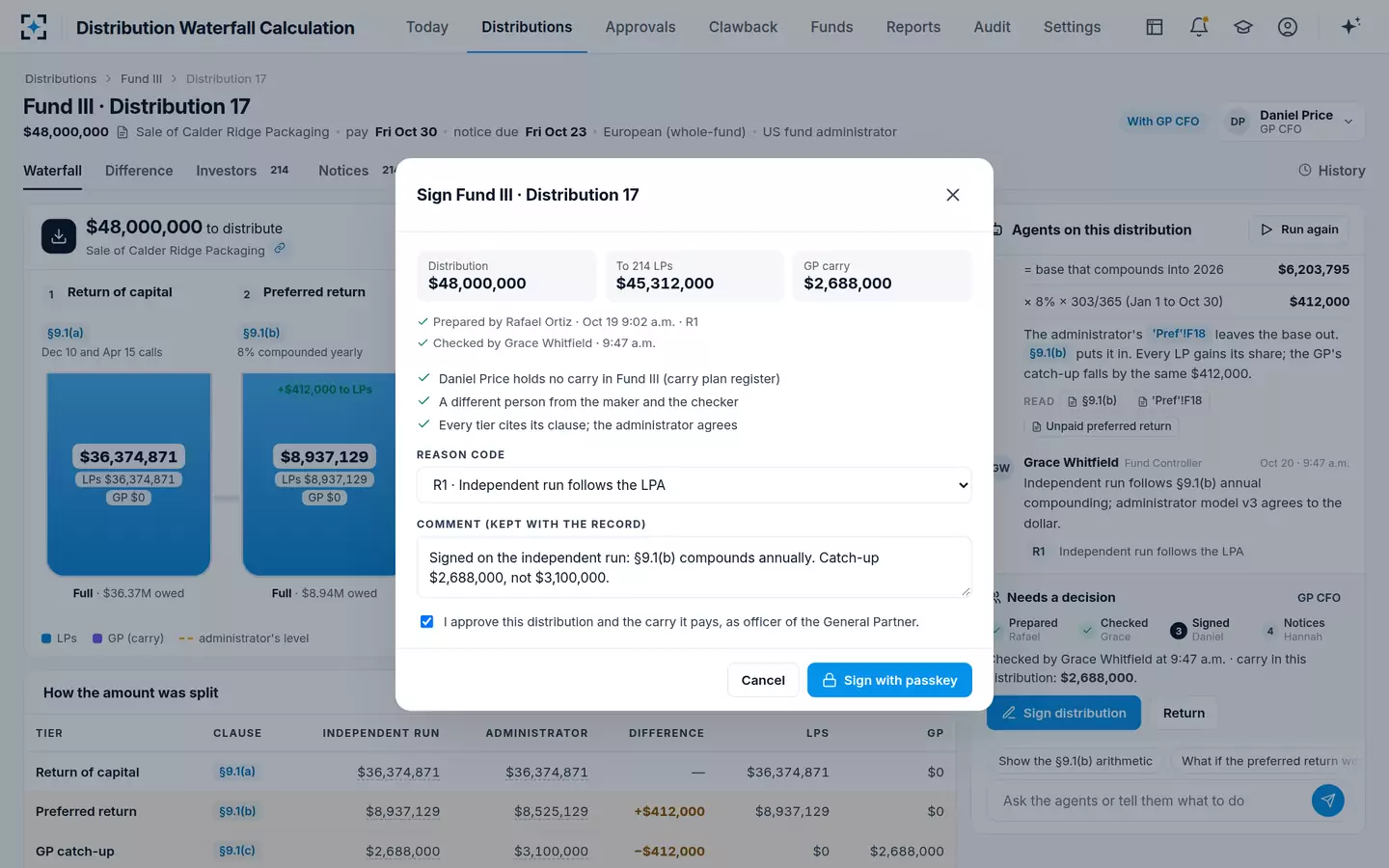
Put the same distribution through each approach and the differences are about time and about what gets caught. The sample makes it concrete. The fictional Quillfield Fund III distributed $48 million; its administrator's model accrued the preferred return as a simple rate on capital, in one formula, where the agreement compounds unpaid preferred return each December 31. The error was internally consistent and moved $412,000 from the LPs to the GP's catch-up.
One distribution, four ways: where the $412,000 is caught, if it is
- Administrator models and issuesmodel consistent, convention wrong
- Build or update modelconventions carried over
- Tick and tietotals agree
- Rebuild tiers from the agreement1–2 days
- Trace the cell, querywithin the notice period
- Independent run, comparisonminutes
- Decide, query, agreea day
The administrator-alone route does not fail because the administrator is careless. It fails because nobody independent looks. The spreadsheet route fails for the same reason when the reviewer checks the workbook against itself, which is what a tick-and-tie does. Re-performance by hand works, at a cost in days that grows with every vehicle. The software route is the same re-performance, done before anyone has to ask for it.
Who holds the documents, and why it decides the choice
The approach should follow the documents. A waterfall is only as right as the reading of the agreement behind it, and the agreement is rarely one document: the sample Fund III's terms come from the agreement, three amendments and 61 side letters, seven of them with economics. Whoever holds and reads those documents is, in practice, deciding the waterfall.
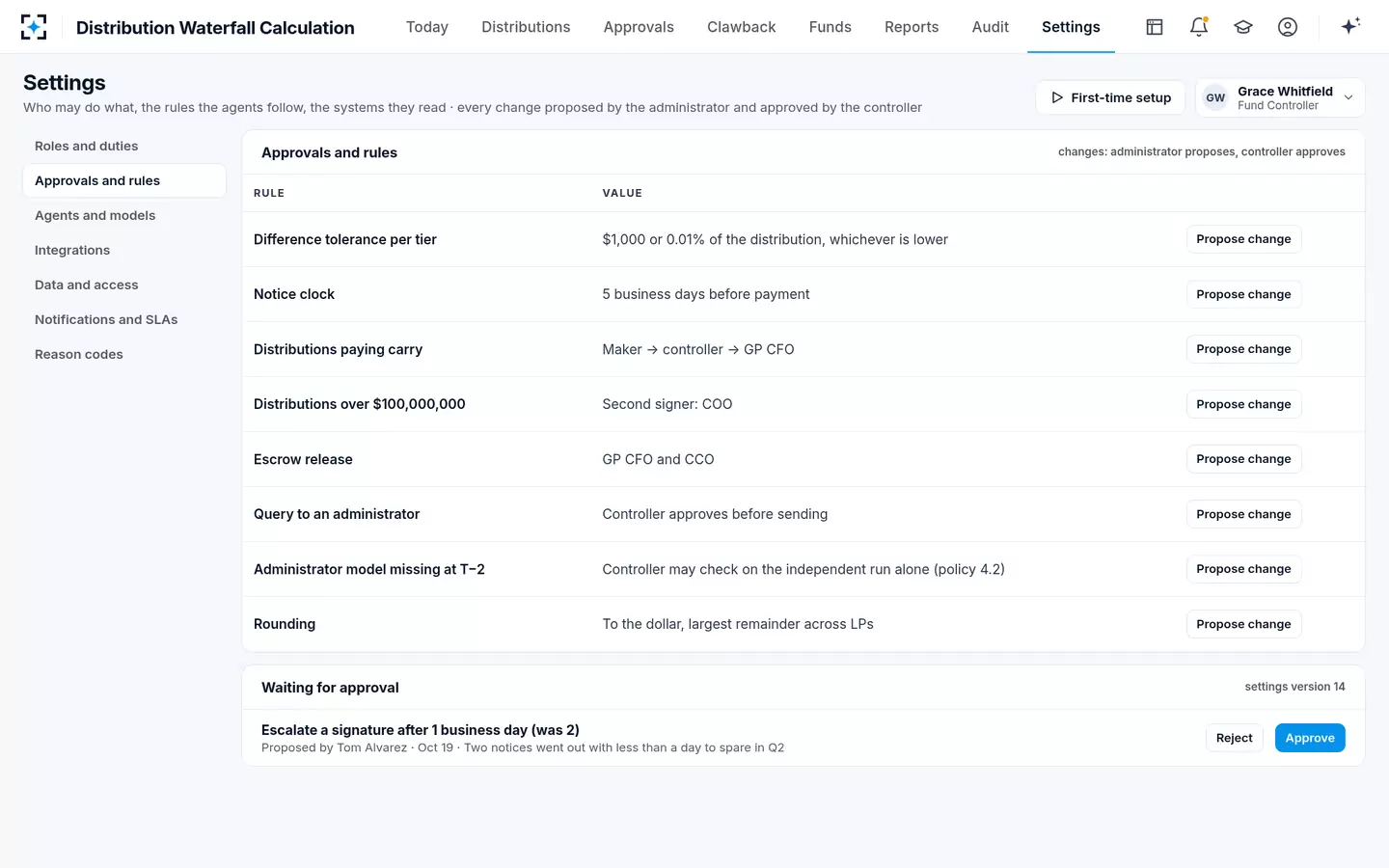
Three questions settle where the reading should sit. Does the administrator receive every amendment and side letter, and when? Does the manager's own team have a current, cited summary of the terms, or only the administrator's? And when a clause is ambiguous, who decides what it means, and is that decision written down? A manager that cannot answer the first two for every vehicle is relying on the administrator's reading by default. Software that reads the documents directly, and keeps each term linked to its clause, gives the manager its own reading to compare with.
Distribution Waterfall Calculation: the rules each waterfall is checked against are settings
The evidence each approach leaves behind
The approaches also differ in what remains a year later, when the annual audit, an LP's consultant or an examiner asks why a distribution paid what it did. A spreadsheet leaves its last saved version and the emails around it; which version was approved, and which convention was argued over, has to be reconstructed. An administrator leaves its model and its sign-off, which show what was calculated but not whether anyone at the manager checked it against the agreement.
An independent check can leave more, if it is designed to. In the sample manager's set-up, each distribution keeps the term table version used, with every term cited to its clause; the independent run; both administrator models; each difference with its arithmetic; the fund finance manager's decision and reason code; the query and the reply; the controller's check; the GP CFO's signature; the notices; and the payment file. Each entry is chained to the one before it, so a later edit would show. Anyone who holds carry in the fund is blocked from preparing, checking or signing, and a blocked attempt is kept too: the sample's third-quarter report shows one.
That file answers the questions an auditor or examiner is likely to ask about compensation: which clause, which balance, who decided, and whether the people paid the carry were the people who approved it. It is also the cheapest way to answer an LP who re-performs a distribution and gets a different number.
What each approach costs, and how to estimate it
Vendors and administrators don't publish prices for waterfall work, and no regulator or independent study publishes what re-performance costs, so the useful comparison is in your own hours. Count distributions a year, multiply by the working days each takes from the administrator's model to signed notices, and split those days by step. The steps that are search and re-typing are what software removes; the decisions are what it keeps.
Where a distribution's working days go, by hand and with the solution (estimate)
By hand: 4.5 days
- Terms · 11%
- Re-perform · 22%
- Trace a gap · 22%
- Allocate · 11%
- Check, sign · 23%
- Notices · 11%
With Distribution Waterfall Calculation: 1.6 days
- Terms, re-run, allocation, notices · 24%
- Trace a gap · 38%
- Check, sign · 38%
At the sample manager's scale, about 300 distributions a year across 40 vehicles, the estimate implies roughly 1,350 working days of effort by hand against roughly 480 with the solution: our arithmetic on Botminds' estimate, not a measured saving. A manager with five funds and twenty distributions a year would save a fraction of that, and should weigh it against the cost of one carry error found at audit or at wind-down. The scale of the base helps frame that cost: private equity funds reported $8,523 billion of net assets on Form PF at the end of 2025 (SEC Private Fund Statistics, Q4 2025).
Questions to decide how your waterfalls are run and checked
Decide with questions about your own funds rather than about products. The answers usually point to a combination: the administrator calculates, the manager re-performs, and the question is only how systematically.
Seven questions for a CFO deciding how waterfalls are run
- How many distributions, across how many waterfall types?
Twenty whole-fund distributions a year and three hundred across deal-by-deal, IRR promotes and continuation funds are different problems.
- Who has read every amendment and side letter with economics?
If the honest answer is the administrator, the manager has no independent reading.
- Is every distribution re-performed before carry is paid?
Or only those that look unusual, which are not the ones with convention errors.
- Does the re-performance start from the agreement or from the model?
Starting from the model checks the model against itself.
- Who decides a difference, and is the reason kept?
A reason code and a comment, a year later, are the difference between a decision and a recollection.
- Are carry holders kept out of the approval chain?
Nobody who receives carry from a fund should prepare, check or sign its distributions.
- When would you find a carry overpayment?
Before payment, at the annual audit, in an LP’s review, or as a clawback at wind-down.
Where Distribution Waterfall Calculation sits between the model and the signature
Distribution Waterfall Calculation fits as the independent check between the administrator's model, or the in-house spreadsheet, and the GP CFO's signature. It reads the agreements in their original language, connects to the fund accounting platform, the administrators' file drops, the investor register, the investor portal and the treasury payment system, and changes none of them. Its agents run, compare, allocate and draft; fund finance decides each difference, the controller checks, the GP CFO signs and investor relations releases.
The GP CFO signs on the independent run, with the carry check on screen
It does not keep the books, calculate NAV, prepare K-1s or run CLO payment waterfalls, and it does not replace the administrator, which keeps calculating and receives queries the controller has approved. A manager with a handful of simple whole-fund vehicles and a model it trusts may be better served by a seeded-error test of that model, described in testing a private equity waterfall model in Excel, than by new software. Where it pays is breadth: many vehicles, several waterfall types, two or more administrators and a notice clock that leaves no time to re-perform by hand. To try it on your own agreements and a sample of past distributions, start from Distribution Waterfall Calculation; for the agents' limits in detail, see private equity waterfall software: what agents do.
Questions people ask
What is a waterfall in finance?
A waterfall is any payment order in which money flows through tiers, each filled before the next receives anything. In private funds it splits distributions between investors and the manager; in securitizations and CLOs it orders payments to classes of notes; in real estate it allocates cash between sponsor and investors through promote tiers.
Is a waterfall calculation the same as a waterfall chart?
No. A waterfall chart is a spreadsheet chart showing how a starting value moves to an ending value through increases and decreases. A distribution waterfall calculation is a contractual allocation of fund distributions; a waterfall chart can illustrate one, but it is only a picture.
Who is responsible if the administrator's waterfall is wrong?
The general partner, which makes the distribution under its own agreement and receives the carry. The administrator's contract may give the GP a claim against it, but the LPs' claim is against the fund and the GP, which is why the GP re-performs before it signs.
Can the fund administrator use waterfall software instead?
Yes, and some already calculate in software. That makes the administrator's model better, not independent. An independent check needs a second calculation, from the agreement, by someone who did not build the first.
How long does it take to set up independent waterfall checks?
The first step is reading each fund's agreement, amendments and side letters into terms that a person approves; the second is running the last quarter's distributions in parallel with the current process and comparing results. The pace is set by how quickly the manager's team can review and approve the term tables.
What is a distribution waterfall model?
It is the calculation, usually a workbook kept by the administrator or the manager, that applies a fund's waterfall terms to its contributions and distributions and produces each distribution's split by tier and by LP. The model is right only if its conventions, such as compounding, day count and what counts as capital, match the agreement.