A preferred return calculation compounded annually works like a savings account that pays interest once a year: each year the 8% is charged on the limited partners' unreturned capital plus any preferred return accrued in earlier years and not yet paid, so unpaid preferred return earns its own 8%. A simple preferred return charges 8% on capital only. The difference grows with time and with every year the fund pays no preferred return. On one illustrative set of cash flows, $60 million called in three calls and $18 million returned, the preferred return owed at June 30, 2026 is $19,024,877 simple, $22,615,423 compounded each December 31 and $23,609,634 compounded daily. Botminds' Distribution Waterfall Calculation reads the preferred return clause, its compounding, its day count and its start dates, into a cited term table and recomputes the preferred return for every distribution from the capital accounts, so a convention that differs from the agreement is caught before carry is paid.
The rate is the part of the clause everyone remembers. The compounding, the dates, the day count and what counts as contributed capital are the parts that decide the number, and none of them appears in "8%". Every figure on this page is illustrative arithmetic unless it says otherwise; the screens show the solution on sample data for a fictional manager, Quillfield Capital, whose funds and people are invented.
The same 8% on the same cash flows: six answers
What does an 8% preferred return mean?
An 8% preferred return means the limited partners must receive their contributed capital back plus a return of 8% a year on it, measured from when they paid it in, before the general partner earns any carried interest. It is a threshold, not a guaranteed payment: if the fund never earns it, the LPs simply receive everything and the GP receives no carry. The SEC's October 2026 proposal on performance fees put it this way: "Preferred returns and hurdle rates establish a minimum return threshold that must be achieved before any performance-based compensation accrues to the manager" (91 FR 63676; a proposal for registered funds, comments due December 7, 2026).
Eight percent is the convention in buyout funds and rare in venture. Robinson and Sensoy, working from the terms of 837 funds, found that "In buyout, this preferred return is almost always 8% annualized, while venture contracts rarely have a preferred return, so the threshold is simply the return of contributed capital" (NBER Working Paper 17942). "Annualized" is where the agreement takes over: it can mean 8% simple, 8% compounded once a year on a fixed date, 8% compounded on each anniversary of each contribution, or an 8% internal rate of return. Each is a different hurdle.
Preferred return vs hurdle rate: one threshold, two ways of measuring it
The preferred return and the hurdle rate name the same threshold; the difference is in how it is measured and paid. "Preferred return" usually describes a balance the waterfall pays to the LPs as its own tier, accrued on unreturned capital. "Hurdle rate" usually describes a test, often an internal rate of return the LPs must reach before carry starts. An 8% IRR hurdle and an 8% preferred return compounded on each contribution's anniversary give nearly the same number; an 8% preferred return compounded each December 31 gives a slightly different one, as the bars show.
The second distinction is what happens after the threshold is crossed. With a catch-up, the GP is caught up to its full share of all profits; without one, carry is paid only on profit above the threshold. The SEC's proposal calls these a "soft" and a "hard" hurdle, and a private equity waterfall calculation example shows the catch-up's effect on one distribution. Whichever word the agreement uses, the clause has to answer the same five questions, and the answers are what the fund accountant has to model.
Five questions every preferred return clause has to answer
- On what base?
All contributed capital, or capital for investments only. Whether management fees and fund expenses paid through capital calls count.
- From which date?
The date each contribution was made, the due date of the call, the date the fund drew on a credit line, or a quarter end.
- Simple or compounded, and how often?
Compounded annually on a fixed date, on each anniversary, quarterly, daily, or an IRR.
- Which day count?
Actual/365, Actual/360 or 30/360; and whether a leap year has 365 or 366 days.
- Until when, and in what order?
Until the contribution is returned; and whether distributions reduce capital before or after the preferred return in the agreement’s order.
How to calculate a preferred return compounded annually
To calculate a preferred return compounded annually, accrue 8% a year on each day's balance of unreturned capital plus unpaid preferred return, and on each compounding date add the accrued amount to that balance. With compounding each December 31 and an Actual/365 day count, each call accrues from its own date to the year end, and from then on the year's accrual becomes part of the base.
Preferred return owed, compounded each December 31, against the simple version
| Date | What happens | Unreturned capital | Owed, compounded annually | Owed, simple |
|---|---|---|---|---|
| Dec 31, 2021 | $25M called Mar 15, $15M called Sep 30 | $40,000,000 | $1,896,986 | $1,896,986 |
| Dec 31, 2022 | $20M called Jun 10; 2021 accrual now compounds | $60,000,000 | $6,142,992 | $5,991,233 |
| Nov 20, 2023 | $18M returned, applied to capital | $42,000,000 | $10,840,050 | $10,252,055 |
| Dec 31, 2023 | Year end | $42,000,000 | $11,272,678 | $10,629,479 |
| Dec 31, 2024 | Year end | $42,000,000 | $15,546,168 | $13,998,685 |
| Dec 31, 2025 | Year end | $42,000,000 | $20,149,862 | $17,358,685 |
| Jun 30, 2026 | Measurement date | $42,000,000 | $22,615,423 | $19,024,877 |
The table also shows why compounding bites hardest when a fund pays nothing for years. The $18 million returned in November 2023 went to capital, as the tier order requires, so not a dollar of the preferred return was paid, and the unpaid balance kept compounding on itself. A fund that returns capital early and preferred return late, which is what a European waterfall does, is exactly the fund on which the compounding convention matters most.
The calculation fits in one spreadsheet formula per period. For each period between two cash flows or compounding dates: accrual = (unreturned capital + unpaid preferred return at the start of the period) × 8% × days ÷ 365, with the accrual added to unpaid preferred return on each compounding date. A simple preferred return drops the second term in the brackets. Most errors are not in the formula but in what feeds it, and the same formula pointed at the wrong base cell produces a plausible wrong answer; testing a waterfall model in Excel shows how to plant that error on purpose and see whether a review finds it.
Is the preferred return compounded? The agreement decides
The preferred return is compounded only if the agreement says so, and agreements say so in different words: compounded annually, compounded on a fixed date each year, compounded quarterly, or as an internal rate of return, which compounds by definition. A clause that says only "8% per annum" without compounding language is the one fund finance should take to counsel before modelling it.
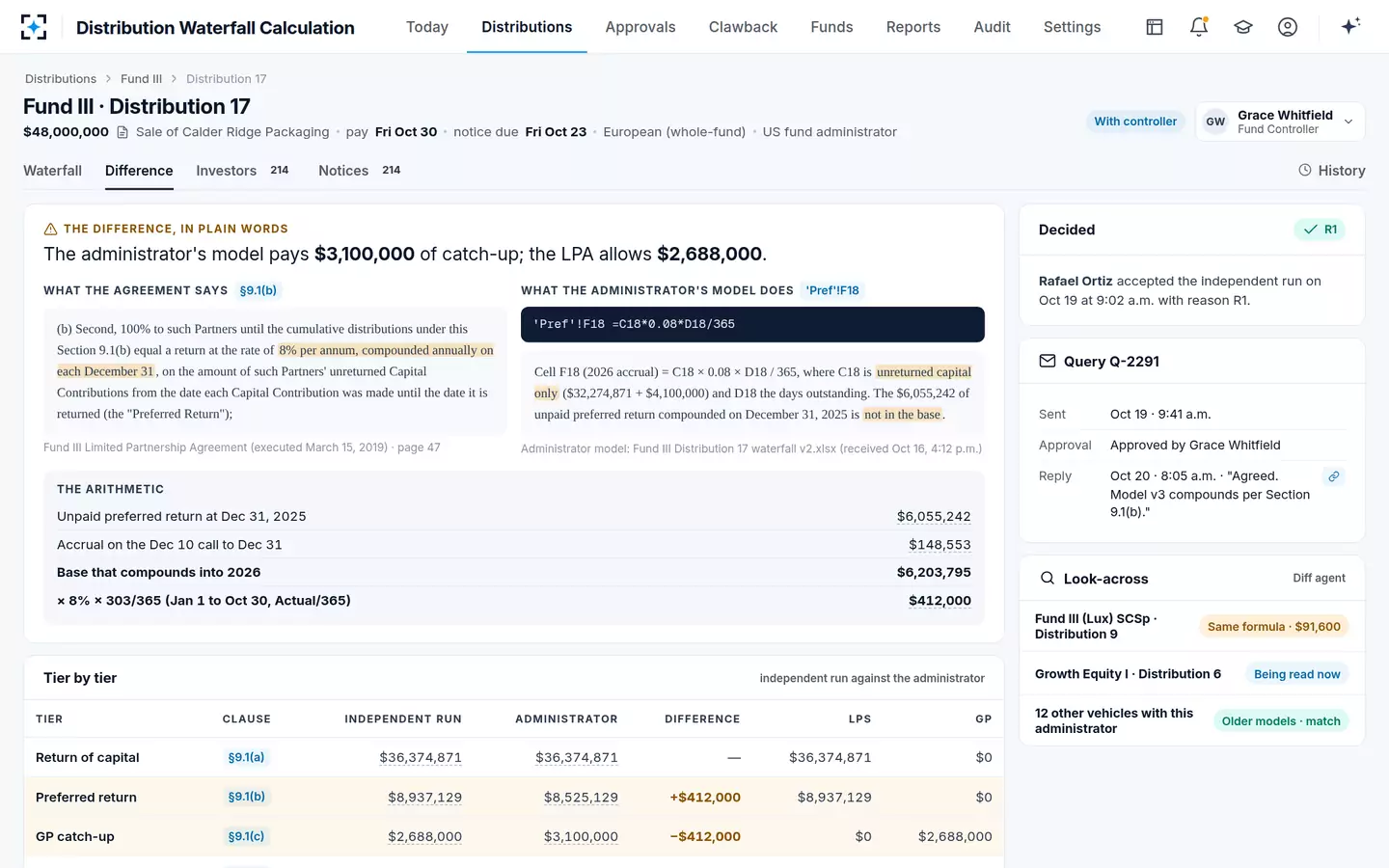
In the sample data the solution runs on, the fictional Quillfield Fund III's clause compounds 8% "annually on each December 31", on unreturned capital, from the date each contribution was made. The administrator's model accrued 2026 on capital alone. On a $48,000,000 distribution paid October 30, 2026, the difference was the 2025 balance the model left out of the base: unpaid preferred return of $6,055,242 at December 31, 2025 plus $148,553 accrued on a December 10 call, $6,203,795 in all, times 8% × 303/365. That is $412,000, which the model had moved from the LPs' preferred return into the GP's catch-up.
Distribution Waterfall Calculation: the clause beside the formula
Dates and day counts: small conventions that still move money
Not every convention matters as much as compounding, and it helps to know which ones do. On the illustrative cash flows, dating each call at its quarter end instead of its actual date changes the preferred return owed at June 30, 2026 by $42,684, because the calls move later and the distribution moves later too. A preferred return measured as an 8% IRR on each cash flow comes out $90,518 below compounding each December 31, because each contribution compounds on its own anniversary rather than on a shared year end.
Small is relative to the distribution. A $42,684 difference on a fund distributing $20 million is above the $1,000 or 0.01%-of-the-distribution tolerance per tier that the fictional manager's settings use, so it would be a difference to explain, not rounding. In that manager's sample third-quarter report, "accrual start dates" accounted for two differences and $0.12 million, and "IRR dated at quarter end" for one difference of $31,000. The day count is the same kind of input. Actual/365 against 30/360 changes each period's accrual by a few days' interest, and over several years of compounding the few days add up.
Which preferred return conventions move money, and how much
On the illustrative cash flows: $3,590,546 more owed compounded each December 31 than simple, by mid-2026.
What to check in the agreement: The word "compounded", and how often. Silence is a question for counsel.
On the illustrative cash flows: Daily compounding owes $994,211 more than annual; quarterly $713,863 more.
What to check in the agreement: Year-end, anniversary or another date; quarterly or daily language.
On the illustrative cash flows: An 8% IRR owes $90,518 less than compounding each December 31.
What to check in the agreement: Whether the hurdle is an IRR test or an accrued balance paid as a tier.
On the illustrative cash flows: $4.2 million of fees left out cuts the hurdle by $6,065,090: capital and preferred return together.
What to check in the agreement: The definition of capital contributions, and whether fees and expenses are returned.
On the illustrative cash flows: $42,684 less owed when calls and the distribution are dated at quarter end.
What to check in the agreement: From which date the return runs: contribution, due date or credit-line drawdown.
What a wrong preferred return costs: the catch-up moves with it
A preferred return error rarely stays in the preferred return. In a waterfall with a 100% catch-up, every dollar of preferred return understated is a dollar that reaches the catch-up tier, and while the catch-up is incomplete that dollar goes entirely to the GP. The LPs lose it twice over: once from tier two, and again because the GP's catch-up target, a quarter of the preferred return paid at 20% carry, is now smaller and completes sooner.
The effect is largest on exactly the distributions that matter. When a distribution clears the catch-up and reaches the split, the GP's total is pinned at 20% of cumulative profit and a preferred return error shrinks to a question of timing. When it lands inside the catch-up, as the sample $412,000 did, the error moves at full value. On the illustrative $105 million distribution worked through in the waterfall calculation example, modelling a compounded preferred return as simple raises the GP's share from $5,227,406 to $9,000,000. That is why the preferred return is the first number to re-perform on any distribution that pays catch-up.
Subscription lines and the preferred return clock
A subscription credit line lets a fund invest first and call capital from the LPs later. Because the preferred return usually runs from the date the LPs actually contribute, a fund that waits months to call capital shortens the period on which it owes 8%, and an IRR hurdle measured on LP cash flows looks higher for the same deal. The SEC described the effect in its 2023 release: "use of subscription lines to boost IRRs can artificially boost IRRs over the fund's preferred return hurdle rate, resulting in the adviser receiving carried interest compensation in a scenario where the adviser would not have received carried interest without the subscription line" (88 FR 63206; the rules it adopted were vacated in 2024, the description stands).
Examiners are still looking. The SEC's examination priorities for fiscal year 2027, published October 23, 2026, list "use of debt and fund-level lines of credit" among the disclosures and controls examiners will review at private fund advisers (Division of Examinations, FY2027 priorities). For the preferred return the practical question is in the clause: does the return run from the LP contribution date, or from the date the fund drew on the line? An agreement can choose the second precisely to neutralise the credit line, and a model that uses capital call dates where the clause uses drawdown dates understates the hurdle.
How Distribution Waterfall Calculation checks the preferred return
Distribution Waterfall Calculation treats every preferred return convention as a cited term. The Terms agent reads the clause into the term table: rate, base, start date, compounding frequency and day count, each linked to its passage, with anything read below 95% confidence confirmed by a person. The Model agent then recomputes the preferred return for each distribution from the capital accounts, contribution by contribution, and never reads the administrator's model, so the two calculations stay independent.
When the two disagree, the Diff agent reads the administrator's formula, sets it beside the clause and shows the arithmetic, and the controller can ask for it in plain words. The answer is cited to the clause, the capital account entry and the spreadsheet cell, so the question of who is right is settled by the agreement, not by whoever built the model.
Asking for the preferred return arithmetic, answered with its sources
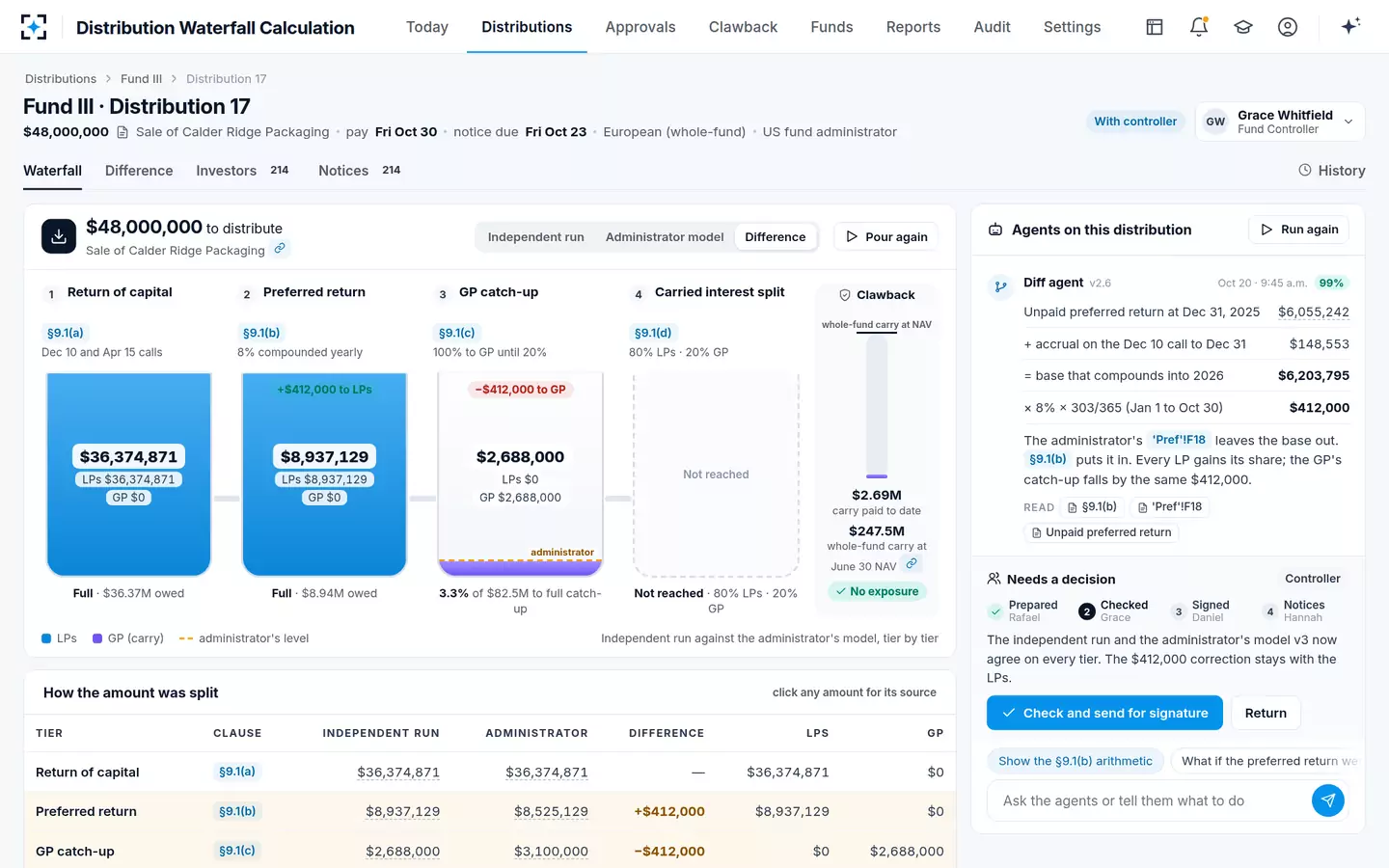
The decisions stay with people: fund finance decides the difference, the controller checks and the GP CFO signs. The preferred return is also the term behind the next one in the waterfall, so a correction here changes the catch-up, and both are visible in one place. To see it on a full distribution, start from Distribution Waterfall Calculation.
Questions people ask
How do you calculate a hurdle rate in private equity?
As an IRR hurdle, find the amount the LPs must receive by a date so that all their contributions and distributions earn 8% a year: each contribution grown at 1.08 to the power of its years outstanding, less each distribution grown the same way. On the illustrative cash flows that comes to $64,524,905 by June 30, 2026: $42 million of capital and $22,524,905 of return.
Is the preferred return paid every year?
No. In a private equity fund the preferred return accrues and is paid only out of distributions, in the waterfall's second tier. Years can pass with nothing paid, which is why compounding matters: under a compounded clause, the unpaid balance earns 8% too.
Does the preferred return accrue on management fees?
If the agreement counts the capital called to pay fees and expenses as contributed capital, yes, and Robinson and Sensoy describe that as the typical contract. On the illustrative cash flows, leaving $4.2 million of fees out of capital lowers the LPs' hurdle by $6,065,090.
How do I calculate a preferred return in Excel?
Lay out every cash flow and compounding date in date order. For each period, accrual = (capital + unpaid preferred return) × rate × days ÷ 365, and on each compounding date move the accrued amount into unpaid preferred return; a distribution reduces capital first, then unpaid preferred return, in the agreement's order. Check the result against an XIRR of the LP cash flows plus the balance owed, which should be close to 8% for an anniversary-compounded clause.
What happens to unpaid preferred return when the fund ends?
It is simply never paid. The preferred return is a priority in the waterfall, not a debt of the fund: if the fund's distributions do not cover capital and the full preferred return, the LPs receive everything and the GP receives no carry.