The difference between an American and a European waterfall in private equity is when the general partner gets paid. An American, or deal-by-deal, waterfall pays carried interest out of each investment as it is sold, once the limited partners have their capital back on that deal, usually with a preferred return and any losses on deals already sold. A European, or whole-of-fund, waterfall pays no carry until the LPs have recovered all the capital they put into the fund plus the preferred return on it. The carry rate is often 20% under both; the date is not, and the date decides how much risk the LPs carry and whether a clawback will ever be needed. Botminds' Distribution Waterfall Calculation runs each distribution from the fund's own limited partnership agreement, whichever type it is, and shows the fund controller the carry paid so far against what the whole fund supports.
The calculation is short; getting it right is not. Each agreement words its tiers differently, deal-by-deal funds add a set of definitions about which losses and write-downs count, and a mistake moves money between the LPs and the GP without anyone noticing until audit or wind-down. The worked figures below are illustrative arithmetic. The screens come from the solution running on sample data for a fictional manager, Quillfield Capital; its funds, investors and people are invented.
American vs European waterfall: the same split, paid at different times
American (deal-by-deal): When one investment is sold at a profit that clears its own capital, its share of realized losses and its preferred return.
European (whole of fund): When distributions from the whole fund have returned all contributed capital and the preferred return on it.
American (deal-by-deal): The capital in the deal being sold, plus losses on deals already realized. Unrealized write-downs count only if the agreement says so.
European (whole of fund): All capital contributed, for realized and unrealized investments, including management fees and fund expenses where the agreement says so.
American (deal-by-deal): The LPs: carry leaves the fund before the remaining portfolio is known.
European (whole of fund): The GP: carry waits until the LPs are whole, however long that takes.
American (deal-by-deal): Central. If later deals lose money, carry already paid has to come back.
European (whole of fund): Still possible if values fall after carry starts, but the exposure is smaller.
American (deal-by-deal): Common partner of the clawback: part of each carry payment is held until the whole fund is clear.
European (whole of fund): Less often needed, because the whole fund is already clear when carry begins.
American (deal-by-deal): One waterfall per realization, a running loss account, and a whole-fund test each quarter.
European (whole of fund): One whole-fund waterfall per distribution, sensitive to every contribution date and the pref convention.
What is the difference between an American and a European waterfall?
The difference is the threshold the LPs must clear before the GP shares in profits: one deal for an American waterfall, the whole fund for a European one. The SEC set the two out side by side in 2023. In the whole-fund case, it wrote, "the fund typically allocates all investment proceeds to the investors until they recoup 100% of their capital contributions attributable to both realized and unrealized investments plus their preferred return, at which point fund advisers typically begin to receive performance-based compensation" (88 FR 63206).
For the deal-by-deal case, "or modified versions thereof", the same passage says "it is common for investment proceeds from each portfolio investment to be allocated 100% to investors until investors recoup their capital contributions attributable to that specific investment, any losses from other realized investments, and their applicable preferred return". The Commission drew the consequence in the next sentence: under the deal-by-deal waterfall "advisers can potentially receive performance-based compensation earlier in the life of the fund".
That release adopted the private fund adviser rules, which the Fifth Circuit vacated on June 5, 2024 (National Ass'n of Private Fund Managers v. SEC). The rules are gone; the Commission's account of how the two waterfalls work was not what the court struck down, and it remains a plain description in a regulator's own words. Neither label is about geography. "European" and "American" are names for whole-fund and deal-by-deal mechanics, and the SEC uses them as such.
Everything else in the agreement sits on top of that threshold. Both types normally run the same four tiers after it: return of capital, the preferred return, a catch-up that brings the GP to its share of profits, and the split. A private equity waterfall calculation example walks one distribution through those tiers line by line.
When is carried interest paid under each waterfall?
Carried interest is paid when there is a distribution and the waterfall lets carry through, not on a calendar. Under an American waterfall that can be the first profitable exit, often a few years into the fund. Under a European waterfall it is the distribution that pushes cumulative payments to the LPs past their contributed capital and the preferred return, which on a slow fund can be close to the end of its life.
Take an illustrative fund with $100 million called on day one and split equally between two deals. Deal A is sold at the end of year 3 for $90 million; Deal B is sold at the end of year 6 for $45 million. The agreement has an 8% preferred return compounded annually, a 100% catch-up and a 20% carry. Management fees are left out to keep the arithmetic visible.
One fund, two waterfalls: the GP is paid in year 3 or not at all
- Deal A heldyears 0–3
- GP holds $8.0M of carryyears 3–6
- LPs owed capital and 8% a yearyears 0–6, never cleared
Is carried interest paid annually? Not as a rule. Carry follows distributions, and distributions follow exits. Some agreements let the GP take tax distributions or advances against carry it has been allocated but not yet paid. The SEC describes a tax advance as money advanced against "the adviser's accrued performance fees or carried interest" so that the adviser or its people can meet tax obligations "as they are due" (88 FR 63206). Those payments follow the tax calendar, and the agreement decides how they are credited against later carry.
American vs European waterfall examples: one fund, two deals, two answers
Run the same fund through both waterfalls and the GP's position diverges at the first exit. The American waterfall treats Deal A on its own: $50 million of capital back, $12,985,600 of preferred return (8% a year for three years on $50 million, compounded), a catch-up of $3,246,400 and an 80/20 split of the remaining $23,768,000. The GP takes $8,000,000. The European waterfall sends the whole $90 million to the LPs, because $100 million has been called and only $90 million has come back.
American vs European waterfall example, distribution by distribution
| Event | American: to LPs | American: to GP | European: to LPs | European: to GP |
|---|---|---|---|---|
| Year 3: Deal A sold for $90.0M | $82,000,000 | $8,000,000 | $90,000,000 | $0 |
| Year 6: Deal B sold for $45.0M | $45,000,000 | $0 | $45,000,000 | $0 |
| Total over the fund | $127,000,000 | $8,000,000 | $135,000,000 | $0 |
| Whole-fund entitlement at the end | $135,000,000 | $0 | $135,000,000 | $0 |
| Clawback owed by the GP | not applicable | $8,000,000 before any tax reduction | not applicable | none |
Change one input and the answer flips. If Deal B sells for $70 million instead, the whole fund makes $60 million and the European waterfall pays the GP $12.0 million in year 6, after a full catch-up. The American waterfall, applied deal by deal, still pays $8.0 million in year 3 and nothing on Deal B, because Deal B's own $20 million profit falls short of six years of preferred return on its $50 million. The GP is better off under the European terms in this version, and worse off in the first. Neither waterfall is GP-friendly in every state of the world; the American one is GP-friendly about timing.
That is the SEC's point in a footnote to the same release. "The result is that total distributions to investors and advisers under the two waterfalls can be equal (but may not always be), conditional on correct implementation of clawback provisions. In that case, the key difference in the two arrangements is that deal-by-deal waterfalls result in fund advisers potentially receiving their performance-based compensation faster" (88 FR 63206, note 1197).
Why a deal-by-deal waterfall needs a clawback, and escrow
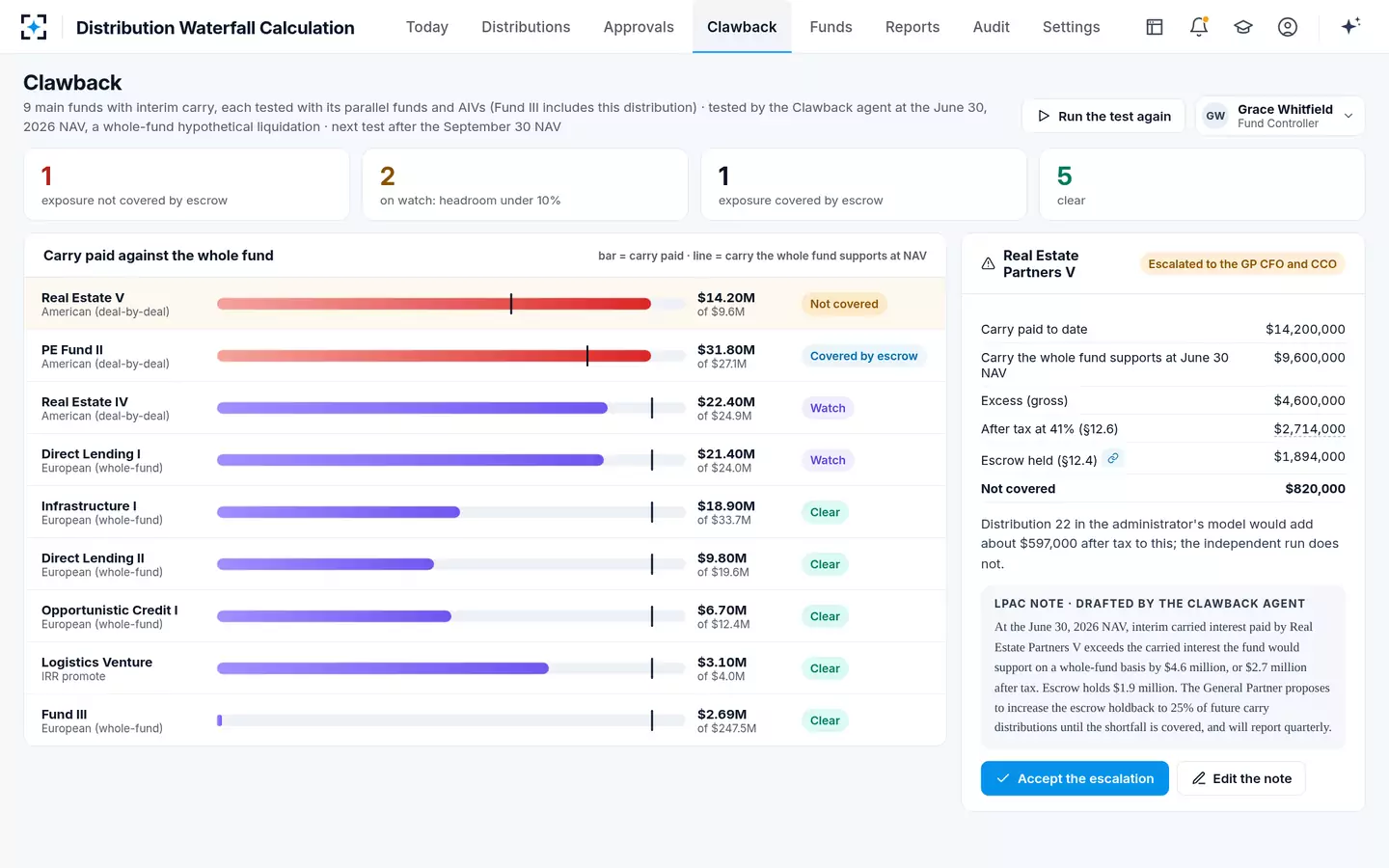
A deal-by-deal waterfall needs a clawback because it pays carry before anyone knows how the whole fund will end. In the first example the GP holds $8 million for three years that, on the whole fund's result, it was never entitled to. The clawback is the promise to give it back. The SEC's footnote describes the usual design: waterfalls, "especially deal-by-deal waterfalls", typically "have clawback arrangements to ensure that advisers do not retain carried interest unless investors recoup their entire capital contributions on the whole fund, plus a preferred return."
A clawback is only as good as the money behind it, and two features of most agreements thin it out. The carry has usually been distributed to individual carry holders who have paid tax on it, so many agreements cap the clawback at the after-tax amount. And the GP entity that owes it may hold little else, so agreements often add guarantees from the carry holders, escrow, or both. The same footnote notes that "some deal-by-deal waterfalls may also require fund advisers to escrow their performance-based compensation until investors receive their total capital contributions to the fund plus their preferred return on the total capital contributions." How a clawback provision in private equity actually pays out follows one overpaid carry through each of those limits.
Distribution Waterfall Calculation: deal-by-deal carry tested against the whole fund
Is a European waterfall always better for limited partners?
No. A European waterfall protects the LPs' capital better, but the peer-reviewed evidence does not show that it produces better funds. Hüther, Robinson, Sievers and Hartmann-Wendels read limited partnership agreements of venture capital funds and found that "“GP-friendly” contracts—agreements that pay general partners on a deal-by-deal basis instead of withholding carried interest until a benchmark return has been earned—are associated with higher returns, both gross and net of fees" (Management Science, 2020).
The authors tie the result to exit timing and summarize the trade-off in one line: "Timing practices balance GP incentives against limited partner downside protection." An association is not a recommendation. Better managers may simply be able to negotiate GP-friendly terms, and the study's sample is venture capital funds. What it does show is that the choice between the two waterfalls is a choice about incentives, not about arithmetic.
For an LP the practical questions are narrower. How much carry could leave the fund before the portfolio is known? Who owes it back, and what stands behind that promise? Is the clawback tested only at the end of the fund's life or periodically along the way? How is it reduced for taxes? Those terms decide whether the totals in the SEC's footnote really do come out equal.
What the research says about carry timing and exits
The timing of carry changes when GPs sell. Robinson and Sensoy studied 837 buyout and venture funds with almost $600 billion of commitments and found that distributions bunch around the quarter in which a fund first crosses its carry threshold (NBER Working Paper 17942, published in the Review of Financial Studies in 2013). Because they did not see each fund's timing rules, they used the most common whole-fund scheme, in which the GP earns carry once LPs have received back all contributed capital, "including both capital contributed for investments and management fees paid", plus a preferred return.
Distributions spike when carry switches on
47.72%
of fund size: how much higher distributions were in the quarter a fund crossed its carry threshold than in the average of the four quarters before
837
buyout and venture funds studied, almost $600 billion of commitments, vintages 1984 to 2009
54%
of buyout funds and 42% of venture funds in the sample crossed the threshold at some point
In the period one to four quarters after the threshold, distributions averaged 3.25% of fund size more than before it; five to eight quarters after, 2.97% less. The authors read the hump as an agency problem: once carry is switched on, the GP "earns immediate carried interest on those distributions, and avoids the risk that the investments might later decline in value." They are careful about what that means for LPs: "this behavior will lead some investments to be harvested too early, when delaying would have generated more value for LPs."
“Once you reach the waterfall, it’s time to turn on the vacuum cleaner.”
A practitioner quoted by Robinson and Sensoy, NBER Working Paper 17942
Both papers point the same way. Under a whole-fund waterfall the switch-on moment is one date, late in the fund, and it changes behaviour around it. Under a deal-by-deal waterfall carry switches on deal by deal, earlier, with the clawback as the only correction if the late deals disappoint. A fund finance team that knows which regime it is in knows which distributions deserve the closest look.
Hybrids: write-downs, fair-value tests and interim clawbacks
Few agreements are purely one type. The SEC's phrase "or modified versions thereof" covers the common middle ground, where a deal-by-deal waterfall borrows protection from the whole-fund model. The usual additions are three.
The first counts write-downs, not just realized losses: before carry is paid on a sale, the LPs also recover the capital in investments that have been marked down. The second is a fair-value test, under which carry is paid only if the remaining portfolio, valued at its latest marks, still covers the LPs' remaining capital by a stated margin. The third is an interim clawback, tested at set points during the fund's life rather than only at the end. Each moves the American waterfall toward the European one, and each adds an input that a spreadsheet has to carry correctly.
The write-down clause is where errors cluster in the sample. In the fictional manager's third-quarter report, the largest cause of differences between the independent runs and the administrators' models was "write-downs left out (deal-by-deal)": two distributions and $1.39 million, against $0.81 million across the three preferred-return compounding differences. A hybrid term only protects the LPs if the model actually reads it.
How Distribution Waterfall Calculation handles both waterfall types
Distribution Waterfall Calculation starts from the agreement, not the model. Its Terms agent reads the limited partnership agreement, amendments and side letters into a term table in which the waterfall type is a cited term like any other: European (whole-fund), American (deal-by-deal), an IRR promote, deal-level co-investments, MOIC-tiered continuation funds or incentive allocation. Below 95% confidence a person confirms the reading, and an ambiguous clause goes to fund counsel rather than being guessed.
The Model agent then runs each distribution from that term table and the capital accounts, without ever seeing the administrator's model, and the Diff agent compares the two tier by tier. For deal-by-deal funds the Clawback agent adds the test the waterfall itself does not: every quarter it liquidates the whole fund hypothetically at NAV and compares the carry already paid with what the whole fund would support, after the agreement's tax limit and escrow. Exposure not covered goes to the GP CFO and the chief compliance officer with a drafted note for the LP advisory committee.
Every open distribution, filterable by waterfall type
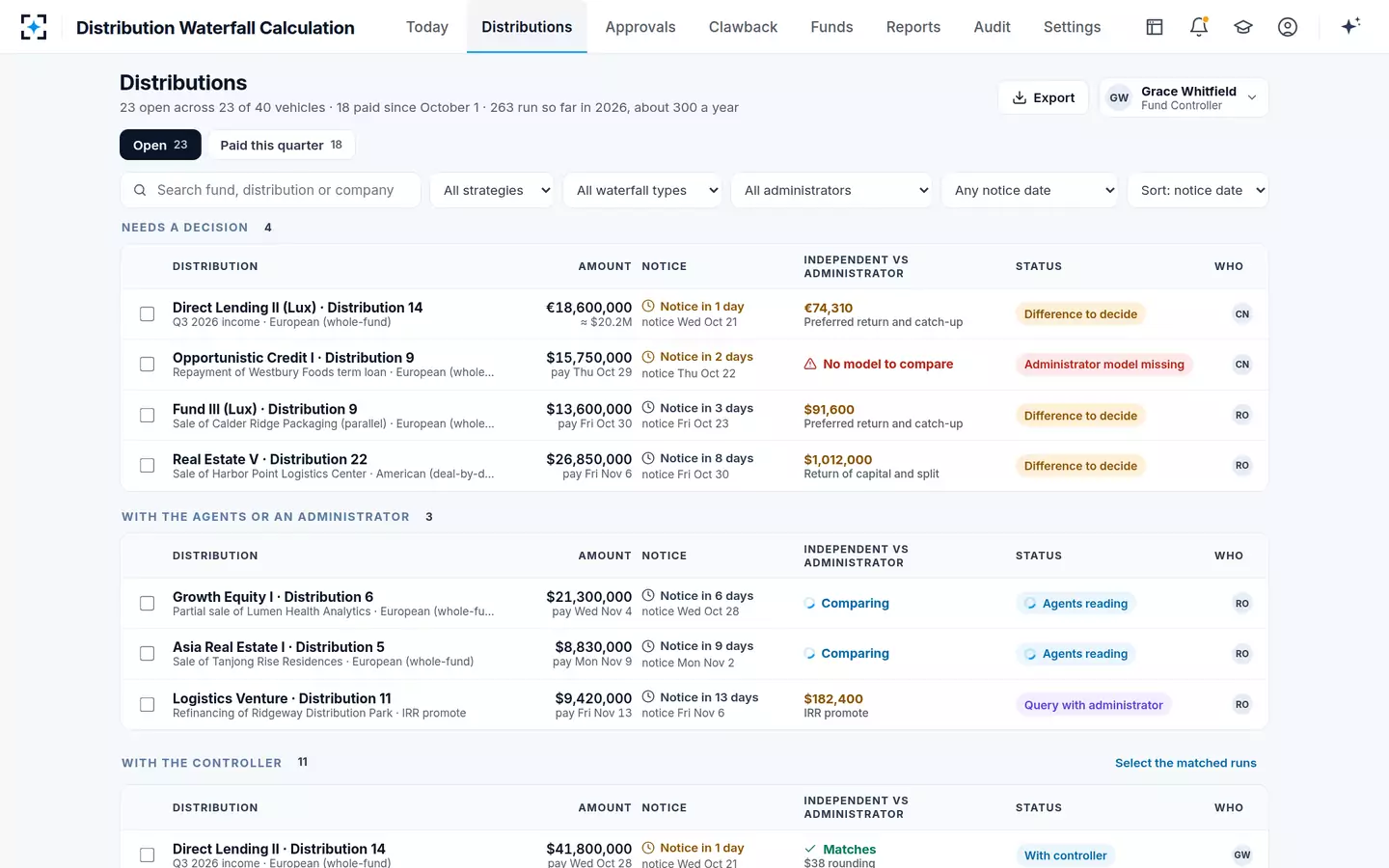
The people stay where they are. Fund finance decides each explained difference, the controller checks, and the GP CFO signs any distribution that pays carry; anyone who holds carry in the fund is blocked from all three. The agents never pay, sign, send or move escrow. To see the whole sequence on one distribution, start from Distribution Waterfall Calculation.
Questions people ask
What is a European waterfall?
A European waterfall, also called a whole-of-fund waterfall, sends every distribution to the limited partners until they have recovered all the capital they contributed to the fund and the preferred return on it. Only then does the general partner receive carried interest, usually through a catch-up followed by an 80/20 split. The SEC describes it as recovering "100% of their capital contributions attributable to both realized and unrealized investments plus their preferred return" before performance compensation begins.
Does a European waterfall still need a clawback?
Usually yes, though the exposure is smaller. Once carry starts, a later fall in the remaining investments can leave the GP holding more than the final whole-fund result supports, and tax distributions made before the carry is earned can do the same. The SEC's description, that waterfalls "(especially deal-by-deal waterfalls) typically have clawback arrangements", covers whole-fund agreements too.
Is carried interest paid annually?
No. Carried interest is paid when a distribution passes through the waterfall to the carry tiers, which depends on exits, not the calendar. Separate tax distributions or advances can be made each year against carry already allocated, and are credited against later carry.
Which waterfall gives the GP more carry in total?
It depends on the order in which deals succeed and fail. In the illustrative fund above, the American waterfall pays $8.0 million early that a full clawback would recover, while with a stronger second deal the European waterfall pays $12.0 million against the American waterfall's $8.0 million. The SEC's own description is that totals "can be equal (but may not always be), conditional on correct implementation of clawback provisions".
Do the names American and European refer to where the fund is based?
No. They are conventional names for the deal-by-deal and whole-fund mechanics, used whatever the fund's domicile; the SEC's 2023 release uses them as alternative names for the two structures. What matters is the waterfall clause in the agreement, which may also mix features of both.
How does the preferred return differ between the two?
The rate is often the same, but the base is not: deal by deal it accrues on the capital in the investment being sold (and losses on other realized deals), while whole-fund it accrues on all capital contributed. The compounding convention and the dates used matter as much as the rate; preferred return calculation, compounded annually shows how far apart the answers land on one set of cash flows.