A clawback provision in private equity is the clause in a fund's limited partnership agreement that makes the general partner, and usually the individuals who received the carry, give back carried interest they were paid in excess of what the fund's final, whole-fund result entitles them to. The SEC's 2023 definition of an adviser clawback, in private fund rules a court later vacated, is "any obligation of the adviser, its related persons, or their respective owners or interest holders to restore or otherwise return performance-based compensation to the private fund pursuant to the private fund's governing agreements" (88 FR 63206). A clawback is the bill for carry calculated on results that did not last: early exits that were followed by losses, marks that later fell, or tax distributions paid ahead of carry that never arrived. Botminds' Distribution Waterfall Calculation tests every fund that has paid carry against a whole-fund hypothetical liquidation each quarter, so the exposure shows up while escrow and the remaining distributions can still cover it.
The way to understand a clawback is to watch one happen. This page tells one overpaid carry forwards, year by year, and at each link names the control that would have broken the chain. The fund and its figures are illustrative arithmetic. The screens show the solution on sample data for a fictional manager, Quillfield Capital; its funds, investors and people are invented.
Ten years, one overpaid carry: paid in year 4, owed back in year 10
- No carryyears 0–4
- Carry paid on two exitsyears 4–8 · $12.0M
- Losses known; excess $9.0Myears 8–10
- Nothing owedyears 0–4
- Exposure invisible without a testyears 4–8
- Clawback demandedyear 10 · $5.4M
What is a clawback provision in private equity?
A clawback provision is the GP's promise to return excess carry at the end of the fund, or at interim test dates if the agreement has them, so that over the fund's life the GP keeps only its agreed share of the whole fund's profit after the LPs' capital and preferred return. It exists because carry is paid before the fund's result is known. The SEC said as much in the same release: waterfalls, deal-by-deal ones above all, usually carry a clawback so that the adviser keeps carry only once investors have their whole-fund capital back with the preferred return, as the American vs European waterfall guide sets out.
The 2023 release adopted rules that the Fifth Circuit vacated on June 5, 2024 (National Ass'n of Private Fund Managers v. SEC), so none of its requirements apply. Its description of how clawbacks work, and of the commenters' arguments about them, is still a detailed account in a regulator's own words, and this page quotes it as description, not as law.
Two different obligations share the name. A GP clawback returns carry to the fund. An LP clawback, often called a giveback, returns distributions from the LPs to the fund, typically to meet indemnification claims or liabilities the fund incurs after it has paid out. Delaware's limited partnership statute sets a floor for the second: a limited partner who receives a distribution that leaves the partnership's liabilities above the fair value of its assets, and "who knew at the time of the distribution that the distribution violated" that limit, is liable to return it, and "Unless otherwise agreed", an LP has no liability for a distribution "after the expiration of 3 years from the date of the distribution" (6 Del. C. § 17-607). Everything else about either clawback is contract.
A pre-mortem: one overpaid carry, told forwards
A pre-mortem asks how a failure would happen before it does. Applied to a clawback, it shows that no single mistake causes one; a chain of reasonable decisions does, and each link has a control that would have broken it. The fund in the timeline is a $200 million deal-by-deal fund with an 8% preferred return, a 100% catch-up and a 20% carry.
How an overpayment becomes a clawback, link by link
| Year | What happens | Why it builds the exposure | The control that breaks the link |
|---|---|---|---|
| 4–5 | Two profitable exits pay $12.0 million of carry, deal by deal. | Carry leaves the fund while most of the portfolio is unrealized. | Escrow or holdback of a share of each carry payment; or a fair-value test before carry is paid. |
| 4–7 | Carry holders receive the carry and pay tax on it; part is spent or reinvested. | Money that may come back is now in individuals’ hands, net of tax. | Several or joint guarantees from carry holders, with a list of who received what. |
| 6–7 | The remaining investments are carried at marks that hold up the fund’s NAV. | An interim test, if any, compares carry paid with NAV that may be too high. | Valuation checked independently of the deal team; tests rerun when marks move. |
| 8 | Two investments are written off. | The whole fund can no longer support the carry already paid. | A quarterly whole-fund test that shows the gap the quarter it opens. |
| 10 | Final distribution: the whole fund supports $3.0 million of carry. | $9.0 million of excess is now owed back. | A clawback clause that is gross of tax, or a tax rate tied to taxes actually paid. |
| 10 | Clawback capped after tax at a 40% assumed rate: $5.4 million. | $3.6 million of LP profit is never recovered. | Disclosure of the gross and after-tax amounts, so LPs know the size of the gap. |
Read down the right-hand column and the clawback stops looking like a single clause. It is the last of several protections, and the only one that operates after the money has gone. A fund whose agreement has the first four controls is far less likely to reach the fifth with a large number. A fund that relies on the clawback alone learns its size in year 10, from a calculation nobody ran in years 4 to 9.
Where clawbacks start: early carry, high marks and subscription lines
Most clawbacks start with carry that was correctly calculated on the numbers available at the time. The deal-by-deal waterfall pays it by design, as American vs European waterfall in private equity explains. Two other sources inflate it. SEC examiners reported in 2020 that some advisers that did not follow their own valuation process overcharged both management fees and carried interest (OCIE risk alert, June 23, 2020, staff observations, not a rule). And in its 2023 release the SEC noted that early carry earned with the help of subscription credit lines "can create clawback complications later in the life of the fund".
Both work through the same channel: carry is a calculation on numbers that can move. A hypothetical liquidation at NAV, which interim clawback tests use, is only as good as the NAV. In private equity most of that NAV is a model.
Interim clawback tests rest on marks, not prices
$8.5T
net asset value of private equity funds reported on Form PF, fourth quarter of 2025
$6.4T
of private equity fund assets classified Level 3 in the fair value hierarchy
86%
of the private equity fund assets reported in the fair value hierarchy are Level 3 (our arithmetic)
Is the clawback net of taxes?
Often, yes. Many agreements cap the GP's clawback at the carry it received less the taxes its partners paid, or are deemed to have paid, on it. The SEC's release says so directly: "many fund agreements only require advisers to restore the excess performance-based compensation (less taxes) to the fund, without requiring them to provide investors with any information regarding the adviser's related determinations and calculations, such as whether a clawback was triggered and the aggregate amount of the clawback."
The tax is rarely the actual tax. A footnote to the release explains that because carry recipients are taxed individually, in different places, "advisers typically use a ‘hypothetical marginal tax rate’ to determine the tax reduction amount, which is usually based on the highest marginal U.S. Federal, State, and local tax rates." The commenters who opposed a ban argued that taxes "paid in respect of excess performance-based compensation generally cannot be recouped by amending prior tax returns", so a gross clawback could leave carry holders worse off than if they had never been paid.
A $9.0 million excess, and what comes back
The 2023 rule tried a middle course. It would not have banned after-tax clawbacks; it would have required the adviser, within 45 days after the quarter in which a clawback occurs, to send investors "the aggregate dollar amounts of the adviser clawback both before and after any such reduction" for taxes. With the rule vacated, that disclosure is again a matter for negotiation, and an LP that wants to know the size of the tax gap has to ask for it in the agreement or a side letter.
GP clawback provision: the terms that decide what comes back
A GP clawback provision is a handful of terms, and each one moves the recovery. Reading them before carry is paid tells an LP, and the fund's own finance team, what the clawback in the timeline would actually have returned.
Nine terms to read in any clawback provision
- When it is tested
Only at the end of the fund’s life, or also at interim dates such as the end of the investment period or each year. An end-of-life test can come a decade after the carry.
- What it is measured against
The whole fund’s cumulative result after capital and preferred return, or something narrower.
- Gross or after tax
And if after tax, at which rate: actual taxes, or an assumed rate set in the agreement.
- The cap
Commonly no more than the carry received, less taxes. Whether interest is owed on late payment.
- Who owes it
The GP entity alone, or the individual carry holders too; and whether their guarantees are several or joint.
- Escrow or holdback
What share of each carry payment is held back, and when it is released.
- Tax distributions
Whether advances for tax on allocated carry are credited against later carry and counted in the clawback.
- Timing of payment
How long the GP has to pay once the clawback is determined.
- What investors are told
Whether the gross and after-tax amounts, and interim estimates, are reported.
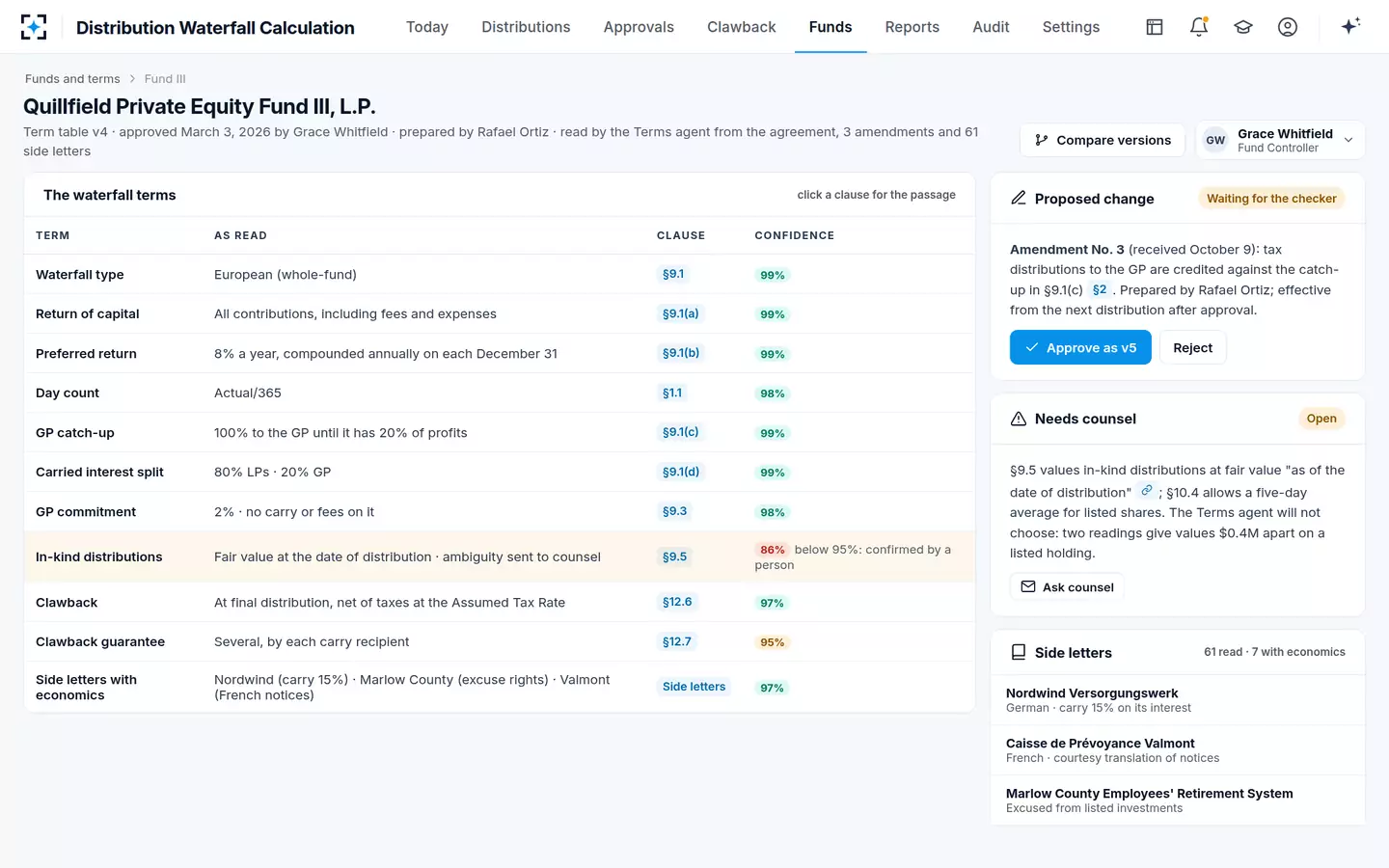
The sample agreement in the solution's screens shows how these terms look in practice. Its term table reads the fictional Fund III's clawback as "At final distribution, net of taxes at the Assumed Tax Rate", from section 12.6, and the guarantee as "Several, by each carry recipient", from section 12.7. Each is cited to its clause with a confidence, so the controller can open the passage instead of trusting a summary.
The clawback terms read from the agreement, each cited to its clause
Interim clawback in private equity: testing before the end
An interim clawback tests carry paid against the whole fund before the fund ends, at dates the agreement sets, and requires the GP to return any excess then rather than at wind-down. Its value is time: the GP still holds the money and the fund still has distributions from which to withhold it. Its weakness is that it has to value what has not been sold.
End-of-life clawback vs interim clawback
End-of-life clawback: Once, at the final distribution or liquidation.
Interim clawback: At set dates during the fund’s life, often on a hypothetical liquidation at NAV.
End-of-life clawback: Realized results: no valuation judgment.
Interim clawback: Realized results plus the current marks of unrealized investments.
End-of-life clawback: LPs, who fund the excess for years and depend on the GP’s solvency at the end.
Interim clawback: The GP, who may return carry that later marks would have supported.
End-of-life clawback: Payment from the GP and guarantors, often after tax.
Interim clawback: Withholding from later carry, top-ups to escrow, or payment.
A fund finance team does not need an interim clawback clause to run an interim test. Recomputing the whole-fund waterfall on a hypothetical liquidation at each quarter's NAV, and comparing the carry it supports with the carry already paid, tells the GP CFO what a final clawback would cost today. The same calculation underlies accrued carry in the fund's financial statements, which carried interest accounting treatment works through entry by entry.
Clawback provision private equity example: one fund in the sample data
In the sample data the solution runs on, the clawback test covers the fictional manager's nine main funds that have paid interim carry, each with its parallel funds and alternative investment vehicles, at the June 30, 2026 NAV. One of them, Real Estate Partners V, is a deal-by-deal fund that has paid $14,200,000 of carry against $9,600,000 that the whole fund supports on a hypothetical liquidation.
The excess is $4,600,000. The agreement's clawback is after tax at 41%, under its section 12.6, which brings the obligation to $2,714,000. Escrow under section 12.4 holds $1,894,000. That leaves $820,000 that the clawback, as written, would not recover from escrow. The Clawback agent escalated it to the GP CFO and the chief compliance officer with a note for the LP advisory committee already drafted, proposing to raise the escrow holdback to 25% of future carry distributions until the shortfall is covered.
Distribution Waterfall Calculation: carry paid against the whole fund, every quarter
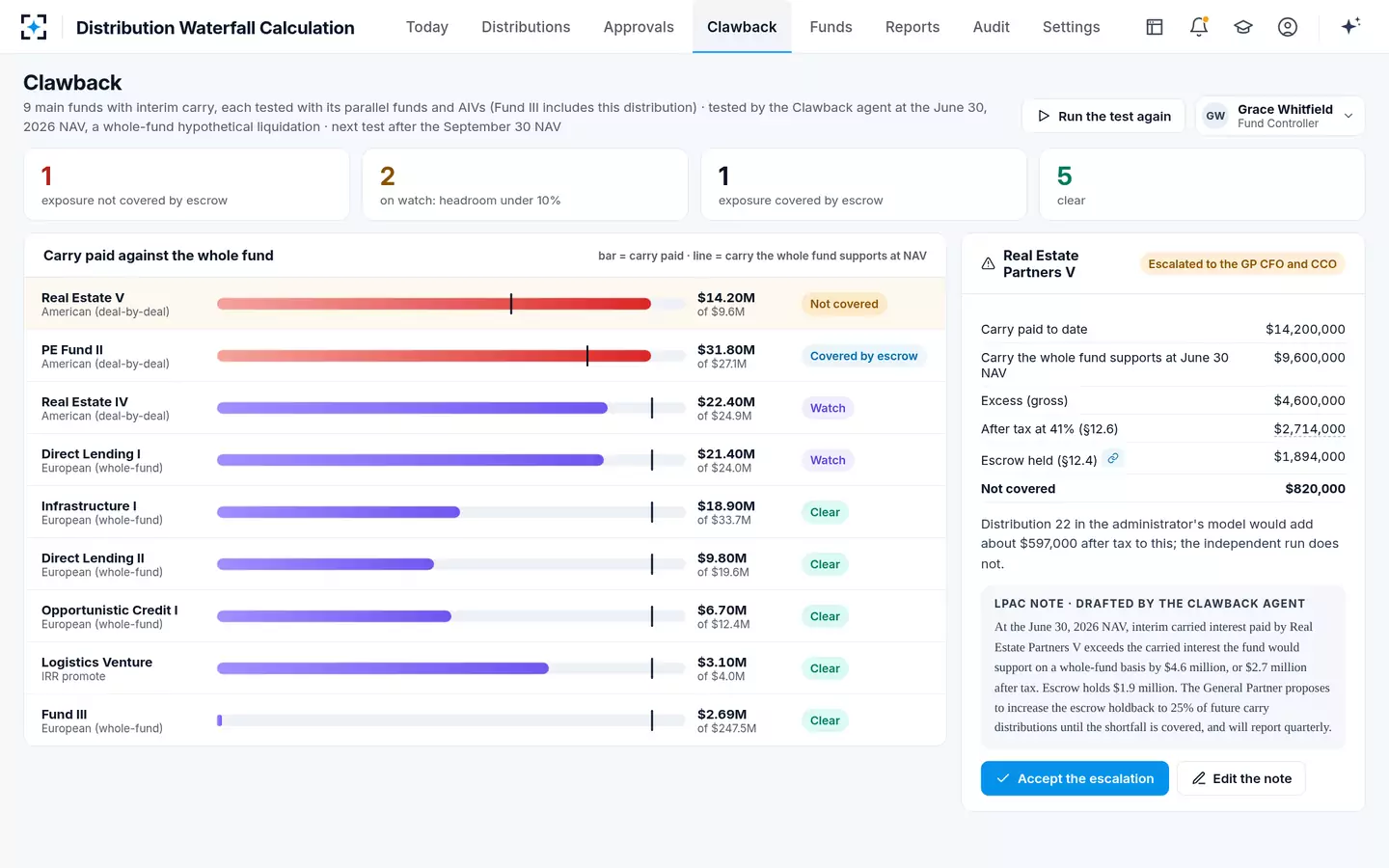
How Distribution Waterfall Calculation tests clawback exposure every quarter
Distribution Waterfall Calculation runs the whole-fund test the pre-mortem asked for in year 6. Each quarter the Clawback agent takes every vehicle that has paid carry, applies a hypothetical liquidation at the latest NAV through the fund's own waterfall terms, and compares the carry the whole fund would support with the carry paid, after the agreement's tax limit, escrow and guarantees. Funds close to the line go on watch; any exposure escrow does not cover goes to the GP CFO and the CCO with a drafted note.
The agent's limits are deliberate. It never moves or releases escrow and never contacts LPs; escrow release needs both the GP CFO and the CCO. The test uses the same term table as every distribution, so a clawback clause read wrongly would show up in both, and the controller approves the term table before any run uses it. To see the test beside the distributions that feed it, start from Distribution Waterfall Calculation.
Questions people ask
What are clawback payments in private equity?
They are payments by the general partner, and often by the individuals who received carried interest, back to the fund when carry paid during the fund's life exceeds what the whole fund's final result supports. In many agreements the amount is capped at the carry received less taxes, and the payment is shared among the LPs as an additional distribution.
What is an interim clawback in private equity?
An interim clawback is a test of carry paid against the whole fund at dates during the fund's life, rather than only at the end. If the carry paid exceeds what a hypothetical liquidation at that date supports, the GP returns or escrows the excess then, while the money is still within reach.
What is a clawback in accounting?
In a fund's books, a clawback is the reversal of carried interest previously allocated to the general partner: accrued carry falls when values fall, and a clawback obligation appears when carry actually distributed exceeds what the general partner is entitled to. For an asset manager, a FASB staff paper notes that carried interest allocations "generally are subject to reversals or clawbacks in future periods if the fund performance does not continue to exceed the contractually predetermined benchmark".
Who pays the clawback: the GP or the individual partners?
The obligation usually sits with the GP entity, which may hold little beyond the carry it has already distributed. LPs therefore negotiate guarantees from the individual carry recipients, which may be several, each for their own share, and escrow of part of each carry payment.
Can limited partners be clawed back too?
Yes, under a separate giveback clause, usually to fund indemnification or liabilities that arise after distributions. Under Delaware law, an LP who knowingly received a distribution that left the partnership insolvent on the statute's test must return it, and unless the agreement says otherwise has no liability for a distribution after three years.
Does a European waterfall eliminate clawback risk?
It reduces it. Carry under a whole-fund waterfall starts only after the LPs have their capital and preferred return back, but a later fall in the remaining investments, or tax distributions ahead of carry, can still leave the GP over-paid, so whole-fund agreements carry clawback clauses as well.