A carried interest calculator answers one question: of the profit a fund returns, how much goes to the general partner? Under a typical whole-fund waterfall the limited partners first get back the capital they paid in and an 8% preferred return; then a catch-up pays the GP until it holds 20% of the profit; then everything else is split 80/20. The calculator below runs that waterfall for a single call and a single distribution. With its defaults, $100 million called and $200 million returned six years later, the GP's carried interest is $20,000,000, the LPs' net multiple falls from 2.0x to 1.8x and their IRR from 12.2% to 10.3%. Botminds' Distribution Waterfall Calculation runs the same tiers for real funds, contribution by contribution and LP by LP, from each fund's own agreement, and checks the administrator's model before carry is paid.
Every figure on this page is illustrative arithmetic unless it says otherwise; the screen near the end shows the solution on sample data for a fictional manager, Quillfield Capital, whose funds and investors are invented. Nothing you enter in the calculator leaves the page.
How is carried interest calculated in private equity?
Carried interest is calculated as the carry percentage, usually 20%, of the fund's cumulative profit, but only once the LPs have received their capital and the preferred return, and only to the extent the catch-up has brought the GP up to that share. Profit is everything distributed less everything contributed, management fees included where the agreement treats them as contributions. Robinson and Sensoy, who read the terms of 837 buyout and venture funds, found that "a carried interest of 20% is the norm, obtained by 89% of VC funds and 97% of buyout funds" (NBER Working Paper 17942).
Three terms turn the 20% into a number. The preferred return decides when carry can start. The catch-up decides whether, once it starts, the GP is paid on all profit (a full catch-up) or only on profit above the hurdle (no catch-up). And the waterfall type, whole-fund or deal-by-deal, decides when the money leaves the fund. A private equity waterfall calculation example follows one distribution through each tier.
Carried interest calculator: one call, one distribution, a whole-fund waterfall
Try the default fund at eight years instead of six, and the carry falls from $20,000,000 to $14,906,979; at nine years it is $99,537, and at ten, nothing. The fund is the same 2x fund each time. What changed is that eight years of 8% compounded preferred return swallow most of the profit before the catch-up starts, and by ten years the preferred return owed, $115.9 million, is larger than the $100 million profit itself.
How much carry does an LP pay on a 2x fund?
On a fund that turns $100 million into $200 million, an LP pays the full $20 million of carry, 20% of the profit, if the money comes back within about seven years, and much less or nothing if it takes longer. The holding period sets the IRR, and the IRR against the 8% hurdle decides how much of the catch-up is paid.
Carry on a 2x fund, by years from call to distribution
The eight-year bar shows what the catch-up does to the LP. After carry the LPs' net multiple is 1.85x and their net IRR is exactly 8.0%: the catch-up takes everything above the hurdle until the GP is caught up, so an LP in a fund that ends inside the catch-up earns the hurdle and no more. The hurdle is a floor on the LP's return, not a fee-free zone above it.
Carried interest example calculation: what 20% does to multiple and IRR
Carry is usually quoted as a percentage of profit; LPs feel it as a lower multiple and a lower IRR. The table translates the bars into the measures an investment committee reads.
Carried interest example calculation on a 2x fund
| Years | Carry to GP | LP multiple, net | LP IRR, gross | LP IRR, net | IRR given up |
|---|---|---|---|---|---|
| 4 | $20,000,000 | 1.80x | 18.9% | 15.8% | 3.1 points |
| 5 | $20,000,000 | 1.80x | 14.9% | 12.5% | 2.4 points |
| 6 | $20,000,000 | 1.80x | 12.2% | 10.3% | 2.0 points |
| 7 | $20,000,000 | 1.80x | 10.4% | 8.8% | 1.7 points |
| 8 | $14,906,979 | 1.85x | 9.1% | 8.0% | 1.1 points |
| 10 | $0 | 2.00x | 7.2% | 7.2% | none |
Two readings follow. In dollars, a 2x fund costs its LPs the same $20 million of carry whether it takes four years or seven. In IRR, the faster fund costs them more, 3.1 points against 1.7, because the same dollars are taken from a shorter period. An LP comparing funds on net IRR is comparing carry and speed together.
When the carry is paid matters as much as how much
The calculator assumes one distribution at the end. Real funds distribute as investments are sold, and the waterfall type decides whether carry leaves the fund with the first exit or waits for the whole fund. Under a deal-by-deal waterfall the GP can be paid years earlier; the SEC observed in 2023, in a release whose rules were later vacated, that successful investments "can deliver advisers performance-based compensation before investors have recouped their entire capital contributions to the fund" (88 FR 63206). The total can come out the same if the clawback works, but the LP finances the GP in between, and carries the risk that the clawback falls short.
Earlier carry is not necessarily worse for LPs. Hüther, Robinson, Sievers and Hartmann-Wendels found deal-by-deal contracts in venture funds associated with higher returns, gross and net of fees (Management Science, 2020). The point for a calculator is narrower: two funds with the same 20% and the same profit can cost an LP different amounts in present value, depending on when the carry is paid. American vs European waterfall in private equity works the timing through one fund.
Carried interest vs performance fee
Carried interest and a performance fee both pay a manager a share of gains, but they are different instruments. Carried interest is an allocation of the partnership's profits to the general partner, usually realized and paid through the waterfall. A performance fee is a fee the fund pays the manager, common in funds with redemptions, usually calculated on NAV gains above a high-water mark and accrued as a liability.
Carried interest vs performance fee, in the SEC's terms
Carried interest: "a form of performance-based compensation where a portion of profits is allocated to a general partner before the remaining profits are distributed to limited partners"
Performance fee: A fee charged to the fund, usually on gains above a high-water mark, the fund’s prior peak NAV, and sometimes a hurdle.
Carried interest: Closed-end drawdown funds structured as partnerships.
Performance fee: Evergreen funds that permit periodic redemptions; registered funds face limits that the 2026 SEC proposal would relax.
Carried interest: Realized gains, because investments are held until they are sold.
Performance fee: Often unrealized gains, with the risk that a fee paid on marks is later reversed.
Carried interest: The preferred return, and a clawback if early carry proves excessive.
Performance fee: The high-water mark, and how rarely the fee crystallizes.
What carry costs across private equity
No regulator publishes how much carry LPs pay each year, and the figures that exist are estimates. The SEC's 2023 private fund release cited one: "one study estimated that from 2006-2015, performance-based compensation alone for private equity funds averaged $23 billion per year." The same release explains why LPs struggle to check their share of it: for deal-by-deal waterfalls, "even sophisticated investors have reported difficulty in measuring and evaluating compensation made to fund advisers and determining if adviser fees comply with the fund's governing agreements."
Carry is a standard rate on a large, hard-to-check base
20%
carried interest is the norm: 89% of venture funds and 97% of buyout funds in a sample of 837
$23B
a year of performance-based compensation in private equity, 2006–2015, as one study estimated, cited by the SEC
$8.5T
net asset value of private equity funds reported on Form PF, fourth quarter of 2025
A standard 20% on an $8.5 trillion base, paid through calculations that sophisticated investors find hard to verify, is the case for re-performing them. The rate is rarely in dispute; the inputs are.
What a carried interest calculator cannot tell you
A calculator applies clean terms to clean cash flows. The carry an LP actually pays depends on terms no simple calculator models, and each of them moves money in one direction or the other.
Terms that change the carry an LP pays, and in which direction
| Term | What it does to the LP’s carry bill |
|---|---|
| Fees counted as contributed capital | Lowers it: fees must come back, with preferred return, before carry. |
| Preferred return compounding | Compounded raises the hurdle over simple; on a fund that ends inside the catch-up it lowers carry by millions. |
| Full, partial or no catch-up | No catch-up (a hard hurdle) cuts carry most; a partial catch-up delays it. |
| Side letter with a lower carry rate | Lowers that LP’s carry, with its own catch-up target. |
| Deal-by-deal waterfall | Same total if the clawback works, paid earlier; more if it does not. |
| Clawback after tax | Raises what the LP finally pays if early carry was excessive: only the after-tax amount comes back. |
| Fee offsets and expense caps | Change profit, and so the carry calculated on it. |
Two of these are where calculation errors concentrate. A compounded preferred return modelled as simple, or fees left out of returnable capital, each hands the GP millions on a distribution inside the catch-up; preferred return calculation, compounded annually shows six conventions $4.6 million apart on one set of cash flows. And an after-tax clawback can leave an LP paying carry the whole fund never earned.
How Distribution Waterfall Calculation shows the carry, LP by LP
Distribution Waterfall Calculation is built for the GP's fund finance team, and its value to LPs arrives through what the team can then show them. Each distribution is run from the fund's own terms, per LP, so a side letter with a 15% carry rate gets its own catch-up target instead of a manual adjustment. Each notice carries the tier breakdown. And the quarterly report shows carry paid, differences found and corrected before payment, and the clawback position, with every figure traceable to its clause and capital account entry.
Distribution Waterfall Calculation: one LP's share of each tier, side letter applied
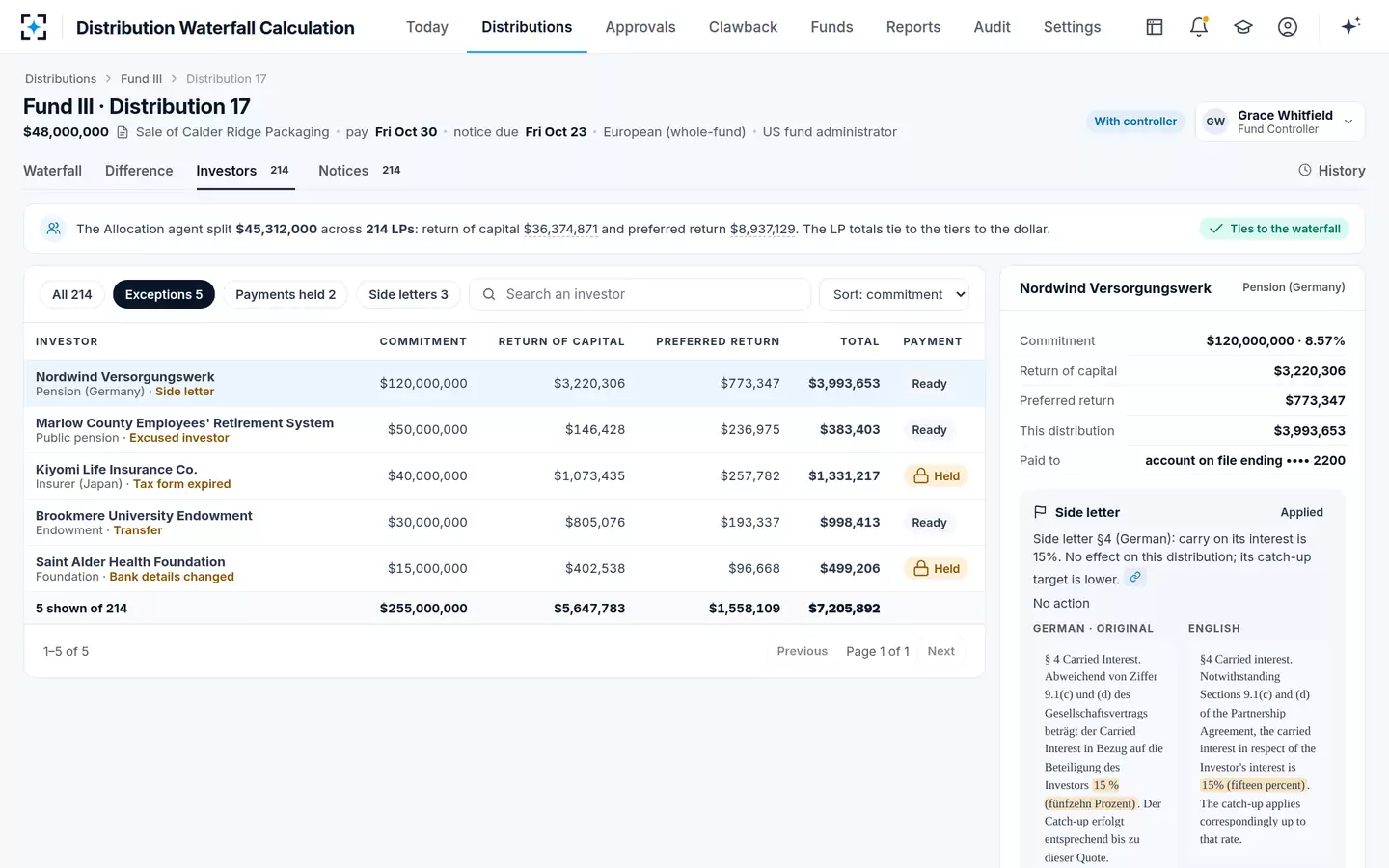
For an LP or consultant comparing fund terms, the calculator on this page is the right tool. For a GP that has to pay carry correctly on every distribution and show its LPs why, the waterfall has to be re-performed from the agreement each time. To see that on your own funds, start from Distribution Waterfall Calculation.
Questions people ask
Is there a free carried interest calculator online?
The calculator on this page is free and runs in your browser; nothing you enter is sent anywhere. It models a whole-fund waterfall with one call and one distribution, which is enough to compare terms. For a real fund, the calculation has to run contribution by contribution under the fund's own agreement.
Is carried interest calculated on gross or net profit?
On profit after the LPs' capital is returned, and in the typical buyout agreement that capital includes the management fees and fund expenses the LPs paid in. Robinson and Sensoy describe the most common scheme as returning all contributed capital, for investments and for management fees, plus a preferred return, before carry is earned.
Do all LPs in a fund pay the same carry?
Not always. Side letters can set a lower carry rate for particular LPs, and those LPs then have their own catch-up targets. In the sample data, one LP's side letter sets its carry at 15% while the fund's rate is 20%.
How is carried interest taxed?
That is a question for the GP's partners and their advisers, not the waterfall: in the United States, gains allocated as carry need a holding period of more than three years for long-term treatment under section 1061. The partnership reports the figures on its K-1s, and the guide to the carry holder's K-1 walks through Worksheet A line by line.
Does the catch-up make the preferred return meaningless?
No, but it changes what it protects. With a full catch-up, once the fund clears the hurdle the GP is caught up to 20% of all profit, so the preferred return delays carry rather than reducing it. It still matters whenever the fund returns less than the hurdle plus the catch-up: in the 2x example, at eight years the LP keeps exactly its 8% return.