Private equity fund distribution accounting is the work of turning distributable proceeds into amounts owed to each partner under the limited partnership agreement, and booking them: classifying the proceeds, running the waterfall's tiers against the partners' capital accounts, allocating the result to every LP with its exceptions, clearing holds on tax forms and bank details, and producing the payment file, the notices and the evidence. The arithmetic of the tiers is short. What takes the time is agreeing the inputs, because every balance in the fund's history is tested at once: a capital call booked to the wrong date three years ago is a preferred return error today. Many managers outsource the books to an administrator and re-perform its waterfall model by hand before anyone signs. Botminds' Distribution Waterfall Calculation runs each distribution independently from the agreement and the capital accounts, compares it with the administrator's model tier by tier, and explains every difference, so the fund finance team starts from a short list of decisions.
The statutes here are Delaware's and the IRS's, linked where they appear. The worked distribution comes from the solution's sample data for a fictional manager, Quillfield Capital, whose funds, investors and people are invented.
One sample $48 million distribution, tier by tier, as the independent run poured it
Return of capital
Unreturned contributions, fees and expenses as the LPA treats them
$36,374,871 under § 9.1(a)
Capital accounts
Preferred return
8% a year on contributions, unpaid pref compounding each 31 December
$8,937,129 under § 9.1(b)
Contribution dates and the LPA’s convention
GP catch-up
100% to the GP until it holds its carry share of cumulative profit
$2,688,000 under § 9.1(c)
The LPA and prior distributions
To the LPs in all
Return of capital + preferred return
$45,312,000; the GP’s $2,688,000 completes the $48,000,000
Allocated across 214 LPs
What does distribution accounting cover in a private equity fund?
Everything between "the fund has cash to distribute" and "each partner's capital account shows what it received." That is the amount and its character, the waterfall terms, each partner's contributions and prior distributions, the fees, expenses and offsets the agreement counts, the investor register with its transfers and excused investors, the tax and bank details for each payment, and the administrator's model if there is one. Delaware leaves the rules almost entirely to the contract: partners receive distributions "to the extent and at the times or upon the happening of the events specified in the partnership agreement" (6 Del. C. § 17-601).
The contract then becomes an obligation. "At the time a partner becomes entitled to receive a distribution, he or she has the status of, and is entitled to all remedies available to, a creditor of the limited partnership with respect to the distribution," and the agreement may set a record date for allocations and distributions (§ 17-606). Once a notice is out, the payment date is a commitment, not a target, which is why the checks belong before the notice.
The inputs, and where each one lives
A distribution cannot be checked until every input is in hand and agrees with the others. The order matters: the terms and the capital accounts come before the administrator's model, so that the model is checked against the agreement rather than the other way round.
The inputs a distribution needs, and what goes wrong with each
| Input | Where it lives | What goes wrong with it |
|---|---|---|
| The amount and its source | The GP’s distribution memo, the sale agreement, the bank | Escrows and holdbacks on the sale; proceeds that are partly income, partly return of cost |
| The waterfall terms | The LPA, its amendments and side letters | An amendment that changed a tier; a side letter with a different carry rate |
| Contributions and distributions to date | The capital accounts in the fund accounting platform | A call booked at its due date instead of its receipt date; a recallable distribution not marked as such |
| Fees, expenses and offsets | The general ledger and the fee calculation | An offset applied after the waterfall instead of before |
| The investor register | Commitments, transfers, excused investors | A mid-life transfer; an LP excused from the investment being sold |
| Tax forms and bank details | Investor services | An expired withholding certificate; changed bank instructions |
| The administrator’s model | A spreadsheet received by file drop | Formulas that encode a convention the agreement did not choose |
Starting from the spreadsheet produces the wrong kind of check. A model can be perfectly consistent with itself and with the wrong convention, and a reviewer who reads it cell by cell ends up confirming the convention. An independent answer built from the agreement and the capital accounts is the only thing that can disagree with it.
How do you check a distribution waterfall against the administrator's model?
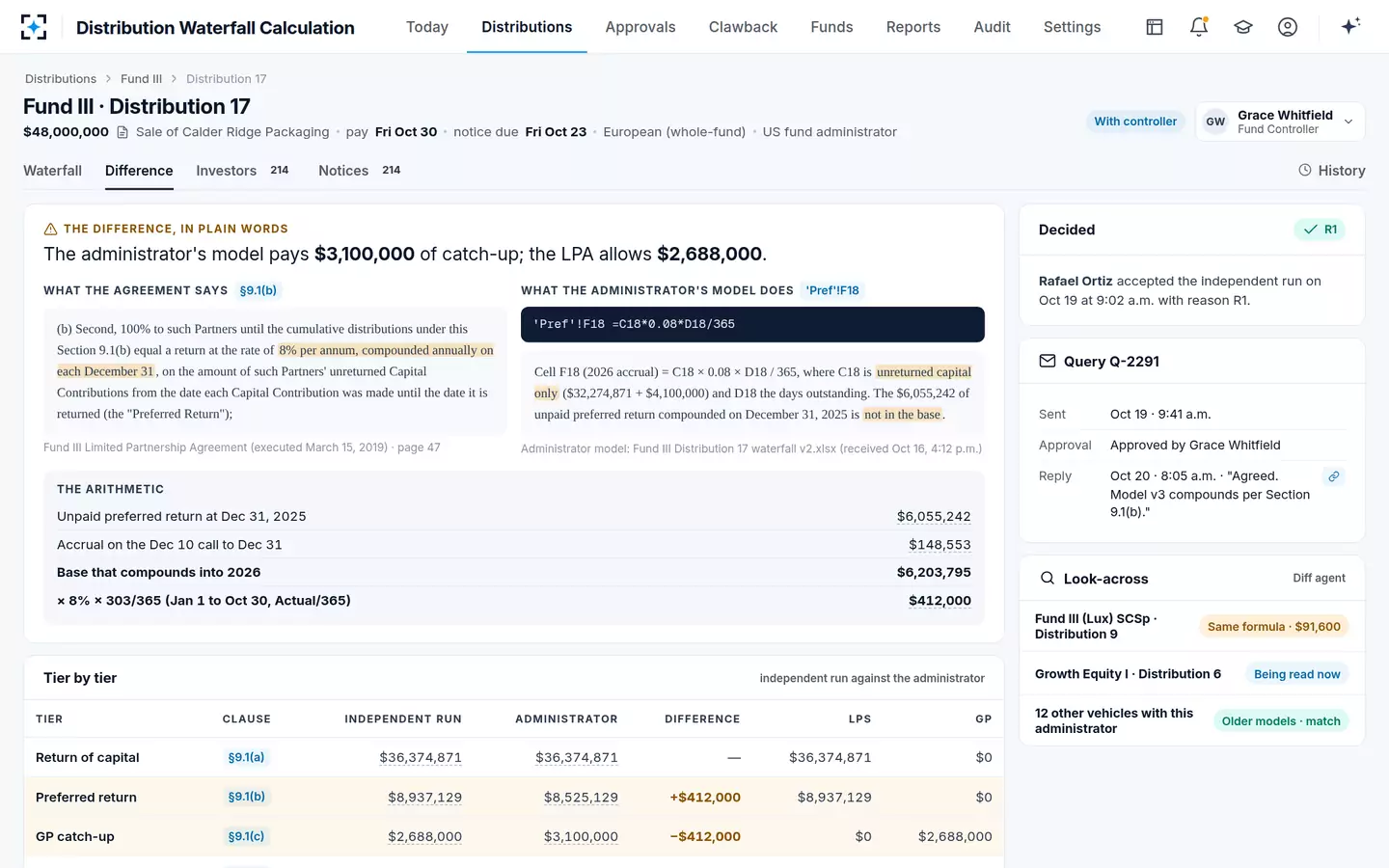
Run it independently and compare tier by tier, not just the total. Offsetting errors in two tiers can leave the total right and the GP overpaid, and the total is all most sign-off emails show. Each difference then needs three things: the cell that causes it, the clause that decides which side is right, and a query the administrator can answer the same day.
One distribution, two models, two tiers apart
Administrator's model: $36,374,871
Independent run from the LPA: $36,374,871: agrees
Administrator's model: $412,000 lower: simple accrual on capital only, ’Pref’!F18 = C18*0.08*D18/365
Independent run from the LPA: $8,937,129: unpaid pref compounds each 31 December, § 9.1(b)
Administrator's model: $3,100,000
Independent run from the LPA: $2,688,000, as § 9.1(c) allows
Administrator's model: $48,000,000
Independent run from the LPA: $48,000,000: the totals match, the split does not
Most differences are conventions, not arithmetic: whether unpaid preferred return compounds, whether fees count as capital, from which date each contribution earns its return. Each is a sentence in the agreement and an assumption in the model. Preferred return calculation, compounded annually shows six conventions landing $4.6 million apart on one set of cash flows.
The clause beside the formula, with the arithmetic and the query
Allocating to every LP: excused investors, transfers, side letters
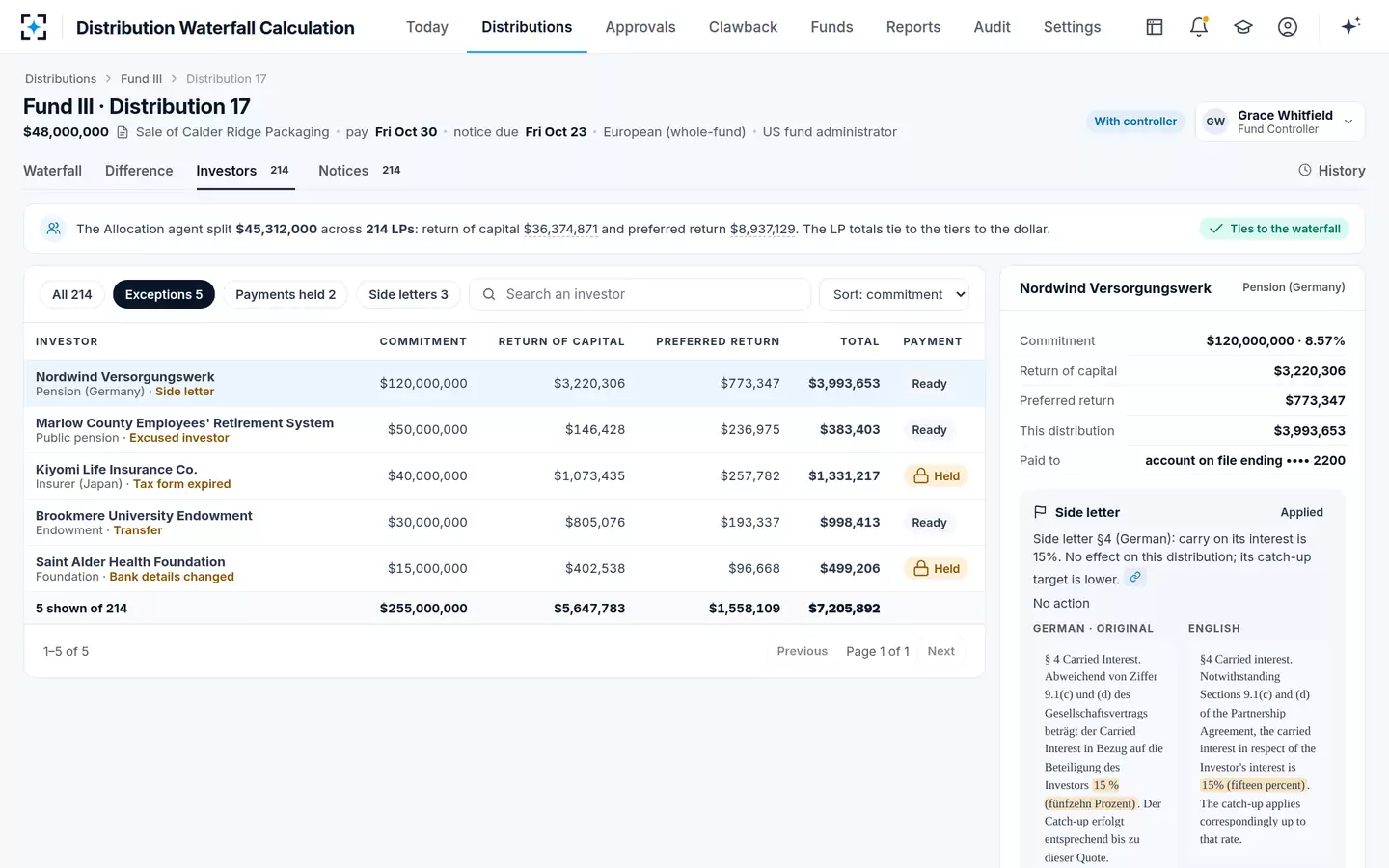
The fund-level tiers then have to be split across every partner, and the exceptions live here. An LP excused from the investment being sold takes no share of its proceeds. A transferee steps into a seller's capital account from the transfer date. A side letter can set a different carry rate for one LP; in the sample, a German pension LP's side letter set its carry at 15%. Every LP's total has to tie back to the tiers to the dollar after rounding, with the rounding rule written down.
The tie-out is the control that catches allocation errors. In the sample distribution, the allocation across 214 LPs tied to the tiers to the dollar, with five exceptions shown on the screen beside the totals. The tier-by-tier waterfall calculation example works the fund-level arithmetic in full.
214 LPs, five exceptions, two payments held
Holds before payment: tax forms and bank details
Two exceptions stop a payment rather than change it. A foreign LP's withholding certificate has a shelf life: the IRS instructions for Form W-8BEN-E say the form generally remains valid until the end of the third calendar year after the year it is signed, unless a change in circumstances makes information on it incorrect (IRS, Instructions for Form W-8BEN-E). A distribution paid on an expired form is paid without the documentation the withholding depends on.
Bank instructions changed shortly before a payment are the other hold. The control is a call to a contact already on file, recorded before any money moves, never a reply to the message that changed them. In the sample distribution, two of 214 payments were held: one for a lapsed tax form and one for bank details changed through the investor portal. The other 212 went out on time.
When may a fund not distribute? The Delaware limits
A Delaware limited partnership may not make a distribution that leaves it unable to cover its outside liabilities. The statute says a partnership "shall not make a distribution to a partner to the extent that at the time of the distribution, after giving effect to the distribution, all liabilities of the limited partnership, other than liabilities to partners on account of their partnership interests and liabilities for which the recourse of creditors is limited to specified property ... exceed the fair value of the assets of the limited partnership" (6 Del. C. § 17-607(a)).
The consequences fall on the recipients, with a time limit. A limited partner who received a distribution in violation of that test, knowing it did, is liable to the partnership for it; one who did not know is not. And "unless otherwise agreed, a limited partner who receives a distribution ... shall have no liability under this chapter or other applicable law for the amount of the distribution after the expiration of 3 years from the date of the distribution" (§ 17-607(b)–(c)). For a fund nearing the end of its life, with guarantees, indemnities or tax liabilities outstanding, the solvency test belongs in the distribution file. The clawback provision covers the GP-side return of overpaid carry, which is a separate obligation.
Who approves a private equity distribution?
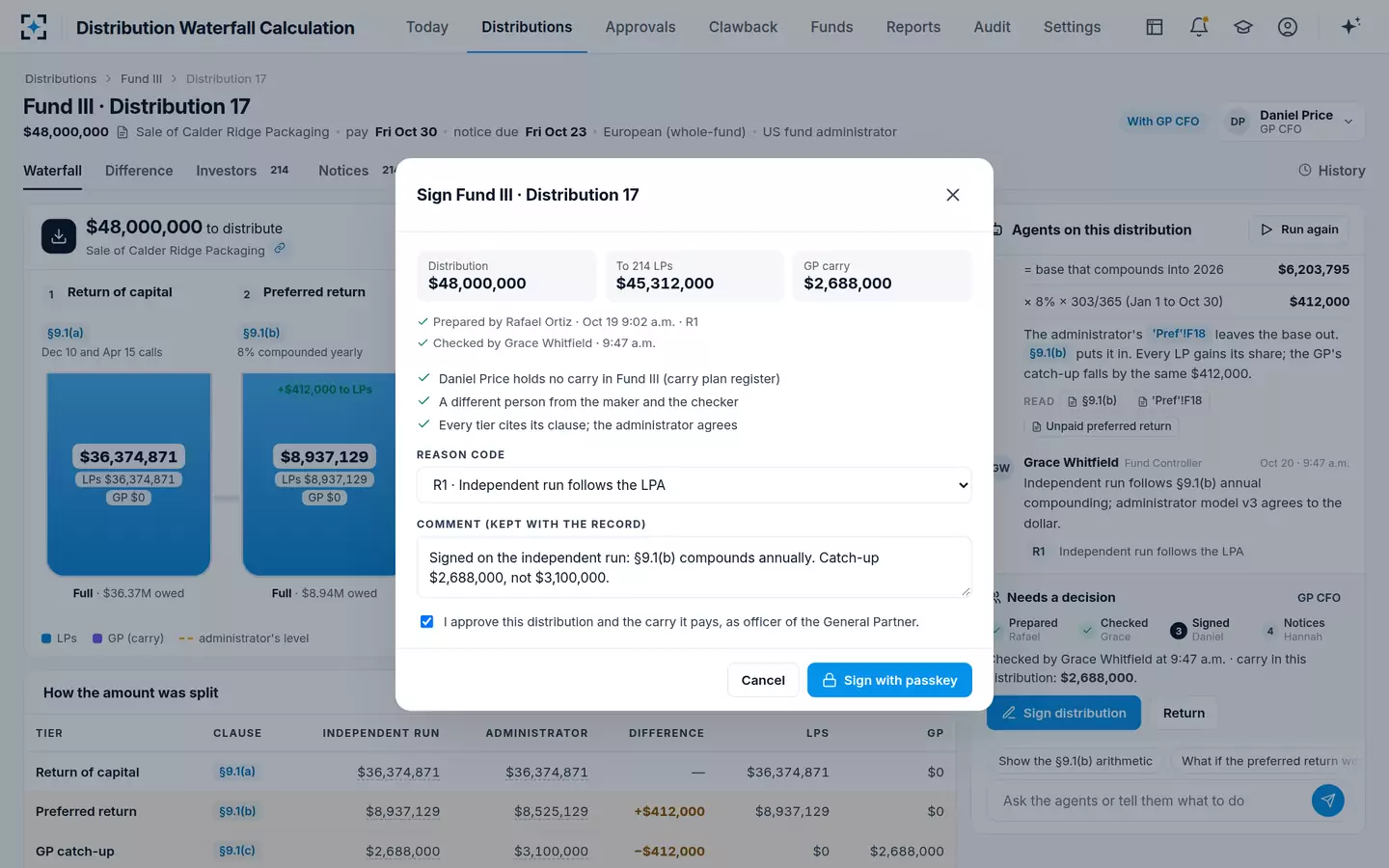
The general partner approves it under the agreement; inside the manager, the approval is split between a preparer, a checker and a signer, with anyone who holds carry in the fund kept out of all three seats for that fund. In the sample manager, the fund finance manager decides each difference with a reason code, the controller checks the distribution, and the GP CFO signs, with the screen confirming that neither the checker nor the signer prepared it or holds carry in the fund.
One distribution, from independent run to released notices
Agent
Run and compareRuns the waterfall from the approved term table and the capital accounts, reads every formula in the administrator’s model and compares tier by tier.
Never: Never edits the administrator’s model or the books
A person decides
Decide each differenceThe fund finance manager accepts one side with a reason code; any query to the administrator needs the controller’s approval to send.
A person decides
CheckThe controller checks the amounts to LPs and GP; the check confirms the controller did not prepare it and holds no carry in the fund.
A person decides
SignThe GP CFO signs, seeing who prepared and who checked and the carry conflict check.
A person decides
ReleaseInvestor relations releases the signed notices; held payments stay held with their notices.
Who prepared, who checked, the carry check and the signature
Notices, the payment file and the evidence
The outputs are one notice per LP with its tier breakdown, payment date and account ending; a payment file for treasury with held payments left out; and the evidence someone can open next year to see why each number is what it is. In the sample, 212 notices were released to the investor portal after the GP CFO signed, with courtesy translations where an LP had asked for one, stating that the English version governs.
The evidence is what examiners and auditors ask for. SEC examination staff reported in 2020 that some private fund advisers had overcharged carried interest, including on holdings valued outside the adviser's own disclosed process (OCIE risk alert, 23 June 2020, staff observations). The question asked about a distribution two years later is which clause, which balance and which decision produced each figure, and a file that answers it protects the fund finance team as much as the fund.
How long the checks take, and where the time goes
No regulator or independent study publishes how long a distribution takes to check, so the figures below are Botminds' estimates, to be measured on a manager's own distributions. For a simple whole-fund distribution checked by hand, from the administrator's model to signed notices, the estimate is about 4.5 working days of effort across the team; with the solution, about 1.6, most of it in the decisions that stay with people. In the sample manager's third quarter, the median time from administrator model to signature was 1.6 days across 76 distributions.
Where a distribution's working days go, by hand and with the solution (estimate)
- Find the terms0.5 d
- Re-perform the model1 d
- Trace and agree a gap1 d
- Allocate to LPs0.5 d
- Check and sign1 d
- Notices and file0.5 d
- Terms, re-run, allocation and notices0.4 d
- Trace and agree a gap0.6 d
- Check and sign0.6 d
To measure your own, take the last four distributions, note when the administrator's model arrived and when the signature was given, and log hours by the six steps above. The useful number is the share spent finding and agreeing inputs, because that is the share an independent re-run removes.
Eight checks before a private equity distribution is paid
- Read the waterfall terms before opening the model
Including amendments and side letters with economics.
- Tie unreturned capital to the capital accounts
Every call and return of capital, with fees and expenses as the agreement treats them.
- Rebuild the preferred return from contribution dates
With the agreement’s compounding and day count.
- Compare tier by tier, not just the total
Offsetting errors can leave the total right and the GP overpaid.
- Tie every LP’s total to the tiers after rounding
With excused investors, transfers and side-letter rates applied.
- Clear tax-form and bank-detail holds
Expired W-8 forms; changed bank details confirmed by call-back on file.
- Run the solvency test where liabilities remain
Delaware bars a distribution that leaves outside liabilities above asset value.
- Keep preparer, checker and signer separate
And out of the chain for any fund in which they hold carry.
Where Distribution Waterfall Calculation fits
The solution is an independent check, not a replacement for the administrator or the books. Its agents read the agreement, amendments and side letters into a term table that a person approves, run each distribution from that table and the capital accounts, read every formula in the administrator's model and compare tier by tier, allocate to LPs and draft the notices. In the sample manager, the controller's view showed 23 open distributions worth $478.6 million and 5 differences to decide, worth $1.78 million between the independent runs and the administrator models.
It never moves money, edits the administrator's model or the books, signs or releases notices. Waterfall calculation software against the spreadsheet and the administrator compares the three ways a manager can run this check.
Questions people ask
What is the difference between return of capital and a gain distribution?
Return of capital gives partners back their unreturned contributions, the first tier of a typical waterfall; amounts above it are profit, split through the preferred return, catch-up and carry tiers. How the agreement counts fees and expenses as capital changes where the line falls.
Can a Delaware fund make a distribution while it has liabilities?
Only to the extent that, after the distribution, its outside liabilities do not exceed the fair value of its assets, excluding liabilities to partners and certain non-recourse debt. A limited partner who knowingly received a violating distribution is liable for it, generally for three years.
When does a limited partner become a creditor for a distribution?
Under Delaware's statute, at the time the partner becomes entitled to receive it, unless the agreement says otherwise. From then the partner has the status and remedies of a creditor for that amount, and the agreement may set a record date.
Why hold a distribution for an expired W-8BEN-E?
Because the form documents the foreign LP's status for withholding, and the IRS instructions say it generally stays valid only until the end of the third calendar year after signing, or until a change in circumstances makes it incorrect. A payment on an expired form lacks that documentation.
Who should sign off a private equity distribution?
A signer who neither prepared nor checked it, typically the GP's CFO, after a checker such as the fund controller; and no one who holds carry in the fund should prepare, check or sign that fund's distribution. Any query to the administrator should be approved before it is sent.
Should the waterfall be checked against the total or tier by tier?
Tier by tier. In the sample distribution the administrator's total matched the independent run at $48,000,000, while $412,000 had moved from the LPs' preferred return to the GP's catch-up because unpaid preferred return was not compounded.