Partnership tax basis capital account reporting is the rule that every partner's capital on Schedule K-1, Item L, be figured on the tax-basis method by the transactional approach: last year's ending tax capital, plus cash and the adjusted tax basis of property contributed, plus the partner's share of income less deductions as figured for tax, plus or minus other adjustments explained in a statement, less cash and the tax basis of property distributed. The result may be negative, it will usually differ from the capital a fund reports to investors at fair value, and it is not the partner's tax basis in the interest, because it leaves out the partner's share of liabilities. For a fund with hundreds of partners, transfers and multiple closings, that is hundreds of roll-forwards that must each tie to the next year's opening balance and in total to Schedule M-2. Botminds' K-1 Preparation builds them as one row per partner, from beginning capital, contributions and transfers to ending capital, and ties every row to the fund return and the administrator's statements before anything is released.
The rules quoted are from the IRS's 2025 Instructions for Form 1065, Item L and Schedule M-2. The partner examples are fictional sample data from the solution.
One sample partner's Item L, line by line
Beginning capital account
Last year's ending tax-basis capital, as reported
24,381,338
Capital contributed during the year
Three capital calls in cash
+ 1,532,370
Current year net income (loss)
Ordinary and interest 152,555 + dividends 347,271 + capital gains 2,461,069 − deductions and foreign tax 430,064
+ 2,530,831
Other increase (decrease)
None this year; a transfer, 734(b) adjustment or depletion would go here, with a statement
0
Withdrawals and distributions
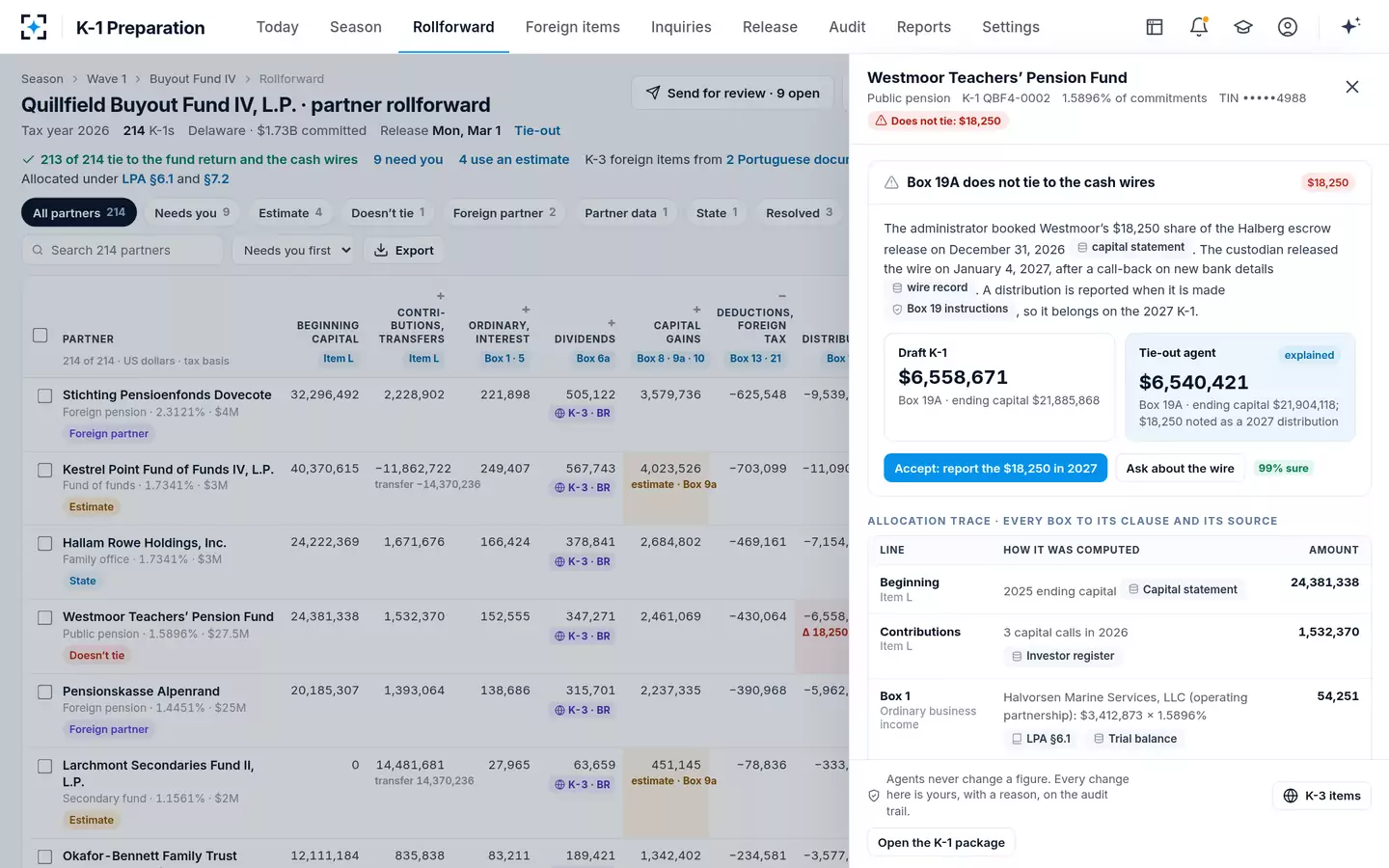
Cash actually paid in 2026: the draft 6,558,671 less the 18,250 wired on January 4, 2027
− 6,540,421
Ending capital account
The sum of the lines above
21,904,118
What is a tax basis capital account?
It is the partner's equity in the partnership measured with tax numbers rather than book or fair values. The Form 1065 instructions set the method in one line, "Tax-basis method. Figure each partner's capital account for the partnership's tax year using the transactional approach", and then define each line of the roll-forward. Where a transaction does not fit a line, the partnership should account for it "in a manner generally consistent with figuring the partner's adjusted tax basis in its partnership interest (without regard to partnership liabilities)", following sections 705, 722, 733 and 742, and report it as an other increase or decrease (IRS, 2025).
The transactional approach means building the balance from events, year after year, rather than deriving it from a balance sheet at the end. Beginning capital is "the partner's ending capital account as determined for last year", and zero for a partner who joined by contribution this year. Contributions are "cash plus the adjusted tax basis of all property contributed", reduced by liabilities the partnership assumed. Current year net income is the share of income and gain "(including tax-exempt income)" less the share of loss and deductions "(including nondeductible, noncapital expenditures)", all "as figured for tax purposes". Distributions are "cash plus the adjusted tax basis of all property distributed". The lines must add up to the ending balance.
How do you roll forward tax capital, partner by partner?
Start from the prior year's ending balance as reported, never from a recomputation, then post the year's events in the order the instructions list them. In the sample, the pension fund's three capital calls, its share of each K-1 income box and its distributions roll its capital from $24,381,338 to $21,904,118, and the arithmetic ties: $24,381,338 + $1,532,370 + $2,530,831 − $6,540,421.
The interesting line is the distribution, because it shows why "transactional" matters. The administrator booked an $18,250 share of an escrow release on December 31, but the custodian released the wire on January 4 after a call-back on new bank details. A distribution is reported when it is made, so the K-1 shows $6,540,421, the $18,250 moves to the 2027 K-1, and ending tax capital is $18,250 higher than the administrator's statement. That difference is not an error to be plugged; it is a timing item to be explained, and next year's beginning balance must carry the same figure.
A row that does not tie, explained instead of plugged
Partnership capital account vs basis: four numbers that share a name
Item L tax capital is one of four capital measures a fund keeps for each partner, and confusing them is the most common source of limited partner questions about Item L. The instructions say directly that the Item L ending balance "might not equal the partner's adjusted tax basis in its partnership interest", generally because outside basis "includes the partner's share of partnership liabilities, as well as partner-specific adjustments", and that "each partner is responsible for maintaining a record of the adjusted tax basis in its partnership interest".
Partnership capital account vs basis: what each measure counts
| Measure | What it reflects | Where it appears | Who keeps it |
|---|---|---|---|
| Item L tax-basis capital | Tax basis of contributions, tax income and loss, tax basis of distributions; no liabilities; no 743(b) adjustments | Schedule K-1, Item L; in total, Schedule M-2 | The partnership |
| Outside tax basis | Tax capital plus the partner's share of partnership liabilities, plus partner-specific adjustments such as a 743(b) step-up | The partner's own workpapers; limits deductible losses | The partner |
| Section 704(b) capital | Contributions and distributions at fair value, book income under the partnership agreement | The partnership's books; drives economic allocations | The partnership |
| Investor statement capital (GAAP) | Fair value net asset value allocated under the fund agreement | Quarterly and annual capital statements to investors | The fund's accountants and administrator |
For a fund, the gap between the last two rows and the first is usually large and grows with time: fair value changes enter investor capital every quarter but enter tax capital only when gains are realised. A limited partner who compares the K-1 with the year-end capital statement will find different numbers in every year the fund holds appreciated positions. A short note with the K-1 that names the measure on each document saves a round of inquiries.
Can a tax basis capital account be negative?
Yes. "A partner's ending capital account determined under the tax-basis method may be negative if the sum of a partner's losses and distributions exceeds the sum of the partner's contributions and share of income" (IRS, 2025). In a fund that can happen when distributions are funded by borrowing, or when a partner has received a large share of losses or deductions; the partner's outside basis can still be positive because it includes its share of the liabilities.
A negative balance has a knock-on effect elsewhere on the K-1. Item J asks for the partner's share of capital as a percentage, and "if the partner's capital account is negative or zero, express the percentage ownership of capital as zero". A K-1 that shows negative Item L capital and a positive Item J capital percentage is inconsistent and will be questioned.
"Note: Section 743(b) basis adjustments aren't taken into account in calculating a partner's capital account under the tax-basis method."
IRS, Instructions for Form 1065 (2025), Item L
Transfers: the buyer starts where the seller stopped
When an interest is sold, exchanged, gifted or inherited, Item L carries the seller's tax capital to the buyer, not the price the buyer paid. The transferee enters, as an other increase, an amount "equal to the transferor partner's ending capital account with respect to the interest transferred immediately before the transfer figured using the tax-basis method", and the transferor enters the same amount as a decrease. Publicly traded partnerships have a narrower option to use the purchase price; private funds do not.
One sample transfer, seen from both sides of Item L
The section 743(b) adjustment that a buyer of an interest gets when the partnership has a section 754 election in effect stays out of Item L, as the note above says. It belongs in the buyer's outside basis and is reported to the buyer separately. A section 734(b) adjustment to the partnership's own property after a distribution is different: the partner's share of it goes into Item L as an other increase or decrease. Getting those two the right way round is a recurring review point when a fund with a 754 election has secondary transfers. Which allocation method governed the transfer, and how it moves income between the two sides, is the subject of interim closing method vs proration method.
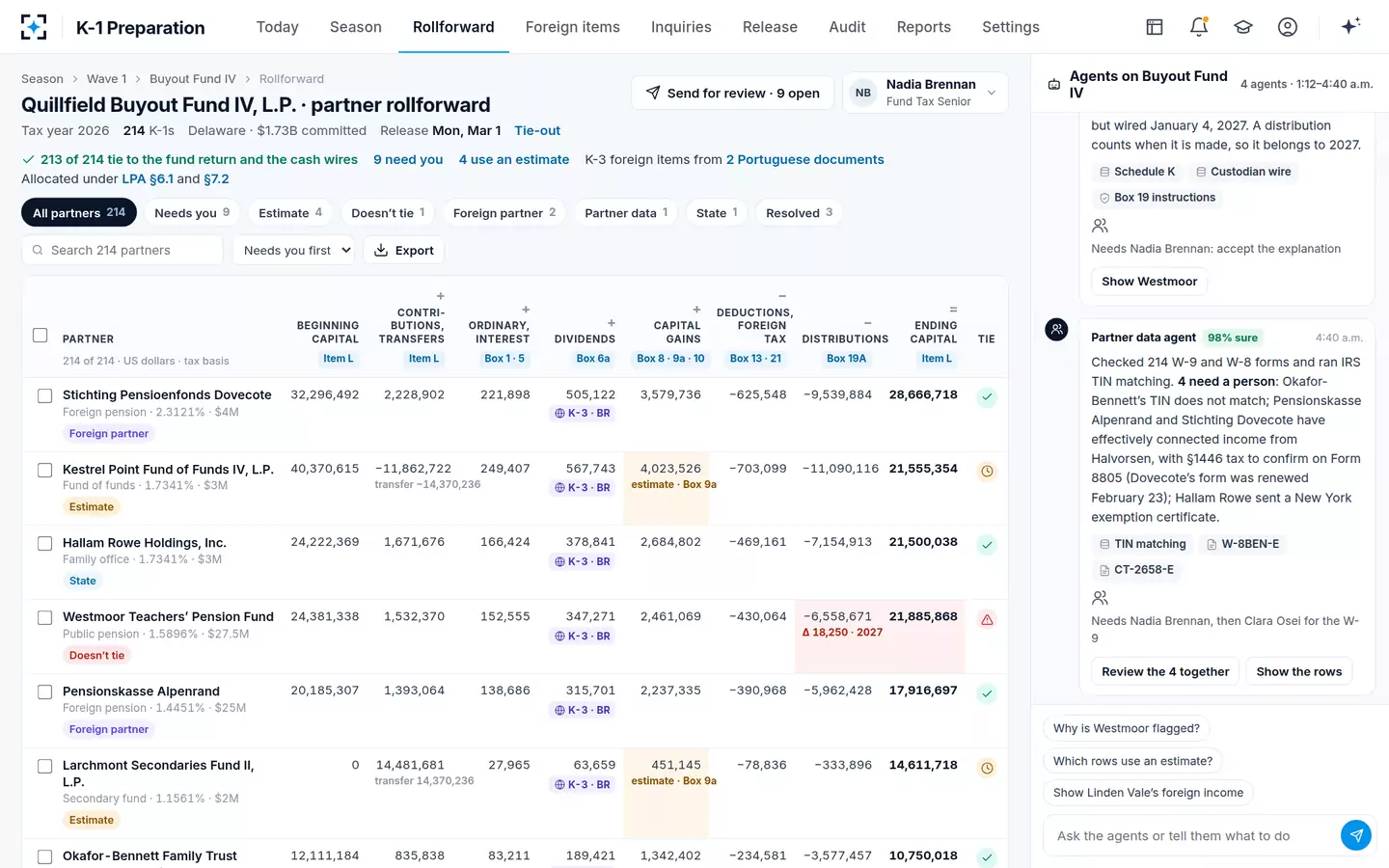
214 partners, one row each, every column a K-1 box
704(c) allocation methods and Item N: contributed and revalued property
Section 704(c) makes the partnership allocate tax items on contributed property "so as to take into account any variation between the adjusted tax basis of the property and its fair market value at the time of contribution", using "a reasonable method that is consistent with the purpose of section 704(c)" (26 CFR 1.704-3). The regulation describes three: the traditional method, the traditional method with curative allocations, and the remedial allocation method, applied property by property. Whichever the fund uses, the tax income on the K-1, and therefore Item L, follows it.
The K-1 also discloses the exposure. Item M asks whether the partner contributed property with a built-in gain or loss during the year. Item N reports the partner's share of "net unrecognized section 704(c) gains or losses", at the beginning and end of the year, "including section 704(c) gain or loss arising from revaluations of partnership property". For a fund that revalues its books at each later closing, Item N is where the gap between book and tax capital is made visible to each partner.
Reporting tax basis capital account on the K-1: the checks before release
Item L is checked in two directions: down, to each partner's own history, and across, to the partnership's totals. The instructions tie the sum to Schedule M-2, which must "show what caused changes during the tax year in the partners' tax-basis capital accounts", and remind preparers that because "section 743(b) basis adjustments and income from guaranteed payments aren't included in the partners' tax-basis capital accounts, certain adjustments may be necessary".
Item L tests, one partner and one fund at a time
- Beginning balance equals last year's reported ending balance
For every continuing partner, to the dollar; zero for a partner admitted by contribution.
- Each transfer appears twice, in equal and opposite amounts
The seller's decrease equals the buyer's increase, at the seller's tax capital immediately before the transfer.
- Distributions are dated by payment, not by booking
A year-end accrual wired in January belongs to next year's K-1.
- No 743(b) adjustments inside Item L
They belong to the buyer's outside basis and are reported separately.
- Negative capital pairs with a zero capital percentage in Item J
The instructions require it.
- The sum of all partners equals Schedule M-2
Line by line: beginning, contributions, net income, other increases, distributions, ending.
- Each other increase or decrease has its statement
The instructions require an attached explanation of each adjustment.
Errors here travel. A wrong ending balance this year is next year's wrong beginning balance, and for a partnership under the centralized audit regime, a K-1 that has gone out cannot simply be reissued after the due date. That is the case for testing the roll-forward on last year's filed K-1s before relying on any new process, which administrative adjustment request vs amended return sets out as a method.
Where K-1 Preparation does the roll-forward, and where people decide
In K-1 Preparation, the Books agent pulls the administrator's capital statements and investor register and rejects a file with a missing partner ID; it never matches partners by name. The Allocation agent fills each partner's row, with every column labelled by the K-1 box or Item L line it fills. The Tie-out agent then recomputes every K-1 independently of the Allocation agent and ties Item L to the administrator's capital statement within a tolerance the tax team sets ($1 in the sample), and the cash distributions to the custodian's wires.
When a row does not tie, the agent explains the cause from the documents, as it did for the $18,250 wire, and a person accepts or returns it. The agents never add a balancing entry. A tie-out that can only be achieved by a plug is a roll-forward somebody does not yet understand, and that is a question for the tax senior, not a line for software to fill. The product is at K-1 Preparation.
Questions people ask
Is a partner's capital account the same as their basis?
No. The Item L tax capital account excludes the partner's share of partnership liabilities and partner-specific adjustments such as a section 743(b) step-up; outside basis includes them. The IRS instructions say the two "might not" be equal and that each partner keeps its own basis record.
What goes in "other increase (decrease)" on Item L?
Anything that changed tax capital and is not a contribution, income or distribution, each with an attached explanation. The instructions give examples: the capital carried to a buyer of an interest (and away from the seller), a partner's share of a section 734(b) adjustment, and certain depletion items.
How is a new partner's beginning capital reported?
A partner admitted by contribution during the year shows zero beginning capital and the contribution on the contributions line. A partner who bought an existing interest shows the transferred tax capital as an other increase, equal to the seller's tax capital in that interest immediately before the transfer.
Does every partnership have to complete Item L?
No. A partnership that answers "Yes" to Schedule B, question 4, meaning total receipts under $250,000, total assets under $1 million, K-1s furnished on time and no Schedule M-3, need not complete Item L or Schedules L, M-1 and M-2. No investment fund of size meets those limits.
Why does my K-1 capital differ from my fund's capital statement?
Because they measure different things. The capital statement reports fair value under the fund agreement; Item L reports tax-basis capital, which changes only when income is realised for tax and when cash or property moves. In years when a fund holds appreciated investments, the statement is usually higher.