The failure to furnish K-1 penalty is $340 for each Schedule K-1, and Schedule K-3 where one is required, that a partnership furnishes late, leaves information off or gets wrong, under section 6722 of the Internal Revenue Code. For statements furnished in 2026 the annual cap is $4,098,500 for an entity with gross receipts over $5 million and $1,366,000 for smaller ones; intentional disregard raises each penalty to $680 or 10% of the amounts that should have been reported, with no cap. A Form 1065 filed late, or filed without the required information, carries a separate penalty of $255 per partner for each month or part of a month, for up to 12 months. Both are counted per partner, which is why a large fund's K-1 calendar is a finance decision as much as a tax one. Botminds' K-1 Preparation is built to move that calendar: agents prepare and tie every partner's K-1 to the fund return, so the tax team reviews exceptions instead of rebuilding allocations, and a partner releases each wave.
The amounts are from the IRS's 2025 Instructions for Form 1065 and the inflation adjustments in Rev. Proc. 2024-40 and Rev. Proc. 2025-32. The fund figures are illustrative arithmetic on a fictional sample fund.
Two meters, both counted per partner
$340
per K-1 (and K-3) furnished late, incomplete or wrong in 2026
$255
per partner, per month or part of a month, for a late or incomplete Form 1065 due in 2026
12months
the most the late-return penalty can run
$4.1M
annual cap on the K-1 penalty for entities with receipts over $5 million ($4,098,500)
How is the failure to furnish K-1 penalty calculated?
Per statement, not per partnership. A Schedule K-1 is a "payee statement" in the Code's sense: section 6724(d)(2) defines the term to include any statement required under "section 6031(b) or (c)", the provision that makes a partnership furnish each partner's share (26 U.S.C. 6724). Section 6722 then imposes a penalty for two kinds of failure: not furnishing the statement on time, and "any failure to include all of the information required to be shown on a payee statement or the inclusion of incorrect information" (26 U.S.C. 6722). The statute's base figures, $250 per statement and a $3,000,000 cap, are indexed for inflation each year.
The IRS's instructions put the current numbers in one paragraph: "a $340 penalty may be imposed for each Schedule K-1 (and Schedule K-3, if applicable) for which a failure occurs", with a calendar-year maximum of $4,098,500 for entities with gross receipts over $5,000,000 and $1,366,000 for the rest (IRS, 2025). A wrong K-1 is priced exactly like a late one. So is a K-1 that leaves out the K-3 a partner needed.
The deadline the penalty measures against is the return's due date, extensions included. The regulation says the statement "shall be furnished on or before the day on which the partnership return for that taxable year is required to be filed (determined with regard to extensions)", and points to section 6722 for the penalty (26 CFR 1.6031(b)-1T).
What is the Form 1065 late filing penalty?
It is a monthly charge for every person who was a partner at any time in the year. "The penalty is $255 for each month or part of a month (for a maximum of 12 months) the failure continues, multiplied by the total number of persons who were partners in the partnership during any part of the partnership's tax year" (IRS, 2025). It is section 6698, and it applies equally to a return filed on time that "fails to show the information required" (26 U.S.C. 6698).
Two features make it heavier for funds than for operating partnerships. Partners who left during the year still count. And "part of a month" counts as a month, so a return one day late costs the same as one 30 days late. The statute's exit is reasonable cause; the IRS's administrative relief for first-time filers is covered further down.
One sample fund, priced: what a late month and a late K-1 set would cost
Late Form 1065, one month
214 partners × $255
$54,570
Late Form 1065, three months
214 × $255 × 3
$163,710
Late Form 1065, the 12-month maximum
214 × $255 × 12
$654,840
Every K-1 furnished late, not corrected by August 1
214 statements × $340
$72,760
Every K-1 late but corrected within 30 days
214 × $60
$12,840
The arithmetic shows where a CFO's attention belongs. One month late on the return costs this fund more than furnishing every K-1 late. A season of 6,012 K-1s, the size of the whole fictional sample manager's three waves, would cost $2,044,080 if every one went out late and stayed uncorrected past August 1. The annual cap applies to each partnership separately and only bites above about 12,054 statements in one partnership's year ($4,098,500 ÷ $340), so for most funds it is not a ceiling they will reach; it is a number they will not see.
Form 1065 due date with extension: when the K-1 meter starts
For a calendar-year partnership, Form 1065 and every K-1 are due March 15; Form 7004 moves both by six months. The instructions: "For calendar-year partnerships, the due date is March 15", and when that falls on a weekend the next business day counts, so "calendar-year partnerships may therefore timely file their returns for the 2025 partnership year by March 16, 2026" (IRS, 2025). Form 7004 must be filed "by the regular due date", and the automatic extension "is generally 6 months" (IRS, Instructions for Form 7004).
The 2026 tax year, seen from the penalty's side
- Books close, K-1s preparedJan 1 – Mar 15
- 30 days: $60to Apr 14
- To August 1: $130to Aug 1
- After August 1: $340Aug – Sep
- Books close, lower-tier K-1s arrive, K-1s preparedJan 1 – Sep 15
- 30 days: $60to Oct 15
- $340later
An extension moves the deadline, not the work. A fund that extends still owes its partners the same K-1s, and most limited partners need them to file their own returns. The extension also removes one of the cheaper correction windows: the August 1 reduction only helps a statement due earlier in the same calendar year. Both calendars keep the 30-day window at $60, but a fund that furnishes in March and corrects in June pays $130 a statement, while one that furnishes in September and corrects in November pays $340.
Is a corrected K-1 a second penalty?
No: a correction reduces the penalty on the failure already made, it does not add one. Section 6722(b) cuts the base penalty when the failure is corrected within 30 days of the due date, and again when it is corrected by August 1 (26 U.S.C. 6722). Rev. Proc. 2024-40 sets the 2026 figures at $60 and $130 a statement, with caps of $683,000 and $2,049,000 for larger entities (IRS).
What one wrong K-1 costs, by when it is put right
Most investment funds face a harder constraint than the penalty. For a partnership under the centralized audit regime, section 6031(b) says the information furnished to partners "may not be amended after the due date of the return", with narrow exceptions. Once the extended due date passes, a mistake in a BBA partnership's K-1 is corrected with an administrative adjustment request rather than a reissued K-1. How that works, and how to find the mistakes before the due date, is in administrative adjustment request vs amended return.
Form 1065 late filing penalty abatement: reasonable cause, and the new automatic relief
Both penalties can be lifted for reasonable cause: section 6698 applies "unless it is shown that such failure is due to reasonable cause", and section 6724(a) waives the K-1 penalty if the failure "is due to reasonable cause and not to willful neglect". The Form 1065 instructions add that a partnership receiving a penalty notice "may send the IRS an explanation", and should not attach one to the return.
The IRS's administrative relief changed in 2026. First Time Abate, which removed a late-filing penalty for a taxpayer with three years of timely compliance, "is transitioning to a new relief called Automatic Exemption from Penalty (AEP), starting Summer 2026". Under AEP, a late return from a filer with a clean three-year history is simply not assessed; Form 1065 is among the eligible returns from "2025 tax year returns, and subsequent", and the eligible penalties include "Partnership returns – IRC 6698(a)(1)" (IRS, penalty relief page, updated October 22, 2026).
The list of eligible penalties does not include section 6722. Automatic relief can remove the per-partner-month charge for a first late return; it does nothing for K-1s furnished late or wrong. For those, the routes are correction inside the reduced-rate windows and a reasonable-cause case built on evidence of what happened and when.
What changes for K-1s furnished in 2027
The per-statement penalty stays at $340 and the cap rises. Rev. Proc. 2025-32 sets the amounts for statements "required to be furnished in 2027", which covers K-1s for the 2026 tax year, and raises the section 6698 figure for returns due in 2027 to $260 (IRS).
Penalty amounts by the year the K-1 or return is due
| Penalty | Due in 2026 (tax year 2025) | Due in 2027 (tax year 2026) |
|---|---|---|
| Late or incomplete Form 1065, per partner per month (section 6698) | $255 | $260 |
| K-1 late, incomplete or wrong, per statement (section 6722) | $340 | $340 |
| Annual cap, gross receipts over $5 million | $4,098,500 | $4,191,500 |
| Corrected within 30 days, per statement / cap | $60 / $683,000 | $60 / $698,500 |
| Corrected by August 1, per statement / cap | $130 / $2,049,000 | $130 / $2,095,500 |
A 214-partner fund that files its 2026 return one month late therefore pays $55,640 rather than $54,570. The change is small; the structure is what matters. Every number on this page scales with the partner count.
Why the per-partner meter turns delay into a fund-size problem
The late-return penalty for one month is the partner count times $255, so the same day's delay costs a 1,000-partner feeder fund a hundred times what it costs a ten-partner club deal. Larger partnerships are also held to the electronic channel: the 2025 instructions say "partnerships with more than 100 partners are required to file Form 1065, Schedules K-1, and other related forms and schedules electronically", and that since 2024 any partnership filing 10 or more returns of any type in the year must e-file.
One month late on Form 1065, by number of partners
The K-1 side scales the same way, with a twist: a fund with many small partners is usually a fund whose investor relations team hears about every late K-1 by phone. The penalty is the cost the IRS charges; the larger cost is limited partners who extend their own returns because a fund was late, and who remember it at the next fundraise. No regulator or independent study publishes what that costs a manager, so the honest measure is your own: count the LP tax inquiries and the corrected K-1s from last season.
Extension, staffing or a different process: the decision a fund CFO makes
Most managers already extend, and for funds of funds and funds that hold other partnerships the extension is unavoidable: their own K-1s depend on lower-tier K-1s that arrive late. The real choice is between releasing in waves, with early K-1s for the funds whose books are complete and estimates for the rest, and holding everything until the last lower-tier K-1 lands. The first serves limited partners and raises the risk of corrections; the second avoids corrections and makes everyone wait.
K-1 Preparation is built for the wave approach without the correction risk. In the fictional sample season, 6,012 K-1s for 40 partnerships go out in three waves: 1,042 on March 1, 1,866 on March 12 and 3,104 from June 15, the last waiting on 119 lower-tier K-1s. Each wave is released by the tax partner against a checklist: every flag resolved or held, every K-1 tied to the fund return, every partnership reviewed by someone who did not prepare it. The design target is the first K-1s to limited partners 44 days earlier than the prior year, on March 1 rather than April 14.
The season as three waves, each with its own deadline
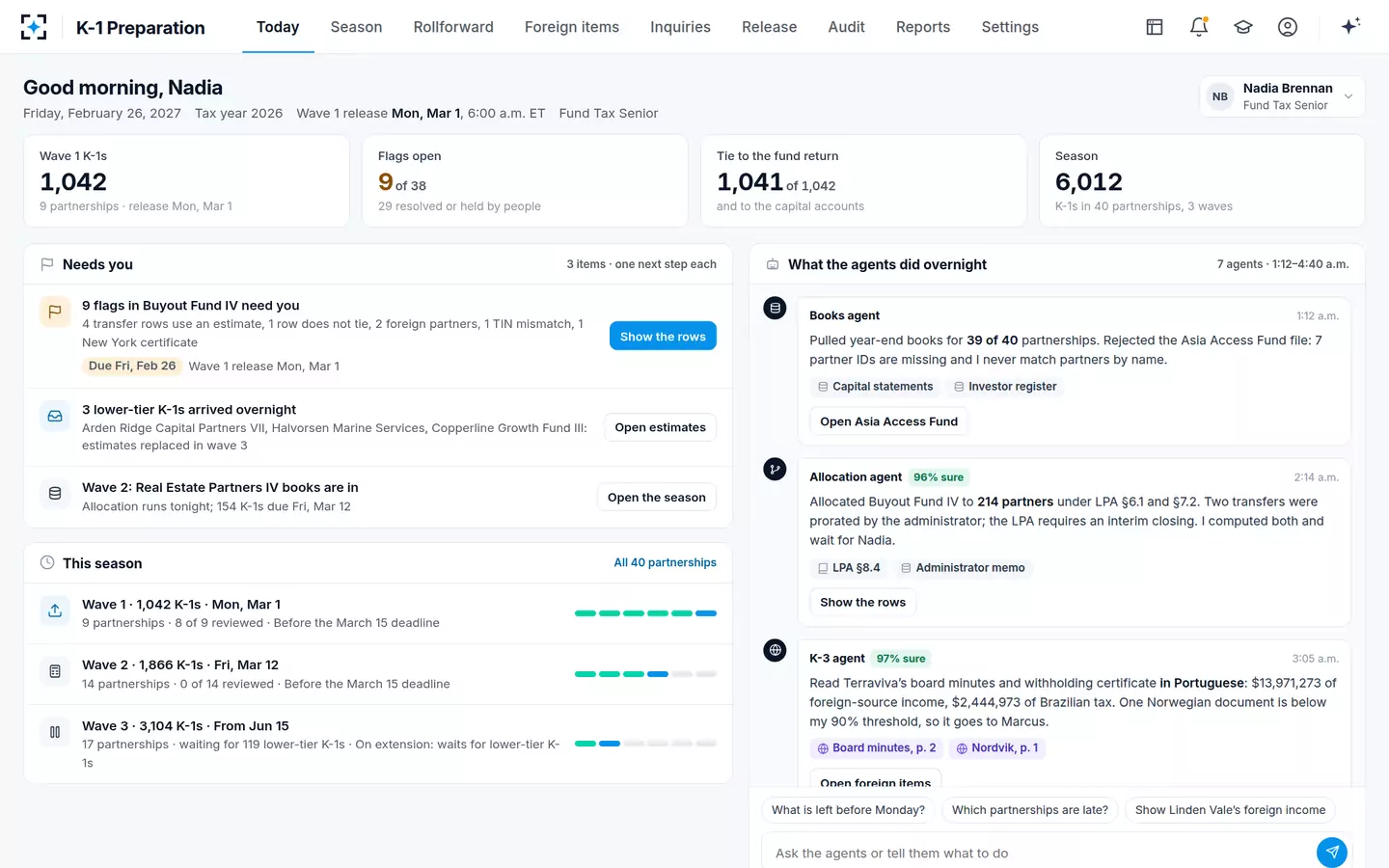
A wave released by the tax partner, with one K-1 held
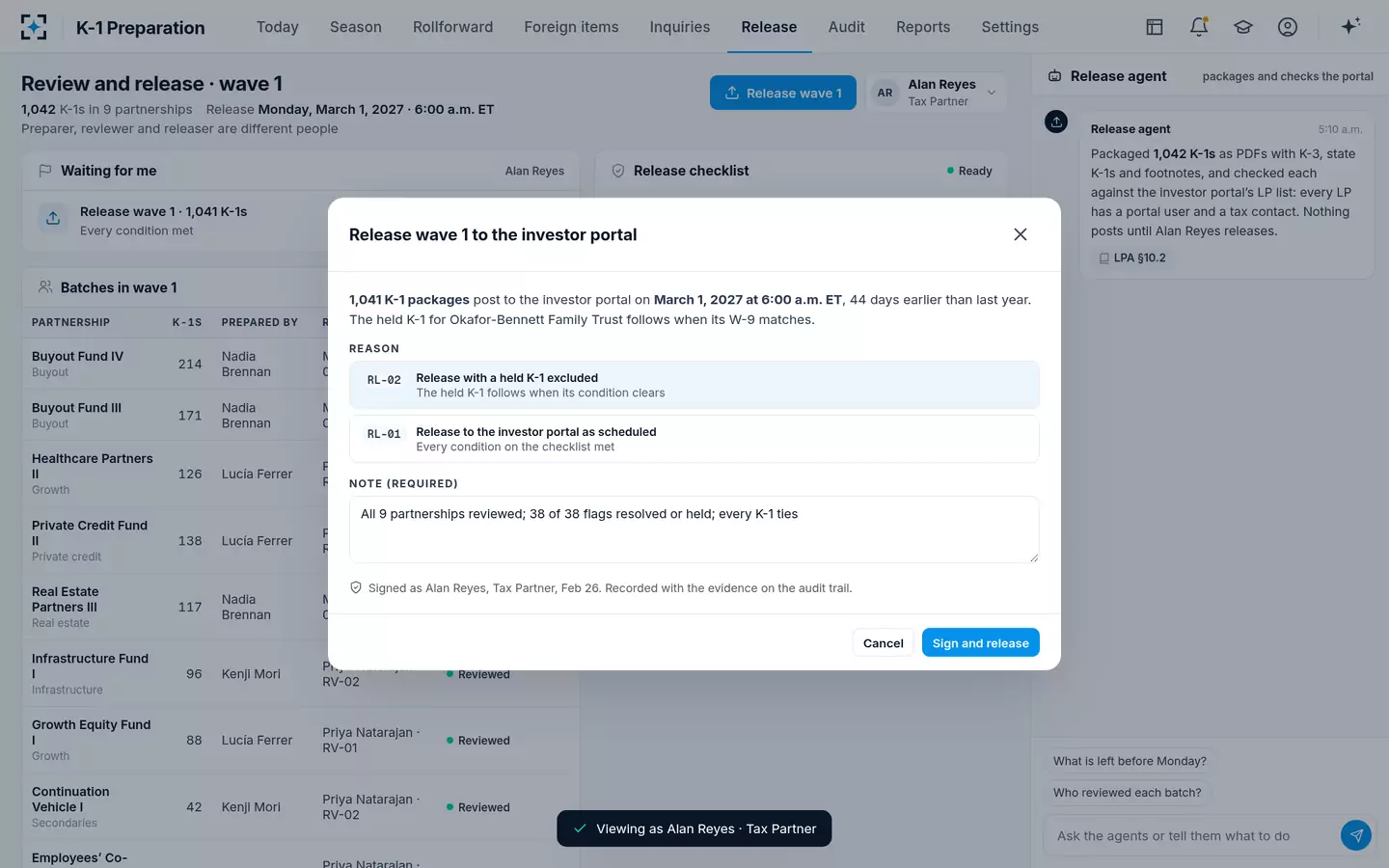
The held K-1 is the penalty logic in miniature. A K-1 sent with a mismatched taxpayer identification number is a K-1 with incorrect information, priced like a late one; a K-1 held for a week while the W-9 is fixed is late only if the hold runs past the due date. The solution also keeps a change threshold as a setting, $500 and 0.5% in the sample, below which an updated estimate letter or corrected K-1 is not issued. Whether a small change is worth a corrected K-1 is a policy the tax partner sets, not a calculation the agents make. For the work that goes into each K-1 before release, see how to prepare a K-1; and K-3 timing has its own trap, covered in the K-2/K-3 domestic filing exception.
Questions people ask
What is the penalty for not filing a K-1?
Not furnishing a K-1 to a partner by the due date, including extensions, is a failure under section 6722: $340 per statement for K-1s due in 2026 and in 2027, reduced to $60 or $130 if corrected within 30 days or by August 1. Not filing Form 1065 itself is a separate penalty of $255 per partner per month in 2026 ($260 in 2027), for up to 12 months.
Is the K-1 penalty charged per K-1 or per partner?
Per statement. Each Schedule K-1, with its Schedule K-3 where one is required, is one payee statement, so a partner who receives two K-1s from two funds is two statements. The late-return penalty is the one counted per partner, including anyone who was a partner at any time during the year.
Can the Form 1065 late filing penalty be abated?
Yes, for reasonable cause, and since summer 2026 automatically for many first-time late filers: the IRS's Automatic Exemption from Penalty covers section 6698(a)(1) for Form 1065 returns from tax year 2025 where the three prior years were filed on time. Section 6722 K-1 penalties are not on the eligible list and need reasonable cause.
Does filing Form 7004 extend the deadline for K-1s?
Yes. The K-1 must be furnished by the return's due date determined with regard to extensions, so a valid Form 7004 moves a calendar-year fund's K-1 deadline from March 15 to September 15. It also moves the date from which the 30-day correction window is measured, and leaves no August 1 reduced rate after it.
What counts as intentional disregard?
The instructions do not define it, but they price it: each $340 penalty becomes $680 or 10% of the aggregate amount of items required to be reported, whichever is greater, and "there's no limit" on the total. A reasonable-cause case and evidence of what the fund knew, and when, are what separate an error from disregard.