The K-2/K-3 domestic filing exception lets a domestic partnership skip Schedules K-2 and K-3 for the year only if four criteria are all met: it has no foreign activity, or only passive income with no more than $300 of creditable foreign tax shown on a payee statement; every direct partner is a U.S. individual or one of a short list of look-through owners; partners are told by the time they receive their K-1 that they will not get a K-3 unless they ask; and no partner asks by the "1-month date". A private equity, credit or real estate fund fails the second test as soon as one pension plan, endowment, corporation or foreign investor sits on its register, so for most fund tax teams the exception is a question to answer quickly and move past. What remains is the K-3 itself: foreign income and tax read out of portfolio documents, often in other languages, for every partner. Botminds' K-1 Preparation exists for that part of K-1 preparation, with agents that read the source documents and fill K-2 and each partner's K-3, and people who decide the judgment calls.
The rules quoted below are the IRS's Partnership Instructions for Schedules K-2 and K-3 (Form 1065), 2025, which govern returns filed in 2026. The fund examples are fictional sample data from the solution.
Foreign activity is the rule in finance partnerships, not the exception
33.8%
of finance and insurance partnerships reported foreign items on Schedule K-2, tax year 2023
165,765 of 490,731
69%
of finance and insurance partners held an interest in a partnership that did
6,608,181 of 9,579,458
6.4%
of all U.S. partnerships reported foreign items the same year
294,745 of 4,575,280
$300
the most creditable foreign tax a partnership can carry and still meet criterion 1
What is the K-3 domestic filing exception?
It is a route out of the international schedules for partnerships whose owners and income are, in the IRS's word, domestic. If the four criteria are met, a domestic partnership "doesn't need to (a) complete and file Schedules K-2 and K-3, or (b) furnish to a partner Schedule K-3 (except when requested by a partner after the 1-month date ...)", and it must not be a qualified derivatives dealer partnership (IRS, 2025 K-2/K-3 instructions).
Schedule K-2 is, in the instructions' words, "an extension of Form 1065, Schedule K", and Schedule K-3 "an extension of Schedule K-1". That is why the exception matters beyond paperwork. The penalties that apply to a late or incomplete Form 1065 and to a late or wrong K-1 "apply to Schedules K-2 and K-3, respectively", so a fund that wrongly relies on the exception has, in effect, furnished an incomplete K-1 to every partner who needed the K-3. What that costs, per form and per year, is worked through in the failure to furnish K-1 penalty.
The exception is tested every year, partnership by partnership. A fund that met it in one year can fail it in the next because it bought a foreign portfolio company, admitted a foreign investor at a later closing, or received a timely request from a single partner.
The four criteria, as a fund tax manager should read them
Read the criteria as a chain: the first failure ends the test. For most funds the order of work is 2, 1, 4, 3, because the partner list is known first and decides the answer for the majority of funds before anyone opens a portfolio document.
The domestic filing exception as a chain: one failure and the fund files K-2 and K-3
1
No or limited foreign activity?
PassesNo foreign activity at all, or only passive category income carrying no more than $300 of creditable foreign tax, shown on a payee statement such as a Form 1099.
FailsA foreign portfolio company, a foreign fund interest, a foreign branch, or foreign tax above $300.
2
Every direct partner on the eligible list?
PassesU.S. citizens and resident aliens; domestic estates and trusts whose beneficiaries (and grantors) are all U.S. individuals; S corporations; single-member LLCs and domestic partnerships owned only by those.
FailsAny C corporation, tax-exempt pension or endowment, foreign investor, or a fund of funds with such investors behind it.
3
Partners told, by the time they get their K-1?
PassesA notice, which may be attached to the K-1, that they will not receive a K-3 unless they ask for one.
FailsNo notice, or a notice sent after the K-1.
4
No request by the 1-month date?
PassesNo partner asked for K-3 information on or before one month before the return is filed (for 2025 calendar-year returns on extension, August 17, 2026 at the latest).
FailsA request on or before that date: file K-2 and K-3 for the parts that partner needs.
All four pass: no K-2, no K-3, unless a partner asks after the 1-month date, in which case that partner's K-3 is due within one month of the request.
Criterion 1 is narrower than "no foreign investments". Foreign activity is defined to include foreign taxes paid, foreign-source income or loss, and an interest in a foreign partnership, foreign corporation, foreign branch or foreign disregarded entity. The limited-activity escape is for passive category income whose creditable foreign taxes do not exceed $300 and are "shown on a payee statement ... that is furnished or treated as furnished to the partnership". The IRS's own example is a partnership whose only foreign item is $100 of foreign tax reported on a Form 1099 from a regulated investment company.
Criterion 3 is a document, not a state of mind. The notice "can be provided as an attachment to Schedule K-1" and must say that partners "won't receive Schedule K-3 from the partnership unless the partners request the schedule". A fund that meets criteria 1, 2 and 4 but forgets the notice does not meet the exception.
Who is required to file Schedule K-2 and K-3?
Any partnership filing Form 1065 that "has items relevant to the determination of the U.S. tax or certain withholding tax or reporting obligations of its partners under the international provisions of the Internal Revenue Code" must complete the relevant parts, unless an exception applies. The instructions are explicit that a purely domestic-looking partnership can be caught: one "with no foreign source income, no assets generating foreign source income, no foreign partners, and no foreign taxes paid or accrued may still need to report information on Schedules K-2 and K-3" (IRS, 2025).
The examples the IRS gives are the ones a fund meets. A partner claiming a foreign tax credit needs Parts II and III to complete Form 1116 or Form 1118. A domestic corporate partner may need Part IV for the foreign-derived intangible income deduction, and Part IX for the base erosion and anti-abuse tax, even where the partnership has only domestic partners. Only the relevant parts are completed: a partnership that does not own stock of a foreign corporation, other than by downward attribution, need not complete Parts V through VIII.
One sentence protects the preparer from an impossible task: "a partnership isn't required to obtain information from its direct or indirect partners to determine if it needs to file each of these parts", except where a statute, regulation or guidance says otherwise. One sentence points the other way: a partnership that lacks information about a partner "must presume such partner is eligible to claim a foreign tax credit", and complete Parts II and III accordingly.
Why criterion 2 decides it for most investment funds
Criterion 2 lists the only direct partners a partnership may have and still use the exception. Everything outside the list fails it, and the list leaves out most of the investors private funds are raised from.
Typical fund investors against criterion 2's list
| Direct partner | On the list? | Why |
|---|---|---|
| U.S. citizen or resident alien individual | Yes | Items (a) and (b) of criterion 2. |
| Family trust with only U.S. individual grantors and beneficiaries | Yes | Domestic grantor and non-grantor trusts qualify only if every beneficiary (and, for grantor trusts, every grantor) is a U.S. citizen or resident alien. |
| S corporation; single-member LLC owned by an eligible person | Yes | Items (f) and (g). |
| Feeder or fund of funds that is a domestic partnership | Only if its own direct partners are all on the list | Item (h) looks one level up; one ineligible partner in the feeder fails the fund. |
| Public or corporate pension plan, endowment, foundation | No | Not an individual, estate, trust of U.S. individuals, S corporation or look-through entity of those. |
| C corporation, insurance company, bank | No | Not on the list. |
| Foreign pension, sovereign fund, foreign individual | No | Criterion 2 is limited to U.S. citizens, resident aliens and domestic entities. |
The practical consequence is that a fund raised from institutions never reaches criteria 1, 3 or 4. Take the fictional sample Buyout Fund IV as it runs through the solution: 214 partners, among them two foreign pension funds, a U.S. public pension, an endowment, a family office organised as a corporation, a fund of funds and two secondary funds. It fails criterion 2 several times over, and it also holds a Brazilian portfolio company, so it fails criterion 1 as well. Its K-2 and its partners' K-3s are not optional.
The interesting cases are the small ones: a co-investment vehicle for a dozen U.S. executives, a GP commitment entity, a family partnership. These can pass criterion 2, and then the other three tests matter. They are also the entities where an exception mistake is cheapest to make and most tedious to unwind, because nobody looks at them closely.
Do I need to file K-2 and K-3 if no partner asks? The 1-month date
If criteria 1 to 3 are met, the answer turns on timing. A request received "on or before the 1-month date", one month before the partnership files Form 1065, defeats the exception for that partner's parts and sections; a request received after it does not, but the partnership must provide that partner's K-3 "no later than 1 month from the date on which the partnership receives the request". For 2025 calendar-year returns filed on extension, the latest 1-month date is August 17, 2026.
Same partnership, same partner, two request dates
- No request yetJan
- Request in hand: exception lostFeb 1 – Jul 31
- FilingAug
- No request by the 1-month dateJan 1 – Aug 19
- K-3 dueto Sep 20
Two details are easy to miss. A request made on or before the 1-month date obliges the partnership to complete K-2 and K-3 "only for the parts and sections relevant to the requesting partner", not a full set for everyone. And for 2025 the IRS changed how long a request lasts: the exception "no longer requires the partnership to provide Schedule K-3 to a requesting partner in subsequent years unless the partner specifically requests". A partner must now ask each year, or ask in terms for every later year, so a partnership needs a dated log of requests that says which kind each one is.
The two other exits: small partnerships and the Form 1116 exemption
A partnership that fails the domestic filing exception can still be excused by two narrower rules, and both are worth checking before anyone starts a K-3.
The small partnership filing exception is new for 2025. It follows Form 1065, Schedule B, question 4: total receipts under $250,000, total assets at year end under $1 million, K-1s filed and furnished on or before the due date including extensions, and no Schedule M-3. A partnership meeting all four is "excepted from completing Schedules K-2 and K-3", subject to the same notice to partners and the same 1-month-date rule for requests. No investment fund of meaningful size meets it, but the GP's small entities often do.
The Form 1116 exemption exception rests on section 904(j), which lets some individuals claim a small foreign tax credit without Form 1116. A domestic partnership need not complete K-2 and K-3 "if all partners are eligible for the Form 1116 exemption and the partnership receives notification of the partners' eligibility for such exemption by the 1-month date". If only some partners notify, the partnership skips their K-3s and completes the schedules for the rest.
Finance partnerships carry foreign items five times as often as all partnerships
What goes wrong when a fund relies on the exception
The failures are rarely about the law. They are about evidence that the test was run, and run again when something changed.
Before a partnership relies on the domestic filing exception
- Test criterion 2 against the register at every closing and transfer, not once a year
One later-closing pension or one transfer to a corporate buyer ends the exception for the whole year.
- Look through feeder and fund-of-funds partners
A domestic partnership partner qualifies only if its own direct partners are all on the list.
- Sum creditable foreign tax from every payee statement before calling activity limited
The ceiling is $300 for the partnership, on passive category income only.
- Send the notice with the K-1, worded as the instructions require
Without it, criterion 3 fails even if nobody would have asked.
- Log every K-3 request with its date and whether it covers later years
The 1-month date decides the treatment, and from 2025 a request covers later years only if it says so.
- Diary one month from any late request
The exception survives a late request, but the K-3 for that partner is still owed within a month.
The partner data behind criterion 2 (entity type, tax-exempt status, U.S. or foreign) is the same data a fund needs for section 1446 withholding and for Form 8805, so it pays to hold it in one place. What that partner file must contain before a preparation process starts is set out in partnership tax preparation software: what to bring.
When the exception fails: where K-1 Preparation does the K-3 work
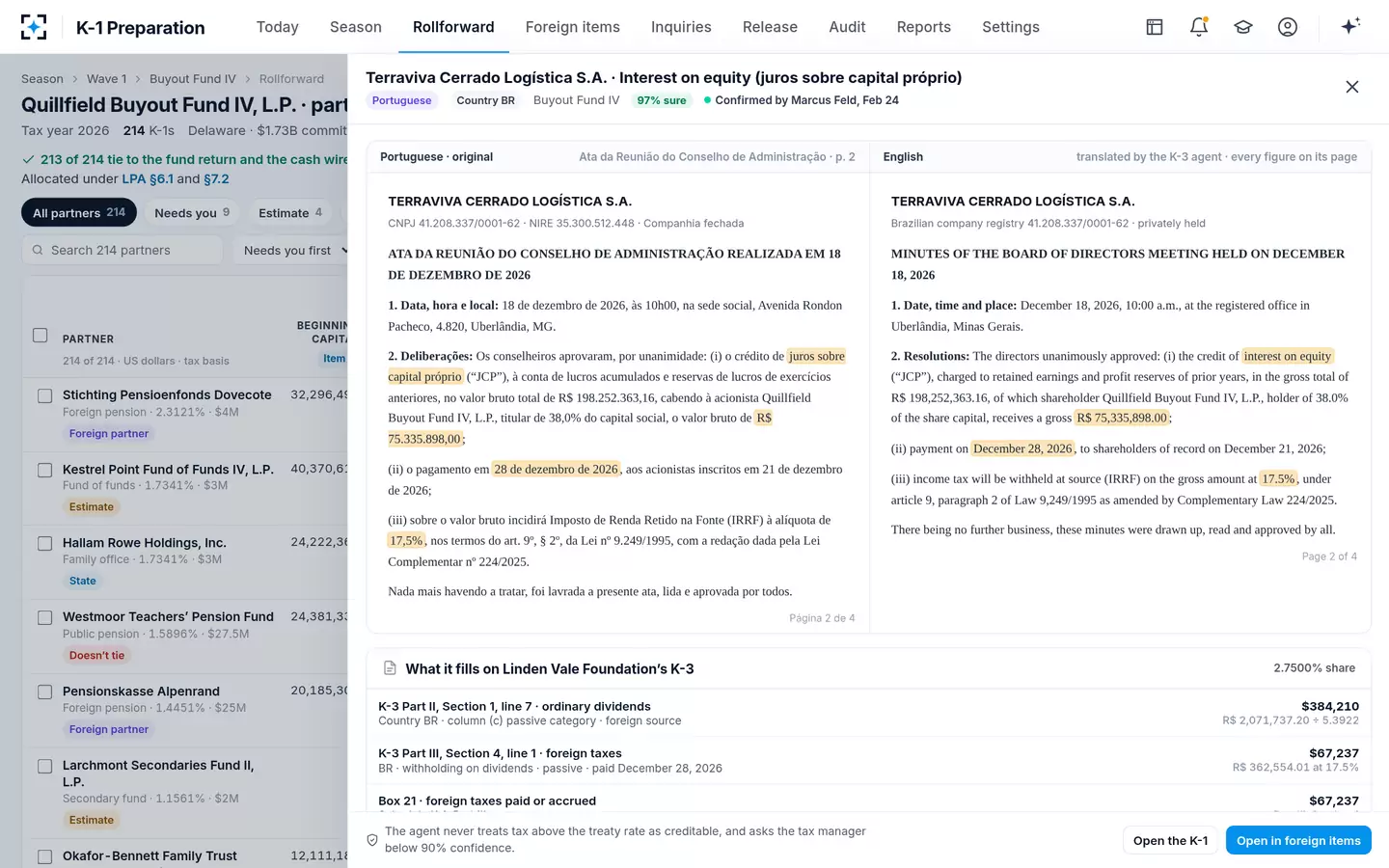
For a fund that must file, the cost of K-2 and K-3 sits in the portfolio documents: a dividend notice in Norwegian, a withholding certificate in Portuguese, board minutes in Japanese. Someone has to find the foreign-source income and the tax withheld, assign the country and the category, translate at the right rate, and put each partner's share on the right line. In K-1 Preparation, a K-3 agent reads those documents in their own language beside an English translation, cites every figure to its page, and fills the fund's K-2 and every partner's K-3.
A Brazilian board minute and what it fills on one partner's K-3
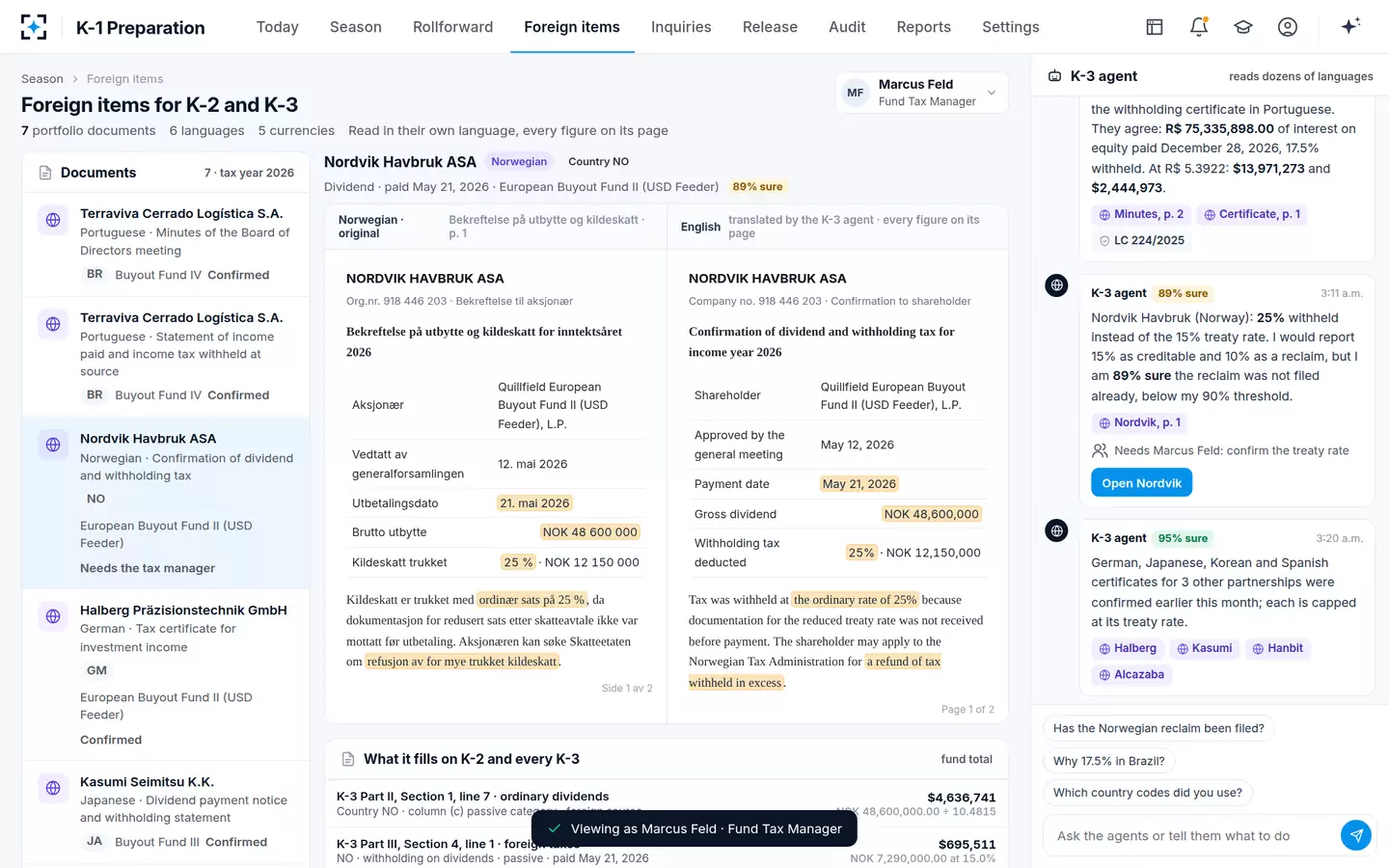
The agents do not decide what is creditable when the position is unclear. When the K-3 agent is less than 90% confident, a setting the tax team controls, it asks the tax manager. In the sample season it stopped on a Norwegian dividend withheld at 25% where the treaty rate is 15%: it proposed the 15% as creditable and the rest as a reclaim, and waited for Fund Tax Manager Marcus Feld to confirm before the decision flowed to European Buyout Fund II's K-2 and its 164 K-3s.
Foreign items for K-2 and K-3: the one the agent would not decide
What the solution does not do is decide whether the exception applies. That is a judgment about the partner register and the year's activity, and it belongs to the fund's tax team. The agents can show the evidence for each criterion; a person signs the conclusion. The wider split between what software takes and what stays with the preparer is set out in K-1 preparation software: what agents take, and the product itself is at K-1 Preparation.
Questions people ask
Is Schedule K-3 required if no partner asks for it?
Only if the partnership meets all four criteria of the domestic filing exception, or the small partnership or Form 1116 exemption exception. Otherwise the relevant parts of K-2 and K-3 must be completed whether or not anyone asks. A partnership that meets the exception still owes a K-3 to a partner who asks after the 1-month date, within one month of the request.
What is the small partnership filing exception for K-2 and K-3?
It is a 2025 addition tied to Form 1065, Schedule B, question 4: total receipts under $250,000, total assets under $1 million at year end, K-1s furnished and filed by the due date including extensions, and no Schedule M-3. A partnership meeting all four is excepted from K-2 and K-3, provided it notifies partners and has no request on or before the 1-month date.
Does a fund with only U.S. investors qualify for the domestic filing exception?
Not necessarily. "U.S. investors" usually includes pension plans, endowments, foundations and corporations, and none of those is on criterion 2's list. A fund owned only by U.S. individuals, their trusts and S corporations can pass criterion 2, and then still needs limited foreign activity, the notice and no timely request.
What happens if a partner asks for a K-3 after the 1-month date?
The exception still holds for the partnership: it does not file K-2 and K-3 or furnish K-3s to the other partners. It must give the requesting partner a K-3, completed with the information requested, no later than one month after receiving the request. In the IRS's example a request on August 20, 2026 makes the K-3 due by September 20, 2026.
Do the K-1 penalties apply to Schedule K-3?
Yes. The 2025 instructions say the penalties for Form 1065 and Schedule K-1 apply to Schedules K-2 and K-3 respectively, and the Form 1065 instructions price a late or incomplete K-1 at $340, counting each required Schedule K-3 with it, up to $4,098,500 a year for entities with gross receipts over $5 million; the K-1 penalty guide works the amounts through.
What changed in the domestic filing exception for 2025?
Three things: the scope of criterion 2 was broadened; a partner's request no longer carries into later years unless it says so; and a separate small partnership exception was added. The four-criterion structure and the 1-month date are unchanged.