To prepare a K-1 for a fund, you close and check the partnership's books, allocate every item of income, gain, loss, deduction and credit to each partner under the partnership agreement and the tax rules, fill the Schedule K-1 (Form 1065) with the partner's information in Parts I and II and its share in Part III, attach the statements, K-3 and Section 1061 information the partner needs, tie the total of all K-1s to the return's Schedule K and the capital accounts to Schedule M-2, and have someone who did not prepare it review and release it to the partner by the return's due date, including extensions. In an investment fund that work passes through six seats, from the administrator's fund accountant to investor relations, and most K-1s that go out late or wrong were held up at a hand-off rather than at a form. Botminds' K-1 Preparation is built around those hand-offs: agents do the mechanical work between the seats and leave each decision with the person who owns it.
The rules cited are the IRS's 2025 Instructions for Form 1065 and the regulations named in each section. People, funds and numbers in the examples are fictional sample data from the solution.
One fund's K-1s, seat by seat, with the agents between them
A person decides
Fund accountant, at the administratorCloses the year: trial balance, capital statements, investor register, transfers and lower-tier K-1s received.
Agent
Books agentPulls the year-end files and checks they are complete and dated December 31.
Never: matches a partner by name; a missing partner ID rejects the file
A person decides
Fund tax senior (preparer)Owns the allocation and every partner's K-1, K-3 and state K-1; resolves the flags.
Agent
Allocation, K-3 and Partner data agentsApply the LPA method to every partner and box, read foreign documents for K-3, check W-9s, W-8s, TINs and section 1446.
Never: change an allocation method or partner data
Agent
Tie-out agentRecomputes every K-1 independently and ties it to Schedule K, M-2, K-2, the capital statements and the cash wires.
Never: plugs a difference
A person decides
Fund tax manager (reviewer)Reviews each batch against the books and the LPA and signs with a reason, or returns it.
Never: reviews a batch they prepared
A person decides
Tax partner (releaser)Releases each wave against a checklist; signs the return; acts as partnership representative.
A person decides
Investor relationsAnswers limited partners' questions from their own K-1, with the numbers approved by the tax manager.
How to prepare a schedule K-1, step by step
The IRS's own summary is short. "Generally, the partnership is required to prepare and give a Schedule K-1 to each person who was a partner in the partnership at any time during the year." On each K-1, "enter the information about the partnership and the partner in Parts I and II (items A through N). In Part III, enter the partner's distributive share of each item of income, deduction, and credit and any other information the partner needs to file the partner's tax return, including information needed to prepare state and local tax returns" (IRS, 2025). The regulation behind it requires the statement to carry the partner's distributive share and, "to the extent provided by form or the accompanying instructions, any additional information" the partner needs (26 CFR 1.6031(b)-1T).
For a fund, those two sentences expand into six steps:
- Close and check the books. Trial balance, book-to-tax adjustments, the investor register with every partner's ID, transfers and later closings, and every lower-tier K-1 the fund received.
- Allocate. Apply the LPA's allocation provisions, targeted capital accounts or the waterfall, to every item, and apply the varying-interest rules to every partner whose interest changed during the year.
- Fill the K-1. Parts I and II, items A to N, including Item L tax-basis capital; Part III boxes with their codes; attached statements where a box needs one; Schedule K-3 where the international rules require it; Worksheet A for holders of carried interest; state K-1s.
- Check the partner data. Name, taxpayer identification number, entity type, tax-exempt status, U.S. or foreign status, section 1446 withholding and state composite or withholding elections.
- Tie out. The sum of all K-1s to Schedule K, Item L to Schedule M-2, K-3s to K-2, distributions to the cash that left the bank.
- Review, release and furnish. A reviewer who did not prepare the batch, a release by the person accountable for the return, delivery to each partner by the due date, extensions included.
The K-1 itself: what each part asks for, and which seat fills it
| Part of Schedule K-1 (Form 1065) | What it holds | Filled from |
|---|---|---|
| Part I, items A to D | The partnership: EIN, name, address, where it files ("e-file" if electronic), publicly traded or not | Fund records; the tax senior |
| Part II, items E to I | The partner: identifying number, name, address, general or limited partner, domestic or foreign, entity type, retirement plan | Investor register and partner forms; partner data checks |
| Item J | Shares of profit, loss and capital at the beginning and end of the year; sale or exchange boxes | The LPA and the register |
| Item K | Share of nonrecourse, qualified nonrecourse and recourse liabilities | Books and the liability allocation rules |
| Item L | Tax-basis capital account roll-forward | Prior-year K-1 and this year's allocation |
| Items M and N | Contributed built-in gain or loss property; net unrecognized section 704(c) gain or loss | Contribution and revaluation records |
| Part III, boxes 1 to 23 | The partner's share of each item, with codes; statements where one amount will not do | The allocation, then the tie-out |
Who prepares a K-1, and who signs off the K-1 set?
The partnership prepares the K-1, which in practice means the fund's tax team or an outside preparer working from the administrator's books; and the partnership return is signed by a partner. The instructions are categorical: "Form 1065 isn't considered to be a return unless it's signed by a partner or LLC member", and where the partner is an entity, "an individual who is authorized under state law to act for the entity partner must sign". A paid preparer signs in the preparer's section with a preparer tax identification number.
For funds subject to the centralized partnership audit regime, which is most of them, a second role sits on top: the partnership representative, who has "the sole authority to act on behalf of the partnership" in an IRS proceeding and who must sign any administrative adjustment request. Naming the same senior person, in the sample the tax partner, as the releaser of K-1s and the partnership representative keeps the accountability for a K-1 and for its later correction in one place.
The six seats, before and after the agents take the mechanical part
Today
Sends year-end files, then answers the tax team's questions about missing IDs and booking dates for weeks.
With agents
Gets one rejection with the reason, the day the file arrives, instead of a trickle of questions.
Today
Rebuilds allocations from the LPA in spreadsheets, re-keys foreign items and ties K-1s to the return by hand.
With agents
Opens partner rows already allocated and tied, and works the rows the agents flag, with their reasons.
Still theirs: Every change to a figure, with a reason code
Today
Signs off batches that cannot be traced from the box to the books without redoing the work.
With agents
Sees each box traced to its allocation step and source, and records fund-level judgments once.
Still theirs: Review, never of a batch they prepared
Today
Releases K-1s after extension and answers to investors for every late or corrected one.
With agents
Releases a wave only when every flag is resolved or held and every K-1 ties.
Still theirs: Release, signature and the partnership representative role
Today
Chases the tax team for the box behind each investor question.
With agents
Receives a drafted reply from the investor's own K-1, every figure cited, for the manager to approve.
Still theirs: Sending; the agents never send
Today
Pieces together who changed an allocation from email and workpaper versions.
With agents
Reads an append-only trail of every allocation, reading, decision and release.
Still theirs: Read-only access
The hand-offs, not the forms, are where K-1s go late
Every seat waits on the one before it, and the first wait is the longest. A fund's K-1 cannot be finished until its books are closed, and a fund that owns interests in other partnerships cannot finish until those partnerships' K-1s arrive. Tiers make it worse. The Form 1065 instructions warn that "special rules in section 706(d)(3) apply to tiered partnerships", and in practice an estimate in a portfolio partnership's K-1 is an estimate in every K-1 above it.
Tiered structures are also why so much partnership income is hard to trace. A study of 2011 administrative tax data found that "Partnership ownership is opaque: 20% of the income goes to unclassifiable partners, and 15% of the income is earned in circularly owned partnerships" (Cooper and others, NBER working paper 21651, published in Tax Policy and the Economy, 2016). For a fund tax team, the same opacity shows up as a wait: K-1s that depend on other K-1s that depend on other K-1s.
The rules for carried interest show the IRS knows it. Section 1061 information must be requested from a lower-tier entity within 30 days after the year closes, or within 14 days of a request from the tier above if that is later (26 CFR 1.1061-6; the carry holder's K-1 guide follows the chain). The same discipline, a dated request on day 30 and a diary for the answer, works for every lower-tier item a fund needs.
The scale of the K-1 season
33.1M
Schedules K-1 (Form 1065) filed in calendar year 2024
33,090,559, actual
35.1M
projected for calendar year 2026
35,132,300
41.6M
projected for 2033
41,617,900
2%
of 2024's Form 1065 K-1s were filed on paper
673,466
Partner data: the seat everyone assumes someone else holds
Every K-1 starts with Part II, and Part II is only as good as the investor file behind it: name, taxpayer identification number, entity type, domestic or foreign, retirement plan or not. Errors here are cheap to make and expensive to carry, because a K-1 with incorrect information is priced like a late one, and because the same data drives withholding that happens during the year, not at K-1 time.
Section 1446 is the clearest case. A partnership with effectively connected income allocable to foreign partners pays the withholding in four installments during the year, not at K-1 time, and reports each foreign partner's share on Form 8805. Partner status comes from withholding certificates. The instructions spell out the risk of shortcuts: a W-9 is not compulsory, but a partnership that relies on other evidence and gets a partner's status wrong is liable for the tax, penalties and interest, and without a certificate it may presume the partner is foreign (IRS, Instructions for Forms 8804, 8805 and 8813).
In the sample season, the Partner data agent checked every W-9 and W-8 and ran the IRS's TIN matching. One family trust's identification number no longer matched IRS records after a change of trustee, so its K-1 was held with reason code HD-01 until a new W-9 arrived, and released after the rest of the wave. The agent proposes; it never changes partner data and never contacts an investor.
The tie-out: four sums that must agree before anyone reviews
Review is wasted on K-1s that do not add up, so the tie-out comes first. Four checks catch most errors: the sum of every partner's boxes equals the same line of Schedule K; the sum of Item L equals Schedule M-2; the sum of the K-3s equals K-2; and each partner's distributions equal the cash that actually left the fund's account in the year. A fifth check runs across years: each continuing partner's beginning capital equals the ending capital on last year's K-1.
The tie-out is only independent if it is computed independently. A check that re-adds the allocation's own output proves the arithmetic, not the allocation. In the sample season the Tie-out agent recomputes every K-1 from the books without using the Allocation agent's numbers, within a $1 tolerance per box set by the tax team, and explains every difference it finds; it never adds a balancing entry. How the capital roll-forward is tested line by line is set out in partnership tax basis capital account reporting.
How to prepare a K-1 for an LLC, a hedge fund or a fund of funds
An LLC taxed as a partnership prepares K-1s exactly as a limited partnership does: it files Form 1065, a member signs, and each member receives a K-1. The differences that matter in investment structures are about how interests change during the year and about who the partners are.
An open-ended fund with monthly subscriptions and redemptions has a variation every month. The regulation lets partners agree to "perform regular monthly or semi-monthly interim closings of its books, regardless of whether any variation occurs", so that each month is its own segment (26 CFR 1.706-4(d)). A closed-end private fund has fewer, larger variations, later closings and secondary transfers, and each needs its method chosen. Either way, the agreement must be dated, written and kept with the books by the extended due date; which method to choose is worked through in interim closing method vs proration method.
Who the partners are changes what each K-1 must carry. A tax-exempt investor needs its share of unrelated business taxable income, reported in Box 20 with code V, and the instructions put the burden on the investor to tell the partnership it is tax-exempt. A foreign investor needs Form 8805 for the section 1446 tax withheld on its effectively connected income. A holder of carried interest needs Worksheet A. A partner claiming a foreign tax credit needs a K-3 unless an exception applies.
Review and release: one person prepares, another reviews, a third releases
Nothing in the instructions requires three people, but a fund that wants its K-1s to survive an investor's scrutiny will use them. The preparer knows where the judgment calls were made; the reviewer's job is to trace them, not to admire them. In the sample season the tax manager reviews each partnership's batch with a reason code, RV-01 "Reviewed: traced to the books and the LPA", or returns it with one of three return codes, and the screen tells him whether he prepared it: a preparer cannot review their own batch.
Reviewed with a reason code, never one's own work
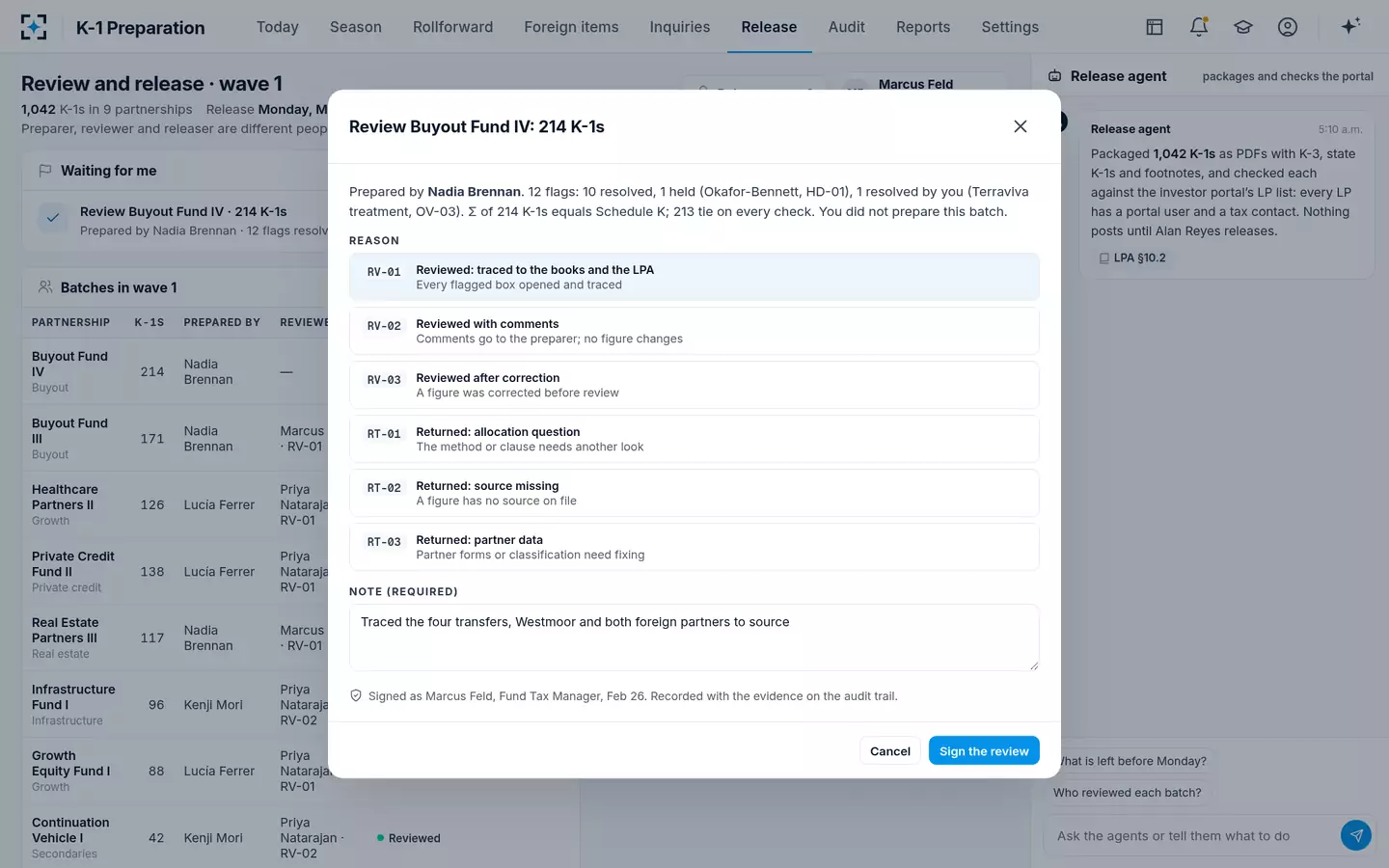
Release is a separate act. The tax partner releases a wave when every flag is resolved or held, every K-1 ties, every partnership was reviewed by someone else and the investor portal has been checked; a K-1 whose partner data does not match is held and excluded rather than sent. What lateness and errors cost if this goes wrong is priced in the failure to furnish K-1 penalty.
After release: the investor's questions
The last seat is the one investors see. Each K-1 produces questions: where an item came from, why capital differs from the statement, whether a K-3 is coming. Answering them well means answering from the investor's own K-1, citing the box, in the investor's language, and never giving tax advice. In the sample season the Inquiry agent drafts each reply from the K-1 with every figure cited; the tax manager approves the numbers and investor relations sends it.
An investor's question answered from its own K-1
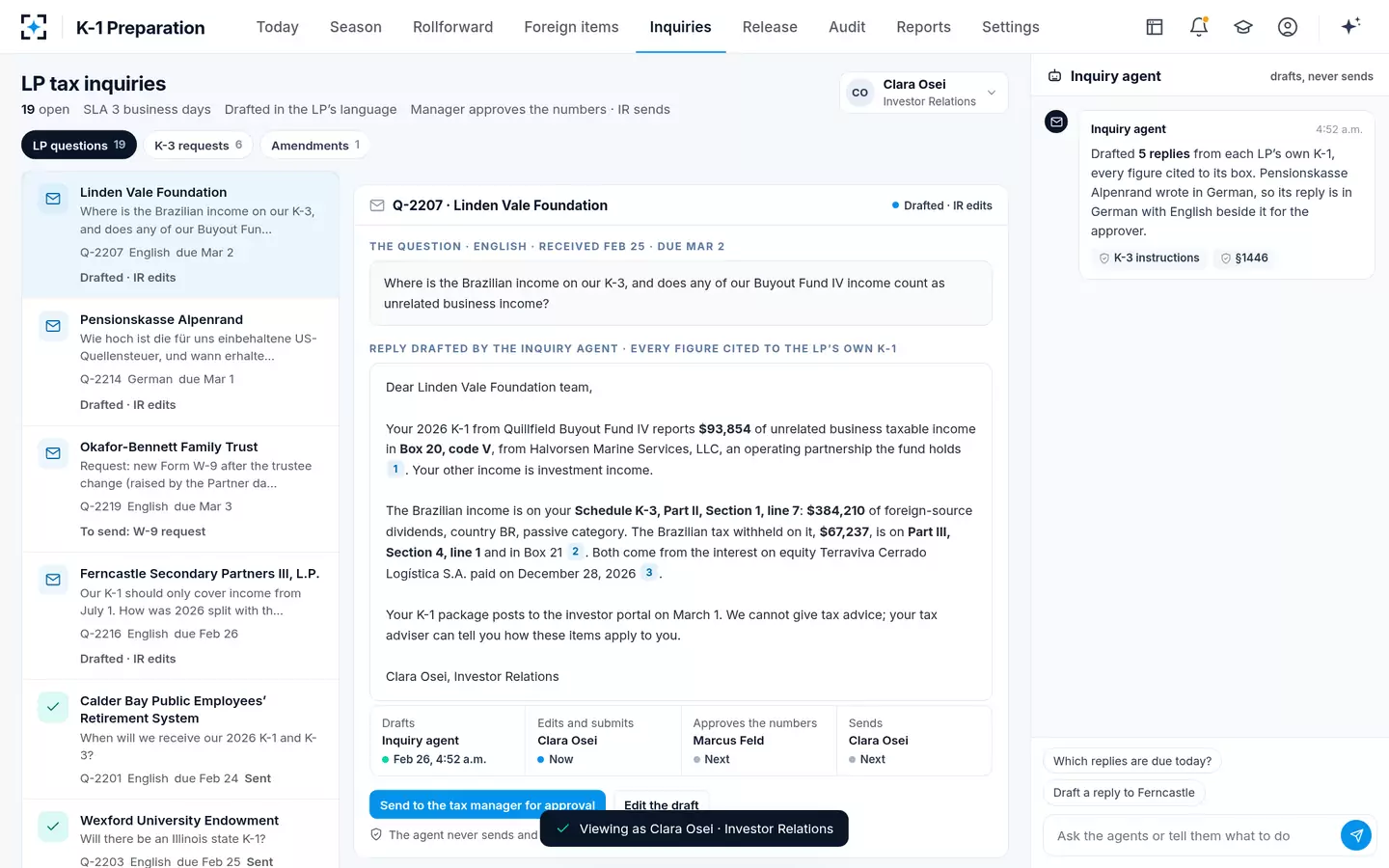
The full list of what the agents do in each seat, and what they are not allowed to do, is on K-1 Preparation; which of those tasks a buyer should expect any K-1 software to take is set out in K-1 preparation software: what agents take and what preparers keep.
Questions people ask
Who prepares a K-1?
The partnership does: its tax team, an outside preparer or the fund administrator's tax group, working from the partnership's books. The partnership is responsible for furnishing a K-1 to every person who was a partner at any time during the year, and Form 1065 is not a return until a partner or LLC member signs it.
When must a fund furnish its K-1s?
By the due date of the partnership return, including extensions: March 15 for a calendar-year partnership, or September 15 with a Form 7004 extension. The regulation ties the K-1 to the return's due date "determined with regard to extensions".
Can a K-1 be furnished electronically?
The IRS points to Rev. Proc. 2012-17 for the requirements for furnishing a substitute Schedule K-1 in electronic format. Separately, a partnership with more than 100 partners must file its Schedules K-1 with the IRS electronically.
What does a fund need from a lower-tier partnership?
Its K-1 and any attachments the upper-tier fund needs to complete its own: K-3 information, Section 1061 amounts, UBTI detail, section 1446 withholding. For Section 1061 the regulation sets a request deadline of the later of 30 days after year end or 14 days after the upper-tier partnership's own request.
How long does it take to prepare a fund's K-1s?
No regulator or independent study publishes a figure. Measure your own: the days from the administrator's year-end files to release, split by seat, for last season's partnerships. The longest wait is usually the first one, for complete books and lower-tier K-1s.