K-1 preparation software for an investment fund should take the mechanical work between the closed books and the investor portal: pulling and checking the year-end files, applying the partnership agreement's allocation method to every partner and box, reading portfolio documents for Schedule K-3, checking partner forms and withholding status, tying every K-1 to Schedule K and the capital accounts, and packaging the release. It should leave with people the decisions that are legally theirs: elections, the choice of method where documents disagree, treaty and creditability judgments, review, release and the signature on the return. Most products sold as K-1 software cover one stretch of that path, which is why fund tax teams still rebuild allocations in spreadsheets between them. Botminds' K-1 Preparation is built for the stretch in between: seven agents that read, allocate and tie out, and three people, a preparer, a reviewer and a releaser, who decide.
What follows is our view of the work, grounded in the IRS's rules where they draw the lines. The examples and the time estimate are from the solution and its fictional sample data.
Where one wave's working days go, by hand and with agents (our estimate)
By hand: 22 working days
- Checking books and register, 3 · 13.6%
- Rebuilding allocations from the LPA, 6 · 27.3%
- Re-keying foreign items for K-2/K-3, 4 · 18.2%
- Partner forms, TINs, 1446, states, 2 · 9.1%
- Tying K-1s to the return, 4 · 18.2%
- Review, release, portal, 3 · 13.6%
With agents: 4 working days
- Books, 0.5 · 12.5%
- Allocations, 1 · 25%
- Foreign items for K-2/K-3, 0.5 · 12.5%
- Partner forms and elections, 0.5 · 12.5%
- Tie-out, 0.5 · 12.5%
- Review, release, portal, 1 · 25%
What is sold as K-1 software, and the gap between the categories
Three kinds of product are usually meant. Tax compliance software computes the return from the numbers it is given, prints the K-1s and files electronically; it assumes the allocations are right. Fund accounting and administration platforms produce the books, capital statements and often an allocation, on a book basis designed for investor reporting. Investor portals deliver the documents. Each is necessary, and none reads an LPA, a Portuguese withholding certificate and a custodian's wire record and reconciles them.
Three kinds of K-1 software, and what each one assumes
| Category | What it does well | What it takes as given |
|---|---|---|
| Partnership tax compliance software | Form 1065, Schedule K and K-1 computation from inputs; e-file; state forms | That the allocations, foreign items and partner data it receives are right |
| Fund accounting and administration platforms | Books, capital statements, investor register, book allocations | That book allocations are what the tax return needs; that the tax team will handle K-3 and tax capital |
| Investor portals | Secure delivery, access, download tracking | That what is posted is final |
| Agents across the gap (where K-1 Preparation sits) | Read the documents, apply the LPA, tie out, explain differences | That the source documents are complete; it rejects or flags those that are not, and people decide what the documents leave open |
A buyer should map each category to the tasks below before comparing prices, because the question is not which product computes a K-1 but which tasks will still be done by hand afterwards. If the answer includes the allocation and the K-3 re-keying, the season will still run on spreadsheets.
Which tasks move to agents, and which stay with the preparer
The dividing line is simple to state: a task moves when its output can be checked against a document, and stays when it requires choosing between readings or signing for the result. The grid applies that line to a fund's K-1 work.
K-1 work, task by task: what the agents do, what the people keep
Pull and check the year-end books
AgentsCollects capital statements, trial balance, register and lower-tier K-1s; rejects a file with a missing partner ID
PeopleAsks the administrator for the fix
WhyMechanical, and checkable against the files
Apply the LPA to every partner and box
AgentsRuns the allocation the LPA describes: waterfall, targeted capital, transfers, later closers
PeopleChooses between readings when the LPA and the administrator differ
WhyChoosing a method is a reading of an agreement
Read portfolio documents for K-3
AgentsReads each document in its own language, assigns country, category and rate, cites the page
PeopleDecides treaty and creditability questions below the confidence threshold
WhyReading is mechanical; creditability can be a judgment
Check partner data
AgentsChecks W-9 and W-8 forms, TIN matching, entity type, section 1446 and state elections
PeopleConfirms each proposed change and contacts the investor
WhyPartner data changes and investor contact carry legal weight
Tie every K-1 to the return
AgentsRecomputes independently; ties to Schedule K, M-2, K-2, capital statements and cash
PeopleAccepts or returns each explained difference
WhyA plug hides an error; an explanation needs a decision
Make partnership elections
AgentsShows where an election matters and what it changes
PeopleDecides section 754, the varying-interest method, conventions, 704(c) methods
WhyElections are the partnership's, made by authorised people
Review, release and sign
AgentsPackages K-1, K-3, state K-1s and footnotes; posts after release
PeopleReviews (not their own batch), releases, signs the return
WhyAccountability for a return is a person's
Two tasks in the grid are where most of the time goes and where software is most often oversold: the allocation and the K-3. The allocation is mechanical once the method is fixed, and judgment where the LPA and the administrator disagree; a good tool computes both readings and shows the difference. In the sample season, the Allocation agent found four transfers the administrator had prorated by days where the LPA required an interim closing, and moved nothing until the tax senior applied the LPA with a reason code. The method question is worked through in interim closing method vs proration method.
Can software read portfolio K-1s, footnotes and foreign documents?
Yes, and that is the part of K-1 work where agents change the most. A fund's K-3 is built from documents it did not write: lower-tier K-1s and their footnotes, dividend notices, withholding certificates, board minutes, often in the portfolio company's language. Reading them is mechanical; what is not mechanical is deciding, for example, how much of a withholding above the treaty rate is creditable. The K-2/K-3 instructions add a rule that makes careful reading worth it: without information about a partner's position, the partnership must treat the partner as able to claim a foreign tax credit and complete the credit parts of the schedules for it (IRS, 2025 K-2/K-3 instructions).
In K-1 Preparation, the K-3 agent reads each document beside its English translation, cites every figure to its page, and below a confidence threshold the tax team sets, 90% in the sample, it stops and asks the tax manager. It never reports tax above the treaty rate as creditable; the excess is shown as a reclaim. Whether the fund needs K-3s at all is a separate test, covered in the K-2/K-3 domestic filing exception.
A foreign withholding, from document to K-3, with the judgment left to a person
Agent
K-3 agent readsA Norwegian dividend confirmation: NOK 48,600,000 gross, 25% withheld because the treaty documentation arrived after payment.
Agent
K-3 agent proposes15% creditable at the U.S.–Norway treaty rate on portfolio dividends, the other 10% as a reclaim noted on each K-1.
Never: reports tax above the treaty rate as creditable
Agent
K-3 agent stops89% sure, below the 90% setting: no reclaim filing was found, but the administrator may have filed one elsewhere.
A person decides
Fund tax manager decidesConfirms the treaty rate; the decision flows to the fund's K-2 and its 164 K-3s, with his reason on the trail.
What stays with people, and the rules that put it there
Elections are the partnership's, and the Form 1065 instructions list them: "Generally, the partnership decides how to figure income from its operations", and it "makes elections under" sections including 754, the optional basis adjustment, which "must be made in a statement that is filed with the partnership's timely filed return (including any extension)". Some elections belong to the partners, not the partnership, including the section 901 foreign tax credit (IRS, 2025). Software can show what an election would change; it cannot make one.
The varying-interest rules are explicit about who chooses. Proration needs either the agreement of all the partners or a selection by a person with authority to make it, and either way it must be written down and dated (26 CFR 1.706-4(f)). A tool that silently picks a method has made a selection nobody authorised.
And the professional standard does not move. Circular 230 requires a practitioner to "exercise due diligence ... In preparing or assisting in the preparation of, approving, and filing tax returns", and presumes diligence when relying on another's work only if the practitioner "used reasonable care in engaging, supervising, training, and evaluating the person" (Treasury Circular 230, §10.22). The rule speaks of persons, not software, but it is the right test for any tool a preparer relies on: can you supervise it, and can you evaluate its work? A tool that cannot show where each figure came from fails the second question.
Your tolerances, thresholds and rules, as versioned settings
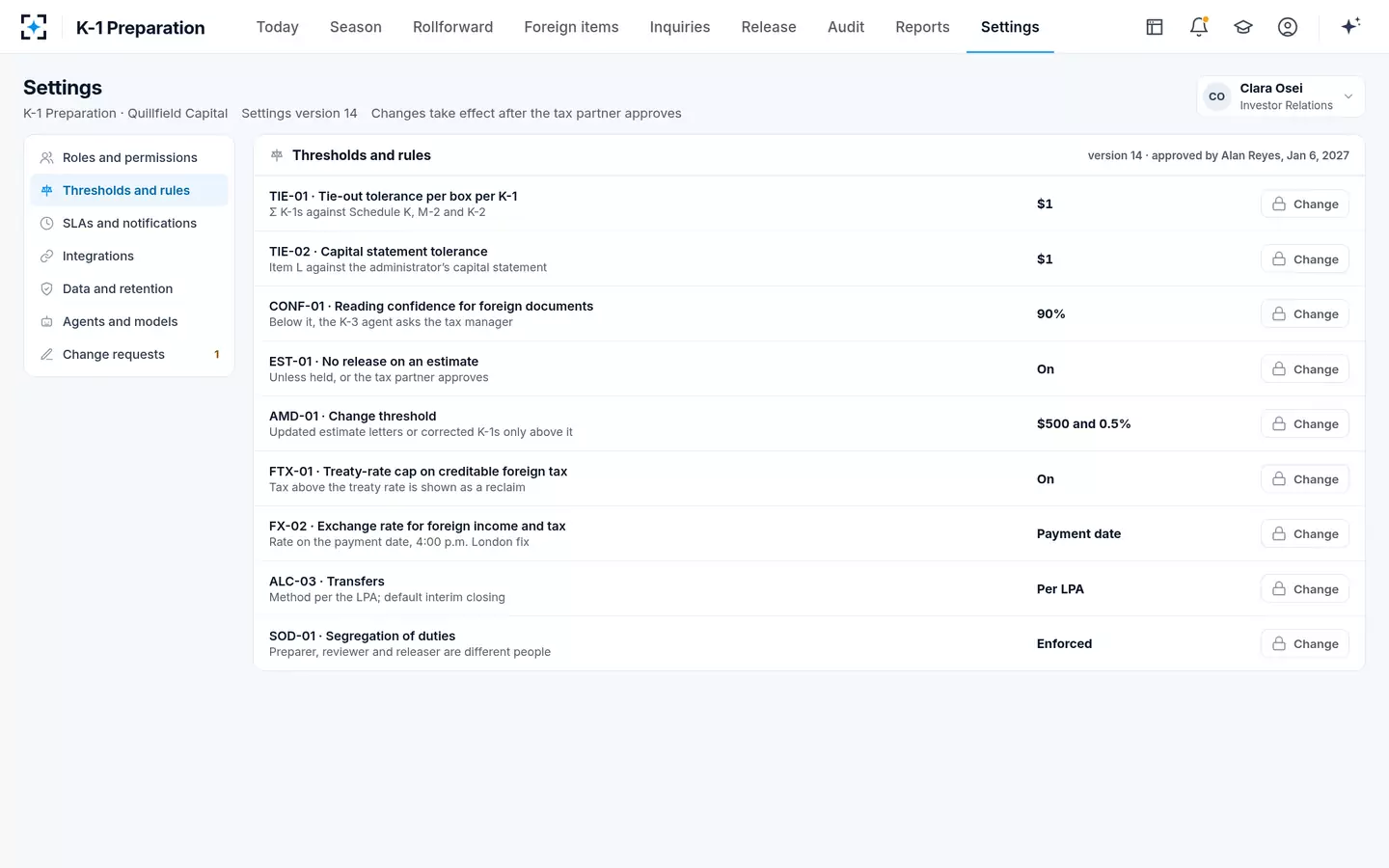
What should K-1 software check before release?
A buyer should be able to list, before the first demonstration, the checks a K-1 must pass before it reaches an investor, and then ask which the software runs on every K-1 and which it leaves to a person.
Checks every K-1 should pass before release
- The sum of all K-1s equals Schedule K, line by line
Within a stated tolerance per box; no balancing entries.
- Item L rolls forward from last year and totals to Schedule M-2
With every transfer appearing on both sides at the same amount.
- K-3s total to K-2, and each foreign figure cites its source document
Including the page and the exchange rate used.
- Distributions equal the cash that left the account in the year
Dated by payment, not by booking.
- Partner data matches IRS TIN records and current withholding certificates
A mismatch holds the K-1 rather than sending it.
- Every flag is resolved or held, with a reason
Nothing goes out on an estimate nobody has seen.
- The batch was reviewed by someone who did not prepare it
And released by the person accountable for the return.
How to evaluate K-1 preparation software on your own fund
Run it on last year. Give the tool the prior year's closed books, the LPAs and side letters, the partner file and the lower-tier K-1s, and compare its K-1s with the ones you filed, box by box. Every difference is one of three things: an error in what you filed, an error in the tool, or a judgment call made differently. Count each, and have your reviewer mark them. The method, and why it matters especially for funds under the centralized audit regime, is set out in administrative adjustment request vs amended return.
Then ask five questions of any vendor. Does it compute the tie-out independently of the allocation, or re-add its own numbers? Can it change a figure without a person's decision? Does every figure cite the document and page it came from? What does it do when it is unsure, and who sets that threshold? Who can release, and can the same person prepare, review and release? A product that answers these well on your own data is worth pricing; one that cannot be tested on your data is asking for trust it has not earned.
What no K-1 software can fix: the K-1s you are waiting for
Software shortens the work a fund controls; it does not shorten the wait for documents it does not. A fund of funds, a secondaries vehicle or any fund holding operating partnerships cannot finish a K-1 until the lower-tier K-1s arrive, and those partnerships run on their own calendars. In the sample season, the third wave, 3,104 K-1s across 17 partnerships, is on extension for exactly that reason: it is waiting for 119 lower-tier K-1s.
What software can do is make the wait cheaper. It can release the funds whose inputs are complete in early waves instead of holding everything for the slowest document. It can track every lower-tier K-1 against a dated request; for carried interest information the regulation already requires an upper-tier partnership to request it within 30 days of year end, or within 14 days of its own investor's request if that is later. And when a late lower-tier K-1 changes a number, it can apply the fund's own change threshold, $500 and 0.5% in the sample settings, to decide whether an updated estimate letter or a corrected K-1 is warranted, and leave that decision to the tax partner. A buyer should ask how a product handles estimates and late inputs, because every season has some.
The harder case is a change after the K-1s have gone out and the return has been filed. For a partnership under the centralized audit regime, that is no longer a corrected K-1 but an administrative adjustment request, and investors may receive a Form 8986 rather than a corrected K-1. That route is slow and visible, which is the strongest argument for finding errors before release rather than after.
Where K-1 Preparation fits, and where it does not
It fits funds where the K-1 work is mostly reading and reconciling: many partners, LPAs with waterfalls or targeted capital accounts, transfers and later closings, foreign portfolio companies, tiers of partnerships. It works with the systems a fund already has: the administrator's statements and register, the fund accounting platform's trial balance, the tax software that produces Form 1065 and e-files, the investor portal and the custodian's wires. It does not replace tax compliance software or the administrator, it does not give tax advice, and it does not make elections. A small partnership with a handful of U.S. individual partners and no foreign activity will get less from it than a fund of funds with 200 institutional investors.
Every allocation, reading, decision and release, on one trail
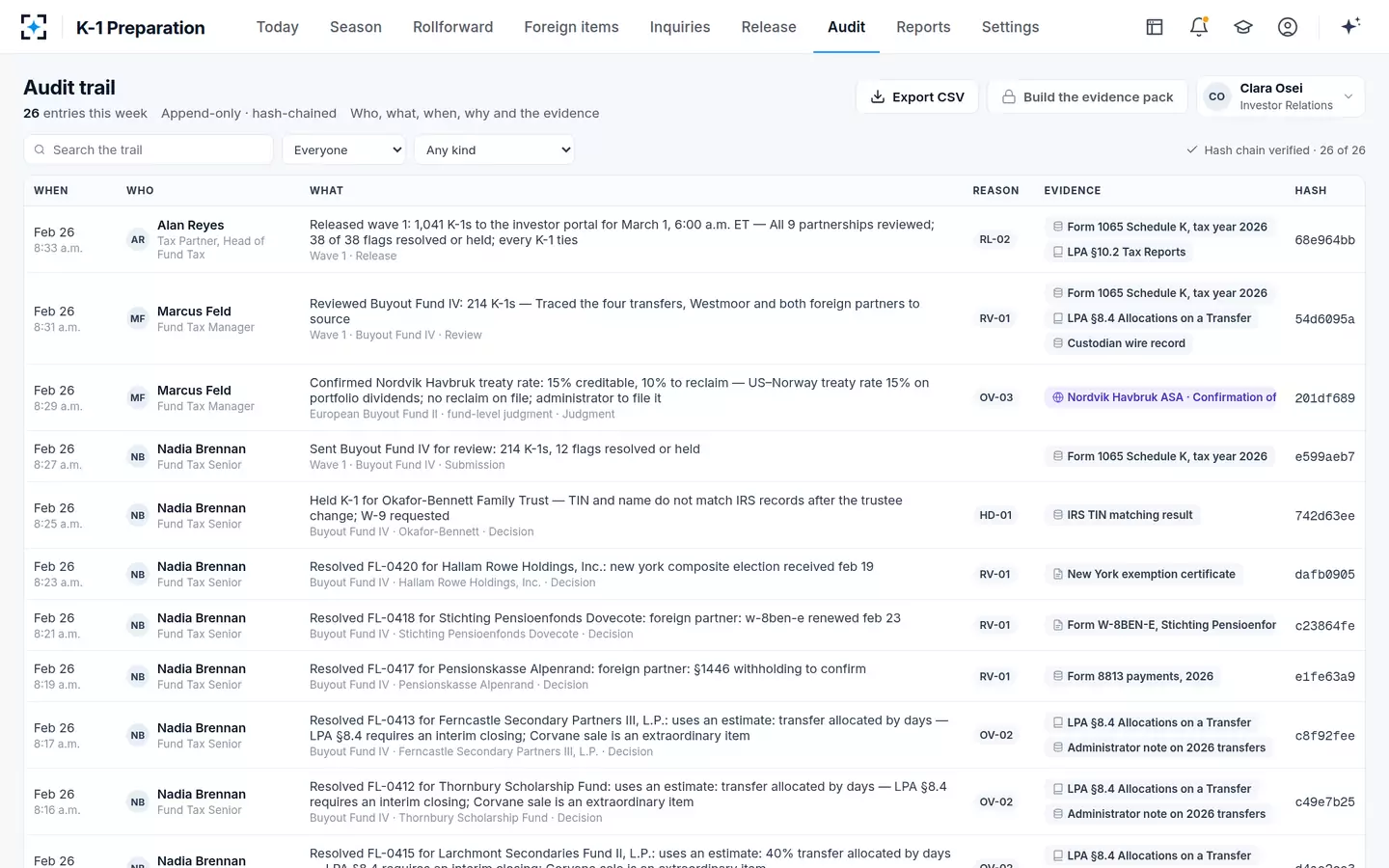
The solution is described in full, with every screen, at K-1 Preparation. If the question is whether AI tools in general are ready for this work, the research is summarised in AI tax preparation tools: what the research actually measured.
Questions people ask
What is the best tax preparation software for K-1s?
It depends on which part of the work you need covered. Tax compliance software computes and files the return from allocations it is given; it does not apply an LPA or read foreign documents. For a fund, test any product by replaying last year's K-1s and counting the boxes that differ and why.
Can K-1 software prepare Schedule K-3?
Most tax software can produce the form; the hard part is the inputs, foreign-source income and taxes read from portfolio documents. Ask whether the tool reads those documents itself, cites the page, and stops for a person when creditability is unclear.
Does K-1 software replace the fund administrator?
Not this kind. The administrator keeps the books and the investor register; K-1 software works from them. K-1 Preparation checks the administrator's files, rejects incomplete ones, and explains where its tax reading differs from the administrator's book reading.
Who is responsible if software gets a K-1 wrong?
The partnership: it must furnish correct K-1s, and the penalty for an incorrect one is $340 a statement for K-1s due in 2026. The preparer's professional duty of diligence also stays with the preparer, which is why review and release should remain human acts.
How long does it take to set up K-1 software for a fund?
Mostly as long as it takes to gather the inputs: books, LPAs and side letters, the partner file, prior-year capital and lower-tier K-1s. A parallel run on last year's K-1s is the step that proves the setup; plan for it before the season, not during it.