The interim closing method and the proration method are the two ways a partnership can share a year's income when a partner's interest changes mid-year, and the regulation that governs them, Treasury Regulation section 1.706-4, makes interim closing the default: "Absent an agreement of the partners ... to use the proration method, the partnership shall use the interim closing method." Interim closing splits the year at each change and gives each partner the income actually earned while they held the interest; proration spreads a period's income evenly over its days. For an investment fund, where a portfolio company may be sold in May and an interest transferred in June, the two can put very different amounts on the buyer's and the seller's K-1s, while the fund's totals stay the same. Botminds' K-1 Preparation applies the method the partnership agreement requires, and where the fund administrator has used a different one it computes both and waits for the tax senior to choose.
Quotations are from the regulation as it stands in the eCFR, 26 CFR 1.706-4. Worked numbers come either from the regulation's own example or from fictional sample data in the solution, and are labelled as such.
Interim closing method vs proration method, rule by rule
Interim closing method: The default for every variation unless the partners agree otherwise.
Proration method: Only by "agreement of the partners": a dated, written statement, which can be the partnership agreement itself.
Interim closing method: The books are closed at each variation; each segment's actual income, gain, loss and deduction go to the partners who held interests during it.
Proration method: A segment's items are spread over its proration periods in proportion to their days, then shared by the interests held in each period.
Interim closing method: Calendar day, or by agreement the semi-monthly or monthly convention, used the same way for every interim-closing variation that year.
Proration method: Calendar day only.
Interim closing method: Allocated to whoever held the interest at the time of day the item occurred.
Proration method: The same: extraordinary items "may not be prorated".
Interim closing method: A profit and loss for every segment of the year.
Proration method: One profit and loss per segment and a day count.
Interim closing method: Nobody in general: income follows the date it was earned.
Proration method: Nobody in general: income follows time held, whenever it was earned.
What is the interim closing method?
It is closing the partnership's books at the moment a partner's interest changes, as if the year ended there, and sharing each piece of the year among the partners who were there for it. The statute gives the principle, that each partner's share must be determined by a method "which takes into account the varying interests of the partners in the partnership during such taxable year" (26 U.S.C. 706(d)(1)); the regulation gives the mechanics.
Those mechanics have a vocabulary worth using precisely. A variation is any change in a partner's interest from a disposition, a reduction, or "the entry of a new partner". A segment is a part of the year between interim closings; with no interim closing, the whole year is one segment. A proration period is a part of a segment created by a variation for which the partnership chose proration. The regulation then prescribes ten steps in order: check the exceptions, pull out extraordinary items, choose a method for each variation, apply the convention, decide on any regular monthly closings, define the segments, apportion items to segments, define proration periods, prorate within segments, and finally compute each partner's share.
The Form 1065 instructions put the rule plainly for preparers: "Partnership items are allocated to a partner only for the part of the year in which that person is a member of the partnership", and for each change "the partnership will either allocate its items using a proration method or a closing-of-the-books method" (IRS, 2025).
Which method applies if the LPA is silent?
Interim closing. Proration is available only by an "agreement of the partners", and the regulation defines that term narrowly: either "an agreement of all the partners ... in a dated, written statement maintained with the partnership's books and records, including, for example, a selection that is included in the partnership agreement", or a selection made by a person authorized to make it, including under a general grant of authority in state law or the partnership agreement, again in a dated, written statement. Either way, the written agreement "must be maintained with the partnership's books and records by the due date, including extension, of the partnership's tax return" (26 CFR 1.706-4(f)).
"The partnership may use different methods (interim closing or proration) for different variations within each partnership taxable year."
26 CFR 1.706-4(a)(3)(iii)
Three consequences follow for a fund tax team. First, an administrator's habit is not an agreement: if the administrator prorated by days and nobody with authority signed a dated selection, the default has not been displaced. Second, a general partner's authority under the LPA can be used to select proration, but the selection still needs to be written and dated, and kept with the books by the extended due date. Third, the choice is per variation, so a fund can prorate routine transfers and close the books around a transfer that straddles a large realisation, provided the selection says so.
Conventions: when the regulation deems a change to happen
A convention decides the date a variation is treated as occurring, and it can move income as much as the method does. Under the calendar day convention a variation happens "at the end of the day on which the variation occurs". Under the semi-monthly convention a change on the 1st to the 15th is deemed to occur at the end of the previous month, and one on the 16th or later at the end of the 15th. The monthly convention treats a change in the first half of a month as occurring at the end of the previous month, and one in the second half at the end of the month. Proration must use the calendar day convention; the other two are available only for interim closing, by agreement, and must be used for all interim-closing variations that year.
The regulation's own example, finished: who gets the $75,000 of ordinary income
| Partner | Jan 1 – Apr 16 (106 days) | Apr 17 – Jul 31 (106 days) | Aug 1 – Dec 31 | Total |
|---|---|---|---|---|
| A (sells half to D on April 16) | 1/3 of $30,000 = $10,000 | 1/6 of $30,000 = $5,000 | 1/6 of $15,000 = $2,500 | $17,500 |
| B (sells half to E on August 6) | $10,000 | 1/3 = $10,000 | 1/6 = $2,500 | $22,500 |
| C | $10,000 | $10,000 | 1/3 = $5,000 | $25,000 |
| D (buys from A) | — | 1/6 = $5,000 | 1/6 = $2,500 | $7,500 |
| E (buys from B) | — | — | 1/6 = $2,500 | $2,500 |
The example shows the semi-monthly convention at work. B sold on August 6, but the convention moves the closing back to July 31, so B gets none of August's income on the half sold and E gets all of it. Under the calendar day convention the books would have closed at the end of August 6, and B would have kept its full third of the first six days of August.
What is an extraordinary item for a partnership?
It is an item that must be allocated to the partners who held interests at the exact time of day it occurred, whatever method and convention the partnership otherwise uses. "Extraordinary items may not be prorated" (26 CFR 1.706-4(e)). The list includes items from the disposition of a capital asset or section 1231 property outside the ordinary course of business, from the discharge of indebtedness, from a tort settlement or judgment, items from a change of accounting method filed after a variation, any item the partners agree to treat as extraordinary that year, and any item that would substantially distort income if prorated.
For a buyout fund the first entry is the one that matters: the sale of a portfolio company is a capital asset disposed of outside the ordinary course of business. The regulation's example is pointed: partner A sells at 9:00 a.m., the extraordinary item happens at 3:00 p.m., partner B sells at 5:00 p.m., and the item is allocated to B and to A's buyer, "but no portion will be allocated to A or E".
A small item exception keeps the rule from swamping the books. A class of extraordinary items can be treated as ordinary if, for the year, it totals less than 5% of the partnership's gross income (or gross expenses and losses, for loss items), and all classes treated that way together do not exceed $10 million. A large portfolio exit fails both tests easily.
A worked transfer: the same sale, two K-1s
The numbers move. Take a fictional sample transfer as it runs through K-1 Preparation: the Thornbury Scholarship Fund sells its whole interest in Buyout Fund IV to Ferncastle Secondary Partners III on June 30, 2026. The administrator prorated the year by days, 181 of 365. The fund's LPA, at §8.4, requires an interim closing, and the fund sold a portfolio company, Corvane, on May 14, an extraordinary item that follows the clock under either method.
Thornbury's Box 9a, net long-term capital gain, under each reading
Proration or interim closing: both readings, side by side
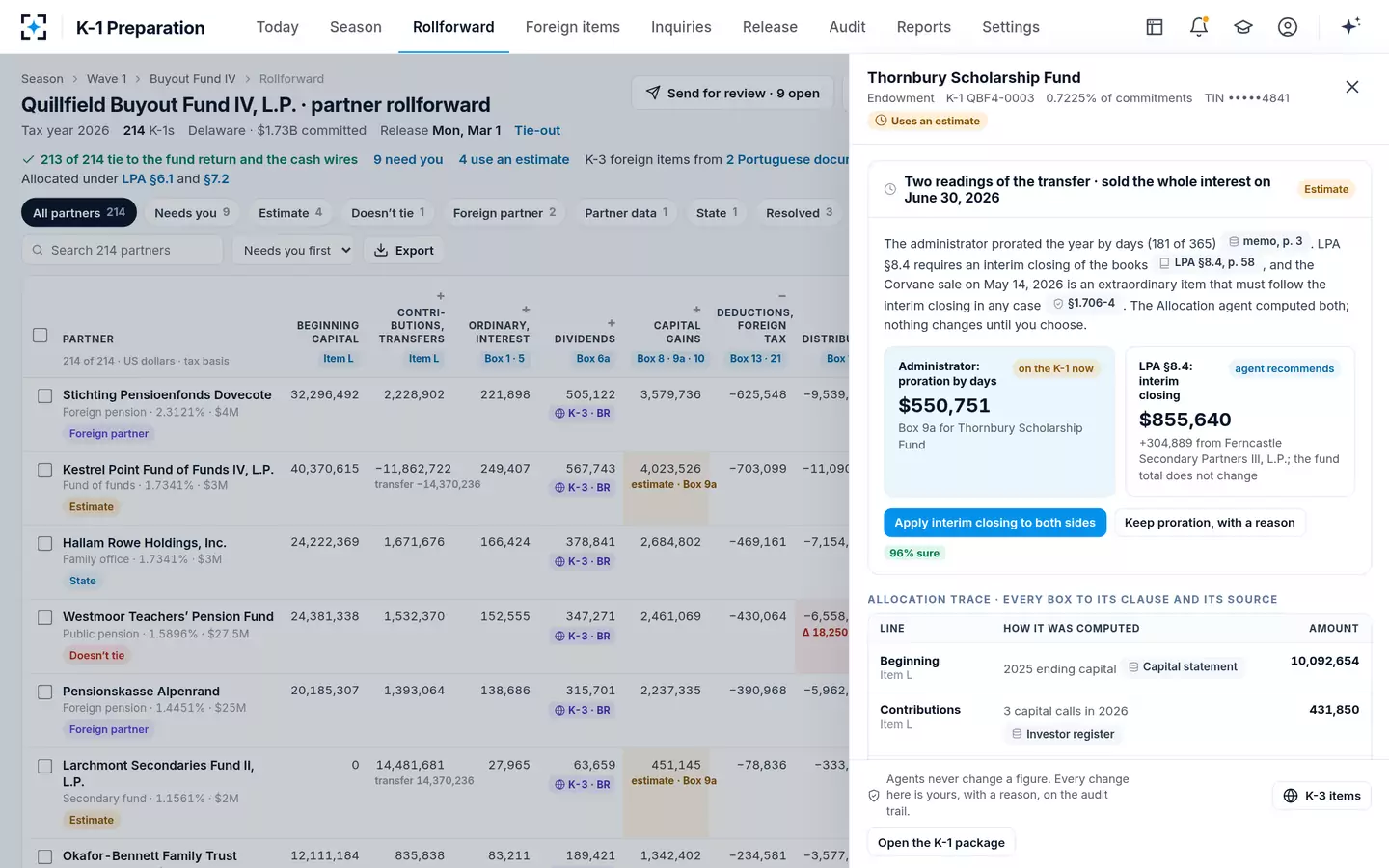
Why does interim closing favour the seller here? Because most of the year's gain came from the May sale, before the transfer, and an interim closing gives May's gain to whoever held the interest in May. Proration would have given Ferncastle nearly half the year's gain for owning the interest from July. In a year when the big exit comes in the autumn the effect reverses. Neither method is generous; each is a rule about time, and the right one is the one the partners agreed to in writing.
The same logic covers a fund's later closings. A new limited partner admitted at a second closing is a variation ("the entry of a new partner"), and the regulation's methods apply to it. How an LPA deals with later closers commercially, with equalisation payments or catch-up allocations, is a question for the fund's counsel and tax adviser; the tax point is that the method for each variation must be chosen and documented, not inherited from a spreadsheet.
What the K-1 must show for a partner who joined or left
Item J of the K-1 reports each partner's share of profit, loss and capital at the beginning and end of the year. "If a partner's interest commences after the beginning of the partnership's tax year, enter in the 'Beginning' column the percentages that existed for the partner immediately after admission", and for a partner who left, the ending column shows the percentages "immediately before termination" (IRS, 2025). Where a share fell, the partnership checks a "Sale" box for a taxable sale of an interest or an "Exchange" box for a nontaxable one.
Item L, the capital account, has its own transfer rule: the buyer's capital account starts from the seller's tax-basis capital for the interest transferred. Both sides of a transfer therefore have to agree to the dollar, which is why tax basis capital account reporting and the allocation method are checked together.
What the file should hold before the K-1s go out
Evidence for every variation in the year
- A log of variations with dates and times
Transfers, redemptions, later closings and partial sales, each with the clause that governed it.
- The method chosen for each variation, and why
Interim closing unless a dated, written agreement selected proration for that variation.
- The agreement itself, kept with the books by the extended due date
An LPA clause, a written consent of all partners, or a dated selection by an authorized person.
- The convention, applied the same way to every interim-closing variation
Calendar day unless the partners agreed to semi-monthly or monthly.
- A list of extraordinary items with the time each occurred
And the small item test, if any class is treated as ordinary.
- A profit and loss for every segment
Interim closing is only as good as the closing; a segment without its own books is proration by another name.
How K-1 Preparation handles a transfer the administrator prorated
The Allocation agent applies each LPA's method to every partner and every box: targeted capital accounts, the waterfall, transfers, later closers and excused investments. Two limits are written into it: it never changes an allocation method, and where the LPA and the administrator differ it computes both and waits. In the sample season it found four rows in Buyout Fund IV on the administrator's proration where §8.4 required an interim closing.
One decision applied to four transfer rows, each logged on its own
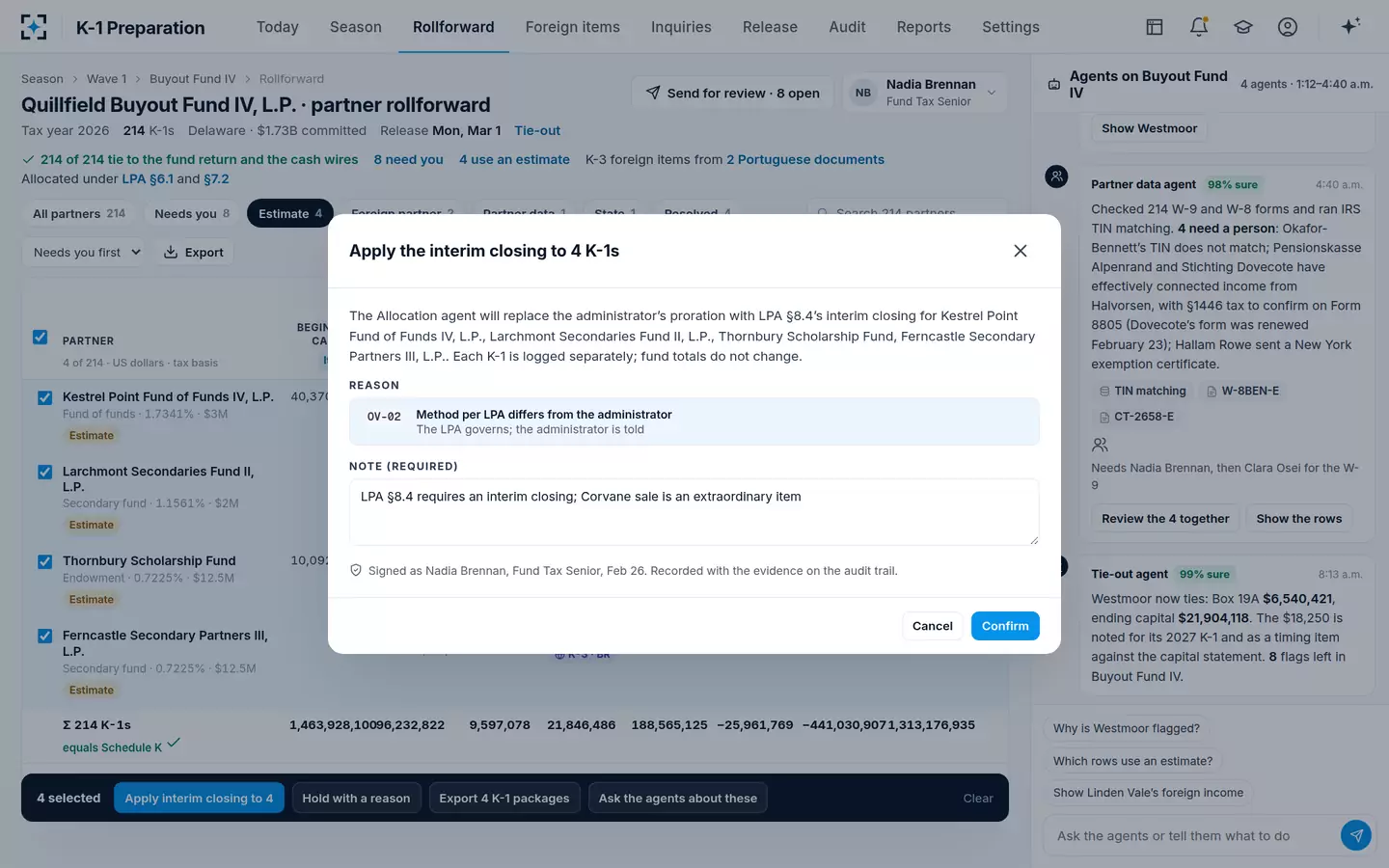
The choice stays with a person because the agreement question is a legal reading, not arithmetic. A dated consent may exist outside the documents the agents can see; a side letter may have changed a clause. What software can do is make the difference impossible to miss and the evidence quick to check. The broader line between what agents take and what preparers keep is drawn in K-1 preparation software; the solution itself is at K-1 Preparation.
Questions people ask
What is the interim closing of the books method for a partnership?
It closes the partnership's books at each change in a partner's interest and allocates each segment's actual items to the partners who held interests during it. Under 26 CFR 1.706-4 it is the default method; the partnership uses it unless the partners agree in a dated, written statement to prorate.
Can a partnership use proration for one transfer and interim closing for another?
Yes. The regulation lets a partnership use different methods for different variations in the same year, though the IRS may restrict this in published guidance. If interim closing uses the semi-monthly or monthly convention, that convention must be used for every interim-closing variation that year.
Does the method change the fund's total income?
No. The method decides how the year's items are split among partners whose interests changed; the partnership's totals on Schedule K are the same either way. In the sample transfer, $304,889 of net long-term capital gain moves between the seller and the buyer and the fund total does not move.
What is the varying interest rule?
It is section 706(d)(1): when any partner's interest changes during the year, each partner's distributive share must be determined by a method, prescribed by regulation, that takes the varying interests into account. Section 1.706-4 is that regulation, and it supplies the two methods, the conventions and the extraordinary item rules.
Is the sale of a portfolio company an extraordinary item?
Generally yes, if it is a disposition of a capital asset outside the ordinary course of business, which a buyout fund's exit usually is. It is then allocated to whoever held interests at the time of day it occurred, unless the small item exception applies: the class is under 5% of gross income and all such classes together are no more than $10 million.