LP onboarding software is software that checks limited partners' subscription packages, the booklet, KYC papers, tax forms and wire instructions, before a private fund closes. Vendors don't publish prices for most of it, and no regulator or independent study publishes what it costs a fund to check one subscription by hand, so the only sound business case is one built from your own close. The cost of a booklet has three parts: reviewers' hours, the rework loops each gap triggers, and the rare error that costs more than the whole close, a diverted wire, a sanctioned investor or a fund pushed over the ERISA 25% line. Botminds' LP Onboarding is built to lower all three, and this page shows how to measure whether it, or anything else, does.
The figures used for the solution are Botminds' design estimates and targets on fictional sample data, Quillfield Private Credit Fund IV's 84-investor first close; they are not a customer's measured results. Wage and loss figures come from the Bureau of Labor Statistics, the FBI, the SEC and OFAC.
Where a close's package-review days go by hand: our estimate for an 84-investor first close
How much does LP onboarding software cost?
There is no public price list to compare, so the question to answer first is what checking a subscription costs you now. Quotes may be per fund, per close or per investor, and they are hard to compare because each covers a different slice of the work: a portal that collects booklets, a screening service that checks names, or a checking tool that reads and compares. Put each quote against the same unit, the cost of taking one booklet from arrival to countersignature, and against the parts of that cost it actually changes.
The comparison has to include what a tool leaves undone. A portal that enforces required fields lowers incomplete pages but does not read a scanned trust deed or recompute the 25% test; a screening service lowers list-checking time but not cross-checking. A business case that credits a tool with the whole review because it touches the whole review will not survive its first close.
What does it cost to check one subscription by hand?
It is the reviewers' time on the booklet and its rework, priced at their loaded cost, plus counsel's time, plus the expected cost of the errors that get through. The labour part is smaller than most people expect. The Bureau of Labor Statistics puts the median annual wage for compliance officers at $80,730 in May 2025, with about 436,400 jobs (BLS Occupational Outlook Handbook, 2025), about $38.81 an hour over a 2,080-hour year before benefits and overhead.
The cost of checking one subscription, written as a sum
First review
hours to read and cross-check × loaded rate
Reading every section, comparing the booklet with the KYC file, tax forms and side letter.
Investor operations
Rework loops
fix requests per booklet × hours per loop × loaded rate
Each loop is a drafted request, an approval, a chase and a second review.
Investor operations and IR
Acceptance
counsel’s minutes × counsel’s rate
Counsel’s review falls when only ready packages reach it, with every closed gap shown.
Fund counsel
Expected error cost
chance an error gets through × what it costs
A diverted wire, a sanctioned investor admitted, a class over 25%, a tax form wrong at reporting time.
CFO, AML officer
A worked illustration makes the scale clear. Suppose, on your own time study, a booklet takes three hours of first review and averages one and a half fix loops of 45 minutes each. That is about 4.1 hours, or roughly $160 at the BLS median compliance wage before overhead, and about $13,400 for 84 booklets. Those inputs are illustrative, chosen for round arithmetic, not a benchmark; your own may be double. Even doubled, the labour bill for a close is small beside one wire diverted at the close.
Where do the hours go in a booklet review?
Mostly into reading, comparing and chasing, the parts a person repeats for every booklet. In Botminds' estimate for an 84-investor first close, those three account for two-thirds of the review days by hand. With agents doing the reading and comparison, the remaining time shifts toward the steps that should take a person's time: counsel's acceptance and the countersignature, and the fix requests that still need an investor to reply.
The same close's review days, by hand and with LP Onboarding
By hand · 9 days
- Logging and reading · 33.3%
- Cross-checking · 22.2%
- 25% test and call-backs · 11.1%
- Fix requests · 22.2%
- Counsel and signature · 11.1%
With the solution · 1.8 days
- Logging and reading · 16.7%
- Cross-checking · 16.7%
- 25% test and call-backs · 11.1%
- Fix requests · 27.8%
- Counsel and signature · 27.8%
Two things in that split matter more than the total. Fix requests barely shrink in absolute terms, because an investor still has to reply; what software changes is when the gap is found, on the morning a booklet arrives rather than days later. And counsel's share rises because the rest falls, which is where a fund wants its scarce senior time to go.
What does one missed error cost?
Far more than the review, which is why the expected-error term usually decides the business case. No source gives the chance of each error at a private fund close; the records below give what each kind has cost when it happened.
What one error at onboarding has cost, from regulators' and the FBI's records
| Error | Record | What it cost |
|---|---|---|
| Payment instructions changed by a fraudster | FBI IC3, 2025: business email compromise, 24,768 complaints | $3,046,598,558 in total, about $123,000 per complaint on average (our arithmetic) |
| Email thread hijacked at an investor-servicing firm | SEC v. Equiniti Trust Co., press release 2024-101 | More than $6.6 million of client funds lost, later reimbursed by the firm; $850,000 civil penalty |
| Sanctioned investor kept on through a proxy | OFAC penalty on GVA Capital, 12 June 2025 | $215,988,868, the statutory maximum |
| A class over 25%: fund assets become plan assets | Internal Revenue Code §4975(a) | A first-tier tax of 15% of the amount involved in each prohibited transaction, for each year in the taxable period |
The table also shows what kind of control each error needs. Wire fraud is stopped by a call-back to a number on file and two approvers, not by faster reading. A sanctioned owner is caught by screening every owner and comparing the ownership chart with the signatory list. A 25% breach is prevented by recomputing the share on each booklet before acceptance. A tool that reads quickly but has none of those controls lowers the first term of the formula and leaves the fourth where it was.
Is it cheaper to outsource onboarding to the administrator?
It can be cheaper in hours; it is not cheaper in responsibility, so part of the cost stays in house either way. Treasury notes that fund administrators handle subscriptions and that many also conduct due diligence on potential investors (Treasury, 2024 Investment Adviser Risk Assessment). But FinCEN's adviser AML rule, effective 1 January 2028, leaves the adviser fully answerable for the programme when it delegates (FinCEN, 89 FR 72156), and a UK firm that relies on a third party for due diligence stays liable for any measure that is not applied (MLR 2017, regulation 39); AML outsourcing to a fund administrator sets the two side by side.
FinCEN's own estimate of the 2024 adviser rule gives a sense of the burden being formalised: about $408 million in one-time costs and about $278 million a year thereafter across the advisers it covers. A fund that outsources still needs its own AML officer to review the high-risk files, its CFO to own the benefit-plan share and its counsel to accept packages, and it pays for the administrator's review on top. The comparison is therefore not administrator against software, but the administrator's work with or without a checking layer the fund's own seats can see.
How to measure cost per booklet on your own close
Use the close you finished most recently; you know how it ended. Five measurements give every term of the formula, and none needs a vendor.
Measure the cost of a booklet from your last close
- Count booklets and fix requests, by section.
From the email or portal log. Fix requests per booklet is the rework term; the section tells you why.
- Time-study ten booklets end to end.
First review, each loop and counsel’s acceptance, in hours. Price them at your loaded rates.
- Record the day each gap was found against the day the booklet arrived.
The lag is what turns a gap into a missed close.
- List every error found after acceptance.
Wire returns, tax forms rejected at reporting time, KYC reopened, a benefit-plan share restated.
- Price your tail risks from your own controls, not from averages.
For each error type, ask which control would stop it and whether you have it on every package.
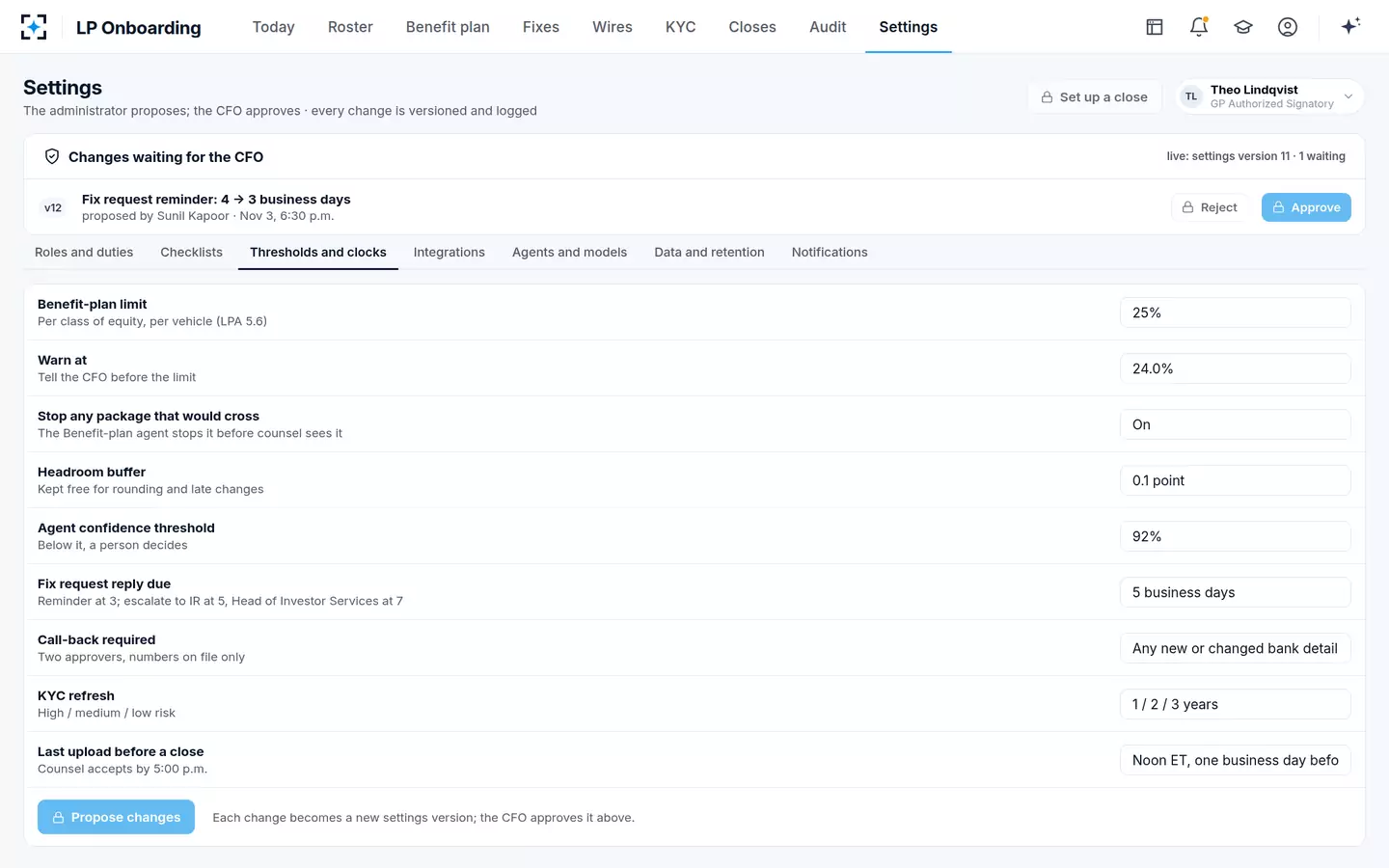
The reply clock and the call-back rule, as settings in LP Onboarding
How to read a vendor's return-on-investment claim
Read it as a claim about someone else's close until it is shown on yours. Figures for subscription packages "in good order on the first pass", or for the cost of an investor KYC review, circulate widely in this market, but no regulator or independent study publishes either, and the published versions trace back to vendors' and administrators' own surveys. That does not make them wrong; it makes them untestable, and a business case built on an untestable baseline cannot show later whether the tool delivered.
Four questions separate a claim from a measurement. Whose files was it measured on, and can you see them? What was the baseline, and was it measured the same way before and after? Does the claim count only the tasks the tool does, or the whole close? And does it say how many errors the tool missed, not only how many it found? A vendor who answers all four with your own last close has given you a measurement. Botminds' figures for LP Onboarding are labelled for that reason: estimates and design targets on fictional sample data, which a pilot on your own booklets either confirms or does not.
What LP onboarding software lowers, and what it does not
Good software lowers the first two terms and, through its controls, the fourth; it barely touches the third, and it cannot make investors reply faster. In LP Onboarding the agents read every booklet in its own language with each field cited, cross-check it against the KYC file, tax forms and side letter, keep the ERISA 25% test live, call back on new bank details to numbers on file and draft every fix request. Botminds' design targets are 80% or more of packages in good order on first review and no benefit-plan, PEP or wire exception reaching the countersignature; they are targets, to be measured on your own closes.
What it does not lower: the time an investor takes to find a missing document, counsel's judgement on a side letter, or the negotiation of terms. Nor does it replace the screening data, the portal or the administrator's register it works with. Where most of a fund's delay is investors not replying, the bigger saving is in finding the gap on day one, which is a matter of timing, not of cost per hour.
What needs the specialist today, and what the agents already did
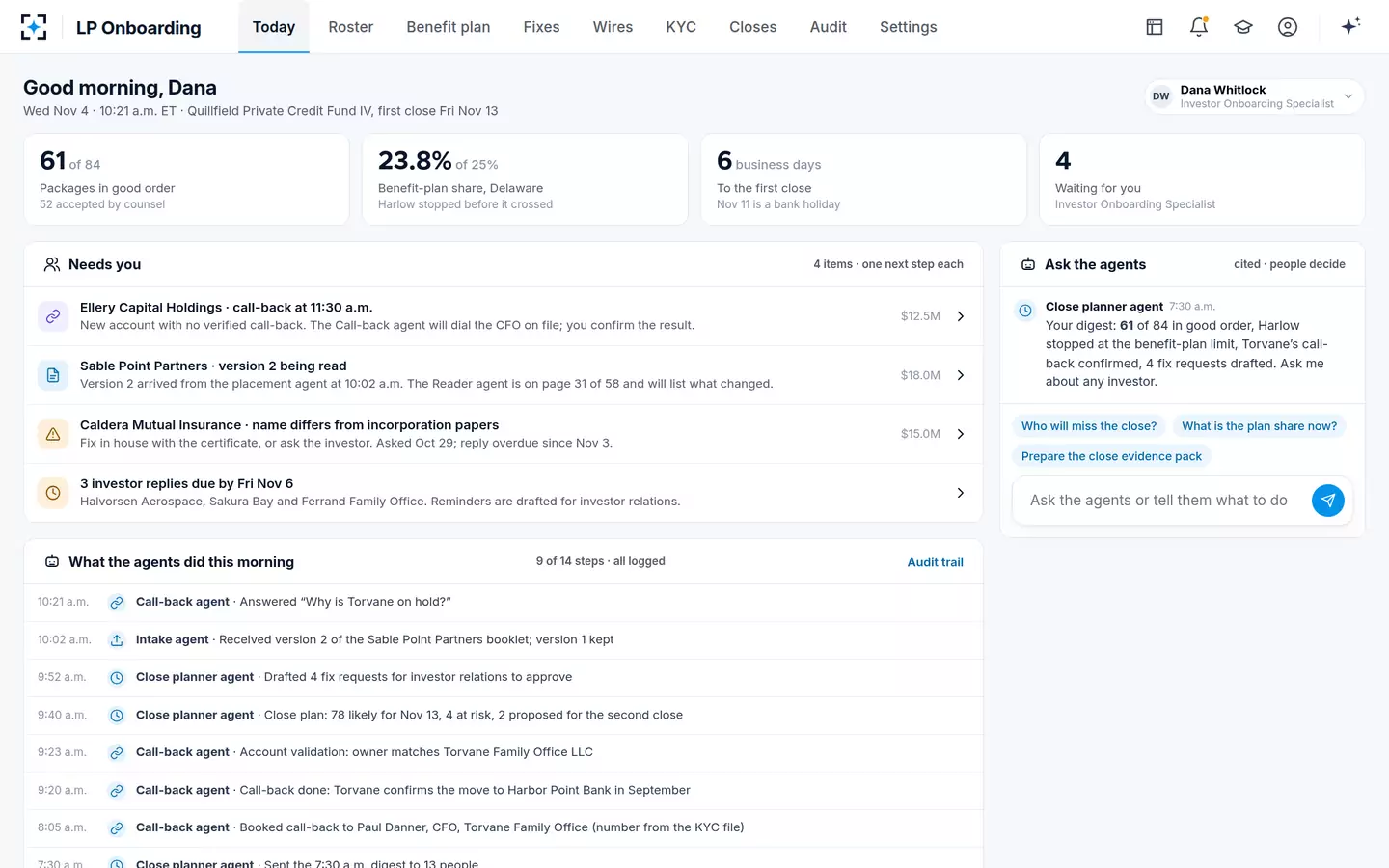
A cost model is only as good as its test. Running a pilot on your last close gives the before-and-after numbers for your own booklets, and which close tasks move to AI agents shows which terms each agent addresses. To build the case on your own packages, start from LP Onboarding.
Questions people ask
Is there free LP onboarding software?
Free tools exist for collecting documents and e-signatures, and a spreadsheet can hold a 25% calculation. What free tools rarely do is read and compare papers, recompute the benefit-plan share with look-through, or enforce call-backs and maker-checker; those are the parts that carry the error cost.
How do you compare LP onboarding software?
On the same unit and the same files: run each candidate on a past close and compare cost per booklet, errors caught, false alarms and the day each gap was found. A comparison of feature lists rewards the tool that collects the most, not the one that checks best.
What is the biggest hidden cost in LP onboarding?
Late discovery. A gap found the morning a booklet arrives costs one fix request; the same gap found the day before the close can cost an investor's place in it. In the sample fund, fix requests are due back in five business days, so anything found later than a week out is already at risk.
Does LP onboarding software reduce wire fraud?
Only if it enforces the controls that stop it: a call-back to a number on file, never one sent with the change, and two approvers. Business email compromise cost $3.05 billion in 2025 by the FBI's count; reading speed does nothing about it.
Who should own the business case for LP onboarding software?
The CFO or COO, with the head of investor services, because the costs sit in several budgets: operations hours, counsel's fees, the administrator's charges and the fund's risk. The case is strongest when each line is measured on the fund's own last close.