Passthrough subscription documents are the parts of a private fund's subscription booklet that an investor which is itself a pooled vehicle, a fund of funds, a feeder, a family partnership or a nominee, must complete about its own investors rather than about itself. They exist because several of the rules a fund must satisfy look through such an investor to the people and plans behind it: the Investment Company Act's 100-holder count, the ERISA benefit-plan share, the tax form the investor must give and, in some cases, the identity checks. Each rule looks through in a different way and at a different threshold, so a booklet answered only for the entity can be complete and wrong at once. Botminds' LP Onboarding reads those pages, applies section 3(42) look-through for plan-asset entities and checks each answer against the investor type before counsel sees the package.
The worked example on this page is illustrative: a fund of funds with figures chosen to show each rule, not taken from a real investor. Screens come from the solution's fictional sample close, Quillfield Private Credit Fund IV.
One fund-of-funds booklet, five look-through tests
Holder count, 3(c)(1)
Looks through whenThe investing company owns 10% or more of the fund’s voting securities and is itself an investment company or a 3(c)(1) or 3(c)(7) fund
ThenIts own holders are counted toward 100, not the company as one
On this bookletHolds 12%: its 140 holders are counted, and the fund passes 100 on this booklet alone
Qualified purchaser, 3(c)(7)
Looks through whenThe company was formed for the specific purpose of investing in the fund
ThenIt qualifies only if each of its own owners is a qualified purchaser
On this bookletWere the vehicle a 3(c)(7) fund: formed years earlier, invests over $25M on a discretionary basis, so it qualifies in its own right
Benefit plan investor, ERISA 3(42)
Looks through whenIts own benefit plan investors hold 25% or more of a class, so its assets are plan assets
ThenIt counts only to the extent of its benefit-plan percentage
On this booklet31% of its equity held by plans: $6.2M of its $20.0M counts toward the fund’s 25%
Tax form
Looks through whenIt is a foreign partnership or other flow-through entity, or receives payments for others
ThenForm W-8IMY with a withholding statement, not a W-8BEN-E
On this bookletCayman partnership: W-8IMY plus a statement allocating payments to its partners
KYC and ownership
Looks through whenIt is the fund’s customer, a legal entity with owners and a controller
ThenIts 25% owners and one control person are identified; for a regulated fund, its administrator’s written confirmation may stand in
On this bookletNo 25% owner; GP’s managing member as control person; administrator’s confirmation on file
What are passthrough subscription documents?
They are look-through questions: pages, or an annex, in which an entity investor states facts about its owners that the fund needs for its own exemptions. The phrase is the market's, not a regulator's; no rule defines it. In a typical booklet the entity sections ask whether the investor is itself an investment company or relies on section 3(c)(1) or 3(c)(7), how much of the fund it will own, whether it was formed to make this investment, whether its assets include plan assets and to what percentage, and whether it receives payments on behalf of others.
The answers matter because they change the fund's position, not only the investor's. Treasury's 2024 risk assessment describes aggregators and feeders that "help consolidate investments from high-net worth individuals or institutional investors" for placement into private funds those investors could not reach on their own (Treasury, 2024 Investment Adviser Risk Assessment). One booklet from such a vehicle can carry dozens or hundreds of people and plans into the fund.
When does a fund look through an investing entity?
When a rule says so, and each rule says so differently. The holder count looks through a company that owns 10% or more of the fund's voting securities and is itself an investment company or a private fund. The qualified-purchaser rule looks through a company formed for the purpose of investing. The ERISA test looks through an entity whose assets are plan assets, and only to the extent of its plan percentage. The tax rules look through an intermediary or flow-through entity to the payees behind it. The KYC rules look through to the individuals who own or control the entity.
The thresholds do not line up: 10% for the holder count, 25% for plan assets, 25% for beneficial ownership under the US customer due diligence rule, and no threshold at all for the formed-for-the-purpose test. An investor can trigger one look-through and not another, which is why each needs its own question in the booklet and its own check on the answer.
Does a fund of funds count as one holder under 3(c)(1)?
Usually, but not if it owns 10% or more of the fund's voting securities and is itself an investment company, or would be but for section 3(c)(1) or 3(c)(7). Then the beneficial ownership "shall be deemed to be that of the holders of such company's outstanding securities" (15 U.S.C. 80a-3(c)(1)(A)). In the illustration, the fund of funds would hold 12% and is itself a private fund, so its 140 investors count toward the 100 limit, and this single booklet would take a 3(c)(1) vehicle over it.
The remedies are structural, which is why the question belongs in the booklet and not in a post-close review. The fund can cap the investor below 10% of voting securities, place it in a 3(c)(7) parallel vehicle if its investors qualify, or decline. In LP Onboarding the investor's stated holding and status are read from the booklet with their page, and the holding is recomputed against the vehicle as commitments change at the close.
Is a fund of funds a benefit plan investor?
Only if its own assets are plan assets, which means benefit plan investors hold 25% or more of a class of its equity; and then only in part. ERISA section 3(42) counts as a benefit plan investor "any entity whose underlying assets include plan assets by reason of a plan's investment in such entity", and limits how much of it counts:
“An entity shall be considered to hold plan assets only to the extent of the percentage of the equity interest held by benefit plan investors.”
ERISA §3(42), 29 U.S.C. 1002(42)
So a fund of funds 31% owned by benefit plan investors counts 31% of its commitment, $6.2 million of $20.0 million in the illustration, toward the fund's 25% test. A fund of funds whose own benefit-plan share is under 25% generally holds no plan assets and counts nothing, unless some other basis applies; that is a question to put to the investor's counsel, not to assume. The booklet's ERISA page should therefore ask an entity two things: whether its assets include plan assets, and, if so, the percentage. The sample booklet's section 4.2 does exactly that, with a blank for the percentage.
The ERISA page in LP Onboarding, with the plan-asset entity box and its percentage
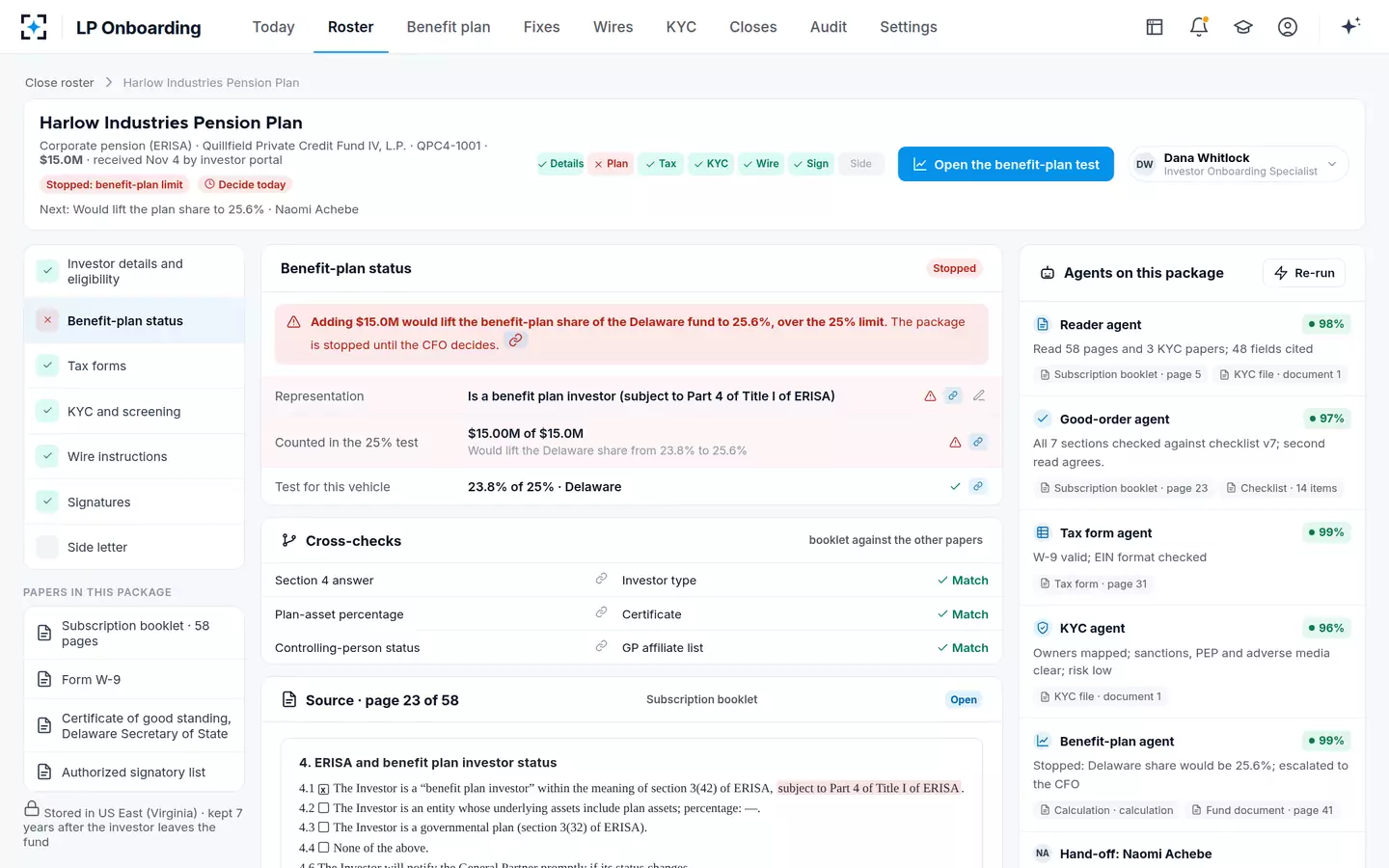
The percentage is not static. A fund of funds that accepts new pension money between the first and second close of the fund it invests in can cross 25% itself, at which point it becomes a plan-asset entity and starts to count. The main fund's booklet should require the investor to notify a change, and the main fund should ask again at each close.
Why does an intermediary give a W-8IMY instead of a W-8BEN-E?
Because it is not the beneficial owner of what it receives. A W-8BEN-E certifies the status of a foreign entity receiving payments for its own account. The IRS instructions direct an entity to provide Form W-8IMY instead when it receives a reportable amount or withholdable payment on behalf of another person or as a flow-through entity, such as a foreign partnership, a foreign simple trust or a foreign grantor trust (IRS, Instructions for Form W-8IMY, revised October 2021).
The W-8IMY usually travels with a withholding statement, which allocates each payment the intermediary receives among its payees, and with the payees' own forms. For a fund, that means a passthrough investor's tax documentation is not one form but a set, and its completeness depends on people the fund never deals with. What makes a W-8IMY and its withholding statement complete is a matter for the fund's tax adviser; how each W-8 in the set is checked field by field is traced in W-9 validation and W-8 checks.
Whose KYC does the fund need — the feeder's or its investors'?
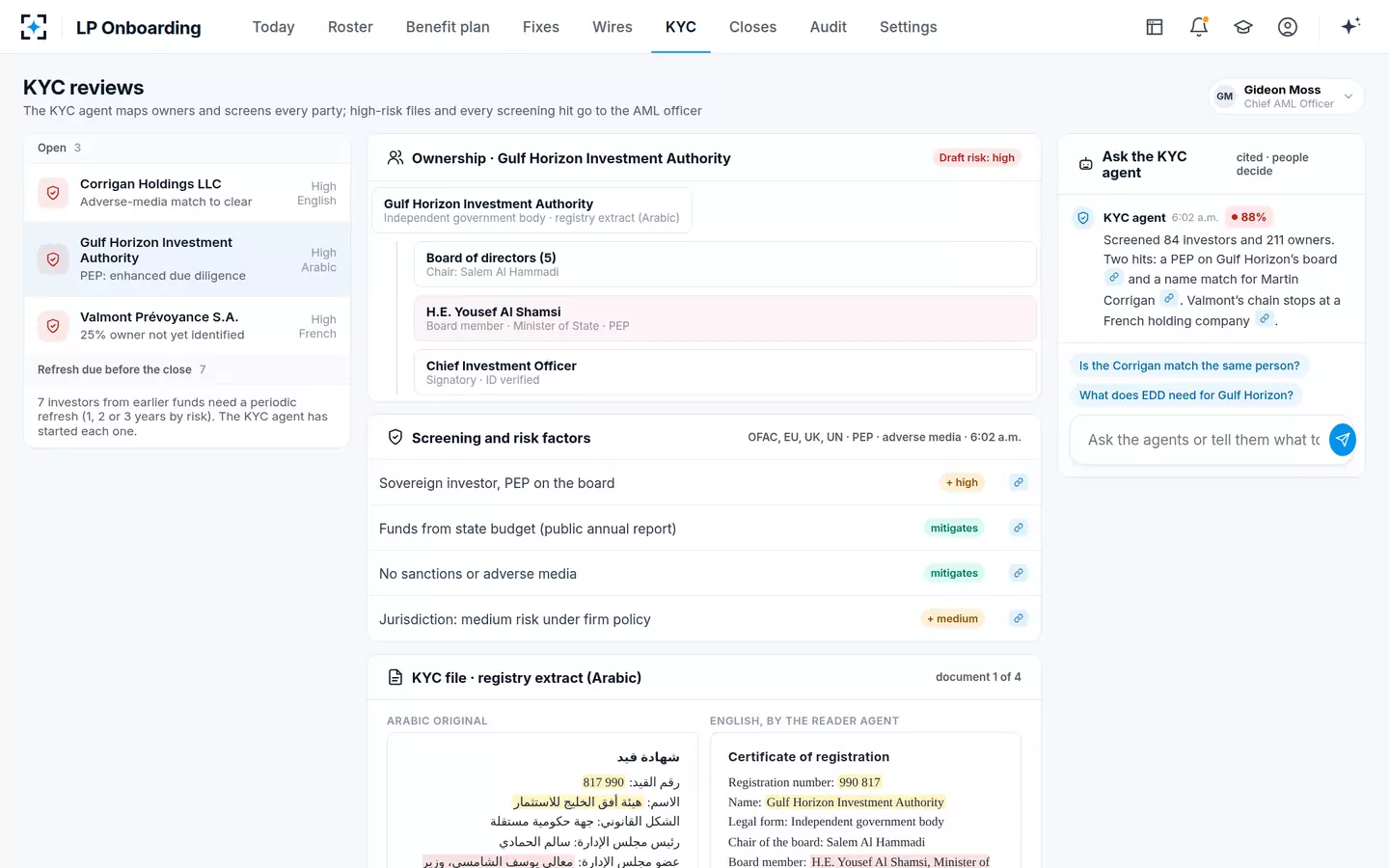
The feeder's, as the fund's customer, including the individuals who own or control it; the feeder's own investors are, in the first instance, the feeder's responsibility. Under the US customer due diligence rule, where it applies, a legal-entity customer's beneficial owners are each individual owning 25% or more of its equity and one individual with significant responsibility to control it (31 CFR 1010.230). A widely held fund of funds often has no 25% owner, which leaves the control person, typically someone at its general partner or manager.
CIMA's guidance for mutual funds and their administrators gives a practical route for an investor that is itself a regulated fund. Where the investor fund is administered in a country the fund assesses as low risk, evidence may be satisfactory if the investor's administrator is subject to anti-money-laundering oversight at home and "confirms in writing that it has obtained and maintains customer verification evidence" under that country's procedures (CIMA Guidance Notes, February 2024). That is a reliance, with the conditions reliance always carries; the fund still owns the decision.
An entity investor's ownership chain in LP Onboarding, mapped and screened
Three look-throughs on one booklet, step by step
A passthrough booklet is best reviewed in the order the look-throughs cascade: holding first, because it decides the holder count; then plan assets, because they decide the 25% share; then the tax set and the ownership file. In LP Onboarding the work divides as follows.
A fund-of-funds booklet through LP Onboarding
Agent
Reader agentReads the entity sections and annex: status, holding, formation date, plan-asset percentage, payee role; cites each to its page
Never: Fill a blank or infer a percentage
Agent
Good-order agentChecks the answers against each other and the investor type: a private fund holding 10% or more must show its holders; a 4.2 answer needs a percentage and certificate
Never: Waives a checklist item
Agent
Benefit-plan agentCounts the entity only to its benefit-plan percentage, and only if its assets are plan assets; recomputes the vehicle’s share
Never: Accepts or scales the commitment
Agent
Tax form and KYC agentsValidate the W-8IMY set; map owners and control person; screen every party
Never: Correct a form or clear a hit
A person decides
SpecialistResolves gaps with the investor’s operations team; marks the package ready
A person decides
AML officer, CFO, counselDecide reliance and risk; any limit question; accept the package
Who answers the passthrough pages, and who relies on them
Today
Signs the entity pages, often from last year’s answers.
With agents
Is asked for the current holding, plan percentage and payee role, with a certificate for the percentage.
Still theirs: Answers for its own investors
Today
Supplies investor data when chased.
With agents
Provides the withholding statement and, where relied on, a written confirmation of its verification.
Still theirs: Holds its investors’ files
Today
Checks that the entity pages are signed.
With agents
Checks that the answers agree with the investor type and with each other.
Still theirs: Marks the package ready
Today
Learn of a look-through problem after the close.
With agents
See the holder count and plan share with this booklet in, before accepting it.
Still theirs: Decide and accept
Look-through thresholds side by side
| Rule | Threshold | What is looked through to | Source |
|---|---|---|---|
| Investment Company Act §3(c)(1) | 10% of voting securities, and the investor is itself a fund | The investor’s own holders, for the 100 count | 15 U.S.C. 80a-3(c)(1)(A) |
| Rule 2a51-3(a) | None: formed for the specific purpose | Each owner must be a qualified purchaser | 17 CFR 270.2a51-3 |
| ERISA §3(42) | 25% of a class of the investor’s own equity | Its benefit-plan percentage only | 29 U.S.C. 1002(42) |
| Withholding and FATCA | Payments received for others, or flow-through status | The payees in the withholding statement | IRS, W-8IMY instructions |
| US customer due diligence | 25% of equity, plus one control person | Individuals who own or control the investor | 31 CFR 1010.230 |
The formed-for-the-purpose test deserves a word of its own, because it has no threshold to warn anyone. A company created to make this investment is not a qualified purchaser in its own right; it qualifies only if each of its owners is (17 CFR 270.2a51-3(a)). How that plays out for trusts and family vehicles is worked through in can a trust be a qualified purchaser? The ERISA arithmetic for the whole vehicle is in the ERISA 25% plan asset rule, and the closing-day tests every investor, passthrough or not, must pass are in the private equity fund close. To see passthrough booklets read on your own packages, start from LP Onboarding.
Questions people ask
What is a passthrough entity in a subscription agreement?
An investor that holds its interest for, or passes its economics through to, other people: a fund of funds, a feeder, a partnership, a grantor trust or a nominee. The booklet asks it to answer certain questions about those people because the fund's exemptions and tax reporting depend on them.
Does a feeder fund count as one investor in the master fund?
For the 100-holder count, only if it owns less than 10% of the master's voting securities or is not itself a fund; a feeder holding 10% or more is looked through to its holders. A master that relies on 3(c)(7) instead avoids the count, but then a feeder formed to invest in it qualifies only if every one of its own investors is a qualified purchaser.
Does a fund of funds need to give the fund its investor list?
Not usually in full. It needs to give the numbers and statuses the rules require: how many holders it has if it is looked through, its benefit-plan percentage, and the payee allocation in a withholding statement. Identity papers for its own investors normally stay with its administrator, whose written confirmation the fund may rely on where its rules allow.
What if a fund of funds' plan percentage changes after the close?
It changes how much of the investor counts at the main fund's next acquisition. The booklet should require the investor to notify a change, and the main fund should ask again at each close and at each transfer, since the 25% test runs immediately after every acquisition.
Is a nominee investor looked through?
For identity, yes: a nominee's underlying owner is who the fund needs to know, and for tax a nominee receiving payments for others gives a W-8IMY or its US equivalent. The fund's booklet should have a separate nominee annex rather than leaving a nominee to answer the entity pages as if it were investing for itself.