A subscription booklet is the bound set of papers a limited partner signs to join a private fund, and a typical review runs against a checklist: every required page present, every box answered, every signature in place. That makes the package complete. It does not make it right, because the most consequential errors in a booklet are contradictions between papers that are each, on their own, perfectly filled in: a tax form that classifies the investor one way and the KYC file another, a bank account that differs from the one on file, a commitment that differs from the side letter. Botminds' LP Onboarding checks each section against the checklist for that investor type, then cross-checks the booklet against the KYC file, the tax forms and the side letter, and a second, independent read checks the first.
Examples come from fictional sample data: Quillfield Private Credit Fund IV's 84-investor first close, as it runs in the solution. Rules and enforcement decisions are the regulators' own, linked where they appear.
Three places the law expects papers to agree
30days
after an account opens, AML documentation that conflicts with a W-8 claim gives a withholding agent “reason to know”
8,000AED
penalty on an Abu Dhabi firm that held two contradictory self-certifications with nothing on file to reconcile them
$216M
OFAC penalty on a venture firm that kept dealing with a sanctioned investor through his proxy
What is a subscription booklet, and what does its checklist test?
A subscription booklet is the fund's form of subscription agreement together with everything the fund needs to admit the investor: the investor questionnaire, the ERISA and tax pages, the KYC request and the signature pages. Its checklist is a list, usually by investor type, of what must be present: for a trust, the trust deed and every trustee's signature; for a non-US entity, Form W-8BEN-E and a CRS self-certification; for a pension plan, the ERISA representation.
A checklist tests presence. It answers "is the W-8 there, signed and dated?" and not "does the W-8 agree with everything else we know?" That is what makes it fast, and why it misses the errors that matter. The parts of the booklet and what each proves are set out in subscription documents in private equity; this page is about what happens between them.
What does 'in good order' mean for a subscription booklet?
No statute or regulation defines "in good order" for a private fund subscription; it means what the fund's booklet and procedures say it means. A useful definition has four parts: complete against the checklist for the investor type; signed by people with authority; consistent with the KYC file, the tax forms and the side letter; and accepted by counsel. The first two are what a checklist confirms. The third is where packages that look finished come apart.
Complete is what the checklist proves; accurate is what the close needs
A complete booklet: A W-8BEN-E is attached, signed, dated and has a chapter 4 status ticked.
An accurate booklet: That status agrees with the CRS self-certification and with the entity the KYC file describes.
A complete booklet: Every box on the investor-status and ERISA pages is answered.
An accurate booklet: The answers fit the investor type: an IRA subscriber is a benefit plan investor, not an individual.
A complete booklet: The signature page is signed.
An accurate booklet: The signer is on the authorised signatory list or meets the trust deed, and so is the W-9 signer.
A complete booklet: A bank, routing number and account are given.
An accurate booklet: The account is in the investor’s name and matches the file, or a change has been verified by call-back.
A complete booklet: An amount is written on the subscription page.
An accurate booklet: It matches the side letter and the placement agent’s allocation.
A complete booklet: An ownership chart is attached.
An accurate booklet: Every 25% owner on it has identity papers, and none is a sanctioned person or a proxy for one.
Can every page be complete and the package still fail?
Yes, and the sample close shows four ways it happens on a single morning. A US public pension's booklet says $50.0 million while its side letter says $45.0 million. A family office's booklet names a new bank, Harbor Point Bank, while its KYC file names Coastline National Bank. An insurance company's name in the booklet differs from its incorporation papers. An endowment's W-9 is signed by someone missing from its authorised signatory list. Every one of those booklets would pass a page-by-page checklist.
The close roster in LP Onboarding: each investor's seven sections, and what is wrong between them
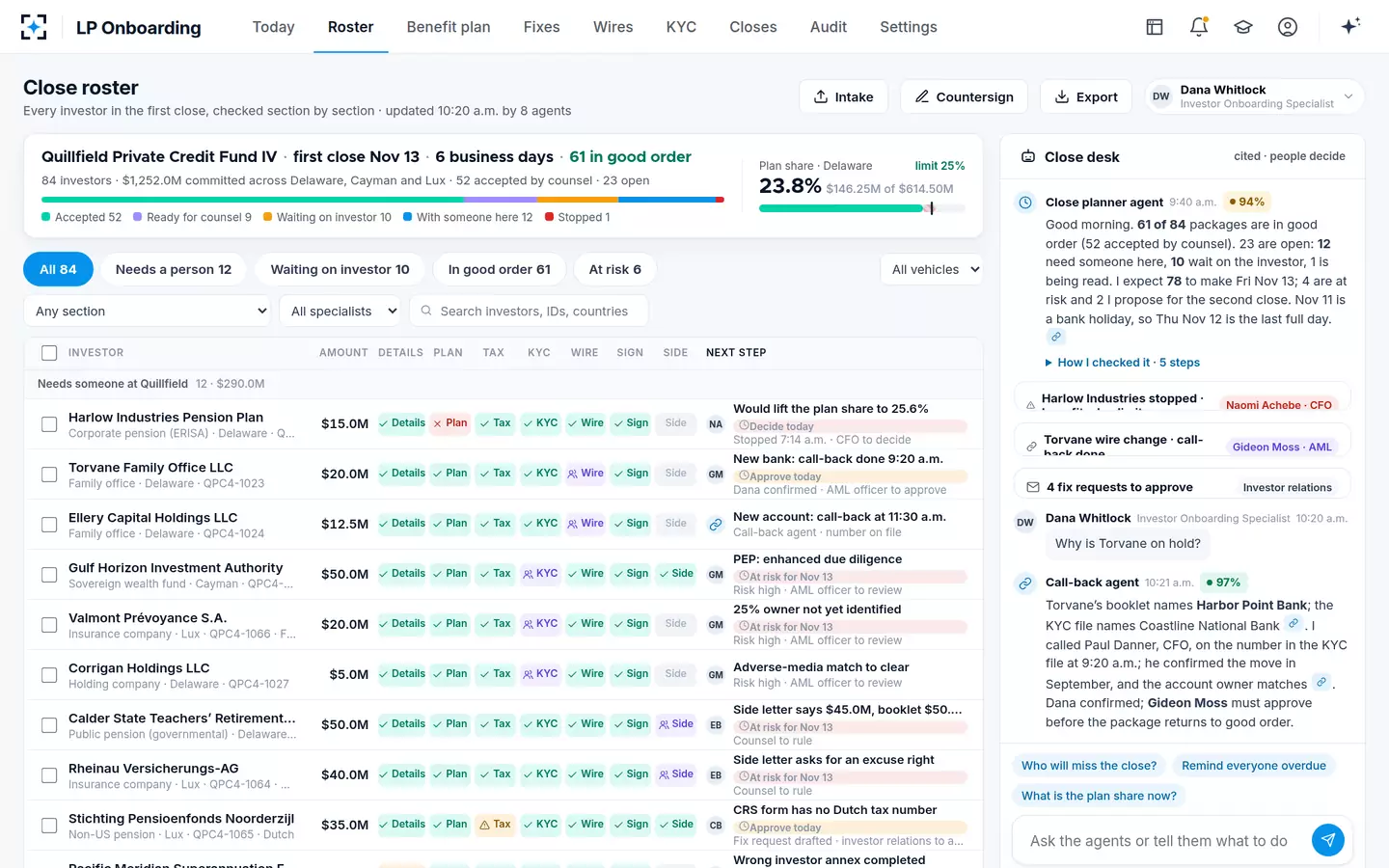
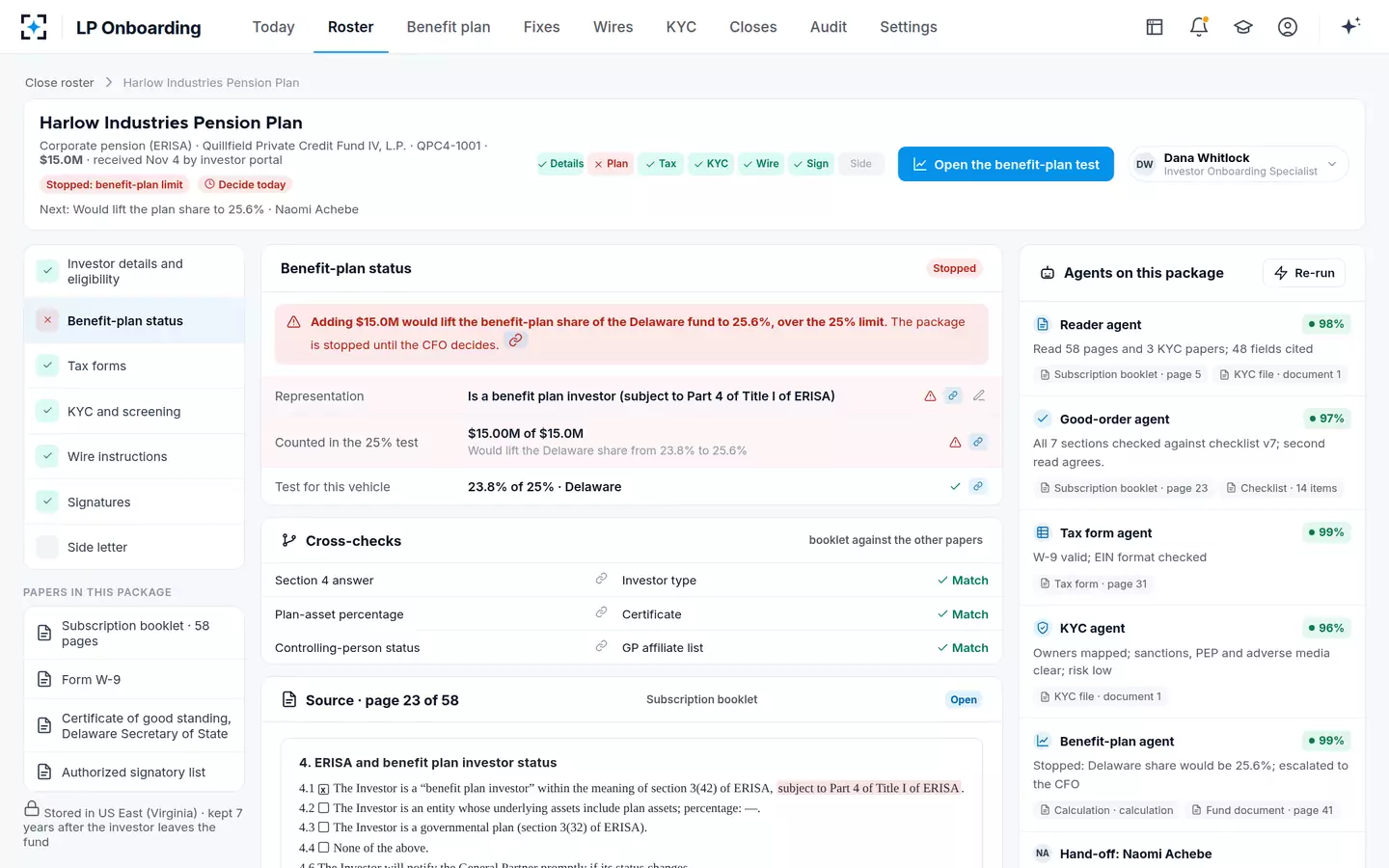
The common thread is that each error is visible only by comparison. The Good-order agent in the solution reads each section against the checklist for the investor type and vehicle, then compares the booklet with the KYC file, the tax forms and the side letter. A second, independent read checks the first; where the two reads disagree, the item goes to a specialist rather than being settled by either agent.
How do you check the booklet against the W-8 and the KYC file?
By treating the KYC file as evidence about the tax form, which is what the Treasury regulations already require. A withholding agent has "reason to know" that a claim on a withholding certificate is unreliable if its knowledge of the facts is such that "a reasonably prudent person in the position of the withholding agent would question" it, and the rule says expressly that information in the account opening files, "including documentation collected for purposes of AML due diligence", that conflicts with the claim is enough, from 30 days after the account is opened (26 CFR 1.1441-7(b)(2)).
In practice the comparison runs field by field. Name and legal form on the W-8 against the registry extract. Country of incorporation and of tax residence against the KYC file's addresses. Chapter 4 status against what the investor actually is: an entity described in its own documents as an investment fund managed by a financial institution should not certify as an active non-financial entity. GIIN against the IRS's published list. Signer against the authorised signatory list. And the form's own clock: a W-8 is valid to the end of the third calendar year after the year it was signed, unless a change in circumstances makes it incorrect sooner (26 CFR 1.1441-1(e)(4)(ii)).
What contradictions do regulators find between tax forms?
The clearest published example is a decision of the Abu Dhabi Global Market's Financial Services Regulatory Authority of 3 October 2025. A client had classified itself as a passive non-financial entity on its CRS self-certification and as a sponsored foreign financial institution on its Form W-8BEN-E. Nothing on file explained the difference, so the regulator held that the firm had not tested the self-certification against what it already knew (the CRS entity form beside the W-8BEN-E walks through the same contradiction); it imposed a penalty of AED 8,000 for that and related failures to collect valid self-certifications (ADGM FSRA decision, 3 October 2025).
The penalty was small; the finding is the point. A regulator read two forms, each validly completed, and treated their disagreement as the firm's failure. For a Cayman feeder the same standard now arrives at account opening: since 1 January 2026, a Cayman financial institution must hold a valid self-certification for a new account no later than the day it is opened (Cayman CRS (Amendment) Regulations, 2025). How self-certifications and W-8 classifications should be reconciled form by form is the subject of the CRS entity self-certification beside the W-8BEN-E.
Six contradictions a page-by-page checklist cannot see
| Paper A | Paper B | What a contradiction means | Who resolves it |
|---|---|---|---|
| W-8BEN-E chapter 4 status | CRS self-certification entity type | At least one classification is wrong; reporting may be wrong in two regimes | Tax form review, then the investor |
| Booklet investor type | ERISA page | The benefit-plan share is mis-stated: an IRA or a plan-asset entity counted as neither | Specialist, then the CFO if the 25% share moves |
| Booklet wire instructions | Bank account in the KYC file | A change nobody verified, or a fraud in progress | Call-back, then two approvers |
| Commitment on the subscription page | Side letter and allocation | Two versions of the deal | Fund counsel |
| Ownership chart | Identity papers and screening | A 25% owner unidentified, or a proxy for a sanctioned person | AML officer |
| Signer of the booklet or W-9 | Signatory list or trust deed | The offer or the form is not validly given | Specialist, with the investor |
The ownership row is the costliest when it fails. In June 2025 OFAC imposed the statutory maximum, $215,988,868, on a San Francisco venture firm that kept managing a sanctioned Russian investor's money after his 2018 designation by dealing through his nephew, whom it knew to be acting for him (OFAC, 12 June 2025). OFAC's compliance framework lists improper due diligence on customers' ownership among the recurring root causes of violations (OFAC, A Framework for OFAC Compliance Commitments, May 2019). A booklet's ownership chart and its signatory list are where a proxy shows up, if anyone compares them.
Which contradictions can be fixed in house, and which go back to the investor?
A contradiction can be resolved in house when the fund already holds a paper that explains it, and must go back to the investor when only the investor can supply the truth. The distinction decides how many days a contradiction costs, so it is worth making explicitly for each one rather than sending every gap back by reflex.
A name that differs from the incorporation papers is often the first kind: if the registry extract shows a recorded change of name, the specialist can note it and attach the extract, as the sample fund's specialist is prompted to do for an insurance company whose booklet name differs from its certificate. A tax-form classification that disagrees with the KYC file is the second kind: the fund cannot correct an investor's certification, and the sample's Tax form agent flags a form but never corrects it. A changed bank account is a third kind, resolved neither by the file nor by the investor's email, but by a call to a number the fund already holds and the approval of two people. A commitment that differs from the side letter belongs to counsel, because only counsel can say which document states the deal.
Sorting contradictions this way also sorts the close. Those that need the investor are the ones to find on the morning a booklet arrives, because each one needs a drafted request, an investor relations approval and a reply. Those that can be fixed in house can wait for the specialist's afternoon. In the sample close, fix requests are due back in five business days, with a reminder at three, which is a week the fund cannot spend if the gap is found on the Thursday before the close.
Who should do the second read?
Someone, or something, that did not do the first, and that cannot sign off its own work. A second read by the same reviewer on the same day finds what the first one found. An independent read, starting from the papers and not from the first reviewer's notes, is the only way to catch what the first read normalised. The person who accepts the package should be a third party to both: in the sample fund, the specialist marks a package ready as maker and fund counsel accepts it as checker, and the settings refuse any role change that would let one person do both.
In LP Onboarding the two reads are both done by agents and the disagreement is resolved by a person. The Good-order agent's first read and its second, independent read either agree, in which case the specialist sees a clean section with every field cited, or they disagree, in which case the item is routed to the specialist with both readings. Neither agent accepts a package or waives a checklist item, and below a 92% confidence threshold a person decides.
Cross-checks in LP Onboarding: the booklet against the other papers
Measuring accuracy instead of completeness
Accuracy can be measured on a fund's own past closes, and nobody else's figure will tell you yours: no regulator or independent study publishes the share of subscription booklets that arrive in good order, or the share that contain a cross-document contradiction. The method is a re-review. Take a sample of packages counsel accepted at your last close, have them re-read independently against every paper in the file, and count what was missed.
Five measures that tell you whether a booklet review is accurate
- Contradictions found after acceptance, per hundred accepted packages.
From an independent re-review of a sample. The number a checklist-only review cannot report about itself.
- Defects found downstream: tax forms rejected at reporting time, wires returned, KYC reopened.
Each one is a booklet that passed and was wrong.
- First-pass fix requests by section, against your own previous close.
Shows where your booklet confuses investors; the denominator is yours, not an industry average.
- Disagreements between the first and second reads, and who was right.
A second read that never disagrees is not independent.
- Time from arrival to the first named gap.
An error found the morning a booklet arrives costs an email; found on the day before the close, it costs the close.
Running that re-review on a past close is also the fairest way to test any tool, including ours: it shows misses and false alarms on papers you already understand. How to run an onboarding software pilot on your last close sets out the steps. To see the cross-checks on a sample of your own booklets, start from LP Onboarding.
Questions people ask
What should a subscription documents checklist include?
Per investor type and vehicle: the subscription agreement and signature pages, the investor questionnaire, the ERISA page, the right tax form and CRS self-certification, the KYC papers for the investor and each 25% owner and the control person, wire instructions, the authority document for the signer, and any side letter. Add a second column for each item: what it must agree with.
What does NIGO mean in fund subscriptions?
NIGO stands for "not in good order": a subscription that cannot be accepted until something is fixed. Because no rule defines good order for private funds, a fund should write its own definition, and it should include consistency between papers, not only completeness.
Is a W-8BEN-E still valid if the investor's KYC file says something different?
It may be formally valid and still unreliable. Under Treasury Regulations §1.1441-7(b)(2), information in account files, including AML documentation, that conflicts with the claim gives the withholding agent reason to know it is unreliable, from 30 days after the account is opened. The fund should resolve the conflict before relying on the form.
Does an IRA have to answer the ERISA page differently from an individual?
Yes. An IRA is a plan under section 4975 of the Internal Revenue Code and therefore a benefit plan investor under ERISA §3(42), even though no employer is involved. If the IRA is the subscriber, its commitment counts toward the fund's 25% test (29 U.S.C. 1002(42)).
How many reviewers should read a subscription booklet?
At least two independent reads and a separate acceptance. In the sample fund the agents provide both reads and route any disagreement to a specialist, the specialist marks the package ready as maker, and fund counsel accepts it as checker.