Verification of accredited investor status is the set of reasonable steps an issuer takes, in a Rule 506(c) offering, to confirm from evidence that each buyer meets a category of Rule 501(a): income over $200,000, or $300,000 jointly, in each of the last two years; net worth over $1 million excluding the home; a qualifying professional licence; or one of the entity tests. The rule puts the duty on one party: "The issuer shall take reasonable steps to verify" (17 CFR 230.506(c)(2)(ii)). Several people usually touch the file, from the investor's accountant to the fund administrator, and the difficulty is that each of their signatures has to be traceable to what it relied on, because the issuer will be asked to prove its exemption long after they have moved on. Botminds' Accredited Investor Verification has agents read the returns, statements and letters and build each path, then keeps the people distinct: an analyst prepares, a compliance reviewer signs, and a different person decides every exception.
The signature chain in one verification of accredited investor status
1The investor
What they signThe subscription, and written representations: that income will reach the line this year, that all liabilities are disclosed, or that status still holds
What the signature provesWhat only the investor can say. The rule asks for these statements alongside the evidence, never instead of it.
2A third-party writer
What they signA letter confirming reasonable steps within the prior three months and a determination
What the signature provesThat a broker-dealer, SEC-registered adviser, attorney or CPA did the checking, if the writer was in good standing that day.
3The preparer
What they signThe draft determination: the category, the figures, the documents and their dates
What the signature provesHow the evidence reaches the threshold. Prepares; never signs the same case.
4The compliance reviewer
What they signThe verification, with a reason code and a note
What the signature provesThat a second person checked the basis and accepted it for the issuer. This is the issuer's step.
5The exception approver
What they signDecisions on cases that are not clean: tampering, lapsed writers, edge cases, reuse
What the signature provesThat doubt was resolved by someone who neither prepared nor signed the case.
6Fund operations
What they signRelease of the subscription to the administrator for the dealing date
What the signature provesThat nobody was admitted before a signed verification existed.
How do you verify accredited investor status?
You pick the category the investor claims, gather the evidence that category needs, and either use one of the rule's methods or show that your own steps were reasonable. For an individual, the rule names income (IRS forms for the two most recent years and a representation about this year), net worth (asset statements and a consumer report dated within the prior three months, and a representation that all liabilities are disclosed), a letter from a broker-dealer, SEC-registered adviser, attorney or CPA, and two routes for people verified before (17 CFR 230.506(c)(2)(ii)(A)–(E)). Each is deemed to satisfy the duty, "provided, however, that the issuer does not have knowledge that such person is not an accredited investor".
Outside those methods the test is reasonableness. The SEC said in 2013 that issuers should consider "the nature of the purchaser and the type of accredited investor that the purchaser claims to be; the amount and type of information that the issuer has about the purchaser; and the nature of the offering", including how the buyer was solicited and terms "such as a minimum investment amount" (SEC Release 33-9415). In January 2026 staff confirmed that one 506(c) offering can mix verification methods (the Latham no-action letter shows how the high-minimum route fits that mix), so one investor can be verified on income and the next on a letter (C&DI 260.39).
Who is responsible for verification of accredited investor status: the issuer or a third party?
The issuer. Anyone else's work counts only as steps the issuer took, or had taken "on its behalf". The rule lets the issuer rely on a professional's confirmation, and the 2013 release foresaw outside services verifying status for issuers (third-party verification covers them), but neither shifts the duty: because the issuer "has the burden of demonstrating that its offering is entitled to an exemption", the SEC said it would be important "for issuers and their verification service providers to retain adequate records" (SEC Release 33-9415).
That is why the chain matters more than any single signature in it. If the exemption is challenged, the question will be whether the issuer took reasonable steps for this buyer at this sale, and the issuer can answer only with what it can show: who did what, on what evidence, when. A verification provider's certificate without the evidence behind it, or an internal sign-off with no trace of what was checked, leaves a gap in exactly the place the issuer will be asked about.
Every signature in a verification is either evidence the issuer can point to or a gap the issuer will have to explain. The duty itself never leaves the issuer.
What does the reviewer's signature mean?
It is the issuer's own act of verification: a person with authority looked at the determination, checked that the evidence supports it and accepted it. A defensible signature therefore says what was checked. In the fictional sample data used throughout this series, Quillfield Private Markets, an invented sponsor with five 506(c) offerings, the compliance reviewer signs investor Jordan Bellweather's verification with reason code V-01 (verified, income path, Rule 506(c)(2)(ii)(A)) and a note: he checked line 11 on both returns and the W-2s, and the residence was correctly set aside.
The reviewer's signature: a reason code, a note and a passkey
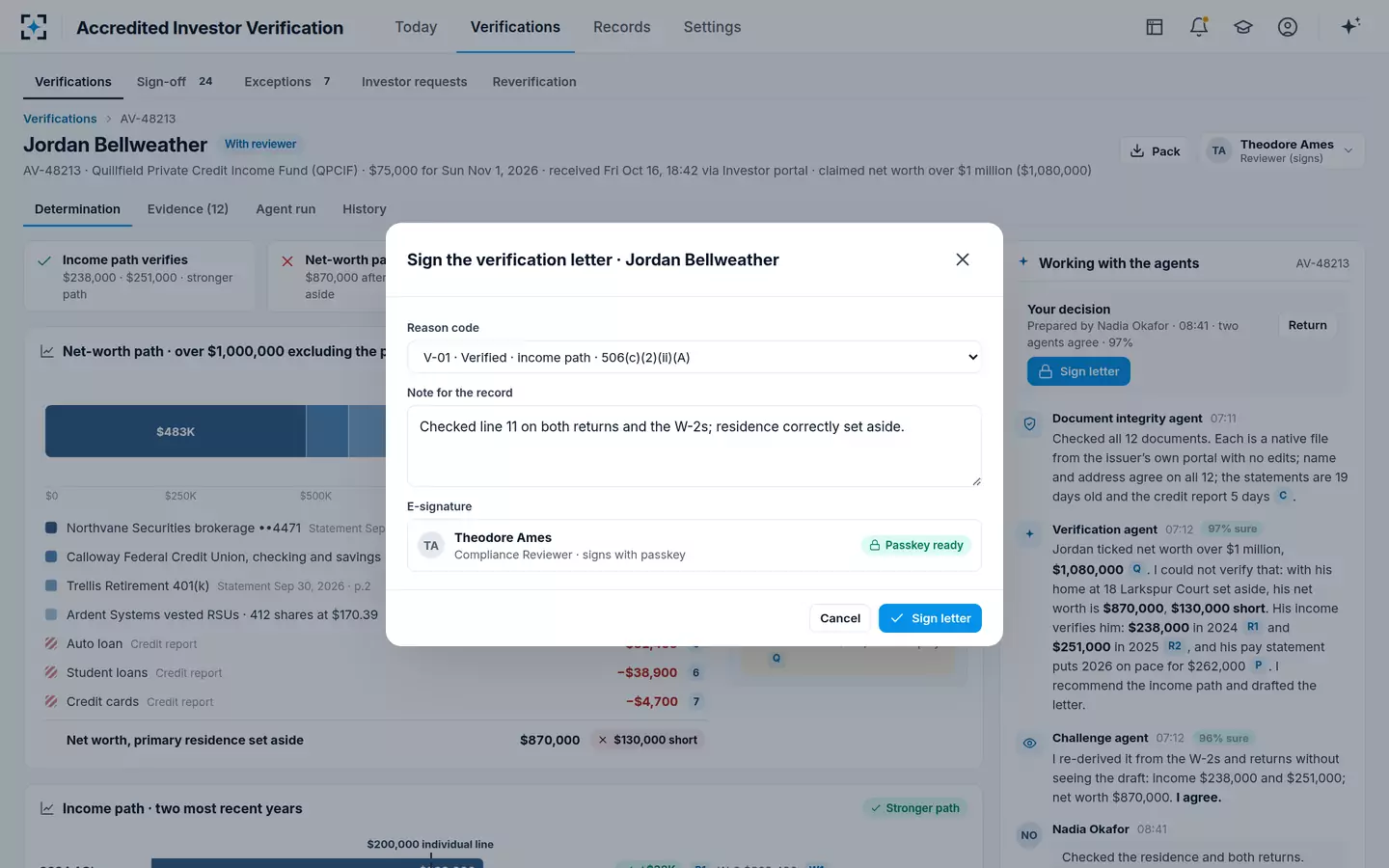
Two details make that signature worth something later. The reason code names the method, so a reader in 2030 knows the file rests on income under (A), not on a letter. And the preparer cannot sign. Separation is not required by Rule 506(c), but a second person is the simplest evidence that a determination was checked rather than produced and approved in one motion, which is the question any examiner of a control will ask first.
Five people stand behind one 506(c) verification
Today
Reads returns and statements into a spreadsheet, works both paths by hand and answers "is my investor verified yet?" all day.
With agents
Opens each case with both paths built and cited, checks what matters and sends it to a reviewer.
Still theirs: Preparing the determination. Never signs it.
Today
Signs letters he can only check by re-reading the evidence himself.
With agents
Sees the path, the figures and the preparer, opens any citation in one click, signs with a reason code or returns it.
Still theirs: The issuer's signature.
Today
Rebuilds the workings for every case that is not clean before she can decide it.
With agents
Decides with the findings, both workings and the options side by side.
Still theirs: Every decision on tampering, lapsed writers, edge cases and reuse.
Today
Chases verifications against dealing-date cutoffs and hopes nothing unverified reaches the administrator.
With agents
Sees each offering's verified count and forecast; releases only subscriptions with a signed letter.
Still theirs: The release to the administrator.
Today
Writes every document request by hand.
With agents
Approves one plain message per investor naming exactly what is missing.
Still theirs: What the investor is told, and when.
Who decides an exception in accredited investor verification?
Someone who neither prepared nor signed the case. Exceptions are where the issuer's knowledge is most likely to change, and the safe harbour falls away once the issuer knows a buyer is not accredited, so the decision should belong to a person whose judgement is not tied to the draft. At the sample firm, seven cases sit with the senior compliance officer for exceptions: a brokerage statement whose printed total is $300,000 more than its lines add up to, a letter-writer whose licence lapsed, a verification reused across two issuers, an entity whose minimum investment was financed, a trust that needs a look-through to its owners, a foreign-currency case at the edge of a line, and a couple claiming joint income as spousal equivalents.
Seven exceptions, decided by a third person with a reason code
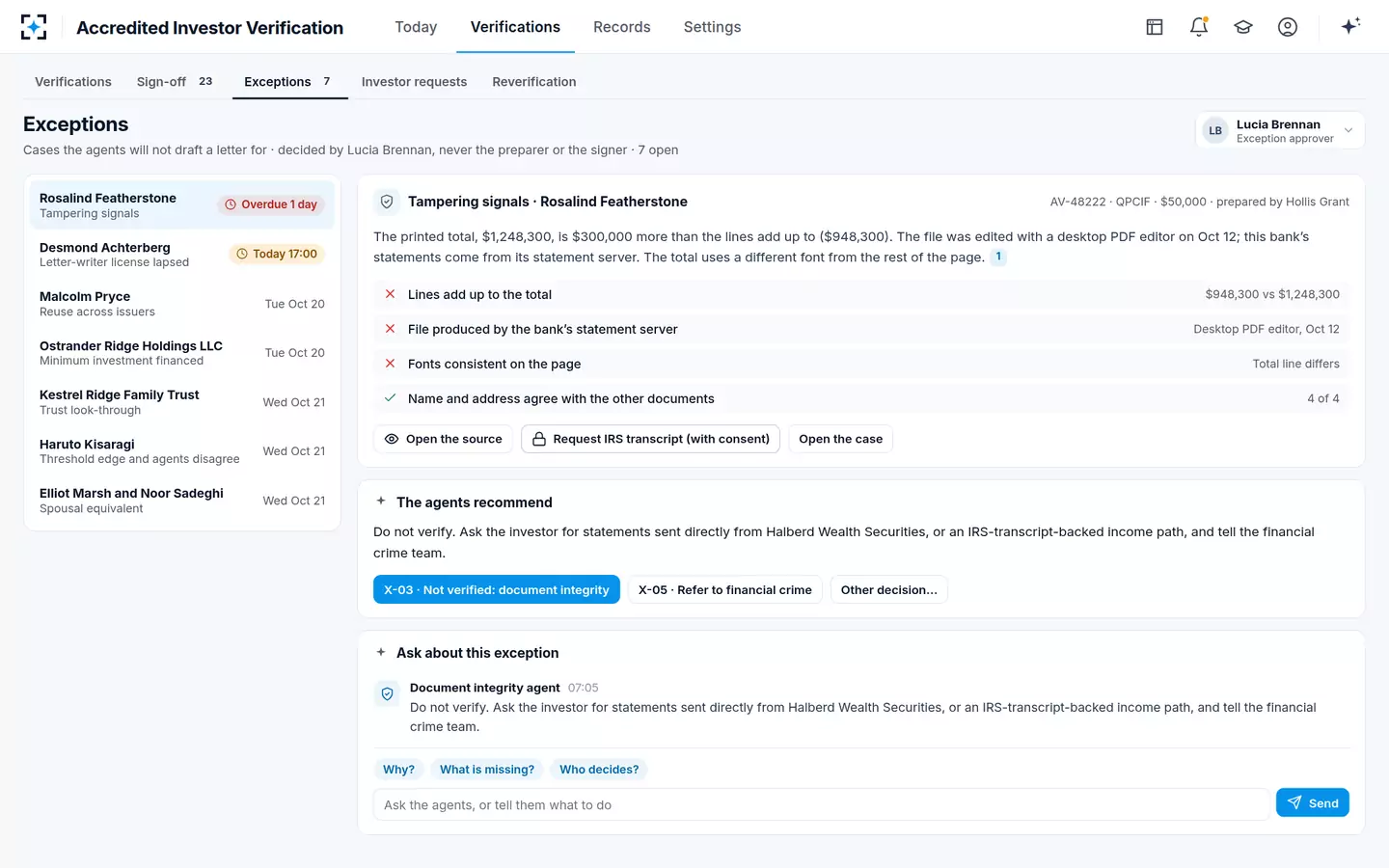
The tampering case shows why the decision needs its own owner. The agents' recommendation is not to verify, to ask for statements sent directly from the broker or an income path backed by IRS transcripts, and to tell the financial crime team. Each of those has consequences beyond this subscription, for the investor relationship and possibly for a suspicious activity review, and the person deciding them should be the one whose role is to weigh exactly that.
What if the letter-writer's licence has lapsed?
Then the letter is outside the safe harbour. The rule names only attorneys in good standing where they are admitted and CPAs registered and in good standing where they live or practise (the full list is in the accredited investor verification letter), and a lapse on the date of the steps means the confirmation came from someone the rule does not list (17 CFR 230.506(c)(2)(ii)(C)). The issuer can still look at the evidence another way, by asking for the documents themselves or a letter from someone in good standing, but it cannot treat the lapsed writer's letter as a method.
Catching a lapse needs a lookup on the date, and proof that it was made. The SEC's October 2026 notice on CPA licences is a useful guide to the registries: it describes CPAVerify.org and notes that two states, Hawaii and New Mexico, do not feed it, though each runs its own public lookup (SEC notice, October 5, 2026). In the sample data the solution's License agent confirms each writer in the public registries and keeps a snapshot of the result; one Illinois CPA's licence had expired two months before the letter was signed, and the case went to an exception rather than to a reviewer.
Joint tests: two people, one verification
When an investor relies on joint income or joint net worth, the verification covers two people and both must sign. The rule's instructions say an issuer verifying joint income meets the income method "by reviewing copies of Internal Revenue Service forms that report income for the two most recent years in regard to, and obtaining written representations from, both the person and the spouse", and treat joint net worth the same way (17 CFR 230.506(c)(2)(ii), Instructions 2 and 3). Since 2020 the joint tests also cover a spousal equivalent: a partner who lives with the investor in a relationship generally equivalent to marriage (17 CFR 230.501(j)).
The spousal-equivalent case adds a fact to verify that no tax return shows. In the sample data, an unmarried couple subscribing together qualify on combined income above $300,000 in both 2024 and 2025, and the investor relations request the agents drafted asks each of them to sign a short declaration that they share a relationship generally equivalent to marriage. The case sits in the exceptions queue until the declaration arrives, because the category depends on it. For joint net worth, the rule's note allows the couple's assets to be combined even when they are not held jointly, and the investment need not be bought jointly either, which is why the file should say plainly which of the two is the purchaser.
One verification, from upload to release, by the clock
Most of the elapsed time in a verification is waiting for the investor; the people's time is short if the reading is done before they arrive. The sample investor's twelve documents arrived through the portal on a Friday evening. By Monday 07:30 the agents had read them, built both paths and drafted the letter, and the analyst opened the case where they pointed.
Monday morning on one sample verification: where each person's minutes went
- Analyst checks the residence and both returns71 min
- In the reviewer's queue, then signed27 min
Once signed, the verification is the only thing that lets fund operations release the subscription. For the sample fund's November 1 dealing date, 214 subscriptions were in: 186 verified and released to the fund administrator, 28 still being verified, none admitted unverified. That last number is a design target of the solution, not a measured result, and it is what a release control should be built to guarantee.
What records should an issuer keep for 506(c) verification?
Rule 506(c) imposes no recordkeeping requirement; the need comes from the burden of proof. The SEC's 2013 release said issuers "or their verification service providers will document the steps taken" because the issuer must show its exemption, and it warned that what is collected for verification may fall under federal and state privacy and data-security law (SEC Release 33-9415). A verification file holds Social Security numbers, tax returns and account statements, and it has to be both complete and guarded.
What a verification file should let you show, years later
- The category relied on, and the method
Income under (A), net worth under (B), a letter under (C), or reasonable steps outside the methods, with the reasoning.
- Every document, unaltered, with its date
A fingerprint of the original shows the file the reviewer saw is the file you still hold.
- The arithmetic from documents to threshold
Including what was left out: the home and its mortgage up to its value under Rule 501(a)(5).
- The investor's representations, signed and dated
About current-year income or complete liabilities, as the method requires.
- Registry checks on any letter-writer, as of the date
A snapshot, not a note saying "checked".
- Who prepared, who signed, who decided exceptions
Three names, three times, three reasons.
- When the verification stops covering new sales
So the next subscription is checked against the right clock.
The last item connects verification to the next sale. A verification under the issuer's own methods supports later sales for different lengths of time depending on how it was done, which how long accredited investor status lasts sets out, and a letter from a third party carries its own three-month window, covered in what a defensible verification letter says. The solution page, Accredited Investor Verification, shows the whole file per investor.
Questions people ask
Can the same person prepare and sign an accredited investor verification?
Rule 506(c) does not forbid it; it requires only that the issuer take reasonable steps. Separating preparer and signer is a control: it makes the issuer's file show that a determination was checked by a second person, which is the easiest way to show the steps were real.
Can a fund administrator verify accredited investor status?
An administrator can do the work on the issuer's behalf, and the rule's wording covers steps taken by "those acting on its behalf". The duty and the burden of proof stay with the issuer, so the issuer should be able to see the evidence and the determination, not just a pass.
Does the investor have to sign anything?
Yes, for the rule's income and net-worth methods. Under the income method the investor represents a reasonable expectation of reaching the line this year; under the net-worth method, that all liabilities needed for the calculation have been disclosed. When the test is joint, the rule's instructions have both people provide the representations.
Can an issuer verify investors in different ways in one offering?
Yes. SEC staff confirmed in January 2026 that an issuer may use different verification methods in the same Rule 506(c) offering, including safe-harbour methods for some investors and its own reasonable steps for others.
Who verifies an entity investor?
The issuer, by applying the reasonable-steps test directly, because the rule's listed methods are written for natural persons. For an entity accredited because all its equity owners are, the steps usually reach each owner; for one accredited on assets or investments over $5 million, its statements are the main evidence.