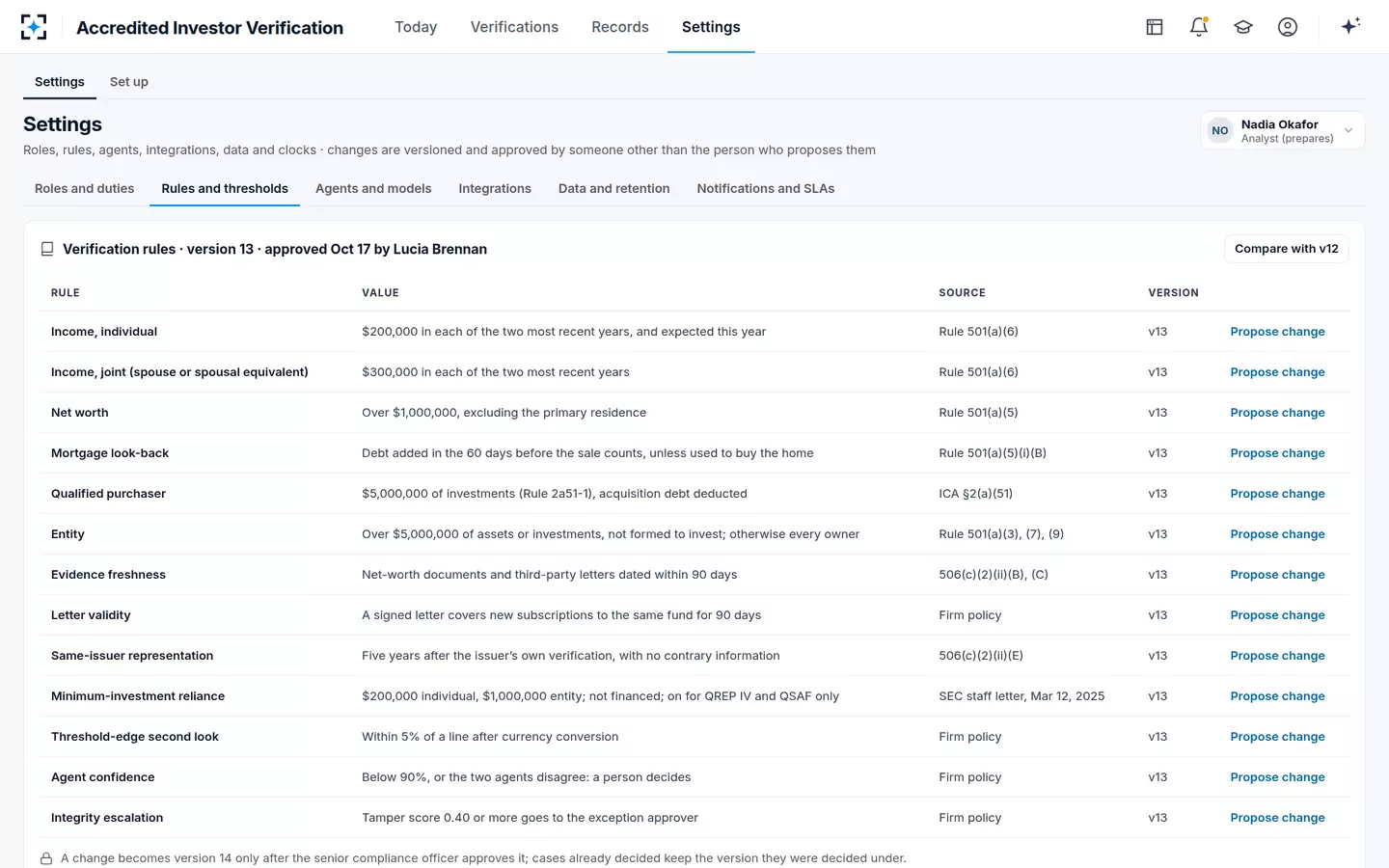
The Latham no-action letter is the SEC Division of Corporation Finance's response of March 12, 2025 to a request from the law firm Latham & Watkins, in which the staff agreed that an issuer in a Rule 506(c) offering "could reasonably conclude that it has taken reasonable steps to verify" that its buyers are accredited if the offering requires a high minimum investment, each buyer represents in writing that it is accredited and that its minimum investment "is not financed in whole or in part by any third party for the specific purpose of making the particular investment", and the issuer has no actual knowledge to the contrary (SEC staff, no-action letter, March 12, 2025). The minimums in the request the staff answered were "at least $200,000 for natural persons and at least $1,000,000 for legal entities" (request published by the SEC). For an issuer the route replaces reading tax returns and statements with a different job: proving the minimum was met with the buyer's own money. Botminds' Accredited Investor Verification treats minimum-investment reliance as a setting per offering, checks the representations and refuses the route when the investment is financed.
The minimum-investment route under the Latham no-action letter, step by step
A person decides
Offering termsThe fund requires a minimum of at least $200,000 for individuals and $1,000,000 for entities, including commitments payable as called.
Never: turns the route on for an offering whose documents set a lower minimum
Agent
Representation checkConfirms the signed representations name an accredited category (501(a)(5) or (6) for an individual) and state the minimum is not third-party financed for this investment.
Never: accepts a representation that names no category
Agent
Knowledge checkLooks across what the issuer already holds, such as AML files, wire details and earlier subscriptions, for facts that contradict either representation.
Never: ignores a loan or a financed wire it has seen
Agent
Look-throughFor an entity accredited only through its owners, checks each owner's own minimum obligation and representations.
Never: treats an owner-accredited entity like an asset-tested one
A person decides
Compliance reviewerSigns the verification on the minimum-investment basis with a reason code, or sends it to the full income or net-worth path.
What did the Latham no-action letter say?
It said yes to a specific question. Latham & Watkins asked the staff to "concur with our view that an issuer will have taken reasonable steps to verify a purchaser's accredited investor status if the issuer requires purchasers to agree to the minimum investment amounts and related conditions described below" (request of March 6, 2025). The staff replied on March 12, 2025, in a letter signed by the chief of its Office of Small Business Policy, that on those facts the issuer "could reasonably conclude" it had taken reasonable steps. On the same day the staff published a new interpretation, Securities Act Rules C&DI 256.36, asking whether a high minimum cash investment can satisfy the verification requirement and answering that an issuer may reasonably conclude so where it has no knowledge that a buyer is not accredited and the investment is not third-party financed (C&DI 256.36).
Neither invented the idea. The SEC had written it into its 2013 adopting release: "if the terms of the offering require a high minimum investment amount and a purchaser is able to meet those terms, then the likelihood of that purchaser satisfying the definition of accredited investor may be sufficiently high" that it may be reasonable to take "fewer steps to verify or, in certain cases, no additional steps to verify accredited investor status other than to confirm that the purchaser's cash investment is not being financed by a third party" (SEC Release 33-9415, 2013). What the 2025 letter added was a number. For twelve years issuers had a principle and no line; the letter gave them a line the staff would not object to.
"The more likely it appears that a purchaser qualifies as an accredited investor, the fewer steps the issuer would have to take to verify accredited investor status, and vice versa."
SEC, Release 33-9415, adopting Rule 506(c), July 2013
What minimum investment amounts are in the Latham letter?
$200,000 for an individual and $1,000,000 for an entity, with a variant for entities accredited only because their owners are. The amounts come from the request; the staff agreed on the facts as presented and did not set a minimum of its own. Calling them the letter's lines is fair shorthand, so long as it is remembered that no other amount was put to the staff.
The three kinds of buyer in the Latham request, and what each must provide
| Buyer | Representation of status | Minimum investment |
|---|---|---|
| Natural person | Accredited under Rule 501(a)(5) (net worth) or 501(a)(6) (income); minimum not third-party financed for this investment | $200,000, including a binding commitment paid in instalments as called |
| Entity accredited by total assets | Accredited under Rule 501(a)(3), (7), (9) or (12); minimum not third-party financed | $1,000,000, including a binding commitment |
| Entity accredited only through its owners, Rule 501(a)(8) | All equity owners accredited under 501(a)(3), (5), (6), (7), (9) or (12); each owner has a minimum obligation to the entity of $200,000 (person) or $1,000,000 (entity); none of it financed | $1,000,000, or $200,000 per owner where the owners are fewer than five natural persons |
Does the Latham letter apply to capital commitments and owner-accredited entities?
Yes to both, with conditions of their own. A minimum can be met by "a binding commitment to invest a minimum amount in one or more installments, as and when called by the issuer", so a drawdown fund's capital commitment counts, not only the first call. And the no-financing condition "would apply solely to the funds applied or committed to the minimum investment amount but not to any greater investment amount", so an investor who commits $500,000 needs only the first $200,000 to be unfinanced (request, footnote 5).
For an entity accredited only because all its equity owners are accredited, under Rule 501(a)(8), the request goes a level down. Each owner must itself be accredited, each must have its own minimum obligation to the entity of $200,000 for a person or $1,000,000 for an entity, none of those minimums may be financed for the purpose, and the entity must commit $1,000,000 to the issuer, or $200,000 for each owner where there are fewer than five owners and all are natural persons. A family partnership of three siblings can therefore qualify by committing $600,000, provided each sibling has committed $200,000 of their own money to the partnership. It is also the easiest condition to miss, because the entity's own representations look complete while the owners' obligations were never checked.
What representations does the Latham letter require?
Two, in writing, from each buyer: that it is an accredited investor under a named category, and that its minimum investment is not financed in whole or in part by any third party for the specific purpose of making this investment. The request allows them in "a standalone document, in a subscription agreement for the offering, in an affirmative written electronic communication from the purchaser, or any other written means" the issuer reasonably chooses. In July 2026 staff went further for tokenised securities, agreeing that representations given "programmatically through the tokenized security via a digital attestation" are a satisfactory way to provide them, provided the issuer "retains sufficient records" (C&DI 260.40).
What the issuer holds: the income and net-worth paths against the minimum route
Income or net worth, Rule 506(c)(2)(ii)(A)–(B): Two years of IRS forms, or statements and a consumer report from the last three months.
High minimum, staff letter of March 2025: The offering's minimum, the subscription amount, two signed representations.
Income or net worth, Rule 506(c)(2)(ii)(A)–(B): Home equity counted, stale statements, an edited PDF, a missed liability.
High minimum, staff letter of March 2025: A financed minimum, a commitment below the line, an owner-accredited entity whose owners were not checked.
Income or net worth, Rule 506(c)(2)(ii)(A)–(B): Inside the documents: arithmetic, dates, fonts, names.
High minimum, staff letter of March 2025: Around the subscription: wire details, AML and source-of-funds files, side letters, earlier subscriptions.
Income or net worth, Rule 506(c)(2)(ii)(A)–(B): Tax returns and statements shared with the fund or a third party.
High minimum, staff letter of March 2025: A tick and a signature, if the investor can meet the minimum.
Income or net worth, Rule 506(c)(2)(ii)(A)–(B): A safe harbour written into the rule.
High minimum, staff letter of March 2025: A staff view with "no legal force or effect", resting on the rule's reasonable-steps standard.
What if the minimum investment is financed?
Then the route is not available for that buyer, and the issuer is back to the rule's methods or its own reasonable steps. The request describes three kinds of financing that do not count against the representation: financing programmes "including a secured credit facility, that has other purposes than solely making the particular investment"; commitments or financing that "predate the commencement of the offering"; and financing the buyer raised as an issuer itself under the same conditions (request, footnote 4). A loan taken out to meet this fund's minimum is the case the condition exists to catch.
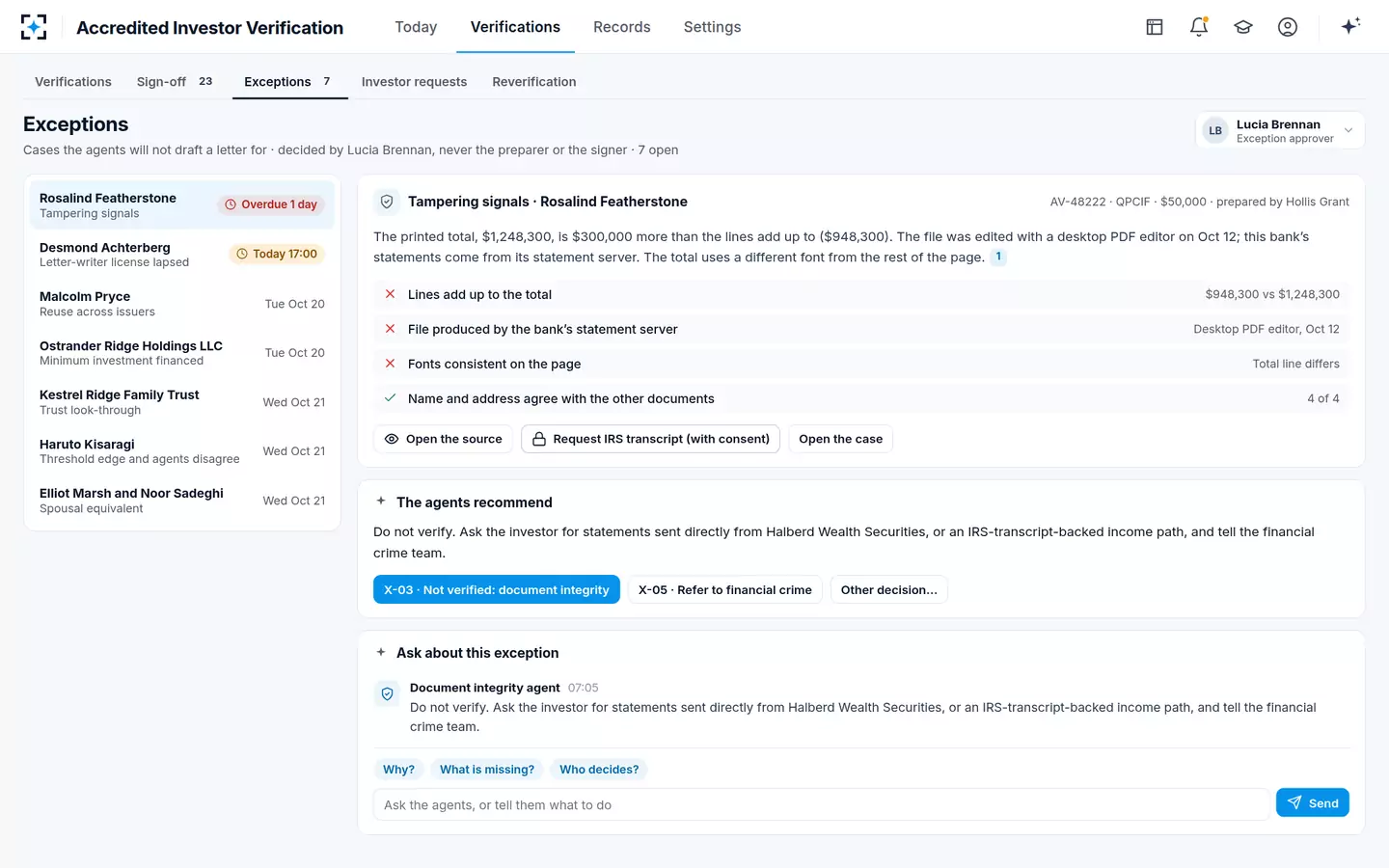
The harder question is what the issuer knows. The staff's position depends on the issuer having no actual knowledge that a minimum was financed, and a fund's own files can contain that knowledge without anyone connecting it: a source-of-funds answer in the anti-money-laundering file that mentions a margin loan, a wire from a lender, a side letter about a credit line. In the fictional sample data used by Accredited Investor Verification, one entity investor, Ostrander Ridge Holdings LLC, sits in the exceptions queue because its minimum was financed. The agents found it; a senior compliance officer decides it, and the minimum route is refused. Teams that hold investor due diligence elsewhere will find the source-of-funds side in the investor due diligence checklist.
A financed minimum is an exception, decided by someone other than the preparer
Mixing the minimum route with the other methods in one offering
Many 506(c) funds will need the minimum route for some investors and the rule's methods for the rest. SEC staff confirmed in January 2026 that "an issuer may use different verification methods in the same Rule 506(c) offering" (C&DI 260.39), so a fund can verify a $1 million commitment on representations and a $50,000 subscription on tax returns in the same close. The file for each investor should say which basis was used, because the first question about a mixed offering is whether each buyer's basis fits that buyer.
Two edges need a policy. The first is the investor who meets the minimum at the first close and later subscribes below it, for example an evergreen top-up. The rule's five-year route lets an issuer rely on a written representation from someone it "previously took reasonable steps to verify", and the staff's view is that the minimum route is reasonable steps; whether that combination holds has not been addressed by the staff, and the cautious course is to treat the top-up as a new verification unless the investor was earlier verified on evidence. The second is the investor whose minimum is met through an entity it controls: if the entity is accredited only through its owners, the request's look-through conditions apply, and the entity's own representations are not enough. In the sample data, look-through cases go to a person in the exceptions queue rather than being decided by a setting.
Is a no-action letter binding?
No. The letter itself says so: it states the views of the Division's staff, not a rule or a statement of the Commission, it "has no legal force or effect: it does not alter or amend applicable law", and "any different facts or conditions might require the Division to reach a different conclusion" (SEC staff letter, March 12, 2025). What it offers is the staff's view of how the rule's reasonable-steps standard applies to these facts. A court, the Commission or a later staff would not be bound by it, and a buyer challenging the exemption years later would argue about reasonableness, not about the letter.
That matters for how a fund adopts it. The safe course is to follow the conditions exactly as the request described them, to treat any departure, such as a $150,000 minimum or an unchecked look-through, as outside the letter, and to keep the evidence that each condition was met. No SEC enforcement action that turns on a failed 506(c) verification could be found, so there is no case to show what a regulator would do with a gap; the exposure is the exemption itself.
Which funds the minimum route suits, and which it does not
It suits offerings whose minimum already sits at or above the lines and whose investors are mostly direct subscribers with their own money: institutional share classes, closed-end funds with high commitments, co-investment vehicles. It suits less well an evergreen fund with a $25,000 minimum, where most subscriptions are below the line and the route covers only the few that are not, or a feeder raising from many individuals through intermediaries who may themselves provide financing.
Minimum-investment reliance as a setting, on only for the offerings that meet it
Before you rely on the Latham letter in a 506(c) offering
- Put the minimum in the offering documents
At or above $200,000 and $1,000,000, stated as a condition of subscription, including how commitments count.
- Write both representations into the subscription
A named accredited category, and no third-party financing of the minimum for this investment.
- Decide how owner-accredited entities are handled
Each owner's minimum obligation and representations, or the entity goes to another path.
- Connect the AML and funding files to verification
Actual knowledge of financing anywhere in the issuer defeats the route.
- Check the wire against the subscriber
Money from the investor's own account is the simplest evidence the minimum was self-funded.
- Note which basis each investor was verified on
A reviewer's reason code that names the minimum route, so the file is honest about what it rests on.
- Re-read the staff's caveats each year
A staff view can be withdrawn or narrowed; check the SEC's page before each new offering.
The route also changes how long a verification lasts, because a minimum is met at each sale rather than once. How long accredited investor status lasts covers the clocks, and who really pays for verification what the route saves. The solution page, Accredited Investor Verification, shows the route alongside the income, net-worth and letter paths.
Questions people ask
Does a minimum below $200,000 work under the Latham letter?
Not under the letter. The staff answered a request built on $200,000 and $1,000,000 and warned that different facts might lead to a different conclusion. An issuer can still argue that a lower minimum, with other information, amounts to reasonable steps under the 2013 principles, but it would be doing so without the staff's comfort.
Does the Latham letter apply to capital commitments?
Yes, as described in the request: a binding commitment to invest at least the minimum in one or more instalments, as and when called, counts as the minimum investment. The no-financing condition applies to the committed minimum, not to any larger amount.
Can an investor's representation be electronic?
Yes. The request allows representations in the subscription agreement, a standalone document or an affirmative written electronic communication, and SEC staff said in July 2026 that a digital attestation through a tokenised security is satisfactory if the issuer keeps sufficient records.
Does the minimum route replace the income and net-worth checks for everyone?
Only for buyers who meet the minimum, give both representations and about whom the issuer knows nothing contrary. Others in the same offering are verified another way, and SEC staff confirmed in January 2026 that different methods can be used in one Rule 506(c) offering.
Why is it called the Latham letter?
Because the law firm Latham & Watkins wrote the request, dated March 6, 2025, and the staff's response is filed under its name. The SEC publishes both the request and the response on its website.