The accredited investor definition changes on the table in 2026 start with an exam that does not exist yet. On October 5, 2026 the SEC published a notice that it "is considering whether to issue an order designating passage of an accredited investor exam (the ‘Exam’) to be developed by the Financial Industry Regulatory Authority", with parallel notices for a U.S. CPA licence, the CFA charter, a U.S. CFP certification and the Series 79 and Series 86/87 licences, and asked for comments by December 4, 2026 (SEC notice, Federal Register, October 5, 2026). Until the Commission issues an order, the only professional credentials that make a person an accredited investor are the Series 7, 65 and 82 licences designated in 2020. For anyone verifying investors in a Rule 506(c) offering the notices matter for a practical reason: a credential is proved by a registry lookup rather than by tax returns, so each would bring a new check with its own source, its own meaning of good standing and its own gaps. Botminds' Accredited Investor Verification already confirms Series 7, 65 and 82 holders in public registries, and keeps every qualifying route as a versioned rule that can be added when, and only if, the SEC acts.
Autumn 2026: two comment windows open, and no decision date
- From the SEC agenda (Aug 14) to the notices52 days
- Comment period, all five60 days
- Then: no date setopen
- From the SEC agenda to the proposal53 days
- Comment period62 days
- Then: no date setopen
Is there an accredited investor exam?
Not yet, and nothing in the October 2026 notice makes one law. The notice describes an exam FINRA would build if the Commission designates it: open to anyone 18 or older, "largely modeled on the Securities Industry Essentials Exam", about 75 multiple-choice questions in about two hours, a fee "similar to the SIE Exam fee, which is currently $100", and a pass valid for ten years (SEC notice, 2026). The notice is careful about its own status: what FINRA "intends" or "anticipates" is what FINRA staff have told SEC staff, and the passing score has not been set.
The route exists because of a 2020 rule, in force since December 8, 2020, adopted with an order that designated the Series 7, 65 and 82 licences (SEC Release 33-10824). Rule 501(a)(10) makes accredited "any natural person holding in good standing one or more professional certifications or designations or credentials" that the Commission designates, and lists four attributes it weighs, the last being that the credential "is either made publicly available by the relevant self-regulatory organization or other industry body or is otherwise independently verifiable" (17 CFR 230.501(a)(10)). Designation is "by order, after notice and an opportunity for public comment", which is the step the SEC took in October.
The FINRA accredited investor exam as the SEC's notice describes it
| Section | Share of questions | What it would test |
|---|---|---|
| Investment Risks | 20–28% | Liquidity and resale limits, concentration, dilution, leverage, the effect of fees on net returns |
| Definitions and Structures of Securities | 13–20% | Equity, debt and SAFEs; exempt versus registered offerings; funds, trusts and REITs |
| Disclosures and Regulatory Requirements | 13–20% | Materiality, risk factors, what each exemption requires and does not |
| Financial Statements | 11–19% | Balance sheets and income statements, GAAP and non-GAAP, valuation ratios, IRR, yield to maturity |
| Conflicts of Interest | 10–18% | Issuer, intermediary and insider conflicts; tiered information and preferential terms |
| Corporate Governance | 10–18% | Fiduciary duties, charters and by-laws, voting, information, tag-along and drag-along rights |
What is the FINRA accredited investor exam meant to fix?
The income and wealth tests. The notice gathers years of recommendations, from the SEC's small-business forums and advisory committees, to let people show sophistication rather than money, including the SEC's 2026 Small Business Forum, which recommended that the Commission "[e]xpand the accredited investor definition to include additional measures of sophistication, including through an investor test and experience". It also sets out the other side: the North American Securities Administrators Association told Congress it would prefer an exam "coupled with practical experience" and "would not endorse a test that does not meaningfully probe the investor's financial sophistication" (SEC notice, 2026).
"There is no evidence that we are aware of to suggest that the expansion in 2020 of the accredited investor definition to include these types of financially sophisticated investors has created investor protection concerns."
SEC notice on the accredited investor exam, October 5, 2026
What did the House pass in the INVEST Act, and does it matter?
A bill that would write an accredited investor test into statute; it is not law. The SEC's notice cites the Incentivizing New Ventures and Economic Strength Through Capital Formation Act of 2025, H.R. 3383, "as passed by the House of Representatives, Dec. 11, 2025", which would require any such test to cover the different types of securities, the disclosure requirements of the securities laws, corporate governance, financial statements, unregistered securities and private funds, and potential conflicts of interest, plus anything else the Commission thinks necessary (SEC notice, 2026). An earlier Senate bill, the Empowering Main Street in America Act of 2024, S.5139, introduced on September 23, 2024, would have amended the statutory definition to include people certified through an exam set by the Commission, a state securities regulator or a self-regulatory organisation.
The legislation matters for two reasons. The six sections FINRA contemplates track the House bill's list closely, and the notice says so, which suggests the SEC is designing a route that would survive the bill becoming law. And a statutory route would be harder to change than an order: the SEC designates credentials under Rule 501(a)(10) by order and could withdraw one the same way. For a verification team, nothing changes until one of the two happens, and if both do, the order and the statute may define the exam pass slightly differently, which is a reason to cite the source of each route in the rule that applies it.
Is a CPA an accredited investor?
Not by holding the licence, today. A CPA is accredited only through the income, net-worth or other existing tests, unless the Commission acts on the notice that it is "considering whether to issue an order designating holding a license as a U.S. certified public accountant (a ‘CPA’) in good standing as qualifying natural persons for accredited investor status" (SEC notice on CPA licences, 2026). The notice cites NASBA's estimate of over 650,000 CPAs as of August 27, 2026, a count that leaves out Hawaii and New Mexico, and says the SEC cannot tell how many already qualify another way.
The CPA question is easy to confuse with a different one. A CPA in good standing can already write a letter verifying someone else's status, under Rule 506(c)(2)(ii)(C), and many investors' letters come from their accountants. The notice is about the CPA's own status as a buyer. If it were designated, a verification team would need to tell the two apart in the same file: the CPA as the investor, checked on the licensing board, and the CPA as the letter-writer, checked the same way for a different purpose. What a defensible verification letter says covers the second.
How many people hold each credential the SEC is weighing
650,000+
U.S. CPAs, August 2026, excluding Hawaii and New Mexico
110,000+
U.S. holders of the CFP certification, September 2026
194,000
CFA charterholders worldwide, August 2026
57,000
Series 79 holders, August 2026, plus about 5,900 with Series 86 and 87
Will a CFA or CFP qualify as an accredited investor?
Only if the Commission issues an order after the comment period, and the notices do not say when that might be. Each is framed the same way: the Commission "is considering whether to issue an order designating holding a charter as a Chartered Financial Analyst" in good standing, and, separately, "holding a certification as a Certified Financial Planner (a ‘CFP’) in the United States in good standing" (SEC notice on the CFA charter; on the CFP certification). The qualifiers matter for verification. The CPA and CFP notices are limited to U.S. credentials; the CFA notice is not, and its count of 194,000 is worldwide.
The Series 79 and 86/87 notice is the closest to the 2020 designations: FINRA licences, checked on BrokerCheck, with the SEC's view that "licensees that hold inactive, terminated, or suspended licenses would not be considered in good standing" (SEC notice on Series 79, 86 and 87). The Series 79 exam itself spends about 27 percent of its questions on offerings, including the rules for securities exempt from registration, which is part of the SEC's case for it.
How would an issuer verify an accredited investor exam pass, or any new credential?
By a lookup in the source the SEC names for each one, on the date of the sale, kept with the file. That is what Rule 501(a)(10)(iv) is for, and each notice names its source: FINRA "would develop a process where issuers or others would be able to independently verify the status of Exam Holders (together with the passage date of the Exam and date the ten-year validity period ends)"; CPAs through CPAVerify.org or state sites; CFAs through CFA Institute's member directory, which "does not include individuals whose CFA Institute membership has lapsed, been suspended, or revoked"; CFPs through the CFP Board's free search; Series licences through BrokerCheck.
How each credential under consideration would be checked, and where the check can mislead
| Credential | Where it would be checked | What good standing means in the notice | Watch for |
|---|---|---|---|
| FINRA accredited investor exam | A FINRA verification process, still to be built | Passed, and within the ten-year validity period | The end date of the ten years; a pass counts only for the person's own purchases |
| U.S. CPA licence | CPAVerify.org and state board lookups | Holding a licence in good standing | Hawaii and New Mexico do not report to CPAVerify; inactive or lapsed status |
| CFA charter | CFA Institute member directory | A CFA in good standing | The directory shows current members only; a lapsed member simply disappears |
| CFP certification (U.S.) | CFP Board's public search | Certification in the United States in good standing | Non-U.S. certifications are outside the notice |
| Series 79; Series 86 and 87 | FINRA BrokerCheck | An active licence; inactive, terminated or suspended licences excluded | Both 86 and 87 needed for the research analyst route |
The notices are frank that verification is the point. "[T]he status of an Exam Holder could be easily independently verified, which would directly reduce issuers' costs of confirming accredited investor eligibility, relative to verifying income or net worth," the exam notice says (SEC notice, 2026). The saving is real only if the lookup is right: a name that matches two people in a registry, a licence active today but lapsed on the date of the sale, or a directory that silently drops lapsed members can each produce a pass that is not one.
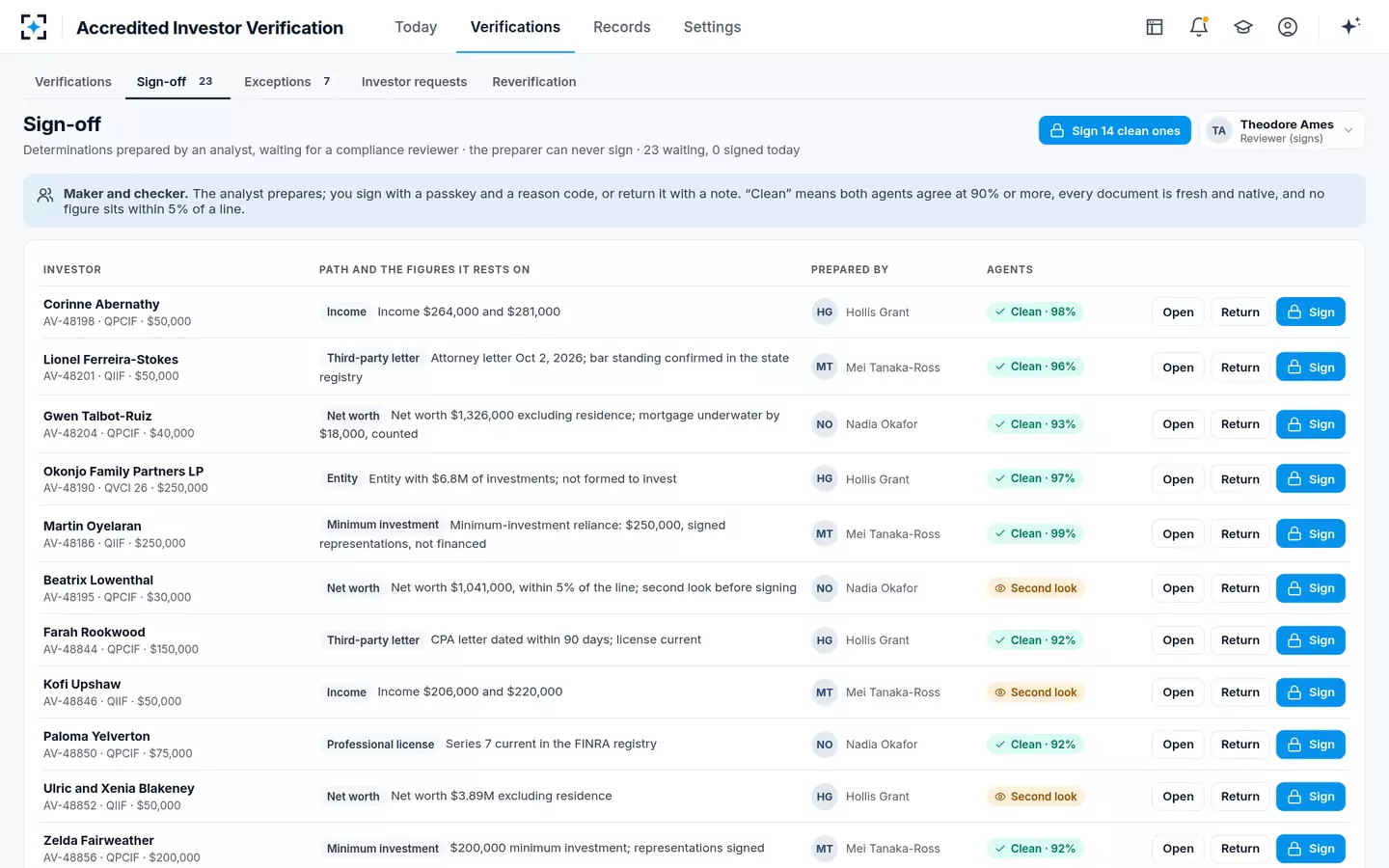
Today's credential route: a Series 7 confirmed in the FINRA registry, waiting for a signature
When will the SEC decide on the accredited investor exam?
No date is set. Comments on all five notices close December 4, 2026, and the Commission can then issue an order, change course or do nothing. Two other items could change the picture. The SEC's regulatory agenda lists a rulemaking on "Updating the exempt offering pathways", "including potential amendments to the definition of accredited investor", with a proposal targeted for October 2026 (SEC agenda, Federal Register, August 14, 2026); no such proposal has yet appeared in the Federal Register. And a separate proposal of October 6, 2026 would revise the "qualified client" definition used for performance fees to include anyone who meets the accredited investor definition (SEC proposal, October 6, 2026). It is a proposal; the qualified client thresholds in force are $1.4 million under management or $2.7 million of net worth, as the proposal itself notes. Wealth teams will find the detail in the qualified client threshold for 2026.
If both were adopted, a credential designated under Rule 501(a)(10) would reach further than private placements: it would also make its holder a qualified client. That chain depends on two decisions not yet taken, and a verification team should prepare for each as a separate, dated change rather than assume either.
What verification teams should prepare now
Preparation is cheap because nothing has to change until an order is issued. What has to exist is the ability to add a route quickly and correctly: a rule for the new credential, a registry check with a dated snapshot, and a clear line between the credential as the investor's own status and as a letter-writer's standing.
Seven things to have ready before any new credential is designated
- A list of today's routes, with their sources
Income, net worth, Series 7, 65 and 82, knowledgeable employee, entity tests, so a new one is an addition, not a redesign.
- A registry check per credential, dated
Keep the lookup result as of the sale date, not a note that someone looked.
- Identity matching against the registry
Name plus a CRD number, licence number or charter year; two people with one name is the common failure.
- An expiry for time-limited credentials
The exam pass would end after ten years; keep the end date with the pass.
- The own-account limit
The notice says exam holders "could not rely on their status as accredited investors to purchase securities on behalf of another person".
- Jurisdiction rules
U.S. CPA and U.S. CFP only, in the notices; a CFA charter from anywhere.
- A rule change that waits for the order
Effective from the date the order says, approved by someone other than the proposer, with earlier cases left under the rules they were decided by.
Verification rules as versioned settings, each with its source
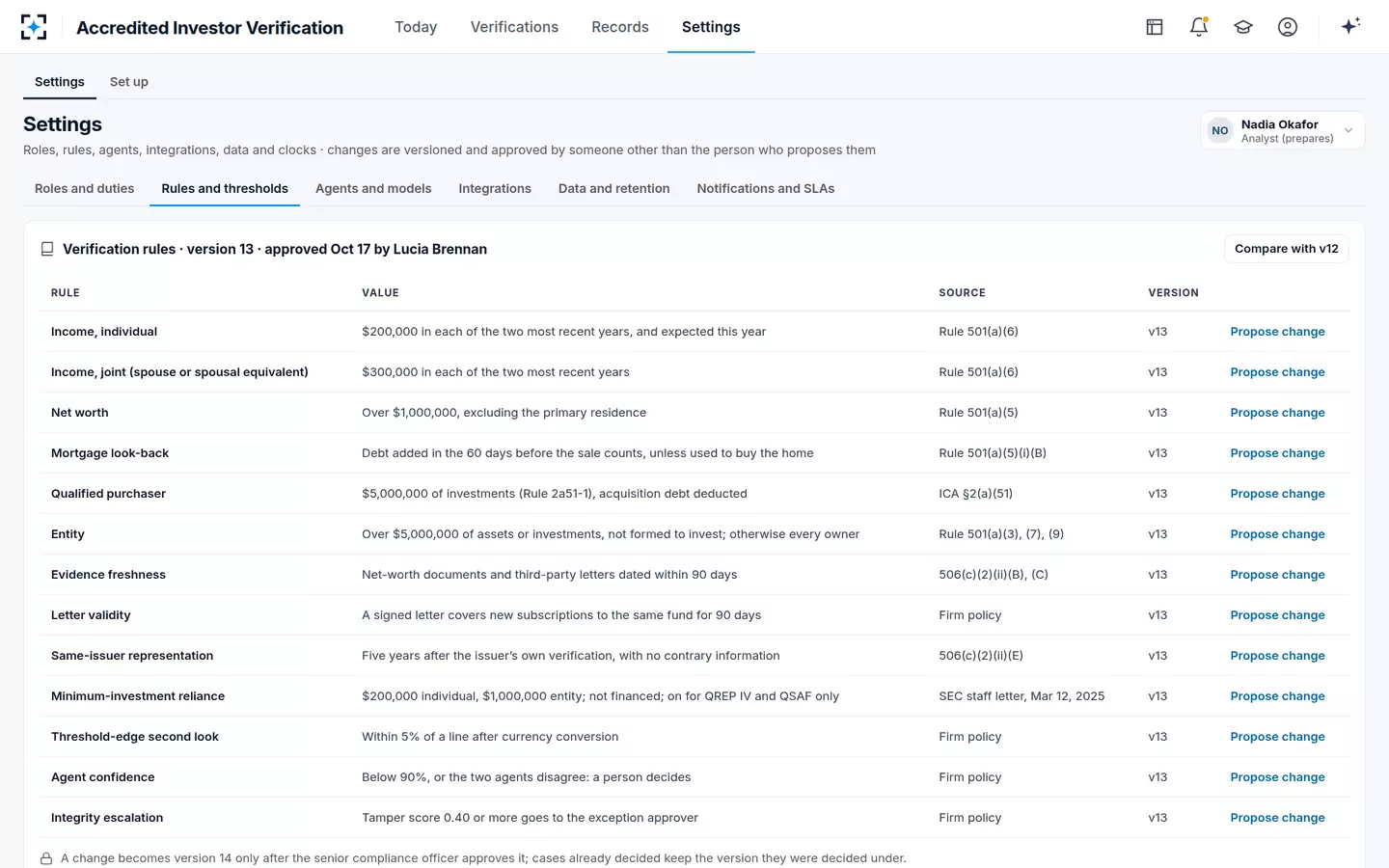
The settings above are where a designation would land in Accredited Investor Verification: as a new row with its source, proposed by one person and approved by another, with every earlier case keeping the version it was decided under. The solution page, Accredited Investor Verification, shows how the License agent's registry snapshots sit in each investor's file.
Questions people ask
Which licences qualify a person as an accredited investor today?
The Series 7, Series 65 and Series 82, held in good standing, designated by the SEC's 2020 order under Rule 501(a)(10). The CPA, CFA, CFP, Series 79 and Series 86/87, and a FINRA exam, are only under consideration in notices published October 5, 2026.
How long would an accredited investor exam pass last?
Ten years from the date of passing, as the notice describes it, after which the holder would have to retake and pass it to keep the status. FINRA does not anticipate waivers, and a person who fails would wait 30 days to retake, or 180 days after three failures in two years.
How much would the accredited investor exam cost?
The notice anticipates a fee similar to the SIE exam fee, currently $100, paid each time the exam is taken. FINRA, a not-for-profit self-regulatory organisation, would rely on the fees to cover building and running it.
Could a foreign investor take the accredited investor exam?
The notice says the exam would be open to anyone 18 or older and would not require association with a FINRA member firm. It would be given in English. It says nothing that limits it by residence.
How can a firm comment on the accredited investor exam notice?
Through the SEC's comment form or by email, citing File No. 4-931 for the exam; each notice has its own file number, and the deadline for all five is December 4, 2026. The SEC posts comments publicly, so submissions should not include personal information.
Would an exam holder be able to invest for a family member?
No. The notice states that exam holders would only themselves qualify, and could not rely on their status to purchase securities on behalf of another person.