Third party accredited investor verification is any arrangement in which someone other than the issuer does the work of confirming that a buyer in a Rule 506(c) offering is accredited: a broker-dealer, SEC-registered adviser, attorney or CPA writing a confirmation letter under the rule's safe harbour, or a verification service collecting documents on the issuer's behalf (17 CFR 230.506(c)(2)(ii)(C)). The SEC allowed for both in 2013, saying an issuer may rely on a third party that has verified a person's status, "provided that the issuer has a reasonable basis to rely on such third-party verification" (SEC Release 33-9415). The catch is that the third party makes the determination while the issuer keeps the burden of proving its exemption, so reliance is itself a check: of the writer's standing, the dates and the basis. Botminds' Accredited Investor Verification is built on that split. Agents read every document and letter, test it for freshness, tampering and the writer's licence, rebuild the determination independently, and draft a cited letter, and a compliance reviewer at the issuer signs.
Maker, checker, signer: one verification through Accredited Investor Verification
Agent
Intake agentTakes returns, statements, credit reports and third-party letters from the portal and e-mail; fingerprints each original and masks Social Security numbers.
Never: alters an original
Agent
Document integrity agentChecks the three-month window, file metadata, fonts, arithmetic and that names and addresses agree across documents.
Never: accuses; it flags and explains
Agent
License agentLooks up the letter-writer, or the investor's Series 7, 65 or 82, in the public registries and keeps a snapshot.
Never: accepts a writer it cannot find in good standing
Agent
Verification agentBuilds every path that applies, sets the home aside, picks the stronger path and drafts the letter with citations.
Never: signs or admits an investor
Agent
Challenge agentRe-derives the determination on a different model without seeing the draft, then compares line by line.
Never: sees the first answer before finishing its own
A person decides
AnalystPrepares: checks what the agents point to and sends the case to a reviewer.
A person decides
Compliance reviewerSigns for the issuer with a reason code and a note, or returns the case. Exceptions go to a third person.
Can an issuer rely on third party accredited investor verification?
Yes, in two ways that carry different weight. A written confirmation from a registered broker-dealer, an SEC-registered investment adviser, an attorney in good standing or a CPA in good standing, stating that it took reasonable steps within the prior three months and determined the buyer is accredited, is one of the rule's own methods: on its own it is deemed to satisfy the duty, unless the issuer knows the person is not accredited. Anyone else's verification, including a verification company's, is evidence the issuer weighs under the general reasonable-steps test, and the issuer needs "a reasonable basis to rely" on it.
The SEC foresaw the second kind. "[I]n the future, services may develop that verify a person's accredited investor status for purposes of new Rule 506(c)," the 2013 release noted, and "This third-party service, as opposed to the issuer itself, could obtain appropriate documentation or otherwise take reasonable steps to verify accredited investor status" (SEC Release 33-9415). What a reasonable basis means is not defined. In practice it means the issuer knows who the provider is, what it checks, on what evidence, and can see the result for each investor, rather than holding a pass with nothing behind it. Accredited investor verification services vs in-house compares the routes.
Who makes, who checks and who signs in third party verification
Today
Reviews the investor's returns or accounts and signs a confirmation, often in the investor's own words.
With agents
Has the letter checked against a registry, the three-month window and the basis it states.
Still theirs: Their own professional determination and its standing.
Today
Reads every document into a spreadsheet and works each path by hand.
With agents
Starts where the agents point: a residence counted, a stale statement, a writer not found.
Still theirs: Preparing the case. Never signs it.
Today
Signs what he can only check by re-reading everything.
With agents
Checks the citations that matter in one click each and signs with a reason code.
Still theirs: The issuer's signature.
Today
Rebuilds the workings before deciding a doubtful case.
With agents
Decides with both agents' workings and the options side by side.
Still theirs: Every decision on tampering, lapsed writers and edge cases.
Who signs the accredited investor verification letter?
Two different people sign two different documents, and confusing them is the commonest mistake in third party verification. The third party signs its confirmation: that is the maker's statement. The issuer, or a person authorised to act for it, signs the issuer's acceptance of that confirmation, or its own determination where it verified directly: that is the checker's and signer's statement. Rule 506(c) does not require the issuer's signature as such, but the issuer must be able to show it took reasonable steps, and a dated, named sign-off is the plainest evidence that someone did.
In Accredited Investor Verification the issuer-side signature is a compliance reviewer's, given with a passkey, a reason code naming the method and a note for the file; the analyst who prepared the case cannot sign it, and a third person decides anything that is not clean. None of that separation is a legal requirement. It is the control that lets the signature mean something.
Can accredited investor verification be automated?
The reading and checking can; the decision should not be. Most of the hours in a verification go to finding figures in returns and statements, checking dates and arithmetic, and working out the income and net-worth paths. Those are mechanical, and the evidence for them is in the documents. The determination is an act of the issuer, with legal consequences, and the safe design keeps it with a person who can see exactly what the automation found. Automation done this way changes what reaches people, not who decides: in the sample below, the agents' overnight output is drafts and exceptions, and even the clean drafts wait for a signature.
What the agents hand to people: most cases ready to sign, the rest routed to a person who decides
Overnight: 67 cases worked by the agents
- 64 determinations drafted, two agents agreeing · 96%
- 3 exceptions · 4%
The reviewer's queue: 23 cases waiting
- 14 clean: both agents at 90% or more, fresh native files, nothing within 5% of a line · 61%
- 9 need a closer look or a return · 39%
Regulators have not written special rules for this, and their general statements point the same way. FINRA's 2024 notice on generative AI reminded firms that its rules are meant to be technology-neutral and apply whatever tool produced the work (FINRA Regulatory Notice 24-09). Its 2026 oversight report lists the risks of AI agents, among them agents acting without human validation and approval, acting beyond their intended authority, and multi-step reasoning that is hard to trace or explain (FINRA, 2026 Annual Regulatory Oversight Report). In its priorities for fiscal 2027, the SEC's Division of Examinations uses the term "super intelligence (SI)" for these tools and says it is working to understand how they influence outcomes and whether firms still meet obligations that do not change with the technology (SEC Division of Examinations, FY2027 priorities). Each of those risks has a design answer in verification: a person signs, the agents' scope is listed as what they never do, and every figure is cited to its page.
Can AI read tax returns and brokerage statements?
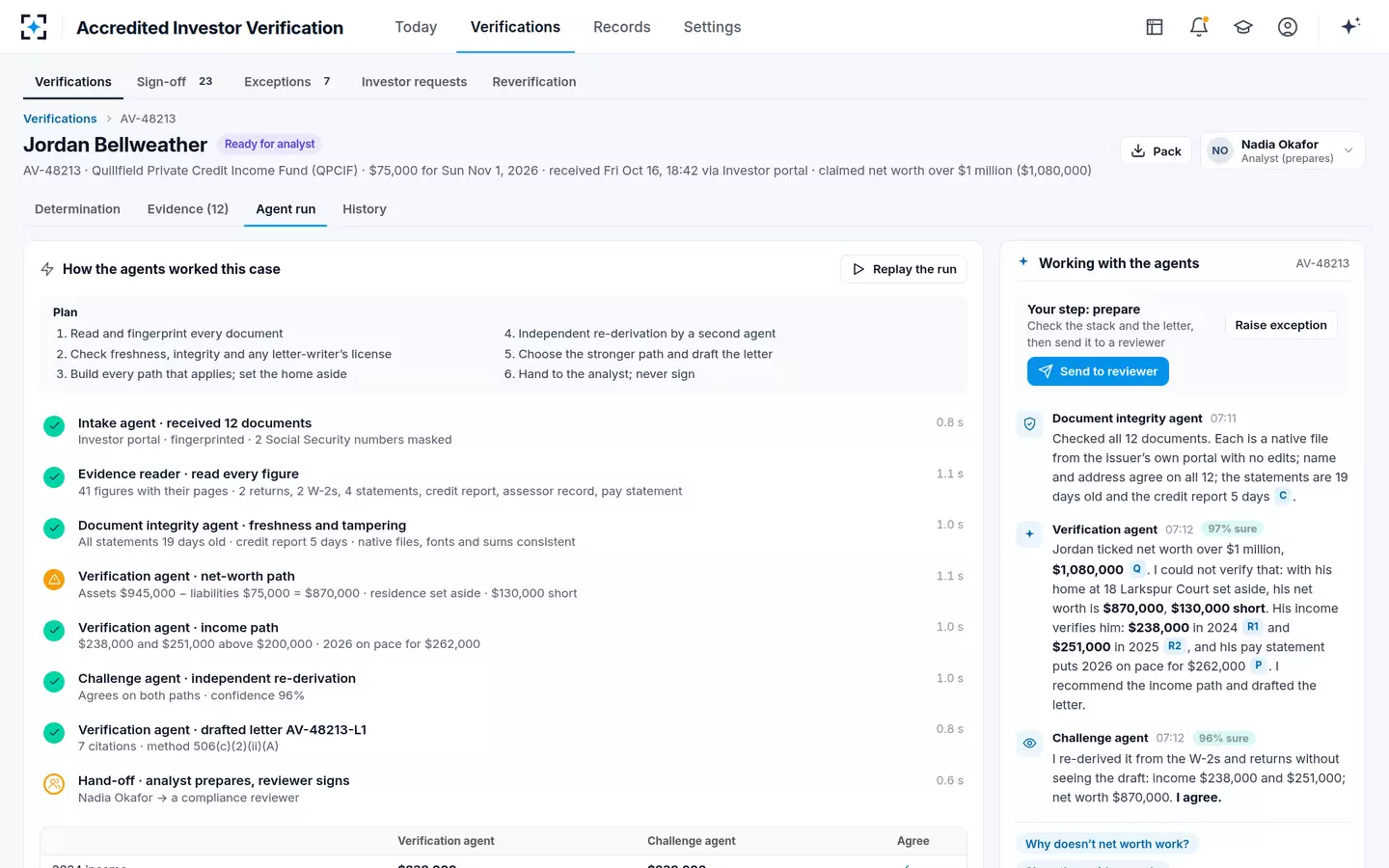
It can read them and pull each figure with the page it came from, and that citation is what makes the reading checkable. In the sample case, the Evidence reader takes twelve documents for one investor, among them two returns, two W-2s, four statements, a credit report, an assessor record and a pay statement, and pulls 41 figures, each linked to its page: adjusted gross income from line 11 of each Form 1040, wages from each W-2, balances from each statement, debts from the credit report. Its limits are written down: it never estimates a missing figure, and it never shows a translated figure without the original beside it, so a Japanese brokerage statement is read in Japanese and checked line against line.
How the agents worked one case, and the second agent's result beside the first
How do you catch an edited PDF statement?
By testing the file as well as reading it. An edited statement usually fails at least one of four checks: the lines do not add up to the printed total, the file was produced by a desktop editor rather than the institution's statement system, the edited figure is in a different font from the rest of the page, or a name or address disagrees with the other documents. In the sample exceptions queue, one investor's brokerage statement printed a total of $1,248,300 while its lines added up to $948,300; the file had been edited with a desktop PDF editor on October 12, and the total was in a different font. A tamper score of 0.40 or more sends a file to the exception approver, and a flagged file never reaches a letter.
A tampered statement: flagged, explained and decided by someone else
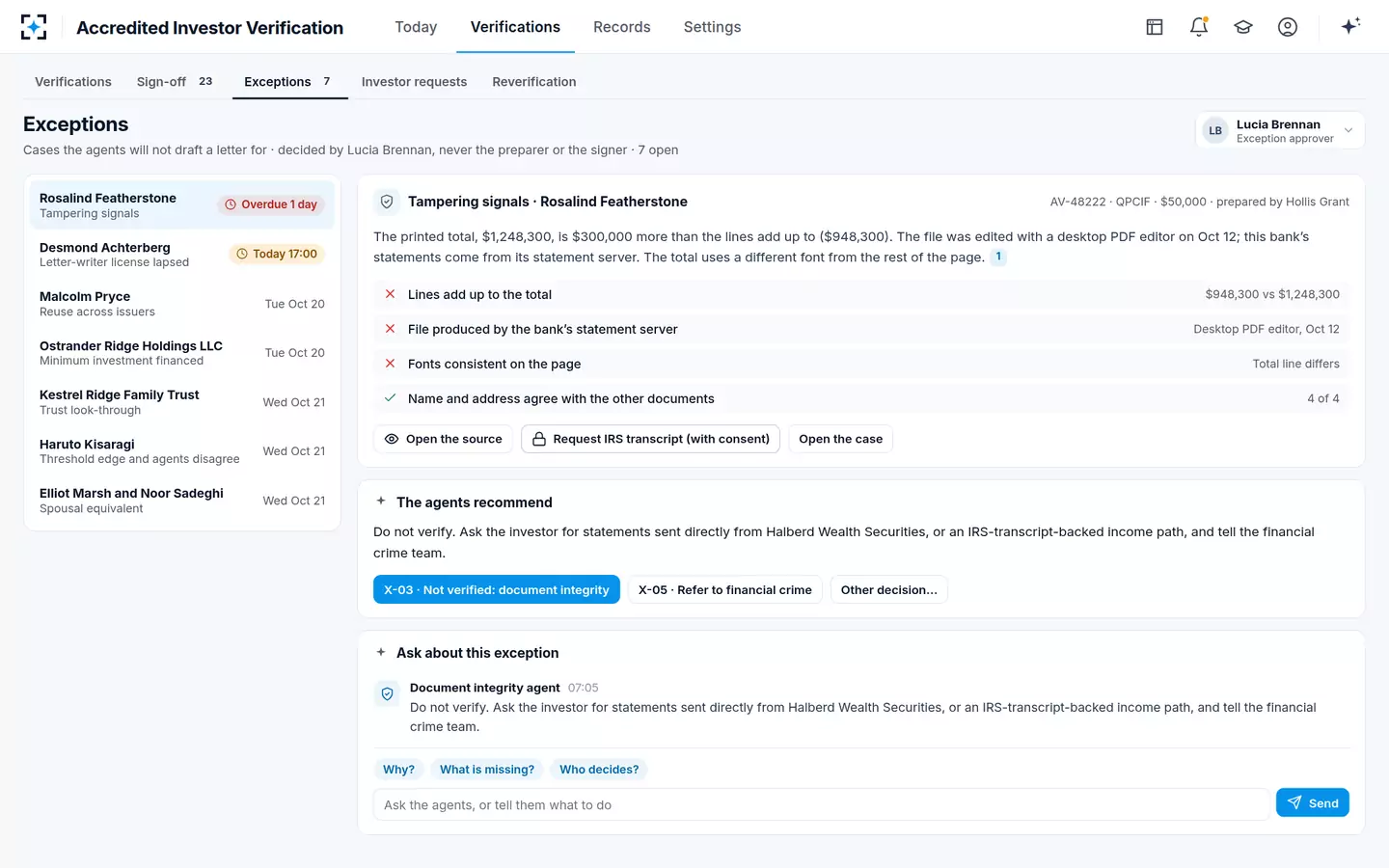
The agents' recommendation in that case shows what a good response looks like: do not verify, ask for statements sent directly from the institution or an income path backed by IRS transcripts with the investor's consent, and tell the financial crime team. A document problem is not proof of intent, so the language stays neutral, and the case goes to someone who neither prepared nor will sign it.
What does a second check add to accredited investor verification?
Independence. A second reader who starts from the first reader's answer mostly confirms it; a second reader who starts from the documents finds what the first missed. That is why re-reading a third party's letter is not the same as checking it, and why the solution's Challenge agent re-derives each determination on a different model, without seeing the draft, before comparing.
Re-reading a determination against re-deriving it
Re-reading: The letter or the draft: its category, its figures, its conclusion.
Re-deriving: The documents alone, with the claim hidden.
Re-reading: Typos, a missing signature, a date out of the window.
Re-deriving: Home equity counted, a debt left out, a wrong exchange rate, a figure from the wrong line.
Re-reading: Any error the first reader made and wrote down confidently.
Re-deriving: Little, if the second reader is genuinely independent; disagreements are surfaced, not settled quietly.
Re-reading: Rarely happens, which is the problem.
Re-deriving: A person decides with both workings side by side; in the sample, also below 90% confidence or within 5% of a line.
Disagreement is the useful output. In the sample data, a Japanese investor's net worth comes to $1,031,000 at the statement-date exchange rate and $988,000 at the day's rate used by the Challenge agent. The firm's rule is the statement-date rate, but the result sits 3.1% above the line and the two agents disagree, so a person takes a second look. A single reader would have produced one number and moved on.
Where third party verification goes wrong
Mostly in the gap between the letter and the sale. The failures that matter are rarely dramatic: a writer whose licence lapsed between two renewals, a letter written for a different sponsor's fund and forwarded by the investor, steps taken in June relied on for an October dealing date, a confirmation of income for an investor whose questionnaire claims net worth, or a letter sent as a PDF that someone has edited. Each is invisible if the reviewer reads only the letter and obvious if the reviewer checks it against the registry, the calendar and the rest of the file.
The sample exceptions queue holds two of these. One investor's letter came from a writer whose licence had lapsed, and the case waits for the exception approver with a same-day deadline; another investor's verification was done for one fund and reused for a sister fund, which is a different issuer. In one quarter of the sample data, 41 letters came from CPAs, attorneys or advisers whose licence had lapsed. Those are invented investors, and the count says nothing about real ones; what it shows is that the checks have to run on every letter, because nothing on a letter's face distinguishes the good ones.
What to ask of any third party or automated verification
The questions are the same whether the third party is an accountant, a verification company or software in your own operations, and they decide whether the issuer has a reasonable basis to rely. They are also where the solution does not fit every case. A sponsor whose investors nearly all meet a high minimum under the SEC staff's 2025 letter, or that runs a handful of verifications a year, may need little more than a registry lookup and a careful reviewer.
Nine questions before you rely on third party accredited investor verification
- Can you see the evidence for each investor, not just a pass?
A reasonable basis to rely is hard to show for a result you cannot inspect.
- Is each figure tied to the page it came from?
So a reviewer can check the two that matter without re-reading everything.
- Is the home set aside, with the 60-day look-back checked?
The commonest net-worth error.
- Are dates tested against your sale, not the upload?
Three months to the dealing date.
- Is every letter-writer looked up in a registry, with a dated snapshot?
Including state boards outside CPAVerify.
- Are files tested for edits, not only read?
Arithmetic, producer, fonts, cross-document names.
- Is the check independent of the first answer?
Re-derived, not re-read.
- Who signs, and can the preparer sign?
A named person at the issuer, distinct from whoever prepared the case.
- Can you export the file per investor for an examiner?
With every read, decision and rule version on the trail.
The evidence screen below is what the first five questions look like answered for one investor. For costs, free accredited investor verification works through who pays and how to measure your own unit cost; for the people behind each signature, see verification of accredited investor status, signature by signature.
Every document, what it was used for, its date and its integrity check
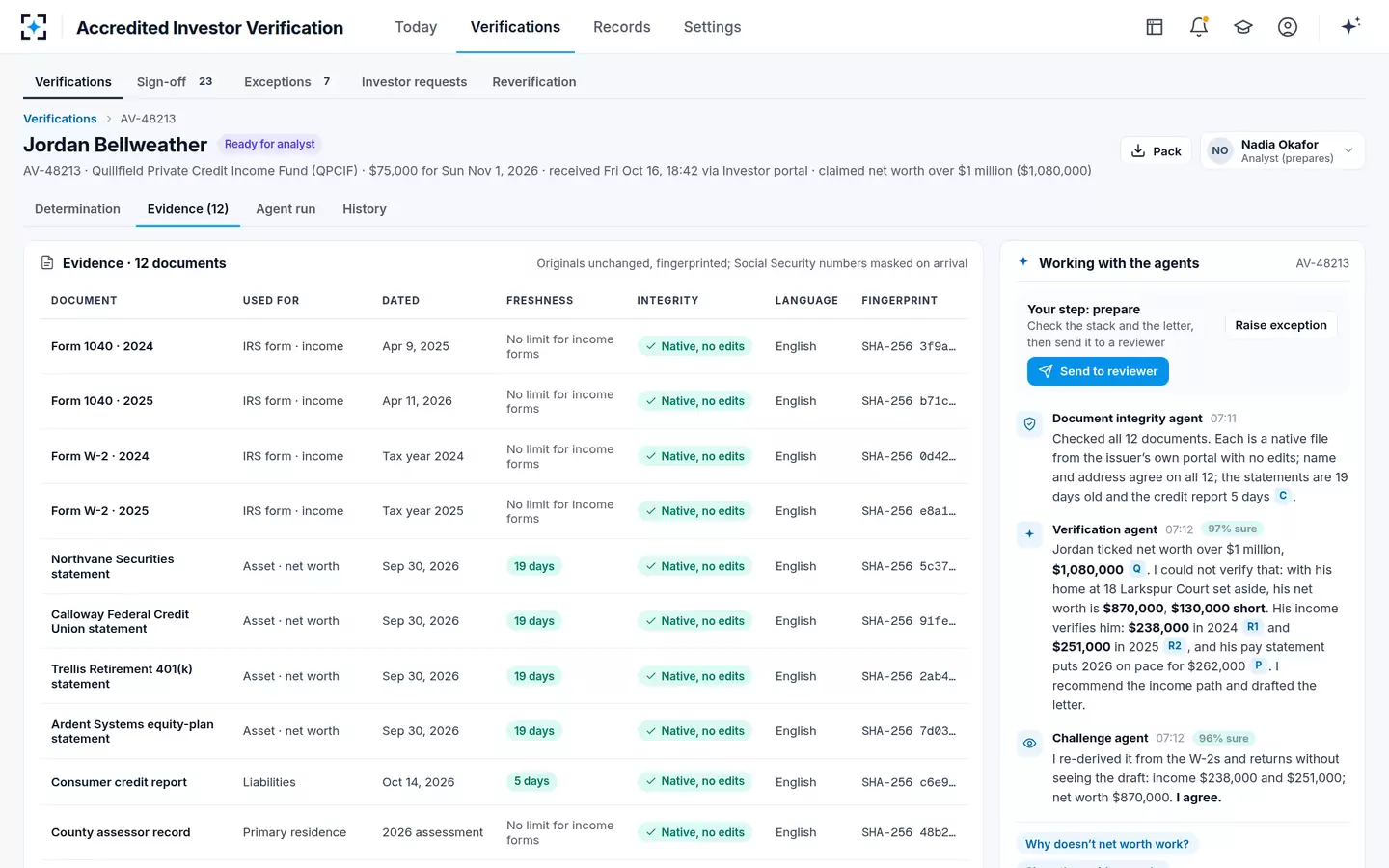
The solution page, Accredited Investor Verification, shows the agents, the roles and the settings together.
Questions people ask
Is a verification company's certificate a safe harbour?
Only if the company is itself a registered broker-dealer, SEC-registered adviser, or employs the attorney or CPA who signs the confirmation under the rule's third-party method. Otherwise its certificate is evidence the issuer weighs under the reasonable-steps test, and the issuer needs a reasonable basis to rely on it.
Can a third party verify for several issuers at once?
A third party can verify an investor and give confirmations to more than one issuer, and the SEC anticipated services doing so for offering platforms in 2013. Each issuer still relies on it for its own sale, within the three-month window for a letter, and the five-year same-issuer route does not carry across issuers.
Does automated verification need the investor's consent?
The investor supplies the documents, so consent is built in for most of the reading. Pulling a consumer report or an IRS transcript needs the investor's specific consent, and the SEC noted in 2013 that verification documents may be subject to privacy and data security requirements.
What happens when the two checks disagree?
A person decides, with both workings side by side. In the sample settings that also happens when either check's confidence falls below 90% or the result sits within 5% of a line after currency conversion, which is where small reading errors change outcomes.
Can a third party verify an entity?
Yes, under the reasonable-steps test, which is how entities are verified in any case. For an entity accredited because all its equity owners are, the verification has to reach each owner; for one accredited on assets or investments over $5 million, its statements are the main evidence.