Free accredited investor verification exists, but only in the sense that one party does not pay for it. A Rule 506(c) issuer must take reasonable steps to verify every buyer (17 CFR 230.506(c)(2)(ii)), and the work of reading two years of tax returns, or statements and a credit report from the last three months, or checking a letter-writer's licence, is done by someone on every route. When a platform or an issuer offers verification free to investors, the issuer is paying for it; when an issuer accepts the investor's own CPA letter, the investor is paying the CPA; when an issuer accepts a ticked questionnaire, nobody pays and the exemption carries the risk. The honest question is the unit cost of one verification on each route, and no regulator or independent study publishes it. Botminds' Accredited Investor Verification exists to bring that unit cost down without moving the risk: agents read and check the evidence, and a reviewer at the issuer signs.
Where one investor's hands-on hours go: about 5.5 by hand, about 0.7 with the agents
By hand, about 5.5 hours
- Logging, matching, masking · 9%
- Reading every figure · 27%
- Freshness, tampering, licence · 14%
- Both paths, home set aside · 18%
- Letter and reviewer's check · 18%
- Asking for what is missing · 14%
With Accredited Investor Verification, about 0.7 hours
- Logging · 7%
- Reading · 14%
- Checks · 14%
- Paths · 14%
- Letter and reviewer's check · 36%
- Requests · 15%
Is there free accredited investor verification?
Yes, in five forms, and each is free only to someone. Self-certification costs nothing and is not enough for 506(c) on its own. The investor's own accountant, attorney, broker or adviser may write a confirmation letter, which is free to the issuer and usually billed to the investor. Some issuers and platforms pay for verification and offer it free to investors. Free public registries prove some kinds of status. And for repeat buyers and high minimums, the rule and the SEC staff allow routes that need little more than a signature.
Free to whom? Six ways an accredited investor gets verified, and who carries the cost
| Route | Who pays in money | Who pays in time | What the issuer still owns |
|---|---|---|---|
| Questionnaire tick only | Nobody | The investor, briefly | The whole risk: the SEC said in 2013 that a tick alone is not reasonable steps |
| Investor's own CPA or attorney letter | The investor, usually | The writer, then the issuer's reviewer | Checking the writer's standing, the three-month window and the basis |
| Verification service, free to investors | The issuer or platform | The investor uploads; the provider reviews | A reasonable basis to rely, and the evidence behind each pass |
| Issuer verifies in house | The issuer | The issuer's analysts and reviewers | Everything, with the evidence in hand |
| Licence lookup (Series 7, 65, 82) | Nobody: BrokerCheck is free | Minutes | Matching the right person and keeping a dated snapshot |
| High minimum, or the same issuer within five years | Nobody, beyond drafting | The investor signs representations | The conditions: no financing of the minimum; no contrary information |
The registries deserve a word, because they are the one place where verification is genuinely free at the source. The SEC's October 2026 notices describe each: BrokerCheck as "a free tool for the public to research the background and experience of financial advisers and firms"; CFA Institute's directory as searchable by the public "at no cost"; CPAVerify.org for CPAs, with Hawaii and New Mexico covered by their own state sites (SEC notice on Series 79, 86 and 87; on the CFA charter; on CPA licences). Today only the Series 7, 65 and 82 make their holders accredited; the others are under consideration, and the notices argue that a credential anyone can look up would cost issuers less to confirm than income or net worth (SEC notice on the exam). The accredited investor exam and five more credentials covers that change.
How much does accredited investor verification cost?
No regulator or independent study publishes a price or an average cost per verification, and providers' prices are not published in a comparable form. What the evidence does say is that the cost is large enough to change behaviour. In the survey Howell and Parker ran for the SEC's small business advocate, "nearly 80% of fund managers cited the time and money required to verify investor's accreditation status as having major or some influence on their decision" not to use 506(c) (Howell & Parker, October 2024).
Why venture fund managers say they stay with 506(b)
The SEC itself declined to put a number on it. Adopting the rule in 2013, it said only that "the costs of compliance will vary depending on the size and nature of the offering, the nature and extent of the verification methods used, and the number and nature of purchasers in the offering" (SEC Release 33-9415). That is a fair description of why a single price would mislead: a verification on two clean W-2s is a different job from a net-worth case with four statements in two currencies and a home equity question.
The useful number is not the price of verification. It is your cost per verification, by route, including the re-requests, the delays and the cases you had to decide twice.
Who pays for accredited investor verification: the investor or the issuer?
The rule puts the duty on the issuer and says nothing about who pays. In practice the answer follows the route. An investor asked to bring a CPA letter pays the CPA; an investor who uploads documents to a verification provider the issuer has engaged pays nothing; an investor whose sponsor verifies in house pays nothing directly, and the sponsor's fund or management company bears the staff time, depending on the fund's documents. What is never free is the issuer's own review of whatever comes back, because reliance needs a reasonable basis.
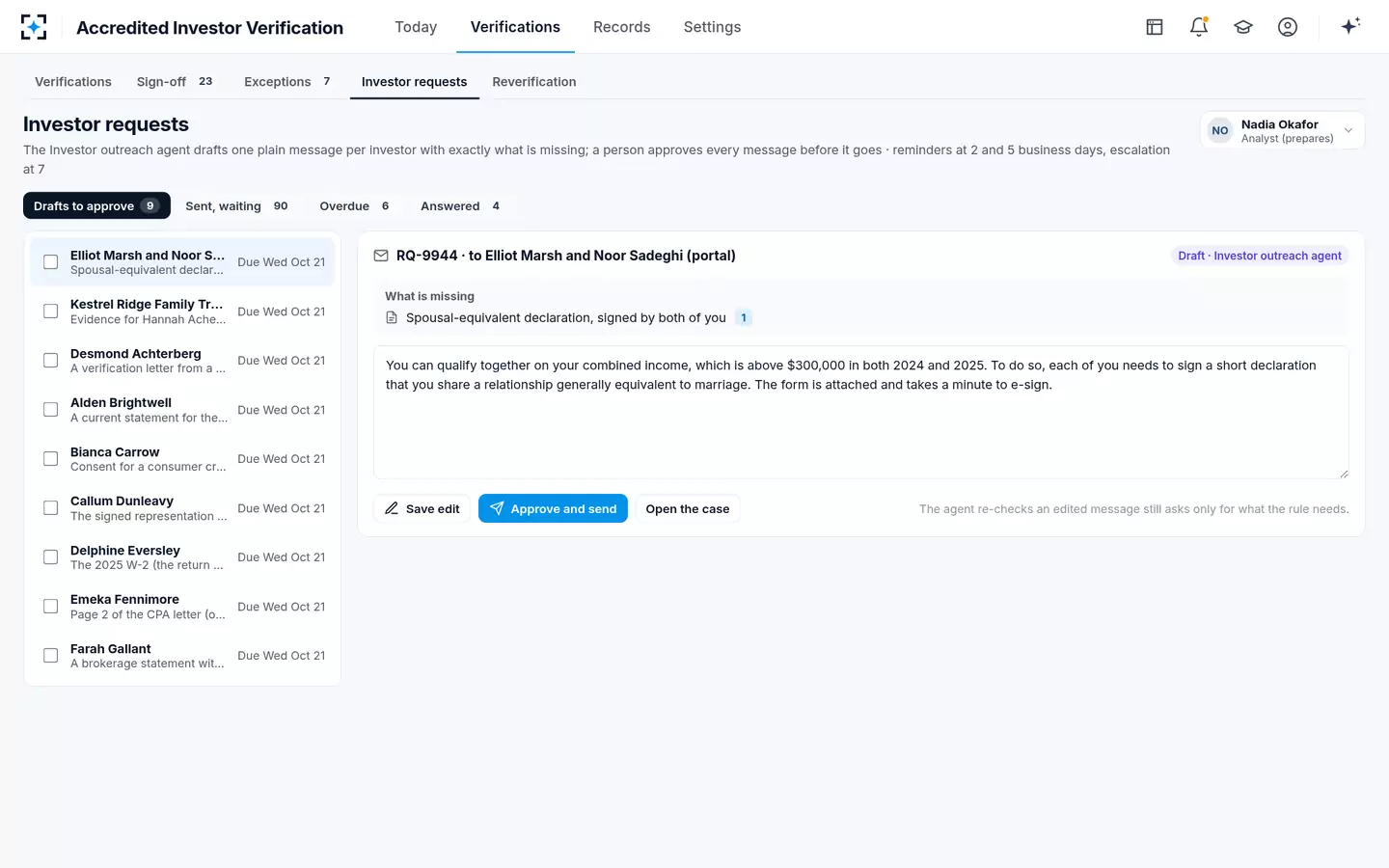
The cost the investor bears that does not appear in any invoice is delay. A missing page, a statement four months old or a letter that names the wrong fund sends the subscription back, and on a fund with a dealing cutoff a few days can move an investor to the next dealing date. In the sample data the solution runs on, the investor outreach agent drafts one plain request per investor naming exactly what is missing, with reminders at two and five business days and escalation at seven, and a person approves each message before it goes.
One plain request per investor, naming exactly what is missing
The cost nobody invoices: missing the dealing date
For a fund with fixed dealing dates and a documents cutoff, the largest cost of slow verification falls on the investor and the fund, not the verifier. A subscription that is not verified by the cutoff waits for the next dealing date, and the investor's money waits with it. In the sample data, the invented sponsor's credit fund has 214 subscriptions for its November 1, 2026 dealing date: 186 verified and released to the fund administrator, 28 still being verified. The forecast is that 26 of the 28 clear by the October 27 cutoff, and two are held to December 1 if not cleared, one an exception for a tampered statement and one waiting on a 2024 return.
That is why a unit cost that counts only hours understates the problem. Two held subscriptions out of 214 is a good outcome; twenty would be a month of uninvested capital, twenty unhappy investors and twenty calls to investor relations. The measurement in the checklist below therefore counts round trips and missed dealing dates as well as hours, and the outreach design matters as much as the reading: one request per investor, naming exactly what is missing, sent early enough to arrive before the cutoff.
What does a CPA accredited investor letter cost?
No public body publishes CPA fees for these letters, and they vary with the work: a CPA who prepared the investor's last two returns can confirm income from files already in hand, while one asked to confirm net worth for a client whose assets sit elsewhere has to gather statements and a credit report, as the issuer would. From the issuer's side the letter is not free either. The rule's safe harbour depends on the writer being licensed and in good standing and the steps falling within three months of the sale, so each letter still needs a registry lookup, a date check and a read of what it says it rests on. What a defensible verification letter says sets out those checks.
Is verification cheaper with a high minimum investment?
Much cheaper, if the offering and the investor fit. On March 12, 2025 SEC staff agreed that an issuer could reasonably conclude it had taken reasonable steps where the offering required a high minimum, $200,000 for individuals and $1,000,000 for entities in the request the staff answered, the buyer represented its status and that the minimum was not financed by a third party for this investment, and the issuer knew nothing to the contrary (SEC staff letter). The cost moves from reading tax returns to checking the representations and the funding trail. The letter has no legal force, and it does nothing for an investor below the minimum, which for many evergreen and feeder funds is most of them. The Latham no-action letter works through its conditions.
What is the cost of getting accredited investor verification wrong?
The exemption, and potentially every purchaser's money back. Rule 506(c) is available only if "All purchasers of securities sold in any offering under paragraph (c) of this section are accredited investors", subject to the issuer's reasonable belief after reasonable steps (17 CFR 230.506(c)(2)(i)). If no exemption is available, the sales were made without registration in violation of Section 5 of the Securities Act, and Section 12(a)(1) makes the seller liable to each purchaser "to recover the consideration paid for such security with interest thereon, less the amount of any income received thereon" (15 U.S.C. 77l(a)). Such a claim must generally be brought within one year of the violation, and within three years of the offering (15 U.S.C. 77m).
The more likely cost is quieter. An issuer that cannot show reasonable steps for one investor has to explain it to its auditors, to counsel on its next raise, to a buyer of the manager, or to an examiner. No SEC enforcement action that turns on a failed 506(c) verification could be found, so there is no public penalty to quote; the exposure is the exemption, and the time spent reconstructing a file that should have been built at the start.
How to measure your own unit cost of verification
Count the hands-on time per verification by route, add what you pay outside, and add the cost of re-work. The estimate in the opening figure, about 5.5 hands-on hours for an individual by hand, is Botminds' design estimate and a reasonable starting hypothesis; your own number may be higher or lower, and it is the only one that should drive a decision.
Measure the cost of one accredited investor verification on your own files
- Pick a sample of last year's verifications by route
Income, net worth, letter, licence, entity, minimum investment. Twenty of each is enough to see the shape.
- Time the hands-on work, not the elapsed days
Logging, reading, checking, both paths, the letter, the review, the requests.
- Count the round trips
Each request to the investor or the writer is time for both sides and a chance to miss a cutoff.
- Price your people at their loaded rate
Use your own payroll figures; a published average will not match your team.
- Add what you pay outside
Provider fees per verification, credit reports, transcript requests.
- Count the cases decided twice
Exceptions, returns from the reviewer, investors who moved to a later dealing date.
- Re-derive a few files independently
The cost of a verification that was wrong is part of the unit cost, even if nobody noticed.
In Botminds' estimate the hand cost sits mostly in two places, reading figures out of documents and chasing what is missing, and your measurement will show whether yours does too. Those are the two Accredited Investor Verification targets. The home screen below is a Monday morning at the invented sponsor whose data runs through the solution: 312 open verifications across five offerings, 64 determinations drafted overnight with two agents agreeing on each, and the requests already drafted for approval.
A Monday morning: what needs the analyst, and what the agents already did
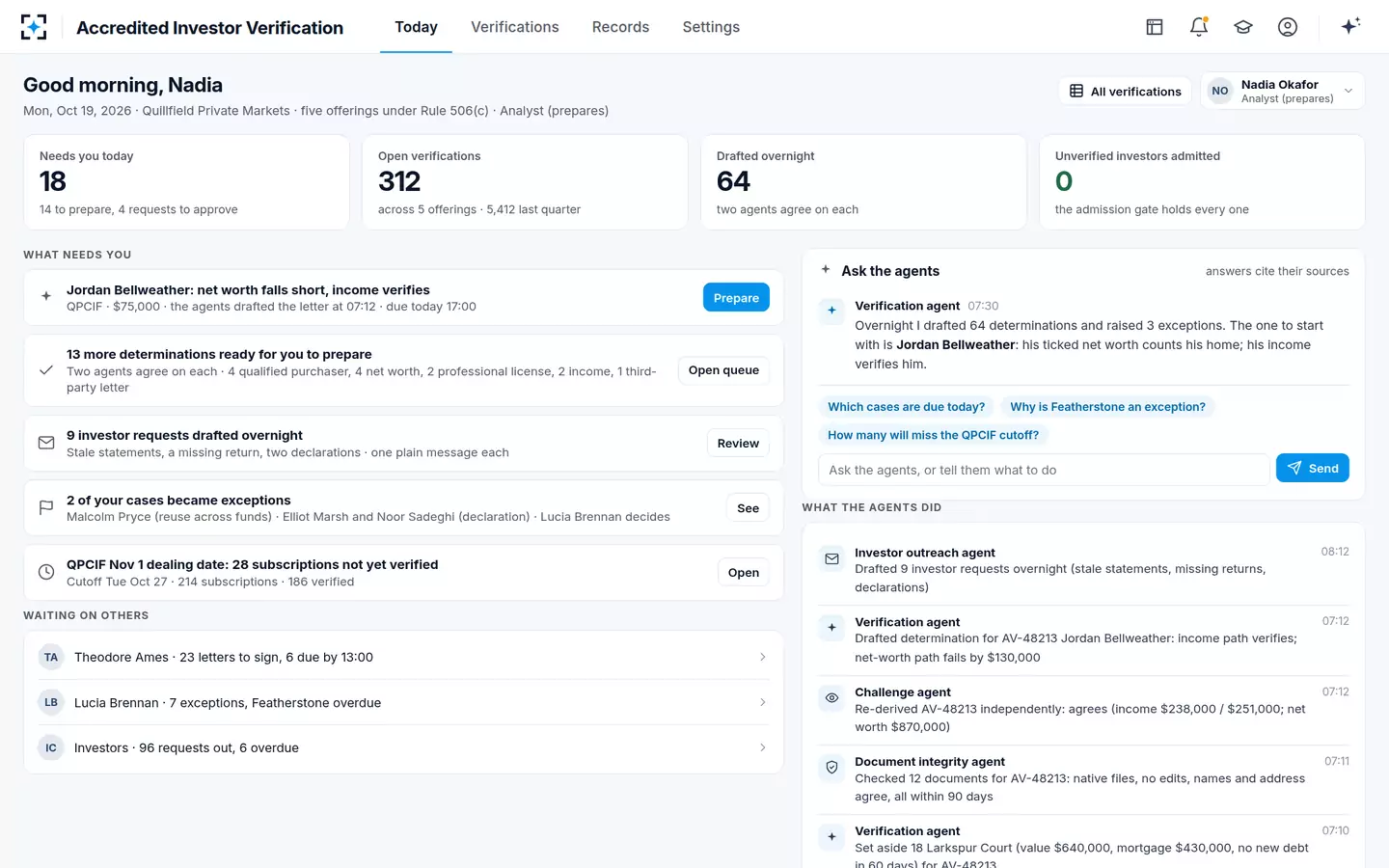
The solution page, Accredited Investor Verification, shows the full path from upload to signed letter; for a comparison of routes on one investor, see accredited investor verification services vs in-house.
Questions people ask
Can an investor verify themselves for free online?
An investor can fill in a questionnaire or upload documents at no charge on many portals, but self-certification is not verification under Rule 506(c). The issuer, or someone acting for it, still has to review evidence or rely on a qualified third party.
Is BrokerCheck enough to verify a Series 65 holder?
A BrokerCheck lookup showing the licence held and in good standing at the time of sale is the natural evidence for the licence route, and it is free. Keep a dated snapshot of the result and make sure the registry entry matches the investor, not someone with the same name.
Are verification costs a fund expense?
That depends on the fund's offering documents and agreements, not on Rule 506(c), which is silent on who pays. Sponsors should check what their documents allow before charging verification to the fund.
Does verifying once save money on later closes?
Yes, for the same issuer. A person the issuer verified can be covered at later sales for five years by a written representation, so long as nothing contradicts it. A sister fund is a different issuer and starts again.
What is the cheapest compliant route for a small 506(c) raise?
Usually a mix: licence lookups for Series 7, 65 and 82 holders, investors' own CPA letters where they have accountants, and in-house review of returns for the rest. SEC staff confirmed in January 2026 that different methods can be used in one offering.