The difference between 506b and 506c, Rules 506(b) and 506(c) of Regulation D, is a trade: Rule 506(c) lets an issuer advertise a private offering to anyone, and in exchange every buyer must be an accredited investor and the issuer must "take reasonable steps to verify" that they are, while Rule 506(b) bans general solicitation but lets the issuer sell to accredited investors it reasonably believes qualify, plus up to 35 non-accredited but sophisticated buyers in any 90 days (17 CFR 230.506). Both are Regulation D exemptions with no cap on the amount raised. The hard part of 506(c) is the verification: someone has to read tax returns, statements, credit reports or professional letters for every investor, and the issuer has to be able to show it did. Botminds' Accredited Investor Verification is built for that step, reading the evidence for each 506(c) buyer, setting the home aside from net worth as the rule requires, and drafting a cited letter for a compliance reviewer to sign.
Rule 506(b) vs Rule 506(c), condition by condition
Rule 506(b): No general solicitation or general advertising. Offers go to people the issuer, or a broker or adviser acting for it, already has a relationship with.
Rule 506(c): General solicitation allowed: a website, a conference talk, social media, press.
Rule 506(b): Unlimited accredited investors, and no more than 35 non-accredited buyers in any 90-calendar-day period.
Rule 506(c): Accredited investors only. One non-accredited buyer and the exemption is not available.
Rule 506(b): Each must be sophisticated, alone or with a purchaser representative, and must receive the disclosure Rule 502(b) prescribes.
Rule 506(c): Not allowed.
Rule 506(b): A reasonable belief that each buyer is accredited (or sophisticated) at the time of sale. No verification step is written into the rule.
Rule 506(c): Reasonable steps to verify that every buyer is accredited, judged objectively; five safe-harbour methods for individuals.
Rule 506(b): Filed within 15 days of first sale; box for 506(b).
Rule 506(c): Filed within 15 days of first sale; a separate box for 506(c).
Rule 506(b): Disqualification under Rule 506(d) applies.
Rule 506(c): Disqualification under Rule 506(d) applies.
What is the difference between 506(b) and 506(c)?
One condition is swapped for another. Under 506(b) the issuer gives up advertising and keeps flexibility about who buys; under 506(c) it gains advertising and gives up both the non-accredited buyer and the comfort of belief alone. Congress made the change in the JOBS Act of 2012, which directed the SEC to lift the ban on general solicitation for Rule 506 offerings "provided that all purchasers of the securities are accredited investors", and required the issuer to "take reasonable steps to verify" that they are, using methods the SEC would set. The SEC's rule took effect on September 23, 2013 (SEC Release 33-9415).
Belief and verification sound close, but they ask different things of the file. Rule 501(a) already counted as accredited anyone the issuer "reasonably believes" falls within a category at the time of sale (17 CFR 230.501(a)), and that standard runs through both exemptions. What 506(c) adds is an affirmative duty to take steps, measured by what a reasonable issuer would have done given the buyer, the information it had and the way the buyer was found. In 506(b), a signed questionnaire from someone the issuer knows is the usual basis. In 506(c), the SEC said in 2013 that a ticked box or a signed form, with nothing else known about the buyer, does not amount to reasonable steps (SEC Release 33-9415).
What is a 506(c) offering, and can a 506(c) fund advertise?
A 506(c) offering is a private placement under Regulation D that may be marketed publicly, so long as every buyer is a verified accredited investor. A 506(c) fund can advertise: it can put its terms on a website, speak about the raise at a conference or take inbound enquiries from people it has never met. What it cannot do is close with anyone it has not verified. The SEC's own description, repeated in its October 2026 notices, is that 506(c) "permits general solicitation, but issuers may not make any sales to non-accredited investors under Rule 506(c), and the issuer must take reasonable steps to verify that all purchasers are accredited" (SEC notice, October 5, 2026).
For a fund, advertising is rarely the whole reason. The Howell and Parker report for the SEC's Office of the Advocate for Small Business Capital Formation found that 40% of venture fund managers using 506(c) did so because they lacked a personal network to raise from, and that 506(c) funds were three times as likely to use an intermediary in fundraising (Howell & Parker, October 2024). The exemption serves the manager who cannot rely on people it already knows.
506(c) is the smaller exemption by far
$19T
raised under Rule 506(b), January 2009 to December 2022
median offering $1.6 million
$752B
raised under Rule 506(c) over the same period
median offering $0.8 million
8.4%
of venture capital funds used 506(c), late 2013 to end 2023
Why do so few funds use 506(c)? Verification and the signal it sends
Because verification costs time and money, and because using the exemption says something about the manager. Asked why they had not used 506(c), close to four in five fund managers in the Howell and Parker survey named the time and money of verifying investors as a major or some influence (the cost itself is worked in free accredited investor verification), with legal risk second (Howell & Parker, 2024). More than 70% of managers who used only 506(b) said they avoided 506(c) in part because it sends a negative signal: a fund that has to advertise looks like a fund that could not raise from people who know it.
"The available steps are not especially onerous, but they do add some cost to 506(c), which in turn could lead to negative signaling."
Howell and Parker, report for the SEC Office of the Advocate for Small Business Capital Formation, 2024
The two costs feed each other. A manager who expects verification to be slow and intrusive for investors chooses 506(b) and stays quiet; investors who rarely see 506(c) from strong managers read it as a weak sign; the next strong manager stays with 506(b). The report also points to a structural limit: many venture funds rely on the Investment Company Act's 3(c)(1) exclusion, whose 100-investor cap blunts the point of advertising to a wide audience in the first place.
The money raised under each exemption, 2009 to 2022, in billions of dollars
Who uses 506(c), and has it widened access to capital?
The managers who use it most are the ones with the thinnest networks, and it has helped them less than policymakers hoped when the JOBS Act passed. Howell and Parker found that, controlling for time and place, the share of first-time managers is 27% higher in 506(c) venture funds than in 506(b) funds, the share of female managers 39% higher and the share of Black or Hispanic managers 95% higher, relative to the mean; 506(c) managers are 8% less likely to have graduated from elite schools (Howell & Parker, 2024). The exemption is doing what Congress hoped for the people who use it.
It is not reaching many of them. Because 506(c) accounts for 8.4% of funds, the higher shares translate into small numbers: the Black and Hispanic share of 506(c) managers is still only 9%. The report's explanation joins the two halves of this page. Raising at arm's length requires hard evidence of quality, usually a track record, which few managers have without the personal network 506(c) was meant to replace, and the cost and signal of verification add to the barrier. A cheaper, faster verification does not fix the first problem, but it removes a cost that falls hardest on the managers who most need the exemption.
Can non-accredited investors invest in a 506(b) offering?
Yes, up to 35 in any 90-calendar-day period, and each must be able to evaluate the investment, alone or with a purchaser representative, or be reasonably believed to (17 CFR 230.506(b)(2)). The SEC's notices note the price of admitting them: "where non-accredited investors purchase in the Rule 506(b) offering, the information requirements in 17 CFR 230.502(b) must be met" (SEC notice, 2026). That means disclosure close to what a registered offering would provide, including financial statements, which is why most private funds admit accredited investors only even under 506(b).
Under 506(c) the answer is no, without exception. The definition's reasonable-belief clause still protects an issuer that verified carefully and was deceived, but there is no allowance for a buyer the issuer knew, or should have found out, was not accredited. In a private fund the verification is one section of the booklet; subscription documents in private equity shows where it sits among the others.
Does 506(b) require verification of accredited investors?
No verification step is written into 506(b); the issuer needs a reasonable belief at the time of sale. In practice that belief usually rests on two things: a questionnaire, and the relationship that let the issuer make the offer without general solicitation in the first place. SEC staff have described a "pre-existing, substantive relationship" as one means, "but not the exclusive means", of showing there was no general solicitation, and a substantive relationship as one in which the issuer has "sufficient information to evaluate" the person's sophistication and financial circumstances. Staff added that self-certification alone, "by checking a box", without any other knowledge of the person's finances, is not enough to form one (SEC Securities Act Rules C&DIs 256.26 and 256.31).
So 506(b) is not verification-free; its checking is front-loaded into knowing the investor before the offer. 506(c) moves the checking to the end, after the investor has arrived from anywhere. That is a real difference for operations. A 506(b) fund needs to know its relationships; a 506(c) fund needs a process that turns evidence from strangers into a determination it can defend.
Which exemption fits which fund: a working guide
| Situation | Usually 506(b) | Usually 506(c) |
|---|---|---|
| Investors come from the manager's and placement agent's existing relationships | Yes: no verification step, questionnaire plus relationship | Possible, but verification work buys nothing the fund needs |
| The manager wants to market publicly or take inbound enquiries | Not available | Yes |
| A few non-accredited employees or friends must be admitted | Possible, with Rule 502(b) disclosure | Not available |
| High minimum investment, institutional or very wealthy investors | Common | Workable at low cost under the 2025 staff letter on minimum investments |
| Platform or feeder raising from many individuals | Hard to show no general solicitation | Common; verification is the main operational load |
What the 506(c) file has to show
The issuer carries the burden of proving its exemption, and in 506(c) that burden lands on the verification file. The SEC said in 2013 that, because the issuer bears the burden of showing its offering is exempt, issuers and their verification providers should keep adequate records of the steps they took (SEC Release 33-9415). Rule 506(c) itself imposes no recordkeeping requirement; the need comes from the burden.
In practice the file shows four things per investor: the category relied on, the evidence and its dates, the reasoning that got from the evidence to the threshold, and who made the determination. The screen below is how Accredited Investor Verification lays that out for one buyer, using fictional sample data from an invented sponsor, Quillfield Private Markets, with five 506(c) offerings.
One 506(c) investor's net worth with the home set aside, and why income carries the file
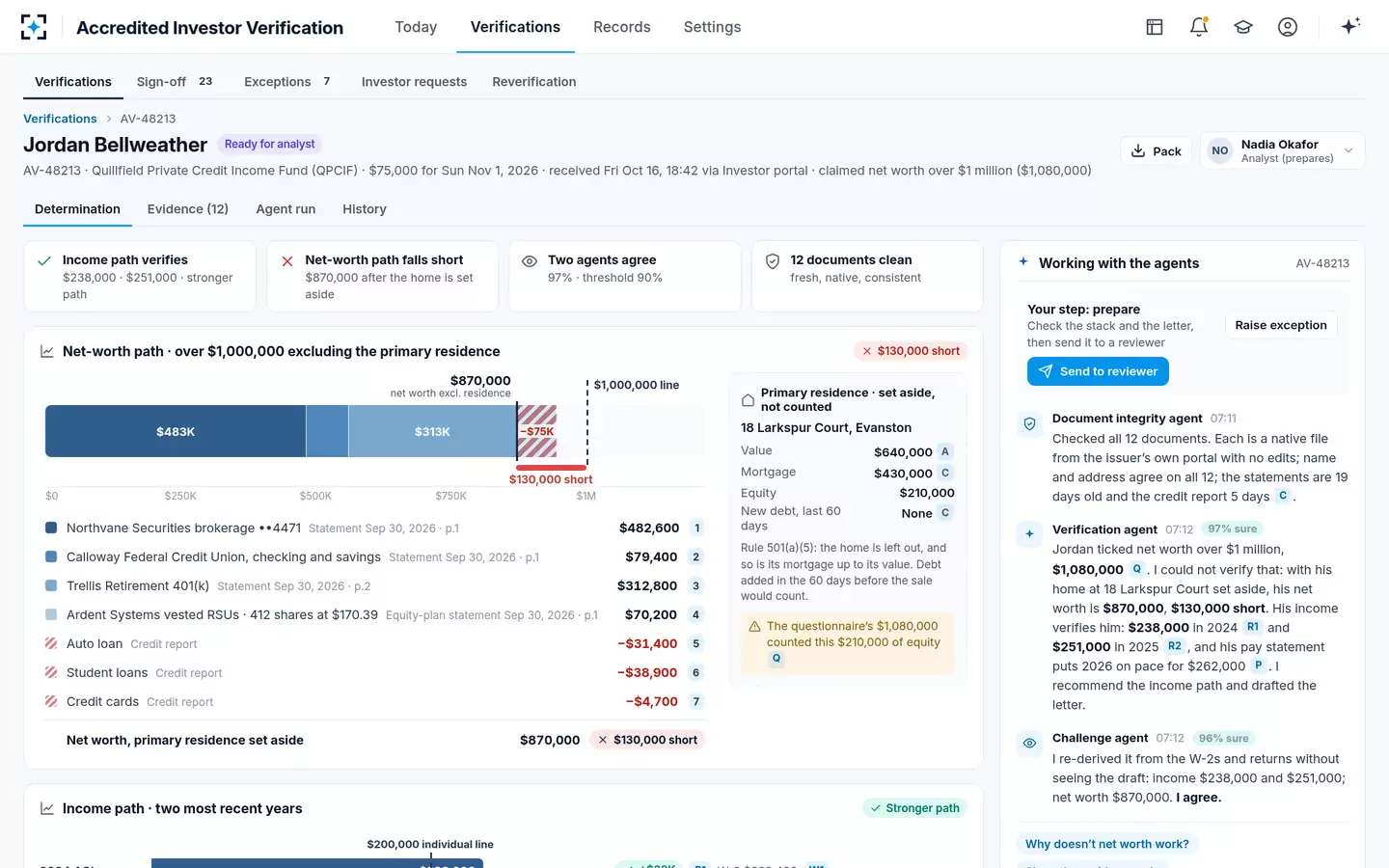
The example shows why the 506(b) habit does not carry over. Under 506(b), the sponsor's questionnaire, ticking net worth over $1 million, would have been a reasonable basis for belief from an investor it knew. Under 506(c) the evidence shows the tick counted $210,000 of home equity that Rule 501(a)(5) leaves out, and the file has to show that the issuer noticed. Why the questionnaire misleads in this way is the subject of an accredited investor questionnaire is not verification.
Is 506(c) getting easier? The 2025 staff letter and the 2026 notices
Two changes lower the cost of 506(c), and neither changes the rule. On March 12, 2025, SEC staff said an issuer could reasonably conclude it had taken reasonable steps where the offering required a high minimum investment, the buyer represented it was accredited and that the investment was not financed by a third party, and the issuer knew nothing to the contrary; the request the staff answered used minimums of $200,000 for individuals and $1,000,000 for entities. The Latham no-action letter covers its conditions and limits.
On October 5, 2026 the SEC published notices asking whether to designate a FINRA-developed accredited investor exam, the CPA licence, the CFA charter, the CFP certification and the Series 79, 86 and 87 licences as qualifying credentials, with comments due December 4, 2026. These are notices, not orders; nothing has been designated. If they were, a credential that a public registry confirms would be cheaper to verify than income or net worth, and the SEC's own economic discussion says as much. The accredited investor exam and five more credentials sets out what verification teams would need to check.
For a manager choosing today, the arithmetic is the one Howell and Parker describe: what verification costs per investor against what advertising is worth. Accredited Investor Verification is designed to bring the first number down while keeping the file an examiner would ask for; the solution page, Accredited Investor Verification, shows the rest of the process.
Questions people ask
What is a 506(c) fund?
A private fund that raises under Rule 506(c), so it may advertise but may admit only accredited investors it has taken reasonable steps to verify. It is usually also relying on an Investment Company Act exclusion, such as 3(c)(1) or 3(c)(7), which sets its own limits on who and how many may invest.
Is 506(b) or 506(c) better for a first-time fund?
It depends on where the investors come from. A first-time manager raising from people it knows usually uses 506(b) and avoids verification. Howell and Parker found first-time managers were more likely than others to use 506(c), and 40% of 506(c) users cited the lack of a personal network.
Do both 506(b) and 506(c) need a Form D?
Yes. Both file a Form D within 15 days after the first sale, and the form has a separate box for each so the SEC can see which exemption is claimed. The box for 506(c) was added in the 2013 rulemaking that created the exemption.
Can a 506(b) offering use a verification letter anyway?
Yes, and some issuers do when an investor's status is unclear. Under 506(b) a letter supports the issuer's reasonable belief; it is not required. It does not turn a 506(b) offering into a 506(c) one or permit advertising.
What happens if a 506(c) issuer admits one non-accredited investor?
The rule requires all purchasers to be accredited, so the 506(c) exemption would not be available for the offering unless the issuer reasonably believed that buyer was accredited after taking reasonable steps. That is why 506(c) issuers hold subscriptions until a verification is signed.
How much is raised under Regulation D?
The SEC's October 2026 exam notice cites about $400 billion raised in Regulation D offerings, excluding pooled funds, between July 2024 and June 2025. Its 2023 review of Form D data found $19 trillion raised under 506(b) and $752 billion under 506(c) from 2009 to 2022.