An accredited investor questionnaire is the part of a subscription document in which an investor states which Rule 501(a) category they meet, such as income over $200,000 in each of the last two years or net worth over $1 million excluding the primary residence, and signs it. In a Rule 506(b) offering it is usually the basis for the issuer's reasonable belief. In a Rule 506(c) offering it is not enough: the SEC said in adopting the rule that it did not believe an issuer "will have taken reasonable steps to verify accredited investor status if it, or those acting on its behalf, required only that a person check a box in a questionnaire or sign a form, absent other information about the purchaser indicating accredited investor status" (SEC Release 33-9415, 2013). The difficulty is that a questionnaire can be complete, signed and sincere and still be wrong, most often because the investor counted something the rule leaves out. Botminds' Accredited Investor Verification treats the questionnaire as a claim to test: agents read the returns, statements and credit report, rebuild the category from the evidence with the home set aside, and flag every claim the evidence does not support.
One accredited investor questionnaire against the evidence behind it
Category claimed
QuestionnaireNet worth over $1,000,000: ticked
EvidenceNet worth with the home set aside: $870,000
Figure given
Questionnaire$1,080,000
EvidenceAssets $945,000 from four statements, less $75,000 of debts on the credit report
The home
QuestionnaireNot asked separately
EvidenceValue $640,000, mortgage $430,000: $210,000 of equity the rule leaves out
Debt added in the last 60 days
QuestionnaireNot asked
EvidenceNone on the credit report; nothing to add back
Income
QuestionnaireNot ticked
EvidenceAdjusted gross income $238,000 (2024) and $251,000 (2025); 2026 on pace for $262,000
Result
QuestionnaireAccredited on net worth
EvidenceAccredited on income; the net-worth claim not relied on
What is an accredited investor questionnaire?
It is the investor's own account of their status, collected so the issuer knows which exemption tests a buyer passes. A typical one lists the Rule 501(a) categories for individuals and entities and asks the investor to tick those that apply: net worth over $1 million excluding the home, alone or with a spouse or spousal equivalent; income over $200,000, or $300,000 jointly, in each of the two most recent years with a reasonable expectation of the same this year; a Series 7, 65 or 82 licence in good standing; a director, executive officer or general partner of the issuer; a knowledgeable employee of a private fund; or one of the entity tests (17 CFR 230.501(a)).
Many questionnaires stop at the tick. Better ones ask for the parts of the calculation, because the parts are where the rule's details live: the home's value and mortgage, debt added recently, whether the test is individual or joint. A questionnaire that asks for the parts does not become verification, but it makes the verification faster and its errors visible earlier.
Is an accredited investor questionnaire enough for 506(c)?
No, not on its own. The rule requires the issuer to "take reasonable steps to verify", and the SEC's view in 2013 was that a ticked box or a signed form, without other information indicating status, does not meet that standard (17 CFR 230.506(c)(2)(ii); SEC Release 33-9415). The questionnaire still has a place in a 506(c) file. The rule's income method needs "a written representation from the purchaser" about the current year, and its net-worth method needs a representation "that all liabilities necessary to make a determination of net worth have been disclosed"; a well-drafted questionnaire is where those representations usually sit.
Questionnaire and verification: what each establishes in a 506(c) file
The questionnaire: The investor, in their own words and arithmetic.
The verification: Documents from third parties: the IRS forms, the bank, the broker, the credit bureau, a licensed professional.
The questionnaire: Which category is claimed, and the representations the rule's methods require.
The verification: Whether the evidence supports the category on the date of the sale.
The questionnaire: Nothing the investor did not know was wrong.
The verification: Home equity counted, stale statements, debts left out, a lapsed letter-writer, an edited total.
The questionnaire: Often, with a relationship that gives the issuer other information.
The verification: Not required.
The questionnaire: No.
The verification: Yes, by one of the rule's methods or reasonable steps of the issuer's own.
When is an accredited investor questionnaire enough?
In a 506(b) offering, usually, because the rule asks for a reasonable belief rather than steps to verify, and the relationship that let the issuer make the offer without general solicitation also gives it other information about the investor. Even there, a questionnaire is a basis for belief only if nothing the issuer knows contradicts it. An issuer that has seen an investor's statements in another context and knows the tick is wrong cannot rest on the tick.
In a 506(c) offering a questionnaire can support verification in one narrow case: a buyer the same issuer verified within the last five years, who now gives a written representation at the time of sale, is covered by the rule's method (E), and the questionnaire can carry that representation. How long accredited investor status lasts sets out the conditions.
What errors does an accredited investor questionnaire hide?
Errors the investor does not know are errors. The commonest is arithmetic done under the wrong rule: counting the home, forgetting a car loan, adding a spouse's assets without electing the joint test, or using last year's statement because it was the one at hand. Others are about the evidence the investor or an adviser supplies: a professional letter signed after the writer's licence lapsed, or a statement whose total has been edited. None of these show on the face of the questionnaire; each shows in the documents.
What one sample quarter's checks caught that the questionnaires never showed
No regulator or independent study publishes how often accredited investor questionnaires are wrong, or in which way. The sample figures above are invented to exercise the checks, not to describe the market. A firm that wants its own number can measure it, and the last section of this page shows how.
Does home equity count toward accredited investor net worth?
No, and it is the first thing to check on any net-worth tick. Under Rule 501(a)(5), "The person's primary residence shall not be included as an asset", and debt secured by it, up to its estimated fair market value at the time of sale, "shall not be included as a liability". Two exceptions catch people out. Mortgage debt above the home's value is a liability. And if the debt secured by the home has grown in the 60 days before the sale, "other than as a result of the acquisition of the primary residence, the amount of such excess shall be included as a liability" (17 CFR 230.501(a)(5)(i)).
The threshold stack: cited assets less debts, with the home set aside
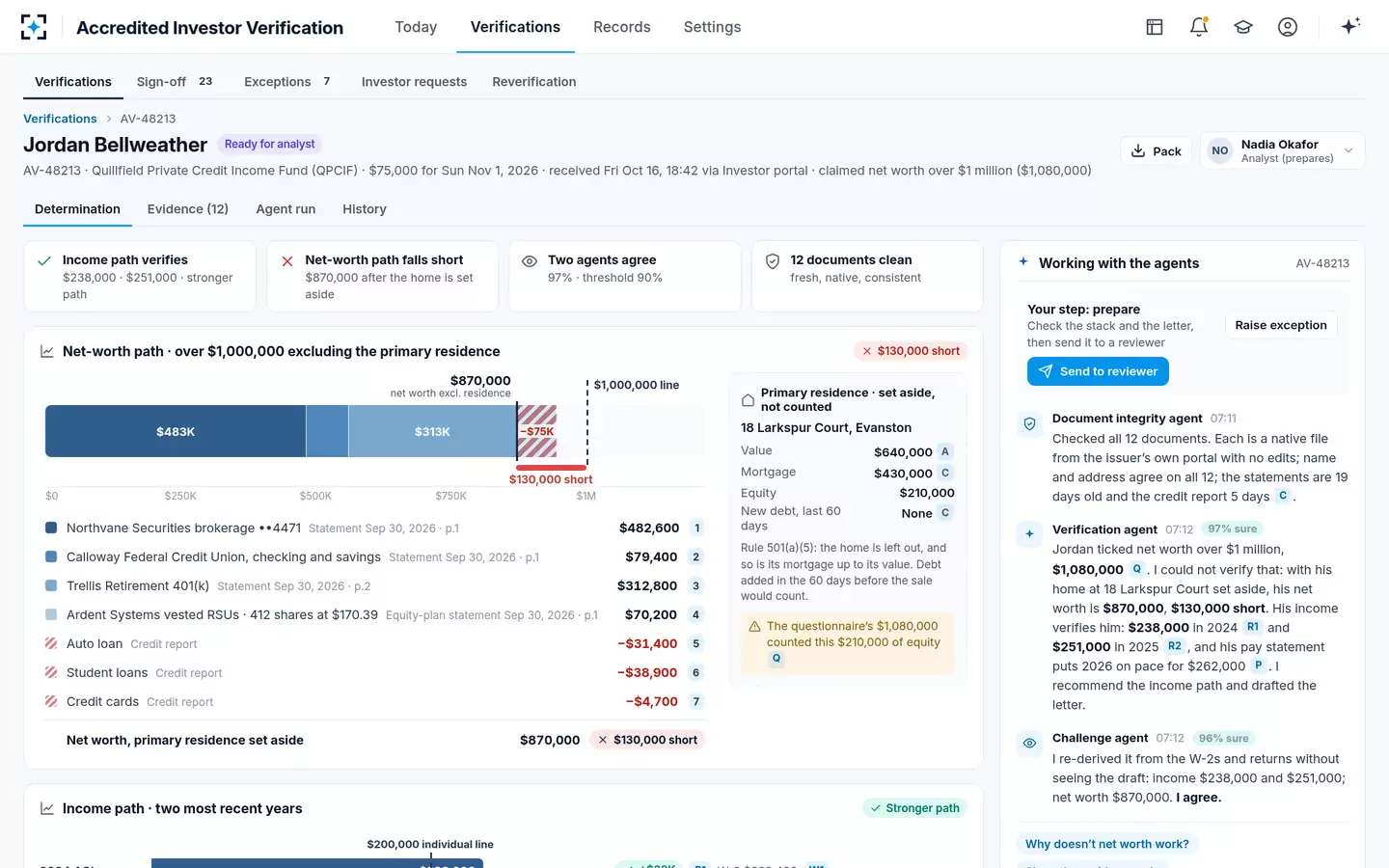
The 60-day rule exists because the alternative is easy to game: borrow against the house, hold the cash as an asset, and the home's equity reappears in net worth. The sample screens show both traps checked: no new mortgage debt in the 60 days before the sale for this investor, and, for another sample investor, a mortgage $18,000 larger than the home's value, counted as a liability. Joint tests add one more trap and one relief. The test may combine a spouse's or spousal equivalent's net worth, and the rule's note says "assets need not be held jointly to be included in the calculation".
Asking the agents why the tick does not hold, and getting the figures back
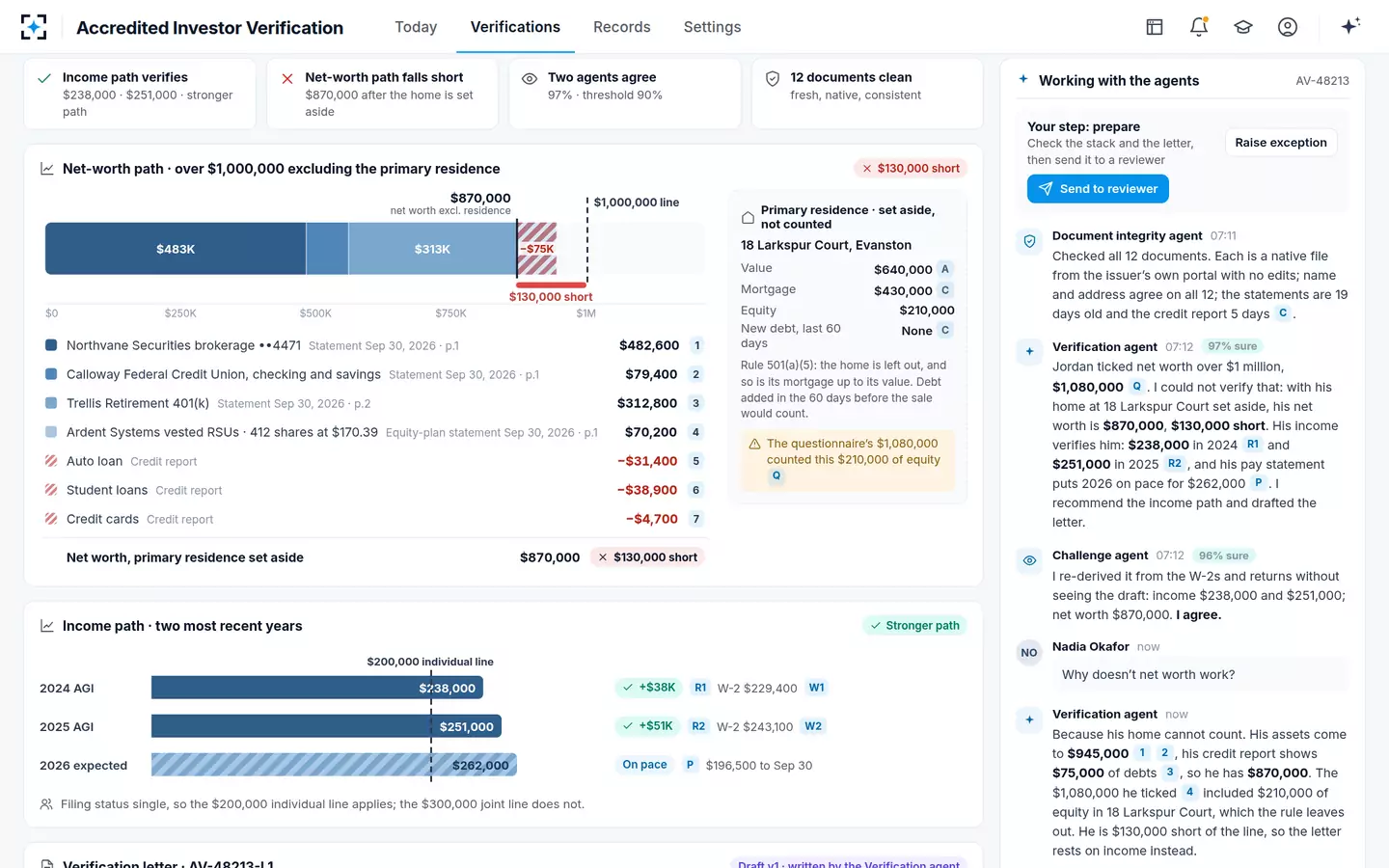
How should a questionnaire handle entities and trusts?
By asking which entity test is claimed, because each needs different evidence and some reach through to people. A corporation, partnership, LLC or charity qualifies with total assets over $5 million, so long as it was not set up to buy this offering; a trust qualifies on the same asset figure only if a sophisticated person directs its purchase; an entity of another kind qualifies on investments over $5 million; and any entity qualifies if every one of its equity owners is itself accredited (17 CFR 230.501(a)(3), (7), (8), (9)). For that last route the rule's note allows the issuer to look through layers of ownership to the natural persons at the end of the chain, the same chain an AML file traces in the investor due diligence checklist.
A questionnaire that asks a trust only to tick "accredited" cannot be verified, because the issuer does not know whether to look at the trust's assets, its trustee's sophistication or its owners. The useful questions are the entity's type, when and why it was formed, its total assets or investments with a statement date, who directs the investment, and, for the all-owners route, a list of owners each with their own category. In the sample data, a family trust sits in the exceptions queue for a look-through to its owners, and the request the agents drafted asks for evidence on one named person behind it. Wealth teams handling trusts for qualified-purchaser feeders will find the parallel tests in can a trust be a qualified purchaser.
The accredited investor questionnaire for 2026: what it should and should not list
It should list the categories in force, including the ones added in 2020, and it should not list the ones only proposed. The 2020 amendments added spousal equivalents to the joint tests, professional licences under Rule 501(a)(10), knowledgeable employees of private funds, family offices and their clients, and an entity category for investments over $5 million (SEC Release 33-10824). The SEC defined a spousal equivalent as "a cohabitant occupying a relationship generally equivalent to that of a spouse", so a joint test claimed by an unmarried couple needs a declaration to that effect.
The SEC's notices of October 5, 2026, on a FINRA-developed exam and on the CPA, CFA, CFP and Series 79, 86 and 87 credentials, are requests for comment with a December 4, 2026 deadline (SEC notice, 2026). A questionnaire that offers "CPA licence" as a box today invites a tick that qualifies no one. The accredited investor exam and five more credentials covers what would change if the Commission acts.
Questions that make an accredited investor questionnaire easier to verify
- Which test: individual or joint?
And, for joint, spouse or spousal equivalent, with a declaration for the second.
- The home's estimated value and the mortgage balance
So equity can be set aside and an underwater mortgage counted.
- Any borrowing against the home in the last 60 days
The look-back in Rule 501(a)(5)(i)(B).
- Filing status and adjusted gross income for each of the two years
So the evidence can be matched line for line to the return.
- Which professional licence, with its CRD number
Series 7, 65 or 82 only, until the SEC designates more.
- Where the evidence will come from
Investor upload, the investor's CPA, a broker or adviser letter, so the request goes to the right person first time.
- The representations the method needs
Current-year income expectation; all liabilities disclosed; no financing of a minimum investment, where that route is used.
How do you test accredited investor verification accuracy?
Re-derive the answer from the evidence without looking at the claim, and compare. That is the only test that catches the errors a questionnaire hides, because any check that starts from the tick inherits its framing. Accredited Investor Verification does it twice: the Verification agent builds every path, and a Challenge agent on a different model re-derives each determination without seeing the first, with a person deciding wherever they disagree or the result sits within 5% of a line.
A firm can measure its own process the same way, with or without software. Take a sample of last year's 506(c) files, have someone who did not work them rebuild each determination from the documents alone, and count the differences by type: home equity counted, stale documents relied on, debts missing, writer's standing not checked, arithmetic errors. Then plant known errors in a set of test files, such as an edited statement total or a mortgage increase in the 60-day window, and see how many the process finds. The first number tells you how accurate past verifications were; the second tells you how accurate the next ones will be. Third party accredited investor verification covers the same test applied to a provider's letters.
The solution page, Accredited Investor Verification, shows the threshold stack, the challenge step and the exceptions queue together.
Questions people ask
Can an accredited investor questionnaire be a PDF form?
Yes. The rule does not prescribe a format; what matters is what it asks and whether it carries the representations the verification method needs, signed and dated. An electronic signature on a portal form serves as well as ink, provided the issuer keeps the signed version.
Do retirement accounts count toward accredited investor net worth?
The rule excludes only the primary residence and the debt secured by it, so other assets, retirement accounts included, count at their value. A statement dated within three months of the sale is the rule's evidence for them under the net-worth method.
Does a spouse have to sign the accredited investor questionnaire?
When the investor relies on joint income or joint net worth, the rule's instructions have the issuer obtain the documents and written representations for both people. In the sample data, an unmarried couple claiming joint income is asked for a declaration, signed by both, that their relationship is generally equivalent to marriage.
What if the questionnaire and the evidence disagree?
The evidence decides, and the file should say why the claim was not relied on. If the evidence supports another category, as income did for the sample investor above, the verification can rest on that; if none, the subscription is held.
Is a questionnaire still needed if a CPA letter is provided?
Usually yes, as the place where the investor states the category and signs any representations. A letter under the rule's third-party method does not itself require a questionnaire, but the subscription document normally collects one anyway.