Accredited investor verification services are outside firms that check, for a Rule 506(c) issuer, that each buyer is an accredited investor: some are registered broker-dealers, SEC-registered advisers, attorneys or CPAs who write the confirmation letters the rule names as a safe harbour, and others are verification companies whose results the issuer weighs under the general reasonable-steps test (17 CFR 230.506(c)(2)(ii)). The alternatives are the investor's own professional's letter, review in house, and, for high minimums, the route SEC staff accepted in March 2025. Choosing between them is hard because each moves different work to different people while the burden of proving the exemption stays with the issuer, and the SEC's 2013 guidance on reliance says only that the issuer must have a reasonable basis for relying on someone else's verification (SEC Release 33-9415). Botminds' Accredited Investor Verification is the in-house route with the reading done by agents: it reads the evidence, checks writers in public registries, builds every path and drafts a cited letter that the issuer's own compliance reviewer signs.
One investor, five ways to verify him, and what the issuer holds afterwards
Self-certification
What happensHe ticks net worth over $1 million and writes $1,080,000.
What the issuer holdsA tick and a signature.
OutcomeNot reasonable steps under 506(c), and the claim itself is wrong: it counts $210,000 of home equity.
His own CPA's letter
What happensThe CPA who prepared his 2024 and 2025 returns confirms he is accredited.
What the issuer holdsA one-page confirmation, and a registry check if the issuer makes one.
OutcomeA safe-harbour method if the CPA is in good standing and the steps fall within three months of the sale; the issuer holds the conclusion, not the evidence.
A verification service
What happensHe uploads his documents to a provider the sponsor engaged; the provider issues a pass.
What the issuer holdsThe provider's result, and whatever evidence the contract lets the sponsor see.
OutcomeEvidence for the reasonable-steps test; strong only if the sponsor can show a reasonable basis to rely, case by case.
In-house review
What happensAn analyst reads twelve documents, works both paths and a reviewer signs.
What the issuer holdsEvery document, the arithmetic, the reasons, two names.
OutcomeVerified on income under the rule's method (A): $238,000 and $251,000 against $200,000. Net worth rightly not relied on.
High minimum
What happensThe staff's 2025 route: a minimum of $200,000, representations, no financing.
What the issuer holdsNothing: the route does not apply.
OutcomeNot available: his $75,000 subscription is below the minimum in the request the staff answered.
What are accredited investor verification services?
They are anyone the issuer pays, or asks the investor to use, to do the checking. Four kinds are common. Registered broker-dealers and SEC-registered advisers, including placement agents, can write confirmation letters under the rule's third-party method. CPA and law firms do the same for their clients or for issuers. Verification companies, often attached to online offering platforms, collect documents and issue results. And some fund administrators verify investors as part of onboarding. The SEC anticipated verification services in 2013, expecting outside services to verify status for issuers and for online Rule 506 portals carrying many issuers' offerings (SEC Release 33-9415; reliance on them is the subject of third-party accredited investor verification).
What separates them legally is whether their output is a safe-harbour letter. A confirmation from a registered broker-dealer, an SEC-registered adviser, an attorney in good standing or a CPA in good standing, stating that it took reasonable steps within the prior three months and determined the buyer is accredited, is one of the rule's own methods. A result from anyone else is evidence. Both can be sound; the second puts more weight on the issuer's own basis for relying.
Which accredited investor verification companies exist?
This guide names no providers: the useful question is not which firms exist but which of the four kinds a provider is, and what it lets you hold. A provider that is a registered broker-dealer or adviser, or that has a licensed attorney or CPA sign each confirmation, can give you a safe-harbour letter. One that is not gives you a result to weigh. Either way, the questions in the checklist further down decide whether you can rely on it.
A verification service against in-house review, on what an issuer has to show
Outside verification service: The provider. The issuer sees what the contract and the platform allow.
In-house review: The issuer's analysts, with every document in its own file.
Outside verification service: The provider's: its view of the home, stale documents, foreign statements, joint tests.
In-house review: The issuer's own written rules, versioned and approved.
Outside verification service: A letter or a pass, sometimes with documents; registry evidence for the writer.
In-house review: Documents, arithmetic, reasons, preparer and signer.
Outside verification service: Tax returns go to a third party, which some investors prefer.
In-house review: Tax returns go to the issuer; access has to be restricted inside it.
Outside verification service: A fee per verification, paid by the issuer or the investor.
In-house review: Staff hours per verification, by route; no regulator publishes either figure.
Outside verification service: Evidence may stay with the provider; check the export before signing.
In-house review: Nothing to move.
What should you check on a third party verification letter?
Five things, on every letter: that the writer is one of the four kinds the rule names, that the writer was in good standing on the date of the steps, that the steps fall within three months of your sale, that the letter names this investor and this issuer, and that nothing you know contradicts it. The standing check needs a registry: the SEC's October 2026 notice on CPA licences notes that Hawaii and New Mexico send nothing to the national CPAVerify database, so those two states' CPAs need their own boards' lookups (SEC notice, 2026). Foreign letters need foreign registries, since SEC staff have said the method is not limited to U.S.-licensed attorneys and CPAs (C&DI 260.09). What a defensible verification letter says takes a letter apart line by line.
Who the choice of route affects, and what each needs from it
Today
Picks a provider on price and speed, then finds the evidence sits on someone else's platform.
With agents
Picks by route and by investor type, with each route's cost measured on the firm's own files.
Still theirs: The decision, and the contract terms on evidence.
Today
Owns an exemption resting on results she cannot fully inspect.
With agents
Sets the firm's verification rules and sees the evidence behind each determination.
Still theirs: The standards, and who may sign.
Today
Explains to investors why documents went to one party and letters to another.
With agents
Sends one plain request per investor that says exactly what is needed and why.
Still theirs: The investor's experience.
Today
Receives subscriptions marked verified without knowing on what basis.
With agents
Receives only subscriptions with a signed verification, and the basis is on file.
Still theirs: The investor register.
Is in-house accredited investor verification cheaper?
It depends entirely on volume and on how the reading is done, and no regulator or independent study publishes the comparison. By hand, Botminds estimates about 5.5 hands-on hours for one individual investor, most of it reading figures out of returns and statements and working both paths; with the agents doing the reading and checking, the same estimate is about 0.7 hours, the largest share of it the reviewer's check and signature. Both are design estimates, not measured results. A provider's fee per verification is the comparison, and a firm can measure its own side in a few weeks. Free accredited investor verification sets out the method.
Hours are not the only cost. In-house review means holding tax returns and Social Security numbers, which the SEC flagged in 2013 when it said verification documents "may be subject to federal and/or state privacy and data security requirements". A provider takes some of that exposure away, and adds the question of what happens to the evidence when the contract ends.
In-house review at scale: determinations waiting for a reviewer, each with its basis
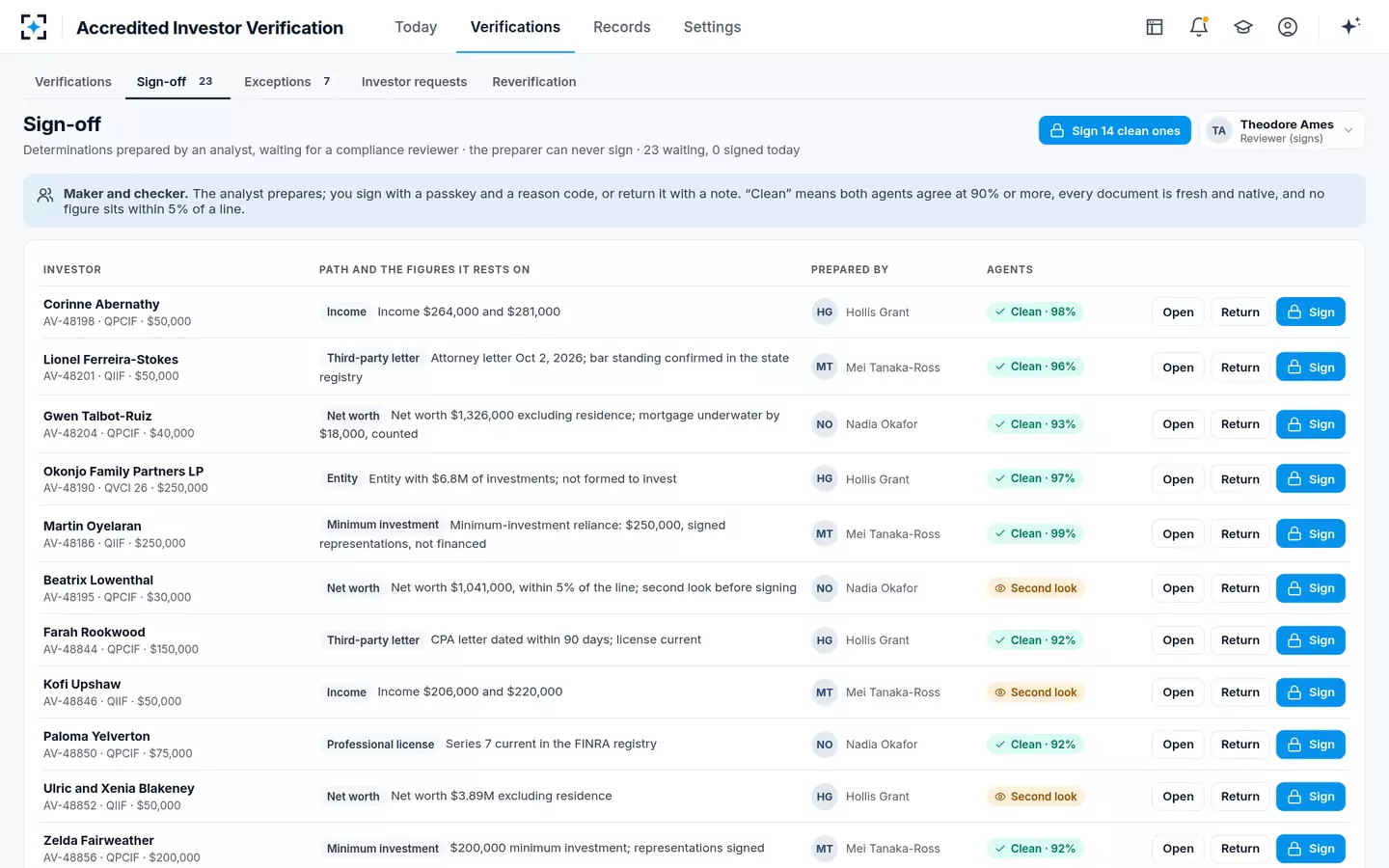
Which verification route suits a high minimum fund?
The high-minimum route, for the investors who meet it, and something else for those who do not. SEC staff agreed on March 12, 2025 that an issuer requiring minimums of $200,000 for individuals and $1,000,000 for entities, with written representations of status and no third-party financing of the minimum, and no knowledge to the contrary, could reasonably conclude it had taken reasonable steps (SEC staff letter). For a fund whose investors all commit well above those lines, that can replace most document review. The staff letter has no legal force, and the financing representation needs its own checks against what the issuer already knows. The Latham no-action letter covers the conditions.
Which route fits which kind of 506(c) offering
| Offering | Route that usually fits | Why |
|---|---|---|
| Institutional class, high commitments | High minimum, with financing checks | Most investors meet the lines; the work is the representations |
| Evergreen fund, low minimum, many individuals | In-house review, with letters accepted | Volume makes the unit cost decisive; repeat buyers use the five-year route |
| Investors with their own advisers or accountants | Third-party letters | The writer already holds the evidence |
| Investors abroad, documents in other languages | In-house or a provider that reads the original | Foreign returns and statements need the principles-based test and currency rules |
| A few dozen investors a year | Letters and a careful in-house reviewer | Software or a provider may cost more than it saves |
The last row is where Accredited Investor Verification does not fit. A sponsor running a few dozen verifications a year, most of them letters from investors' accountants, needs a registry lookup, a calendar and a careful reviewer more than it needs agents. The solution earns its place where volume is high, documents are varied, investors are spread across countries and currencies, and the issuer wants the evidence in its own file.
Foreign evidence read in the original, line beside line
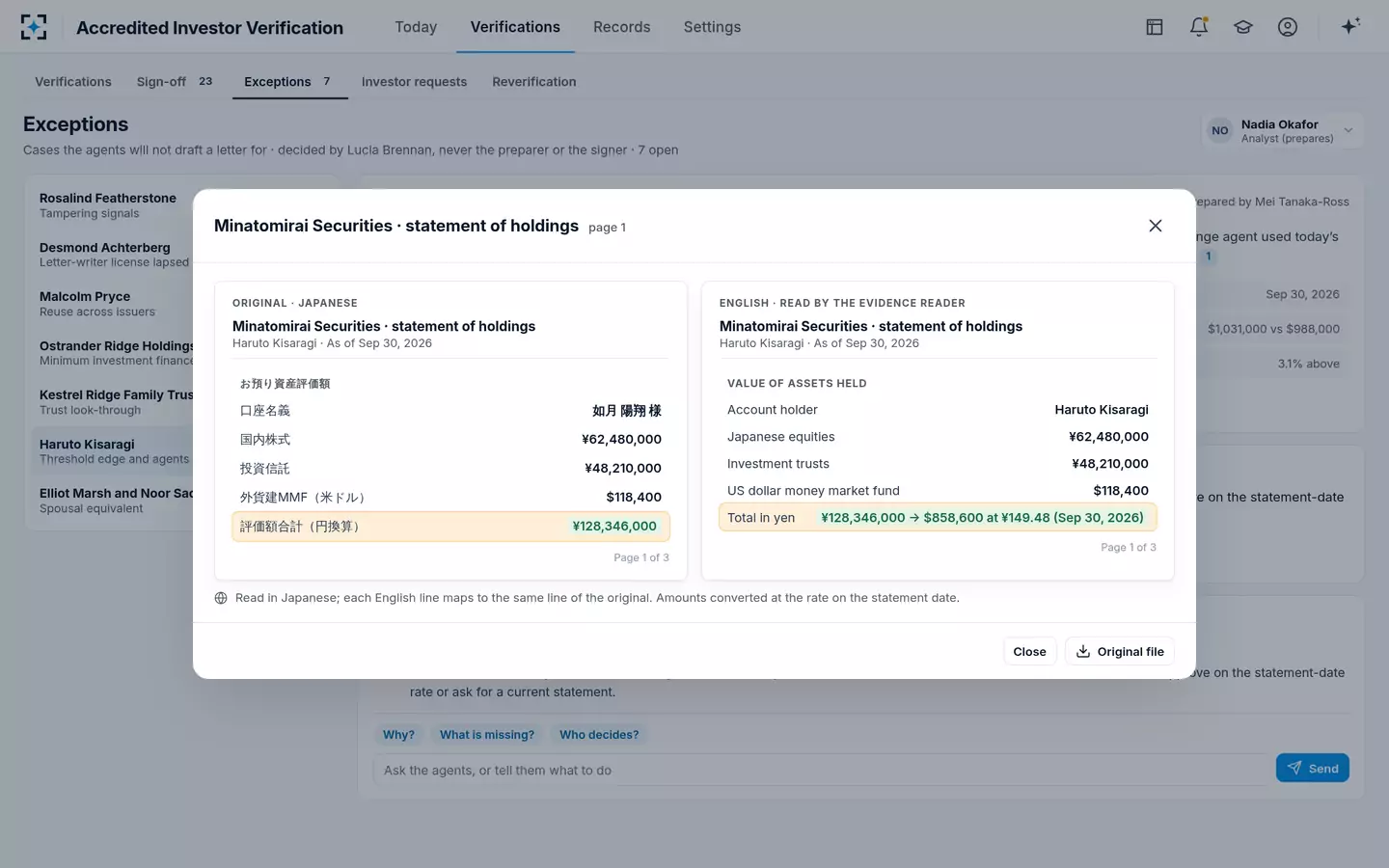
How to test a route before you choose it
Replay a past quarter. Take last quarter's 506(c) files, with the determinations your team made, and run the same investors' documents through each candidate route: a provider's trial, your own team on a stopwatch, or Accredited Investor Verification on a sample of your files. Compare each route's determination with yours, case by case, and sort every disagreement into one of three kinds: the route was right and your file was wrong, the route was wrong, or the evidence supports either reading and a person has to decide. Then plant a few known errors in copies of the files, such as a statement total edited upwards, a mortgage increase inside the 60-day window or a letter from a writer whose licence has lapsed, and count how many each route finds.
The test answers the questions a price list cannot: how often each route is wrong, what kind of wrong, how much reviewer time is left after it, and whether the file it produces is one you would hand an examiner. A route that is fast and cheap but misses an edited statement is not cheap. Botminds offers that test for this solution: Accredited Investor Verification run on a sample of your own past subscription files, before you decide.
Where the investor's tax returns go
Every route except self-certification sends someone a tax return, a brokerage statement or a credit report, and each is a privacy decision as well as a verification one. The SEC noted in 2013 that verification documents may be subject to federal and state privacy and data security requirements, without saying which apply to whom; that depends on what the issuer and the provider are. What an issuer can control is where the documents sit, who inside can see them and for how long they are kept.
The questions are the same for a provider and for an in-house system: are Social Security numbers masked on arrival, are returns visible only to the people who must read them, is every access logged, which country are the files stored in, and when are they deleted. In Accredited Investor Verification, originals are kept unchanged with a fingerprint, Social Security numbers are masked on arrival, tax returns are seen only by those who must, and files stay in the investor's region for six years after final close. Whatever route a firm picks, it should be able to answer those five questions in writing.
How do you switch accredited investor verification providers mid-offering?
Carefully, because the exemption is the offering's, not the provider's. Since SEC staff accept different methods within one offering, a sponsor can change provider, or bring verification in house, part way through without restarting anyone verified properly before (C&DI 260.39). What it must keep is the evidence of the earlier verifications, because the issuer has to be able to show reasonable steps for every buyer, and because the rule's five-year representation route for repeat buyers depends on proving the earlier verification.
Ten questions for any accredited investor verification service or platform
- Is the output a safe-harbour letter or a result to weigh?
Who signs it, and are they a broker-dealer, SEC-registered adviser, attorney or CPA in good standing?
- Can you see the evidence behind each result?
Documents, figures and the arithmetic, not just a pass.
- Whose rules apply?
Home equity, the 60-day look-back, joint tests and spousal equivalents, foreign currency, stale documents.
- Are dates measured to your sale?
Three months to the dealing date, not to the upload.
- Are writers and licences checked in registries, with dated snapshots?
Including states outside CPAVerify and foreign bodies.
- Are files tested for edits?
Arithmetic, producer, fonts, names and addresses across documents.
- Is anything checked twice, independently?
A second derivation, not a second read.
- Who at your firm signs, and on what?
Your reviewer should be able to check a basis in minutes.
- Can you export every file, per investor and per offering?
For an examiner, an auditor, or the day you change provider.
- Where do the documents live, and for how long?
Privacy and data security requirements may apply to verification documents.
Answered for Accredited Investor Verification: the output is the issuer's own determination, signed by its reviewer; every figure is cited to its page; the rules are the firm's, versioned; dates run to the dealing date; writers are confirmed in public registries with snapshots; files are tested for edits; a second agent re-derives each case on a different model; the preparer cannot sign; files export per investor and per offering; documents stay in the investor's region for six years after final close. The solution page, Accredited Investor Verification, shows each of those in the product, and third party accredited investor verification covers how the maker-checker split works.
Questions people ask
Are accredited investor verification platforms regulated?
Rule 506(c) regulates the issuer, not the verifier. A platform is supervised as whatever else it is, such as a registered broker-dealer or adviser, and the issuer must take reasonable steps whoever does the work.
Can an investor reuse a verification from one platform with another issuer?
A third-party letter can be given to more than one issuer, within its three-month window, and each issuer decides whether to rely on it. The five-year representation route works only for the same issuer that verified the person.
Do fund administrators verify accredited investors?
Some do, as part of onboarding, acting for the issuer. The duty and the burden of proof remain the issuer's, so the issuer should see the basis for each determination, not only a status flag in the register.
How long does a verification service take?
Mostly as long as the investor takes to produce documents. The reading itself is short once the documents are in; in Accredited Investor Verification's sample data the median time to a draft determination after the last document arrives is seven minutes, a figure from invented investors that shows the design, not a customer result.
Should a small fund use a service or do it in house?
A small fund with few investors, most with accountants or advisers, can usually rely on letters and a careful in-house review. A service or software pays for itself as volume, document variety and foreign investors grow.