An accredited investor verification letter is a written confirmation from a registered broker-dealer, an SEC-registered investment adviser, a licensed attorney or a certified public accountant that the writer has taken reasonable steps to verify, within the prior three months, that a buyer is an accredited investor, and has determined that the buyer is one. It is one of the methods the SEC's rule names for a Rule 506(c) offering, the private placement that may be advertised to anyone but sold only to accredited investors, and it is the method that moves the reading of tax returns and brokerage statements off the issuer's desk (17 CFR 230.506(c)(2)(ii)(C)). The difficulty is that it moves the reading without moving the responsibility: the issuer still has to show its exemption holds, so a letter that is vague about its basis, more than three months old at the sale, or signed by someone whose licence has lapsed leaves the issuer exposed. Botminds' Accredited Investor Verification reads incoming letters, checks each writer in the public registries and drafts the issuer's own verification letter with every sentence cited to the page it rests on.
Six lines of an accredited investor verification letter, and why each one is there
- 1
Halden & Rook CPAs LLP · Illinois CPA firm licence 066-004417, active on October 14, 2026
Who the writer is, and the licence the issuer will look up. The rule requires a CPA "duly registered and in good standing"; a number and a status date let a reviewer prove it in one search.
- 2
Re: Ana Whitcombe, prospective purchaser of limited partnership interests in Larchmere Credit Opportunities Fund LP
Who was verified, and for which offering. A letter that names no issuer invites reuse for a deal its writer never considered.
- 3
Basis: income, Rule 501(a)(6), individual
The category relied on. Income, net worth, joint or individual: each needs different evidence, and the issuer has to know which test was passed.
- 4
We reviewed her Forms 1040 for 2024 and 2025 and Forms W-2 for both years, and obtained her written representation about 2026
What the steps were. The rule does not require this line; it is what turns "trust us" into steps a reviewer can weigh.
- 5
These steps were completed on October 14, 2026
The date that starts the clock. The writer must have taken the steps "within the prior three months" of the sale, so the date matters more than the letterhead.
- 6
We have taken reasonable steps to verify that the purchaser is an accredited investor and have determined that she is an accredited investor
The determination, in the rule's own terms. Without it the letter is a reference, not a confirmation under 506(c)(2)(ii)(C).
What is an accredited investor verification letter?
It is the third of five verification methods written into Rule 506(c), and the only one in which someone other than the issuer does the checking. The rule says an issuer "shall take reasonable steps to verify" that every buyer in a 506(c) offering is accredited, and then lists methods that are deemed to meet that duty for a natural person, provided the issuer does not know the person is not accredited. The letter method is "obtaining a written confirmation" from one of four kinds of professional that it "has taken reasonable steps to verify that the purchaser is an accredited investor within the prior three months and has determined that such purchaser is an accredited investor" (17 CFR 230.506(c)(2)(ii)(C)).
The methods are a safe harbour, not a requirement. The rule's own instruction says the issuer "is not required to use any of these methods", and the SEC explained in adopting it in 2013 that whether steps are reasonable is "an objective determination by the issuer (or those acting on its behalf), in the context of the particular facts and circumstances of each purchaser and transaction" (SEC Release 33-9415, July 2013). A letter outside the safe harbour can still help an issuer meet that test. A letter inside it does more: it is, on its own, a method the rule deems sufficient.
The five methods Rule 506(c) names for an individual buyer, and what each leaves in the issuer's file
| Method | What the issuer does | What it holds afterwards |
|---|---|---|
| (A) Income | Reviews any IRS form reporting income for the two most recent years and gets a written representation about the current year | Two years of Forms 1040, W-2, 1099 or K-1, and a signed representation |
| (B) Net worth | Reviews asset statements and a consumer report dated within the prior three months, and gets a representation that all liabilities are disclosed | Bank and brokerage statements, a credit report, a signed representation |
| (C) Third-party letter | Obtains a written confirmation from a broker-dealer, SEC-registered adviser, attorney or CPA | The letter, and whatever the issuer kept to show it could rely on it |
| (D) Pre-2013 holder | For someone who bought in the same issuer's 506(b) offering before September 23, 2013 and still holds, a certification at the time of sale | The certification and proof of the earlier holding |
| (E) Earlier verification | For someone the issuer itself verified before, a written representation at the time of sale; good for five years from that verification | The earlier file and the new representation |
Two things follow from the table. A letter is the only method in which the issuer's file can be a single page, which is its attraction and its risk. And a letter is a point-in-time document: it says a check was done and passed, but the issuer still needs to know when, by whom and on what, because that is what an examiner, a buyer's counsel in a later financing or a court will ask about the issuer's exemption.
Who can write an accredited investor letter?
Four kinds of writer qualify for the safe harbour, each with its own standing test. The rule lists "a registered broker-dealer", "an investment adviser registered with the Securities and Exchange Commission", "a licensed attorney who is in good standing under the laws of the jurisdictions in which he or she is admitted to practice law" and "a certified public accountant who is duly registered and in good standing under the laws of the place of his or her residence or principal office" (17 CFR 230.506(c)(2)(ii)(C)).
Who is on the rule's list of letter-writers, and who is not
On the list: An investment adviser registered with the SEC.
Not on the list: An adviser registered only with a state, or an exempt reporting adviser. Their letter is evidence for the principles-based test, not the safe harbour.
On the list: A broker-dealer registered with the SEC.
Not on the list: An individual representative writing in a personal capacity rather than for the registered firm.
On the list: An attorney in good standing where admitted, including outside the United States.
Not on the list: An attorney who is suspended, inactive or not admitted anywhere the writer claims.
On the list: A CPA duly registered and in good standing where they live or practise, including a foreign one in good standing.
Not on the list: An unlicensed tax preparer, an enrolled agent, a bookkeeper, or a CPA whose licence has lapsed.
On the list: —
Not on the list: Banks, financial planners, the investor's employer. The rule names none of them; an issuer relying on one is back to judging reasonableness itself.
SEC staff answered the foreign-writer question in 2013. Asked whether a letter from an attorney or CPA in good standing "in a foreign jurisdiction" counts, the staff said the method "is not limited to written confirmations from attorneys and certified public accountants" licensed or registered in the United States (SEC Securities Act Rules C&DI 260.09). An issuer with investors in Singapore or Zurich can accept a letter from a local accountant, but it then has to check good standing in a registry it may never have used.
Can the investor's own accountant, or the placement agent, write the letter?
Yes to both, as far as the rule goes. Nothing in it requires the writer to be independent of the investor or of the deal: the investor's own CPA, who prepared the returns, is often the best-placed writer, and a placement agent that is a registered broker-dealer is on the list even though it is paid to sell the offering. What the rule asks of the issuer is different. The safe harbour holds only while the issuer knows nothing showing the person is not accredited (17 CFR 230.506(c)(2)(ii)), so an issuer that has reason to doubt a letter, because the figures it has seen contradict it or the writer cannot be found, cannot treat it as a method.
Conflicts matter for a different reason: they change how much a reviewer should test. A letter from the broker-dealer earning a fee on the subscription is not barred, but it is the letter an examiner is most likely to ask about, and the issuer's file should show it checked the writer's registration and the basis as carefully as for any other. A letter from an accountant who has never prepared the investor's returns, and says nothing about what was reviewed, deserves a question before reliance.
One letter can also serve more than one issuer. The rule does not tie a confirmation to a single offering, so an investor's CPA can confirm status to two sponsors in the same month. Each issuer relies on it for its own sale, within three months of the steps, and each runs its own checks. What does not travel is an issuer's own later shortcut: the five-year representation route works only for the issuer that verified the person, which is one reason a letter that names its addressee is easier to rely on.
What should an accredited investor letter say? The required lines and the useful ones
Only two statements are required: that the writer took reasonable steps to verify within the prior three months, and that the writer determined the person is accredited. Everything else in the frame above is there for the issuer's benefit. The SEC's 2013 release put the reason plainly: the issuer carries the burden of showing its offering is exempt, so issuers and the services working for them need adequate records of the steps they took (SEC Release 33-9415; what such a file holds is set out in verification of accredited investor status). A letter that already carries the basis, the evidence reviewed and the date already is that documentation.
What to put in an accredited investor letter template
- The writer, with licence or registration number and jurisdiction
For a broker-dealer, its CRD number; for an adviser, its SEC file number; for a CPA or attorney, the licensing board and number.
- The purchaser by full legal name, and the issuer or offering
Joint filers and spousal equivalents named together when the test is joint.
- The category relied on
Rule 501(a)(5) net worth, 501(a)(6) income, 501(a)(10) professional licence, or an entity category.
- The steps taken, by document type and period
Returns for which years; statements as of which date; a consumer report from which bureau. Figures are optional; dates are not.
- The date the steps were completed
This date, not the date the letter was sent, is what the three-month window runs from.
- The determination in the rule's words
"Has taken reasonable steps to verify … and has determined that such purchaser is an accredited investor."
- A signature by the licensed person, not only the firm
So the issuer can check the individual's standing as well as the firm's.
The figures themselves need not appear. Many writers prefer not to put an investor's income or net worth into a document that will sit in a fund's files, and the rule does not ask for them. What a reviewer cannot do without is the category and the dates, because each test has its own evidence and its own clock.
A letter moves the reading of the returns to someone else. It does not move the burden of proving the exemption, which stays with the issuer that relies on it.
How recent must an accredited investor letter be?
The writer's steps must have been taken within three months before the sale. The rule's wording is "within the prior three months", and the sale, not the subscription or the signing of the letter, is the moment that counts. SEC staff have applied the same reading to net-worth documents: if they have aged past three months by the time the purchaser decides to buy, the net-worth method is no longer available (C&DI 260.08; the clocks are compared in how long accredited investor status lasts).
One letter, two windows: the rule's three months and a 90-day policy
- Sales on or before January 2, 2027 covered92 days
- A April 1, 2027 dealing needs a new letter89 days
- Covered to December 31, 202690 days
- From January 1, that dealing included, a new letter is needed91 days
The difference between three months and 90 days looks pedantic until a quarter-end dealing date lands in the gap. Many firms write 90 days into their procedures because it is easy to count, and a policy can be stricter than the rule. The mistake is to apply one unit in the procedure and the other in the file. Accredited Investor Verification holds the window as a dated setting, 90 days at the fictional sample firm used on this page, and tests each letter against the dealing date the subscription is for.
A fund with monthly or quarterly dealing feels this most. Each dealing is a sale, so an investor who subscribes in January on a letter from November and tops up in April needs a fresh look for April. For the issuer's own verifications, rather than third-party letters, the rule gives a much longer route back, which how long accredited investor status lasts works through clock by clock.
Does the letter writer have to see documents?
The rule leaves the method to the writer: it asks for "reasonable steps", not a particular file. In practice a writer who signs without looking at evidence is offering the issuer the same comfort as the investor's own tick, with a letterhead added. The SEC was direct about what that is worth. A ticked box or a signed form, with nothing else known about the purchaser, is not in its view a reasonable step (SEC Release 33-9415; see the accredited investor questionnaire). A writer acting for the issuer is held to the same standard.
The writers who are best placed are usually the ones who already hold the evidence. A CPA who prepared the last two returns has seen the income; an adviser or broker-dealer holding the accounts has seen most of the assets, though not always the liabilities. That is a reason for the letter to say what was reviewed. An adviser's confirmation that rests on the accounts it manages, with no view of the client's debts, is a weaker basis for a net-worth determination than for an income one, and a reviewer can only see that if the letter says so. Why a questionnaire is not verification takes the same point from the investor's side.
Checking a letter before you rely on it
Relying on a letter is a step the issuer takes, and it has its own checks. The first is the writer's standing on the date of the steps. In its October 2026 notice on CPA licences, the SEC repeated NASBA's description of CPAVerify as the "only official, free, single-source national database of licensed CPAs available to the public", and then noted that "Neither Hawaii nor New Mexico provide information to CPAVerify.org", so letters from those states need the state board's own lookup (SEC notice, October 5, 2026). For brokers and advisers, the SEC noted in 2020 that registration and licensing information is easy to obtain through FINRA's BrokerCheck or its own Investment Adviser Public Disclosure database (SEC Release 33-10824).
Six checks before an issuer relies on an accredited investor verification letter
- Is the writer on the rule's list?
Registered broker-dealer, SEC-registered adviser, attorney in good standing, CPA in good standing. A state-registered adviser is not.
- Was the writer in good standing on the date of the steps?
Look it up and keep the result with its date. A licence active today may have lapsed last month.
- Is the date of the steps within three months of this sale?
Count to the dealing date the subscription is for, in the unit your procedure uses.
- Does the letter name this purchaser and this issuer?
A letter written for another sponsor's fund is evidence, not a confirmation for yours.
- Does the basis fit what you know?
An income letter for someone whose subscription form shows a 2024 job change deserves a question.
- Has anything come in that contradicts it?
The safe harbour is lost if the issuer knows the person is not accredited.
The sample data shows why the lookup belongs in the reading. In one quarter of the fictional sample data used by Accredited Investor Verification, 41 letters came from CPAs, attorneys or advisers whose licence had lapsed, and one Illinois CPA's licence had expired two months before the letter was signed. Those numbers describe invented investors at an invented firm, Quillfield Private Markets, and say nothing about the market. The mechanism is what matters: a lapse is invisible on the letterhead and obvious in the registry, so the lookup has to be part of the reading, with a snapshot kept on file.
When the issuer writes its own verification letter
Many issuers verify in house and write the result as a letter of their own, so that the file reads the same whichever method was used. That internal letter is not a third-party confirmation; it is the issuer's own evidence of having used method (A) or (B). It should carry the same elements as a good third-party letter, and it can carry more, because the issuer has the documents in hand and can point to each one.
An issuer's own verification letter, every sentence cited to its page
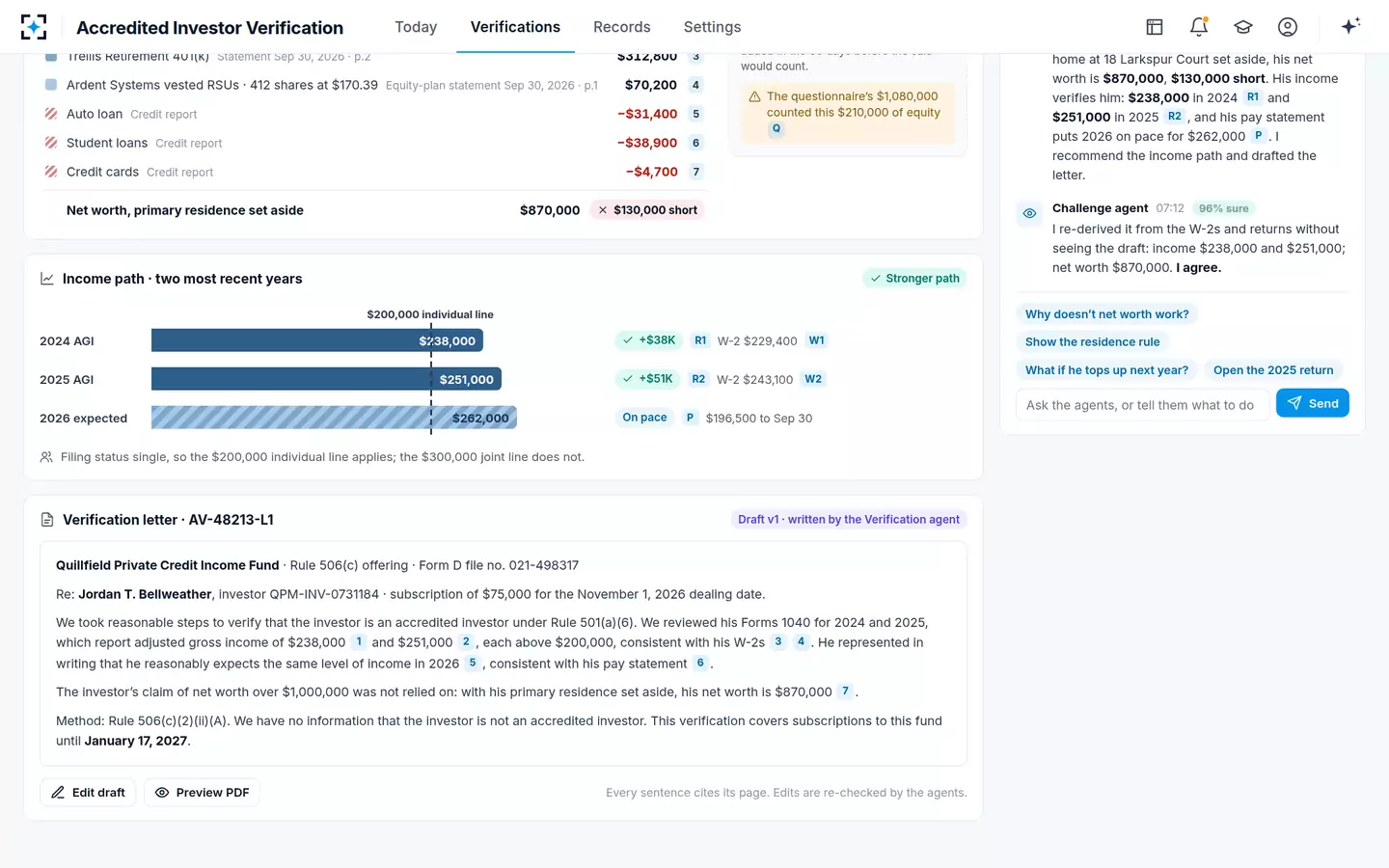
The sample letter above shows two habits worth copying whatever tools a firm uses. It says which claim was not relied on and why: the investor's questionnaire ticked net worth, but with his home set aside he was $130,000 short, so the letter rests on income. And it states its own end date. A reviewer who opens the file in 2029 should not have to reconstruct either.
The reviewer signs the letter with a reason code; the person who prepared it cannot
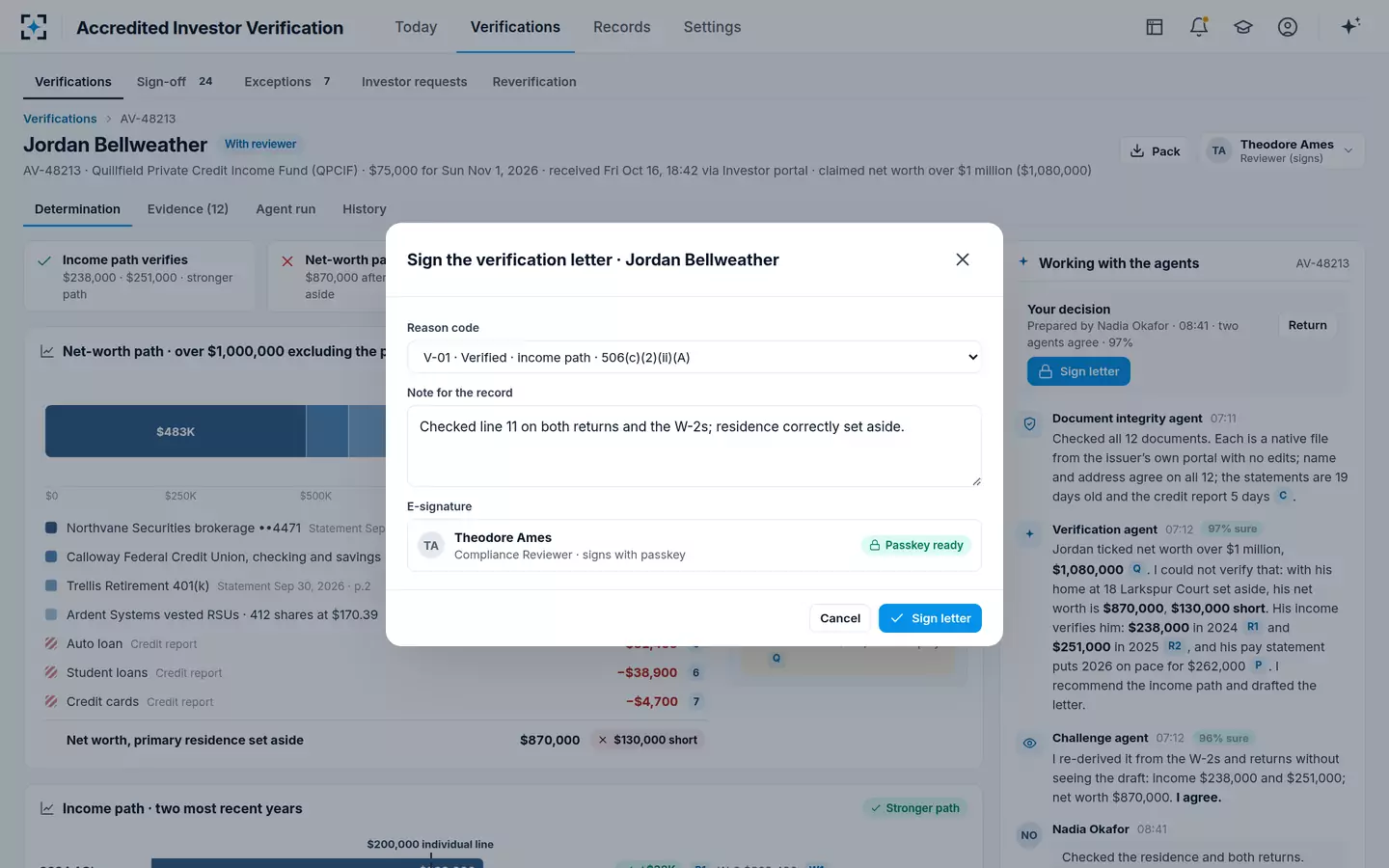
Who signs, and what that signature is evidence of, is the subject of verification of accredited investor status, signature by signature. For the letters themselves, the solution page, Accredited Investor Verification, shows how incoming letters, registry checks and the issuer's own letters sit in one file per investor.
Questions people ask
Can a foreign CPA write an accredited investor letter?
Yes. SEC staff have said the third-party method is not limited to attorneys and CPAs licensed in the United States, so a CPA or attorney in good standing abroad can write one (C&DI 260.09). The issuer then has to confirm standing with the foreign licensing body, and keep what it found.
Is an accredited investor letter the same as a questionnaire?
No. A questionnaire is the investor's own statement; a letter is a professional's confirmation that it took reasonable steps and determined the investor is accredited. The SEC said in 2013 that a ticked box alone, without other information, is not reasonable steps in a 506(c) offering.
How long is an accredited investor letter good for?
The writer's steps must fall within the three months before the sale. A letter dated October 2 supports a sale up to January 2; for a later dealing date the issuer needs a fresh letter or another method. Firms that count 90 days instead differ from three calendar months by a day or two either way, which matters only when a dealing date falls in the gap.
Does an accredited investor letter have to state the investor's income or net worth?
No. The rule asks only for confirmation that reasonable steps were taken within three months and that the person was found accredited. Stating the category relied on, the documents reviewed and the date of the steps makes the letter far easier to rely on and to defend later.
Can a letter verify a trust or a company?
The rule's listed methods, the letter among them, are written for natural persons. For an entity the issuer applies the reasonable-steps test directly, and a professional's letter can be part of that, alongside the entity's statements or, for an entity accredited because all its owners are, evidence on each owner.
What happens if the letter turns out to be wrong?
Rule 501(a) counts as accredited anyone the issuer reasonably believes falls within a category at the time of sale, and the safe harbour holds unless the issuer knew otherwise. A letter relied on carefully, with the writer's standing checked and nothing to the contrary on file, protects the issuer; a letter it had reason to doubt does not.