Accredited investor status does not last for a fixed period: Rule 501(a) tests it "at the time of the sale of the securities to that person", so an investor is accredited for each sale only if they meet a category on that day (17 CFR 230.501(a)). What lasts is a verification, and how long depends on how it was done. Statements and consumer reports must be dated within three months of the sale, a third-party letter must rest on steps taken within three months, and an issuer that verified someone itself can rely on that person's written representation at each later sale "for a period of five years from the date the person was previously verified" (17 CFR 230.506(c)(2)(ii)(E)). The work is keeping those clocks straight across repeat closes, top-ups and sister funds, which are separate issuers. Botminds' Accredited Investor Verification schedules each investor's next verification by issuer and path, reminds them before their next subscription, and never extends a verification or reuses one across issuers.
Three months, five years, ten years: how long each kind of verification holds
- Sales within three months covered
- Fresh documents or a new letter for each later sale
- A written representation at each sale suffices60 months
- Valid for ten years from passing, as the SEC's notice describes it120 months
How long does accredited investor status last?
Only as long as the person still meets a category at the moment of each sale. There is no certificate in Regulation D that confers status for a period. A person accredited on income in 2025 who stops working in 2026 can fall out of the income test as soon as the two most recent years include a low one; a person accredited on net worth can fall below $1 million in a market fall. The rule's definition includes anyone "who the issuer reasonably believes comes within any of the following categories, at the time of the sale", which protects an issuer that took reasonable steps and was wrong, but it does not stretch an old verification over a new sale.
The distinction matters most to funds that sell more than once to the same people: evergreen funds with monthly or quarterly dealing, closed-end funds with several closes, and sponsors with a family of funds. Each sale needs a basis. The rule's clocks decide how much fresh work that basis takes.
How long is an accredited investor letter good for?
Three months from the writer's steps, measured to the sale. The rule asks the writer to confirm that the reasonable steps were taken within the three months before (17 CFR 230.506(c)(2)(ii)(C); the letter itself is taken apart in the accredited investor verification letter), and SEC staff read the parallel three-month limit for net-worth documents the same way: if they are older than three months at the sale, the issuer "may not rely on the net worth verification method" (C&DI 260.08). After the three months, the letter is no longer a basis for a new sale on its own. An issuer that relied on it under the rule has, however, taken reasonable steps to verify the person, so for later sales to the same issuer the five-year representation route below can follow, counted from that verification. What a defensible verification letter says covers the letter itself.
What is the five-year rule for 506(c) verification?
A shortcut for repeat buyers of the same issuer. The method reads: for "any person that the issuer previously took reasonable steps to verify as an accredited investor", so long as the issuer "is not aware of information to the contrary", obtaining "a written representation from such person at the time of sale that he or she qualifies as an accredited investor" (17 CFR 230.506(c)(2)(ii)(E)). It was added to the rule in amendments published in January 2021 (86 FR 3598), and it closes with the time limit.
"A written representation under this method of verification will satisfy the issuer's obligation to verify the person's accredited investor status for a period of five years from the date the person was previously verified as an accredited investor."
17 CFR 230.506(c)(2)(ii)(E)
Three conditions do the work. The earlier verification must have been one this issuer took or relied on under the rule's verification duty, not another issuer's. The issuer must not know anything that contradicts the representation. And the clock runs from the date of the earlier verification, not from the latest representation, so a representation every year does not roll the five years forward. After five years the issuer verifies afresh, and a new five years starts from that verification.
Each route's clock, what restarts it, and what each later sale needs
| Route | How long it supports new sales | What each later sale needs |
|---|---|---|
| Income, (A) | While the two years reviewed are still the two most recent; the current-year representation is part of the method | Once a new tax year closes, the most recent year's IRS form, or under C&DI 260.35 the prior years plus representations and possibly more steps |
| Net worth, (B) | Three months from the date of the documents | New statements and a consumer report, or another route |
| Third-party letter, (C) | Three months from the writer's steps | A new letter, or another route |
| Pre-2013 holder, (D) | As long as the person still holds the earlier 506(b) securities of the same issuer | A certification at the time of sale |
| Same issuer's earlier verification, (E) | Five years from that verification, if nothing contradicts it | A written representation at the time of sale |
| High minimum, staff letter of March 2025 | Each sale on its own terms | The minimum met and both representations given for that sale |
Can I rely on last year's accredited investor verification?
Yes, for the same issuer, if you verified the person yourself or relied on a qualifying letter, nothing you know contradicts it, it is less than five years old, and the person gives you a written representation at the new sale. That is the whole of method (E). The representation is not optional: a later subscription that simply relies on the old file, without a fresh representation, is outside the method.
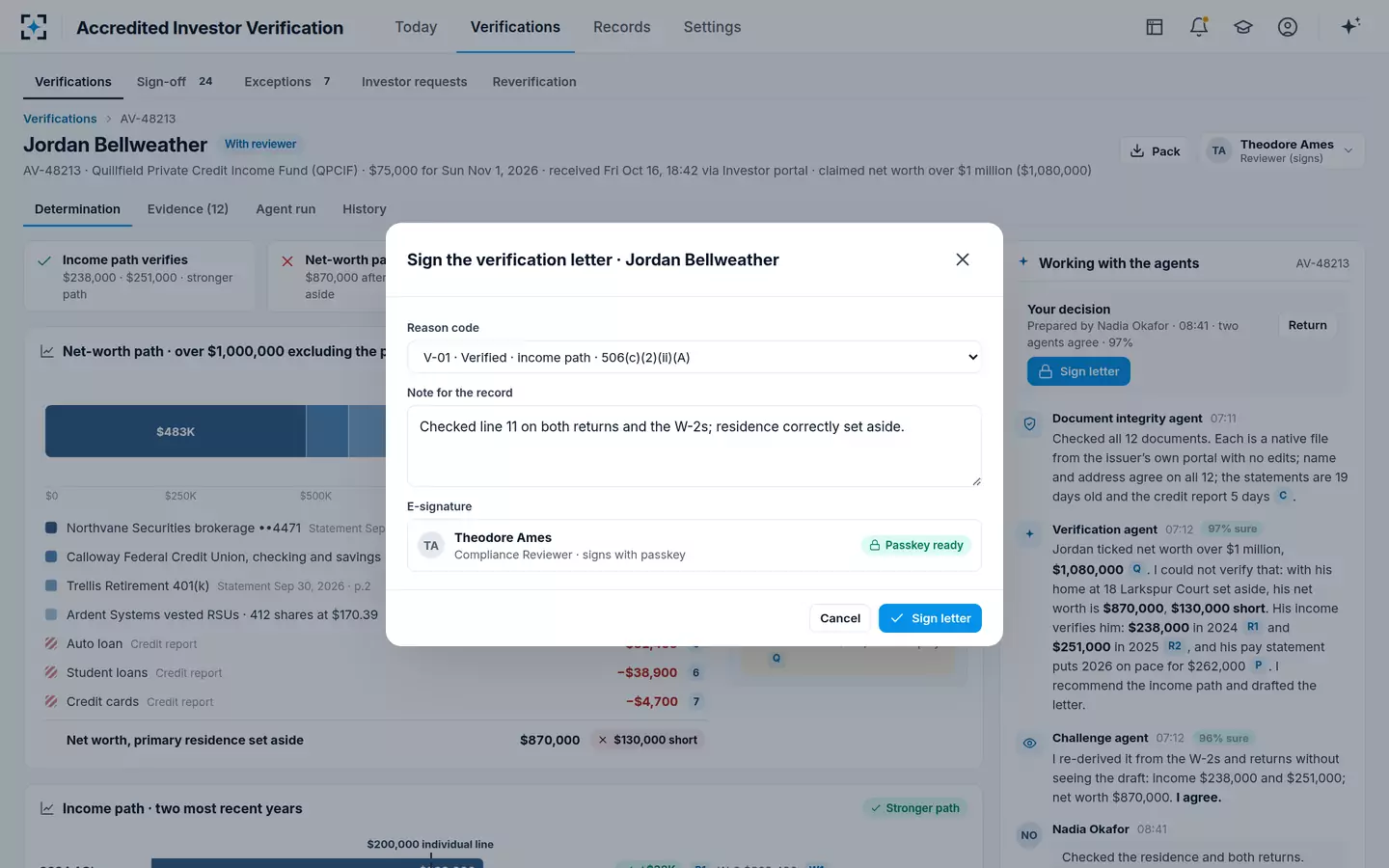
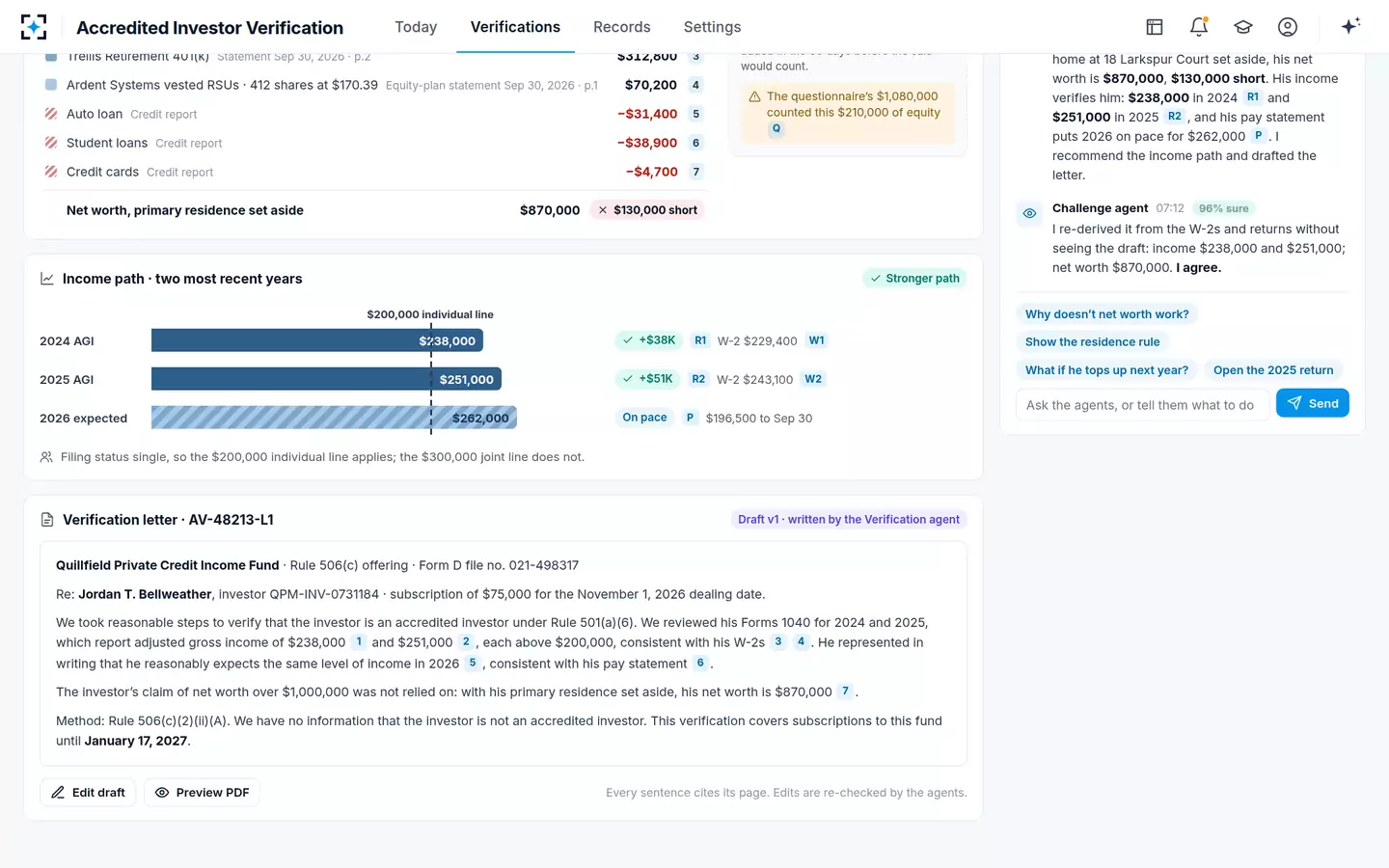
Take the fictional sample investor used throughout this series. Jordan Bellweather was verified on income for the Quillfield Private Credit Income Fund on October 19, 2026, by an invented sponsor's compliance reviewer. The sponsor's own policy, a setting in Accredited Investor Verification, lets the signed letter cover new subscriptions to that fund for 90 days, to January 17, 2027. After that, for this fund only, his signed representation suffices until October 19, 2031, unless the sponsor learns otherwise.
At signature, the next verification is already scheduled by issuer and path
One investor, two funds: how much fresh verification each next subscription takes
The same fund, next five years
- Letter window, firm setting: 90 days · 5%
- A signed representation at each sale, Rule 506(c)(2)(ii)(E) · 95%
A sister fund of the same sponsor
- A different issuer: full verification again · 100%
Repeat closes and evergreen dealing: the clocks across one investor's year
On a fund with monthly dealing the clocks are not theory; they decide what each subscription needs. Follow the sample investor through a year with the sample fund. His first subscription, for the November 1, 2026 dealing date, rests on income verified from his 2024 and 2025 returns. A top-up for December 1 falls inside the sponsor's 90-day window, so under its policy the signed verification covers it; a sponsor without such a policy would take a fresh representation under the five-year route. A top-up for February 1, 2027 falls after January 17, so it needs a signed representation at the time of sale under the five-year route, and nothing else unless the sponsor learns something to the contrary.
A subscription the following autumn, still within the five years, needs the same representation. One into the sponsor's sister fund at any point needs a full verification, and by then, for an income test, the two most recent years will be 2025 and 2026. Each of these is a different instruction to the investor and a different item in the file. Getting them right is a matter of keeping, for each investor and each issuer, three dates: the verification, the end of any policy window, and the end of the five years.
Does the five-year rule apply to a different issuer?
No. The method speaks of a person "that the issuer previously took reasonable steps to verify", and a fund in the same family is usually a different issuer: a separate partnership or company, with its own Form D and its own exemption to defend. In the sample data, the agents' answer to a question about a top-up puts it plainly: a subscription to another of the sponsor's funds is a different issuer and needs its own verification. One case in the sample sponsor's exceptions queue is exactly that: a verification done for one fund reused for another issuer.
Sponsors sometimes ask whether they can share the evidence across funds, rather than the verification. The rule is silent on sharing documents, and nothing in it stops a second issuer from looking at the same returns or statements if they are still fresh enough for its own method. The second issuer still takes its own steps and makes its own determination, and for net worth that usually means documents within three months of its sale, not the first fund's.
Does the five-year rule apply to entities?
The rule's listed methods, (E) included, are introduced as ways of verifying "that a natural person who purchases securities in such offering is an accredited investor". An entity investor is verified by applying the reasonable-steps standard directly, and an earlier verification of the same entity by the same issuer is strong information in that test, but the five-year safe harbour itself is written for individuals. For an entity accredited because all its owners are, the owners' individual verifications can each carry their own five-year clocks with the same issuer.
When must you reverify an accredited investor?
When the clock ends, when you learn something that contradicts the representation, and whenever the sale is by a different issuer. The middle case is the easiest to miss. The method holds only "so long as the issuer is not aware of information to the contrary", and the issuer can become aware through channels the verification team never sees: a hardship redemption request, a divorce notice that splits a joint net worth, a margin call in the AML file, a returned subscription for insufficient funds.
A reverification calendar that will stand up five years later
- Key each verification by issuer, not by sponsor
One investor in three funds has three files and three clocks.
- Keep the date of verification and the method
The five years run from the verification date; the method tells you whether (E) is available at all.
- Hold both end dates
Any firm window, such as 90 days for a signed letter, and the rule's five years.
- Collect a representation at each later sale
In the subscription document itself, signed and dated for that sale.
- Route contrary information to the verification file
Redemption hardship notes, AML findings, returned payments, changes to a joint test.
- Never extend
A new five years starts only from a new verification, never from a representation.
- Remind the investor before the clock ends
So a top-up near the end date is not held at the dealing cutoff.
The last item is where verification meets investor service. An investor who tops up a week after the five years end, on a dealing date with a documents cutoff, finds a subscription held for tax returns they were not expecting to send. A reminder at the right time turns that into an ordinary request. In Accredited Investor Verification the Reverification agent reminds investors before their next subscription, and the Investor outreach agent drafts the request for a person to approve.
The verification letter states its own end date
How the clocks interact with the minimum-investment route is set out in the Latham no-action letter: a high minimum is met sale by sale, so it has no clock at all. The solution page, Accredited Investor Verification, shows the reverification schedule in each investor's file.
Questions people ask
How long is a 506(c) verification valid?
It depends on the route. Net-worth documents and third-party letters support sales within three months; the same issuer's own earlier verification supports later sales for five years from that verification, with a written representation at each sale and nothing known to the contrary.
Does the five-year clock restart with each new representation?
No. The rule counts five years "from the date the person was previously verified as an accredited investor", so annual representations do not extend it. A new five years begins only after a new verification.
Do Series 7, 65 or 82 holders need reverifying?
Their status depends on holding the licence in good standing at the time of sale, so each sale needs a current registry check. For the same issuer, the five-year representation route is also available if the issuer verified them before.
What if an investor's income drops after verification?
If the issuer learns of it, it is information to the contrary and the five-year route is no longer available for that person; the issuer verifies afresh on whatever category still applies. If the issuer does not know, the representation the investor signs at the sale must still be true.
Is a pre-2013 506(b) investor covered forever?
Method (D) lets an issuer accept a certification at the time of sale from someone who bought in its own 506(b) offering as an accredited investor before September 23, 2013 and still holds those securities. It applies only to that issuer's later 506(c) offering.