A secondaries platform, as people search for it, is one of two different products: a marketplace that matches investors selling fund stakes with buyers, or the system a fund uses to process the transfers those sales produce. For a fund choosing the second, a demonstration on clean data proves little. The test that proves something is to take a past transfer file, plant ten known errors in it, such as a breach of the 25% benefit-plan line, a 2% count that tips over after a queued sale, a missing withholding certificate or a capital account split on the wrong date, add five transfers that look wrong but are legal, and count what the platform returns before consent. Botminds' LP Interest Transfer Processing is a transfer-processing system of the second kind, and this page sets out the test a fund should run on it or on anything else.
The examples come from the solution's sample data on fictional funds. The pass marks are our suggestions; no regulator sets a standard for transfer-processing systems.
Real errors sit a whisker from the line: the sample's findings, as a share of each limit used
What is a secondaries platform? Two products share the name
The first kind of secondaries platform is a marketplace: a service where holders list fund interests and buyers bid. The second is a transfer system: the tooling a fund, its administrator or its transfer agent uses to receive transfer requests, test them against the LPA and the fund's limits, and record the result. A fund may meet both in one sale, and it needs to know which it is looking at.
The difference has a tax edge. The Treasury regulation on publicly traded partnerships disregards, for the 2% count, sales made through a "qualified matching service", but only if the service meets a strict design: nonfirm quotes only, no binding sale until the 15th day after a listing, no closing before the 45th, listings removed after 120 days, and no more than 10% of the fund's interests transferred through it in the year (26 CFR 1.7704-1(g)). Such a service "may assist with the transfer documentation necessary to transfer the partnership interest", but the fund still decides whether to recognise the transfer. A marketplace that does not meet the design leaves every sale through it in the fund's 2% count.
What does a private equity secondary platform do for the fund?
For the fund, the useful work happens after the price is agreed. A transfer system should read the incoming package, find what is missing, test the agreement against the LPA, re-test the fund's limits across every open transfer, onboard the buyer, check both sides' tax forms, split the capital account as of the effective date, and draft the consent and the register update for people to approve. Every one of those is a place an error can pass.
The errors that matter are the ones that survive to consent, because after consent they are the fund's. A missed benefit-plan breach can make the fund's assets plan assets; a 101st partner can cost the private placement safe harbor for the year; a missing withholding certificate can turn into the fund withholding the buyer's distributions. A system's value is the count of those it stops, and its cost includes the count of good transfers it stops by mistake.
How do you test a transfer system? Plant errors in a past file
Take a quarter or a year of past transfers the fund has already completed, so the right answers are known, and change some of them. Plant ten errors, add five transfers that are legal but look wrong, leave the rest clean, and do not tell the vendor which is which. Then run the file and record, for each transfer, what the system said, when, and on what evidence.
A 40-transfer test file: mostly clean, with planted errors and legal oddities mixed in
The file
- Clean transfers: 25 · 62.5%
- Planted errors: 10 · 25%
- Legal but odd: 5 · 12.5%
The 10 errors
- Fund limits: 3 · 30%
- Documents and LPA: 3 · 30%
- Tax: 2 · 20%
- Buyer: 1 · 10%
- Controls: 1 · 10%
Run the planted file the way the system will run in production: the same queue, the same order of closing, real LPAs and real investor counts as they stood. A test on one transfer at a time cannot find the errors that only exist in combination, and those are the expensive ones.
Which errors matter most? Ten to plant
Plant the errors that would cost the fund most if consented, each set as close to its line as real ones sit. The checklist names ten.
Ten errors to plant in a past transfer file before you buy a transfer system
- A benefit-plan share of exactly 25.0% in one class
The rule is "25 percent or more", so 25.0% is a breach. Plant it in a class other than the largest.
- A 2% count tipped over by a queued transfer
Each transfer fine alone; the year passes 2% only when an earlier-closing one is counted first.
- A 101st partner from a part sale to three buyers
The seller stays in and three buyers join: plus three, not plus one.
- An effective date the LPA does not allow
The closing date, when the LPA allows only a quarter end.
- Personal side letter rights assigned to the buyer
The agreement hands over rights the LPA says are personal to the seller.
- A foreign seller with no usable 1446(f) certification
Or one dated 45 days before the transfer, when certifications older than 30 days cannot be relied on.
- Two certifications with different determination dates
One date must be used for all purposes for a transfer, and stated on each.
- A near-match to a sanctions list among the buyer's owners
The system should escalate it to the AML officer, never clear it.
- A distribution after the effective date left with the seller
The split must re-attribute it to the buyer; plant it nine days after the effective date.
- A register update prepared and posted by the same person
The kind of control SEC examiners have looked for at transfer agents: a second person confirms before anything moves.
Two errors are worth planting twice, in different forms, because they are the ones people miss by spreadsheet. The queued 2% breach depends on closing order, so plant one where reordering two transfers clears it. And the 25% breach depends on class, so plant one in a fund with two classes where the fund-wide share is well under 25%.
Can a system catch a 25% breach?
It can if it tests the rule as written: per class, after each acquisition, with the right holders left out. Participation is significant when benefit plan investors hold 25% or more of the value of any one class straight after the latest acquisition of an interest, and the interests of the GP, the adviser and their affiliates are disregarded (29 CFR 2510.3-101(f)(1)). A system that computes one fund-wide share, includes the GP's interest in the denominator, or tests only when a transfer closes will pass errors a careful reader would catch.
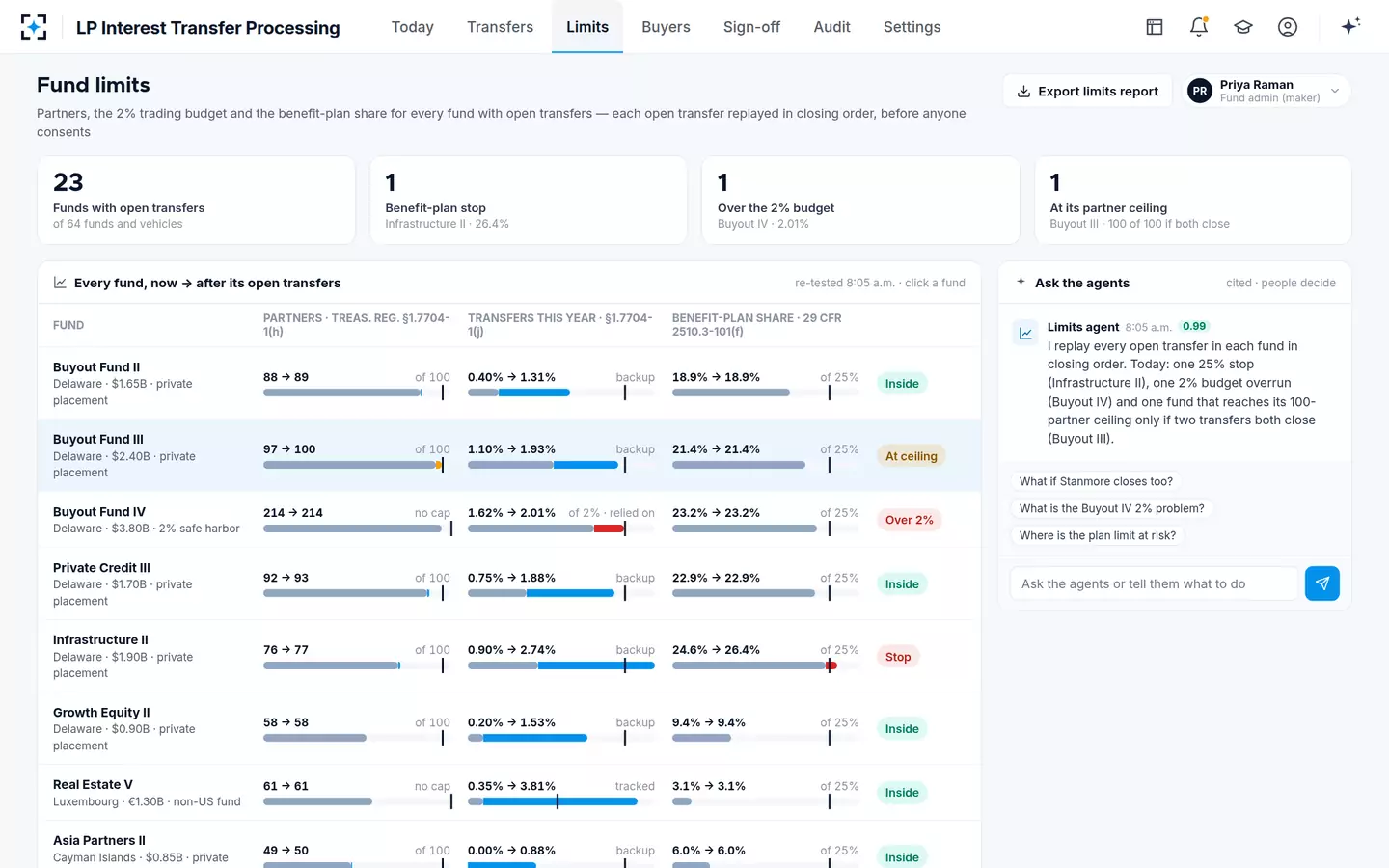
In the sample, the Limits agent stopped a pension trust's $35 million purchase that would have taken Infrastructure II from 24.6% to 26.4%, gave the headroom as $7.4 million and offered the CFO three options: scale back to $7.0 million, hold for the next reading, or decline with a reason code. That is the shape a passing answer should take: the stop, the arithmetic and the choices, with the decision left to a person.
Fund limits in LP Interest Transfer Processing: the stop, the budget and the ceiling, after the queue
Can it split a capital account correctly?
The split is where arithmetic errors hide in plain sight, because each line looks reasonable. A correct split takes the transferred share of every line of the capital account statement as of the effective date, commitment, contributions, unfunded, distributions, recallable amounts and capital, and then re-attributes anything that happened after that date. The planted error should be a distribution paid to the seller a few days after the effective date and left in its column.
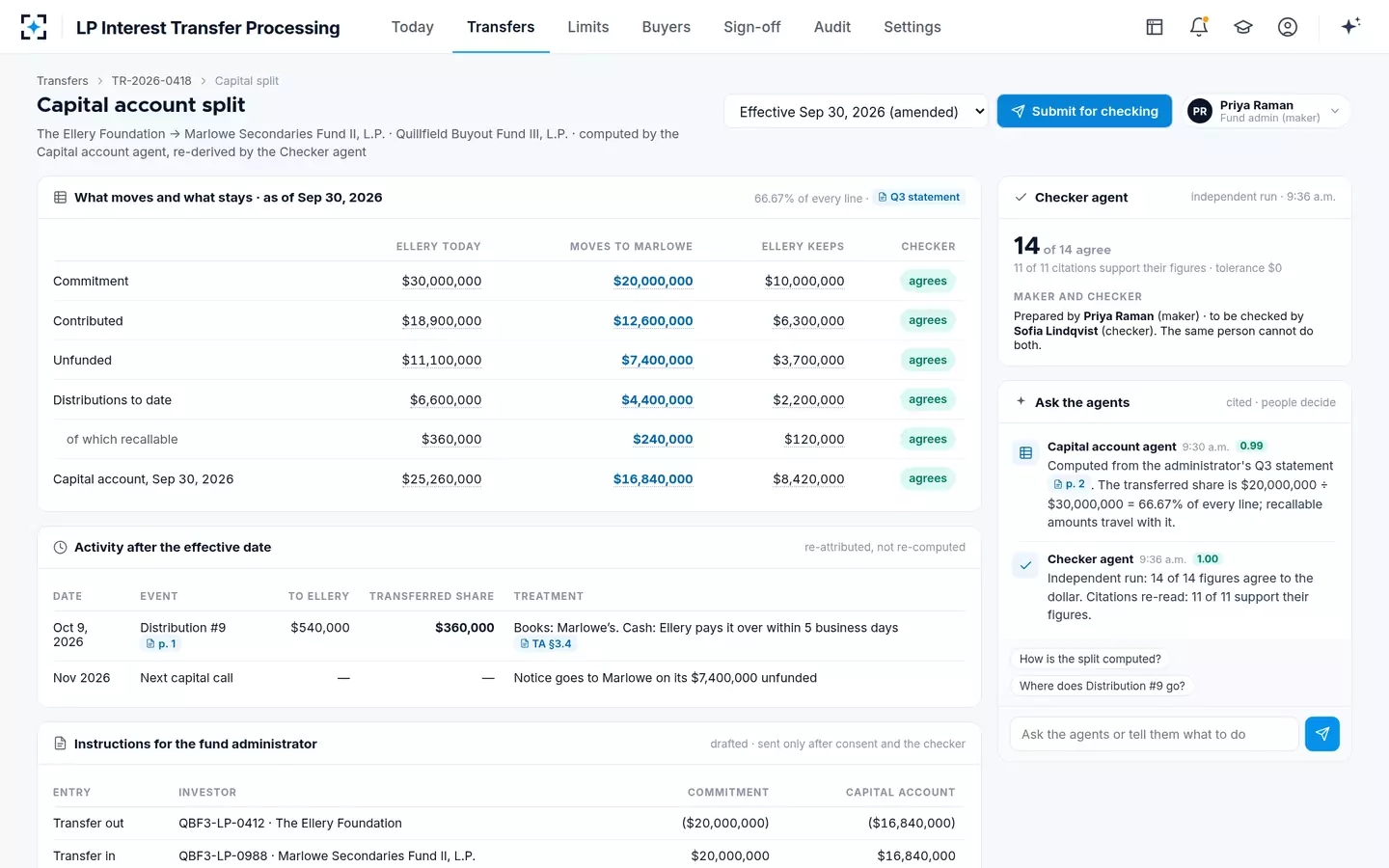
The sample shows what a pass looks like. Every line moved at 66.67%; a distribution paid nine days after the effective date was split, with $360,000 attributed to the buyer; and a second agent re-derived all 14 figures on its own, with a tolerance of $0, before a person checked it. The tax capital that carries to the buyer on its K-1 follows different rules from the book split; tax basis capital account reporting covers it.
A split that passes: every line, activity after the effective date, and a second derivation
Legal but odd: the transfers a good system must let through
A system that stops everything unusual is cheap to build and expensive to run. The five legal oddities in the test file measure false stops: transfers that look like breaches and are not. Each needs the system to know the rule well enough to see the exception.
Five legal-but-odd transfers to hide in the test file, and the right answer for each
| Transfer | Why it looks wrong | Right answer | Rule |
|---|---|---|---|
| A fund at exactly 100 partners after the transfer | It is at the ceiling | Pass: "does not have more than 100 partners" allows 100 | 26 CFR 1.7704-1(h)(1)(ii) |
| One seller moves 3% of a fund in a single sale | It is more than the whole year's 2% | Pass: a block transfer within 30 days is disregarded | 26 CFR 1.7704-1(e)(2) |
| A transfer to a deceased partner's estate | It adds a new holder to the register | Pass for the 2% count; the estate's ownership is the deceased's for 3(c)(1) | 1.7704-1(e)(1)(ii); 17 CFR 270.3c-6 |
| A gift between family members in a year already at 1.9% | It seems to push the year past 2% | Pass: transfers between members of a family are disregarded | 26 CFR 1.7704-1(e)(1)(iii) |
| A seller exits completely to one new buyer | A new partner is admitted | Pass: one leaves and one joins, so the count does not change | 26 CFR 1.7704-1(h) |
What miss rate is acceptable?
For the errors that break a fund limit, none. A system that misses one benefit-plan breach in ten has not saved nine reviews; it has made all ten unreliable, because no one knows which one it missed. Our suggested pass marks follow from that: every planted limit error stopped before consent, with the rule and the arithmetic shown; every document and tax error flagged with the clause or form cited; the sanctions near-match escalated, not cleared; and no false stops among the five legal oddities.
Two further measures separate good systems from adequate ones. Where in the process was each error caught: on the day the package was complete, or only when consent was requested? And could a reviewer reach the evidence in one step, the page of the LPA or the line of the register? A system whose answer is right but unsupported moves the work to the reviewer rather than removing it. LP Interest Transfer Processing's settings make the evidence requirement explicit: a citation below 0.75 confidence sends a person to read the page.
Running the test on LP Interest Transfer Processing
The solution is built to be tested this way, and it is fair to say what it is and is not. It is a transfer-processing system for a fund's transfer desk: it reads requests and documents in any language, tests them against the fund's LPAs and limits, onboards the buyer and drafts the consent package, and it leaves every approval, consent, waiver and posting to a person. It is not a marketplace, does not match sellers with buyers, does not price stakes and does not run continuation-fund elections.
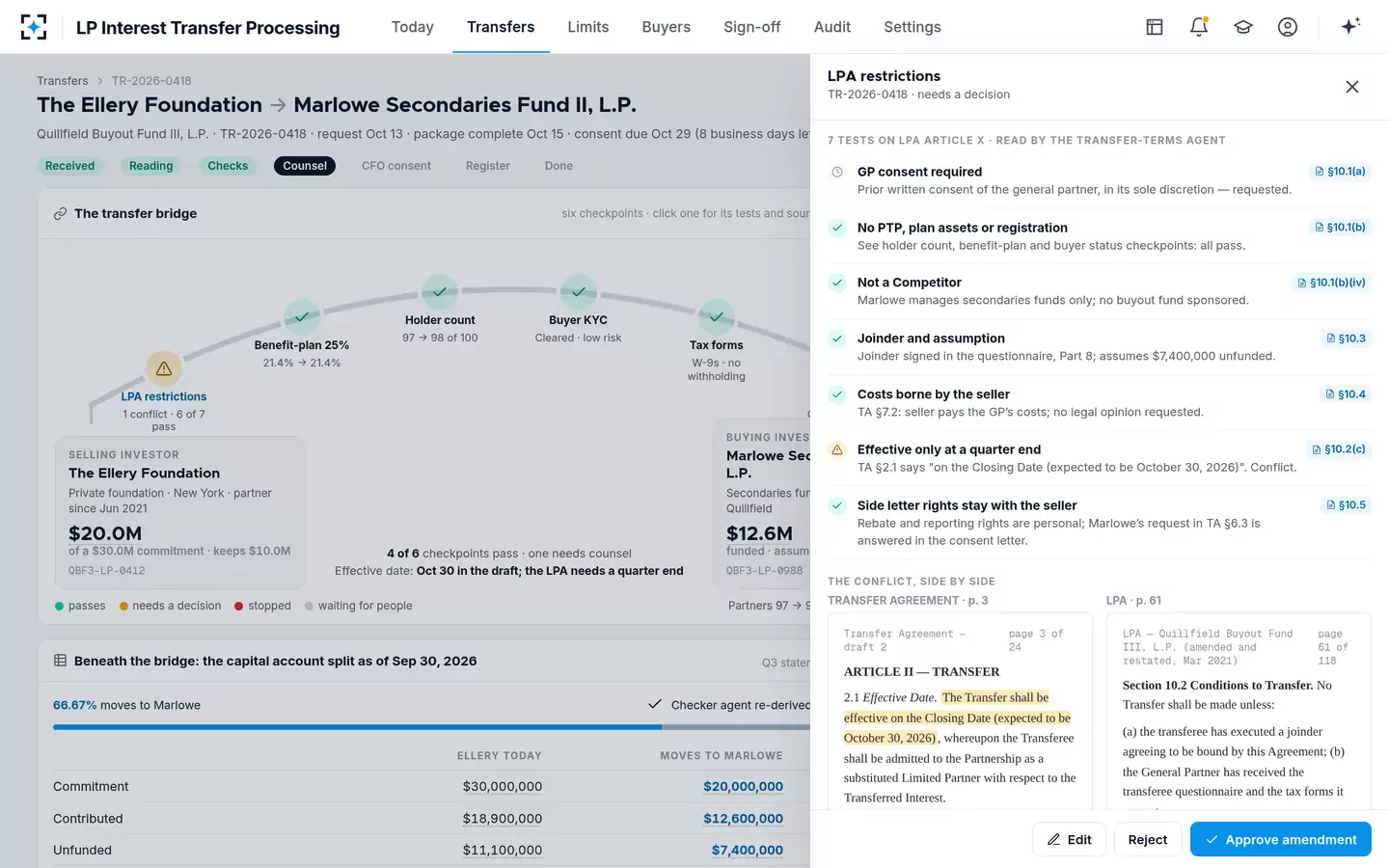
One planted error, found and explained: the effective date against the LPA
A test on the fund's own files takes setup. At first-time setup the agents read every fund document and ask the fund to confirm the transfer rules they extracted; the planted file then runs against those confirmed rules. The fund keeps the answer key. We run LP Interest Transfer Processing on a fund's own LPAs and a sample of its past transfer packages for exactly this purpose. LP transfer systems compared sets the result against the other ways of running the desk, and the agent that re-tests every fund limit shows the part of the system the first three errors exercise. The solution is at LP Interest Transfer Processing.
Questions people ask
Is a secondaries marketplace a qualified matching service?
Only if it meets 26 CFR 1.7704-1(g): a listing system with nonfirm quotes or unpriced interest, no binding sale before day 15 and no closing before day 45 after a listing, removal after 120 days, and no more than 10% of the fund's interests transferred through it in the year. If it qualifies, its sales are left out of the fund's 2% count.
How many past transfers do we need for a test?
Enough to hide the planted errors among ordinary work and to include each fund type you run. Our suggestion is about 40, of which 10 carry planted errors and 5 are legal oddities, drawn from funds where the limits were actually close.
Should the vendor know which errors were planted?
No. Keep the answer key inside the fund and score the results yourself. A vendor that knows where the errors are is testing its preparation, not its system.
Can a transfer system clear a sanctions match?
It should not. It can screen owners and control persons and score possible matches, but only the fund's AML officer should clear a possible sanctions or PEP hit; a planted near-match that comes back cleared is a failed test.
What does a passing result look like?
Every planted limit, document and tax error caught before consent, each with the rule, the arithmetic and the page; the sanctions near-match escalated; the register control enforced; and all five legal oddities allowed through with the exception named. Anything less should be explained before a contract is signed.
Can the test run on transfers in other languages?
It should, if the fund has them. LP Interest Transfer Processing reads requests and papers in their own language and shows them beside the English; the sample includes a transfer agreement in German and a buyer's registry certificate in Japanese.