Fund administrator vs custodian is a question about what each one holds. The custodian holds the fund's assets: the securities and cash, in accounts kept in the fund's name. The fund administrator holds the fund's books: it records what the fund owns and owes, values it and calculates the net asset value (NAV). The transfer agent, the third party people often mean, holds the register of who owns the fund's shares and processes their purchases and redemptions. Each keeps a different record of the same fund, and the NAV is only right when the three agree: the administrator's positions match the custodian's, and the shares in the administrator's books match the transfer agent's register. Botminds' Fund Administration Oversight is built for the manager who has to show that the administrator, the firm in the middle, kept those records in step, with its deliverables timestamped, its breaks measured and its controls report read against what the fund actually saw.
Three roles, filled at almost every registered fund
13,423
funds reported a custodian on Form N-CEN for 2025
13,305
reported a transfer agent
12,944
reported an administrator
400
funds reported four or more custodians
Fund administrator vs custodian vs transfer agent, side by side
The cleanest way to tell them apart is to ask what each would hand you if you asked for its record. The custodian hands you a statement of holdings and cash. The transfer agent hands you a list of shareholders and their balances. The administrator hands you a trial balance, a portfolio valuation and a NAV per share. Each is the system of record for one thing and a user of the other two.
Who holds what: the custodian, the transfer agent and the fund administrator
Custodian · Transfer agent: Custodian: the securities and cash. Transfer agent: the register of shareholders.
Fund administrator: The books: every transaction, accrual, fee and valuation, and the NAV built from them.
Custodian · Transfer agent: Custodian: Investment Company Act section 17(f) for registered funds; the custody rule for advisers to private funds. Transfer agent: defined in the Exchange Act.
Fund administrator: Named in Rule 38a-1 as a service provider the fund must oversee; the books it keeps are the fund's records under Rules 31a-1 and 31a-2.
Custodian · Transfer agent: Custodian: settled positions and cash. Transfer agent: subscriptions, redemptions and shares outstanding.
Fund administrator: The NAV per share, and the reconciliations behind it.
Custodian · Transfer agent: Custodian: a missed corporate action or a settlement break. Transfer agent: an order processed at the wrong price, or a register that disagrees with the books.
Fund administrator: A stale or wrong price, a missed accrual, a booking the evidence does not support.
Custodian · Transfer agent: That holdings and cash reconcile to the books, and that shares outstanding match.
Fund administrator: Timeliness, NAV errors, breaks over tolerance, and whether its controls report covers what it does for the fund.
What is a fund custodian, and why the law insists on one
A fund custodian is the institution that holds the fund's securities and cash so that the manager cannot simply take them. For a registered management company the requirement is in the statute: it "shall place and maintain its securities and similar investments in the custody of" a qualified bank, a member of a national securities exchange under SEC rules, or the fund itself, but only under the SEC's rules for self-custody (15 U.S.C. 80a-17(f)(1)). Where the securities sit with a bank, the cash from selling them must generally be kept with a bank too, apart from a checking account capped at the fund's fidelity bond.
Banks dominate. For 2025, 12,707 funds reported a bank custodian on Form N-CEN, against 723 reporting self-custody, 408 a futures commission merchant or commodity clearing organisation, and smaller numbers for securities depositories and foreign custodians. A fund can report several custody types because it uses several custodians, which is also why the count of funds reporting four or more custodians, 400, matters for oversight: every custodian is another statement the administrator must reconcile to.
Registered funds by type of custody reported, 2025: banks hold almost all of it
Private funds reach the same place by a different route. An adviser with custody of a private fund's assets must use a qualified custodian that keeps them "in a separate account for each client under that client's name" or in accounts holding only the adviser's clients' assets (17 CFR 275.206(4)-2(a)(1)). The administrator is not a custodian under either rule, and an administrator that holds the fund's cash in its own account is a warning sign, not a convenience.
Transfer agent vs fund administrator: the register and the books
A transfer agent keeps the record of who owns the fund; the administrator keeps the record of what the fund owns. The Exchange Act definition, which the SEC quoted when it named transfer agents as Rule 38a-1 service providers, covers anyone who, for an issuer, countersigns securities, monitors their issuance, registers their transfer, exchanges or converts them, or transfers "record ownership of securities by bookkeeping entry without physical issuance of securities certificates" (68 FR 74714, note 27). For a mutual fund that means processing every purchase and redemption at the NAV the administrator calculated, and keeping the shareholder accounts.
The two meet at one number: shares outstanding. The administrator divides net assets by shares outstanding to get the NAV per share, and the shares come from the register. Luxembourg makes the check explicit, requiring "reconciliation between the total number of outstanding units/shares in the UCI's accounts and the total number of outstanding units/shares in the UCI's unit-/shareholder register" as one of the administrator's minimum NAV controls (CSSF 22/811, point 29). In Luxembourg the register itself is part of administration, the registrar function, so the same circular governs both sides.
The register also has a blind spot. Investors who buy through banks and platforms often do not appear in it: the CSSF notes that such end-investors "are not included in the register of investors held by the UCI administrator, since the financial intermediary is included on behalf of one or more final beneficiaries" (CSSF 24/856, point 120). When a NAV error has to be compensated, the transfer agent can pay the intermediary but not see the people behind it, which is why a correction plan has to reach through the chain.
Why the administrator's books must agree with the custodian and the register
Because a NAV built on positions the custodian does not hold, or on shares the register does not show, is wrong however carefully it was calculated. The CSSF draws the line between the depositary and the administrator in one sentence: "Whereas the depositary is in charge of the safekeeping of all of the UCI assets, the UCI administrator must beside others reconcile the investments and cash accounts of the UCI by using independent and reliable sources" (CSSF 22/811, point 63). The administrator is expected to use several sources to confirm that each kind of asset exists, not to copy one statement into the books.
Three records, one NAV: where the reconciliations sit and who checks them
A person decides
CustodianSends settled positions and cash for every account the fund holds.
Never: Does not value the portfolio or calculate the NAV
A person decides
Transfer agentSends subscriptions, redemptions and shares outstanding by class.
Never: Does not keep the fund's books
A person decides
AdministratorReconciles books to custodian and register, prices the portfolio, calculates and releases the NAV.
Never: Should not compile a NAV it has not reconciled
Agent
Fund Administration Oversight agentsTimestamp each NAV file and reconciliation against the contract, measure breaks over tolerance and their age, and link them to restrikes.
Never: Never edit a source record or close a break
A person decides
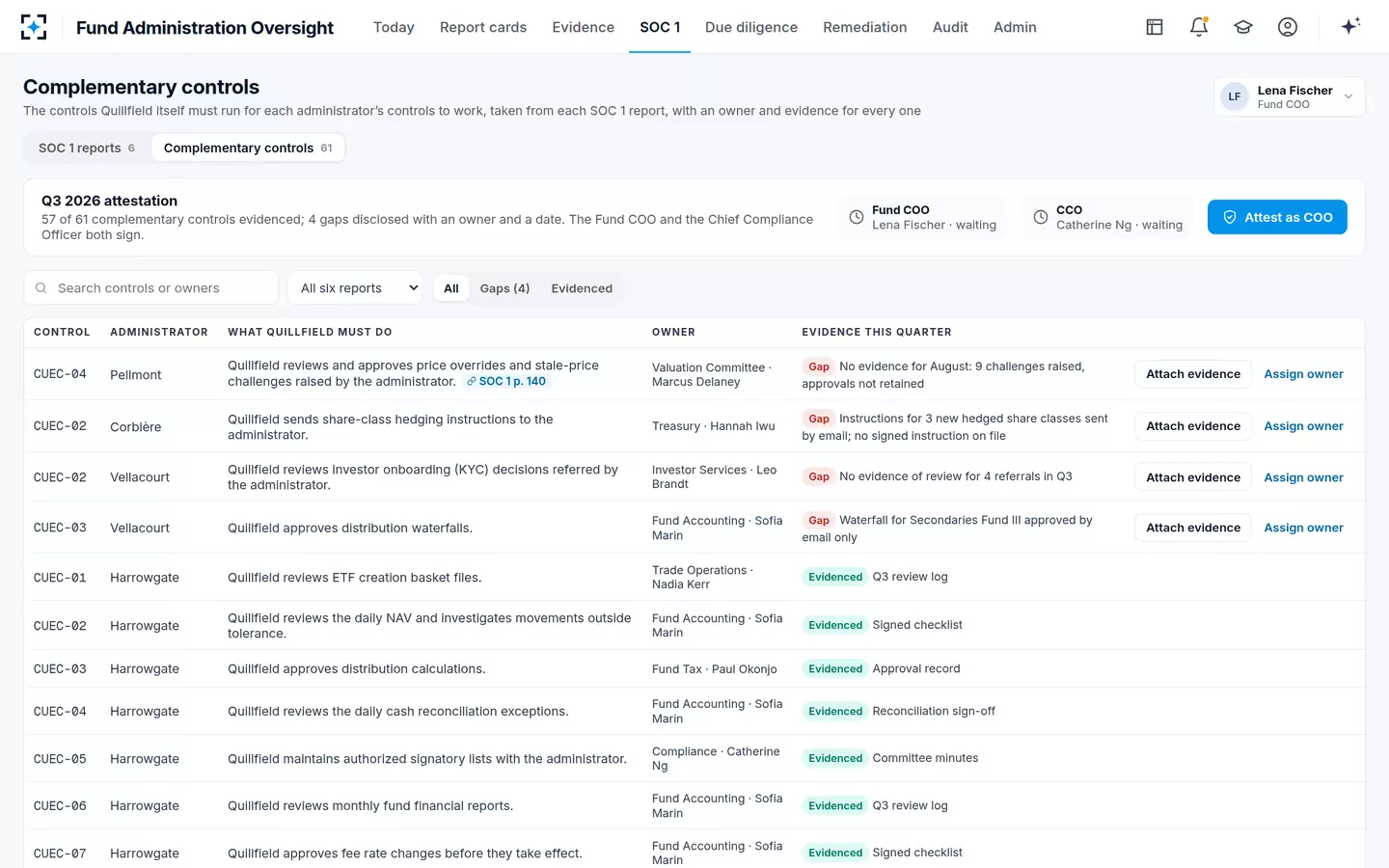
Manager's oversight teamRuns its own complementary checks, such as reviewing cash reconciliation exceptions, and signs the quarter's grade.
Never: Cannot hand the oversight back to the administrator
For the manager, this is the practical difference between the three providers. The custodian and the transfer agent each produce one record. The administrator produces the comparison between records, and the comparison is where errors show up first: a break that stays open for a week, an unexplained cash movement, a share count that drifts from the register. Those exceptions, not the administrator's monthly service percentage, are the evidence an oversight team should be reading. Shadow fund accounting covers how much of that comparison a manager should rebuild itself.
The manager's own checks on the administrator's reconciliations, with owners and evidence
Fund administrator vs fund manager, and fund administration vs fund accounting
The fund manager decides what to buy and sell; the administrator records and values what was bought and sold. The manager sets the valuation policy and answers for the NAV; the administrator applies the policy and produces the NAV. When the two are blurred, the separation that makes the NAV credible disappears, which is why the SEC's swing pricing rule keeps the person administering swing factors apart from portfolio management, and why an administrator booking whatever the manager instructs is a problem rather than a service.
Fund accounting is the part of administration that keeps the books and produces the NAV. In Luxembourg's terms it is one of three functions, NAV calculation and accounting, alongside the register and investor communication. A firm can sell fund accounting alone, with the register at a separate transfer agent; the contract and the controls report should then say exactly which records it keeps. What a fund administrator does, task by task sets out the full list.
Fund accounting, fund administration, custody and transfer agency: what each term usually covers
| Term | Usually covers | Usually excludes |
|---|---|---|
| Fund accounting | Bookkeeping, valuation, accruals, reconciliation, NAV calculation | The register and investor dealing |
| Fund administration | Fund accounting plus, often, the register, investor communications, financial statements and regulatory reporting support | Holding assets; making investment decisions |
| Transfer agency | The shareholder register, subscriptions and redemptions, distributions to shareholders | Valuing the portfolio |
| Custody | Safekeeping of securities and cash, settlement, corporate action processing | Keeping the fund's accounting books |
Can one firm be administrator, custodian and transfer agent?
Yes, and many groups offer all three, but the roles must stay separable inside the firm. Luxembourg allows the administrator and the depositary to be the same entity if the independence requirement is met by "a functional and hierarchical separation" between the two business lines, rather than by separate legal entities (CSSF 22/811, point 60). The same circular requires the administrator to identify conflicts with the depositary and agree documented information flows with it, even when both sit under one roof.
For an oversight team, a bundle changes the evidence, not the duty. When the custodian and the administrator are one group, the reconciliation between them is an internal process, so ask to see it: the break reports, the ageing, who signs off. Ask also which of the three services the group's controls report covers. A report that describes fund accounting but not transfer agency leaves the register outside any auditor's testing.
Who keeps the fund's records when one group does everything?
US record-keeping rules treat the bundle in a practical way. Where a bank or exchange member acts as custodian or transfer agent, a fund meets its duty over records kept by others if that firm agrees in writing to make them available on request and to preserve them for the required periods (17 CFR 270.31a-3(b)). For an administrator that is not a bank, the fund needs the general version: a written agreement that the records are the fund's property.
How Fund Administration Oversight measures the administrator in the middle
The solution focuses on the administrator because its deliverables carry the other two records into the NAV. Take the sample firm as it runs through it, Quillfield Capital, a fictional manager whose administrator Pellmont sends NAV files, reconciliations and pricing exception reports every day. In the third quarter of 2026 the agents logged 1,488 of those deliverables and timestamped each on receipt against the contract's 6:30 p.m. cut-off.
Every NAV file and reconciliation, timed against the contract
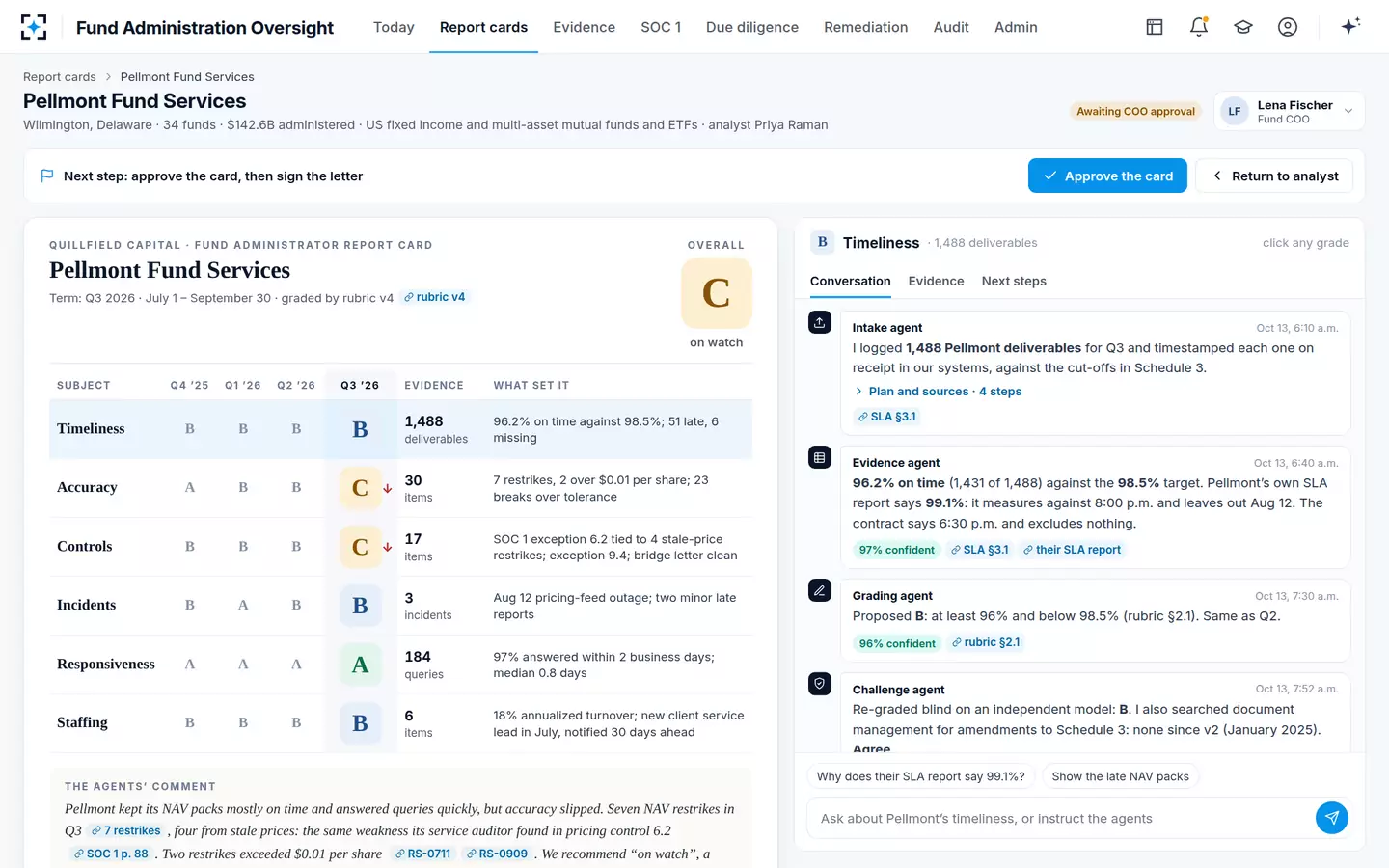
The custodian's and the transfer agent's records come into the same picture through the administrator's reconciliations and through the manager's own checks. A break over tolerance that the administrator closed late shows up under accuracy; a reconciliation exception the manager was supposed to review and did not shows up on the manager's side, as a gap in its own controls, not in the administrator's grade.
Questions people ask
Does the fund administrator hold investors' money?
It should not hold the fund's assets; that is the custodian's job, and registered funds and advisers to private funds are bound by custody rules that point to banks and other qualified custodians. Subscription money may pass through accounts the administrator operates on the fund's behalf, which is a control to ask about, not a reason to treat the administrator as a custodian.
Is a custodian a Rule 38a-1 service provider?
No. Rule 38a-1's list is advisers, principal underwriters, administrators and transfer agents. The SEC's adopting release says the narrower definition does not reduce a fund's duty to consider compliance when hiring others, naming custodians among them.
What is a depositary, and is it the same as a custodian?
In European funds the depositary keeps the assets in safekeeping and also has oversight duties over the fund; in US usage "custodian" covers the safekeeping part. Luxembourg's administrator circular describes the depositary as "in charge of the safekeeping of all of the UCI assets", with the administrator reconciling to it.
Why do some funds report several custodians?
Different assets need different custody: futures margin sits with a futures commission merchant, foreign securities with local custodians, cash with a bank. For 2025, 596 registered funds reported two custodians, 26 three and 400 four or more, and each one adds a statement the administrator must reconcile.
Who corrects the register when a NAV was wrong?
The transfer agent or registrar reprocesses the affected dealing at the corrected NAV under the fund's error policy, after the administrator restates the NAV. Where investors bought through intermediaries, the payment reaches the intermediary in the register, which then has to pass it to the end investors.