A fund administration RFP (request for proposal) is the document a fund manager sends candidate administrators when it appoints one for the first time or re-tenders an existing mandate. Its usual weakness is that its questions can all be answered "yes": do you have a pricing policy, a business continuity plan, a SOC 1 report, experienced staff. A useful RFP asks for things that can fail, meaning documents a weak administrator cannot produce or that would show its weaknesses: its NAV error log for the last two years, the exceptions in its latest SOC 1 or ISAE 3402 report, the controls its report would expect you to run, the subservice providers it carves out, how and how fast it notifies a client of an error, and what happens to your records and data when you leave. Each answer is then scored on evidence, not on prose. Botminds' Fund Administration Oversight is not an RFP tool; it is what measures the winning administrator afterwards, and the same evidence it keeps each quarter is what a re-tender should ask every bidder for.
Fund administration RFP: ten requests that a weak administrator cannot pass with a 'yes'
- The NAV error log, two years, for comparable funds
Every error and restrike, with size per share, cause, how it was found and by whom, time to correct, and who paid. Ask for near-misses too.
- The latest SOC 1 or ISAE 3402 type 2 report, in full
Not a summary letter. Read the period, the opinion, every deviation and management's responses.
- The bridge letter and the next report's expected period
How much of your financial year the reports will actually cover.
- The list of complementary controls you would have to run
From the report's description, mapped to the services you are buying. These are your costs, not the bidder's.
- Carved-out subservice providers, and how each is monitored
Pricing data, hosting, print and mail: which reports the bidder reads and what it concluded last year.
- Where the work is done, and by whom
Locations, delegated or offshored tasks, sub-delegation, headcount per client team and turnover.
- The error notification path, with clocks
Who tells whom, how fast, in what form, for material and non-material errors, and who approves the correction.
- Service levels measured on your clock
Each deliverable's cut-off, measured on your receipt, with no exclusions you have not agreed, and the credit for each miss.
- Records ownership and the exit
A written statement that records are the fund's and will be handed over on request, the transfer process, the data formats and how long history stays accessible.
- A sample of real output
A redacted NAV file, reconciliation and exception report as they would arrive, so your team can see what it will be checking every day.
Fund administrator RFP questions: why most of them cannot fail
A question that every bidder can answer "yes" measures nothing; it only checks that the bidder read the RFP. Questions about whether a policy exists, whether staff are qualified or whether a controls report is available are of that kind. They are not useless, because a "no" would end the conversation, but they do not separate a good administrator from an adequate one. The separation comes from asking for evidence of how the policy performed.
Fund administration RFP questions that pass every bidder, and versions that can fail
Answers 'yes': Do you have a pricing and valuation policy?
Can fail: Send every stale-price and manual-price exception for two comparable funds last quarter, with how each was resolved and when.
Answers 'yes': Describe your NAV review process.
Can fail: Send your NAV error log for two years, including errors under the materiality threshold, with causes.
Answers 'yes': Do you have a current SOC 1 report?
Can fail: Send the full type 2 report and bridge letter; identify every deviation that touches the services in this RFP and what changed.
Answers 'yes': Describe your team's experience.
Can fail: Give the named team, its headcount and turnover for two years, and which tasks are done in which location.
Answers 'yes': Will you cooperate with a transition?
Can fail: Attach your standard transfer process document and the data formats and access periods you commit to.
What should an administrator's NAV error log show?
It should show every error, not only the ones that crossed a threshold, with enough detail to see whether errors repeat. Luxembourg makes the log a regulatory duty: the administrator must have procedures to detect, assess and notify "material or non-material NAV errors, breaches or operational incidents (with a financial impact or “near-by” incident)", and these "must be logged by the UCI administrator" (CSSF 22/811, point 15). Where shortcomings are relevant or significant, the administrator designs a remediation plan with the other parties, to be approved by the fund or its manager.
The fields to ask for in a bidder's NAV error log
| Field | Why it matters in an RFP |
|---|---|
| Date found and date of the error | The gap shows how long errors survive before anyone sees them |
| Fund type and asset class | Lets you compare like with like; ask for funds similar to yours |
| Size per share or unit, and as a share of NAV | Separates rounding noise from errors that reach investors |
| Cause, in categories | Stale price, wrong corporate action, missed accrual, booking error, manual override: repeats show a control that does not work |
| Who found it | The administrator's own control, the client, the custodian or the auditor; client-found errors are the worrying ones |
| Time to correct and to notify | Tests the notification path in practice |
| Who bore the cost | The fund, the administrator, the manager; shows how the bidder reads its own liability clause |
| Near-misses | Errors caught before release show whether pre-release controls fire |
The corrections side has its own order in Luxembourg's NAV error circular: errors are recorded, monitored and, where appropriate, corrected by the administrator upon approval by the fund or its manager, and delegation by the administrator "does not exempt the UCI administrator of its responsibilities" (CSSF 24/856, points 23 and 24). Ask each bidder to describe one real correction end to end, and compare it with that order.
SOC 1 exceptions, complementary controls and carve-outs: the questions behind the report
Asking whether a bidder has a SOC 1 report is the weakest question in the RFP; asking what is in it is one of the strongest. Read the report's deviations as you would for an incumbent, using the SOC 1 review steps, and ask the bidder to map each one to the services you are buying. Then ask what the report will cost you to rely on: the complementary controls its description assumes you will run are work your team must staff, and complementary user entity controls, with examples shows how long that list can be.
Two details in the standard tell you what to probe. The inclusive method, which brings a subservice provider's controls into the auditor's scope, "generally is feasible only if the service organization and the subservice organization are related, or if the contract between the service organization and the subservice organization provides for its use" (ISAE 3402, paragraph A4); otherwise expect carve-outs, and ask how each carved-out provider is monitored. And a report's scope can be narrowed, but the standard says a request to exclude control objectives "because of the likelihood that the service auditor's opinion would be modified" may not be reasonably justified (paragraph A11). If a bidder's report covers fewer control objectives this year than last, ask why.
If the service auditor becomes aware of non-compliance with laws and regulations, fraud, or uncorrected errors attributable to the service organization that are not clearly trivial and may affect one or more user entities, the service auditor shall determine whether the matter has been communicated appropriately to affected user entities.
ISAE 3402, paragraph 56
That paragraph suggests one more question. Ask each bidder whether, in the last three years, its service auditor raised a matter that had to be communicated to clients, and how it was communicated. A bidder that says none should be able to say so in writing.
What should a fund administration SLA measure?
Each deliverable, against a cut-off the fund chooses, measured on the fund's receipt, with exclusions written down in advance. The point of writing it that way is to remove the administrator's discretion over its own measurement. In the sample firm in Fund Administration Oversight, one administrator's monthly SLA report showed 99.1% of deliverables on time because it measured against 8:00 p.m. and left out one outage day; the contract said 6:30 p.m. and excluded nothing, and measured that way the figure was 96.2%. An SLA that does not say whose clock counts invites that gap.
The schedule should cover NAV files, reconciliations and exception reports, pricing challenges, query turnaround, incident notification, and the delivery of the SOC 1 report and bridge letter. Each line needs a credit for misses, computed per instance, so that a credit is a calculation rather than a negotiation. Staffing commitments, such as notice of a change of client service lead, belong in the schedule too.
A written grading rubric: the kind of scoring an SLA and an RFP can share
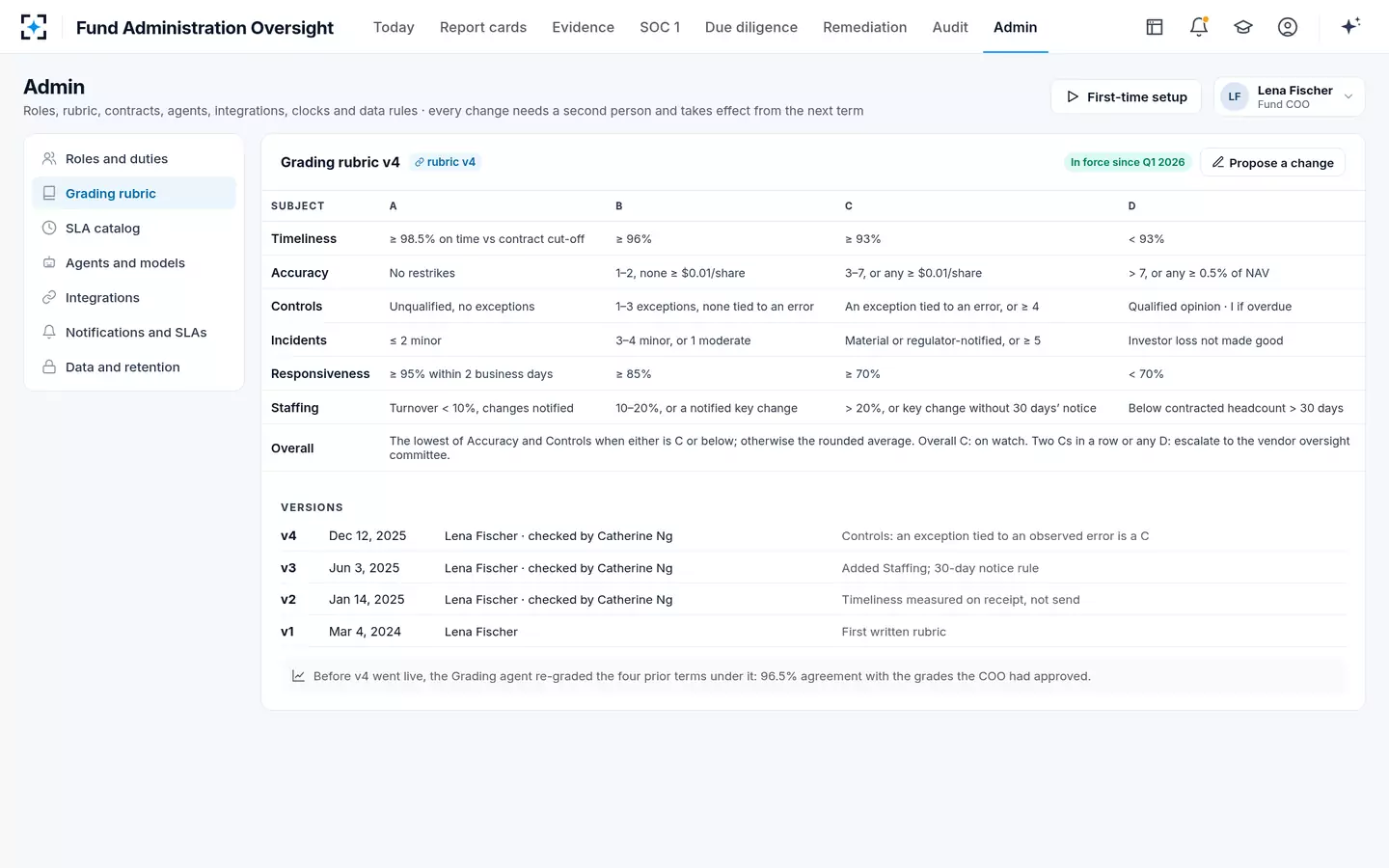
How to score fund administrator RFP answers
Score what the bidder proved, not what it promised. A rubric with three levels per question is usually enough: no evidence, evidence that answers the question, and evidence that answers it and shows the control working, such as an error log in which most errors were caught by the bidder's own controls before release. Weight the sections by what failure would cost your funds, which usually puts pricing, accuracy and controls ahead of technology presentations.
A scoring rubric for fund administration RFP answers: evidence, not prose
| Section | Weight | 0 · no evidence | 1 · answers the question | 2 · shows it working |
|---|---|---|---|---|
| NAV error log | 20% | Summary only, or "no material errors" | Full log with causes | Log shows most errors found by the bidder's own controls, causes fixed |
| SOC 1 / ISAE 3402 | 20% | Letter or summary | Full type 2 report and bridge letter | Deviations mapped to your services, each with a dated fix |
| Pricing and valuation | 15% | Policy document | Exception logs for comparable funds | Second sources and challenge outcomes evidenced |
| Your complementary controls | 10% | Not identified | List from the report | Mapped to your services with the evidence the bidder expects |
| Subservice and delegation | 10% | Not disclosed | Providers and locations listed | Monitoring of each evidenced, with last year's conclusions |
| Notification path | 10% | Described | Written clocks and approvals | A real correction walked through end to end |
| Exit and records | 15% | Cooperation promised | Records ownership in writing | Transfer process, formats and access periods committed |
How do you exit a fund administrator?
With a contract that was written for it before you signed. Four things decide whether an exit is orderly: who owns the records, whether the mandate can be ended at once when investors' interests require, what the outgoing administrator must hand over and in what form, and how long history stays accessible afterwards. The RFP is the cheapest moment to settle all four.
US rules settle the first. Where a fund's required records are kept by someone else on its behalf, the fund must obtain "an agreement in writing to the effect that such records are the property of the person required to maintain and preserve such records and will be surrendered promptly on request" (17 CFR 270.31a-3(a)). Luxembourg settles the second: the administration contract "must not prevent the UCI or its IFM, when applicable, from giving instructions at all times to the entity to which UCI administration functions have been delegated or from withdrawing the mandate with immediate effect when this is in the best interest of investors" (CSSF 22/811, point 39). For the third and fourth, the same circular requires an agreed and documented transfer process when an administrator changes, which the plan for outsourcing fund accounting in 90 days works through.
Where the bidder's own oversight shows: delegation and onboarding
A bidder's answers about how it oversees its own suppliers are a preview of how it will treat you. Luxembourg expects an administrator that delegates tasks to keep "regular contact with the delegates (including periodic calls/chats, meetings, at least monthly)", to visit them, and states that "a sole recourse to virtual on-site visits is not deemed to be sufficient in this context" (CSSF 22/811, point 87). It also prohibits sub-delegation outside the administrator's group to an entity the CSSF does not supervise. Ask every bidder, wherever based, what it delegates, to whom, and how it checks them.
Ask too how the bidder onboards a client, because that is where an administrator first decides what it will accept. In the SEC's 2023 case against Theorem Fund Services, the order records that "aside from the requirements in the Administration Agreement, TFS had minimal policies or procedures regarding onboarding new clients", that it never had access to the fund's bank account, and that it did not confirm an auditor had been engaged until the end of the year (SEC, Release 33-11218). An administrator with a written onboarding procedure that would have stopped at those facts is answering a question that can fail.
After the award: where Fund Administration Oversight fits
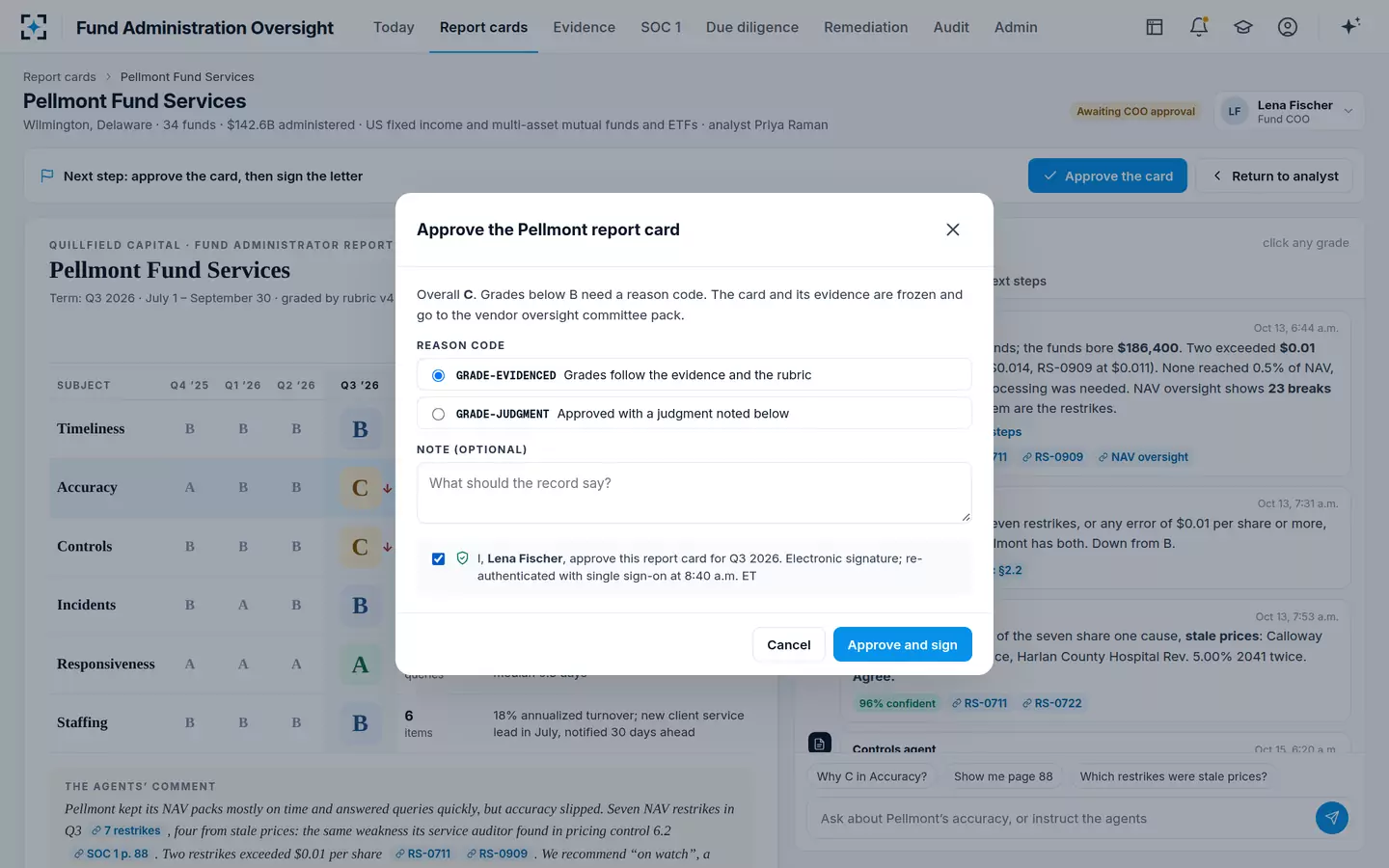
The RFP picks the administrator once; oversight measures it every quarter afterwards, against the same terms. Fund Administration Oversight reads the administration agreement, the SLA schedule and the rubric, then grades each administrator on its deliverables, its restrikes and its controls report, with the analyst proposing and the fund COO approving with a reason code and a signature. When the time comes to re-tender, the quarterly history is the evidence, and the annual review, drafted from the year's evidence, says which questions are still open, as described in the fund administrator due diligence questionnaire.
Approving a quarter's grade with a reason code and an electronic signature
Questions people ask
What is a fund administrator?
A fund administrator is the firm that keeps a fund's books, values its portfolio and calculates its NAV, and often keeps its investor register and prepares investor and regulatory reports. The SEC's Rule 38a-1 release treats as an administrator anyone who provides a fund with significant administrative or business-management services, whatever the contract calls them.
What should a fund administration agreement contain?
At least the services and functions, each party's rights and obligations including any right to delegate, confidentiality and notice periods, the information flows each way, an operating memorandum of content, timing and format, and the escalation and notification procedures for errors and breaches. Those are the minimum elements Luxembourg requires in Circular CSSF 22/811, point 38, and they are a sound checklist anywhere.
How long does a fund administration RFP take?
No regulator or independent study publishes a typical duration. Plan backwards from the date the new administrator must strike its first live NAV, leaving time for the transfer process, any parallel running and the board's approval of the new administrator's procedures for a registered fund.
Should the incumbent administrator be invited to re-bid?
Usually yes, on the same terms and with its own record attached: its error log, controls report findings and service-level history from your oversight program. An incumbent is the only bidder whose answers you can check against years of your own evidence.
Should bidders see how they will be graded?
Yes. Sharing the rubric, the SLA cut-offs and the credit terms in the RFP turns them into contract terms both sides understood at signing, which removes most later disputes about whose clock or whose definition of an error applies.