Fund administration fees are what a fund or its manager pays an administrator to keep the books, calculate the NAV, run the register and produce reports, and there is no public price list: administrators quote privately, and no regulator or independent study publishes what they charge. What a fund pays is in its own administration agreement and, for a registered fund, can show up in its financial statements. But the fee is only part of the cost of the relationship. The rest is what it costs the manager to check the administrator's work each quarter and each year, and what the funds lose when an error is caught late. Botminds' Fund Administration Oversight does not change the administrator's fee. It is built to cut the hours of checking, by having agents collect, timestamp and measure every deliverable and draft the reports, and to make errors cheaper, by finding their cause and computing the service credits the contract allows for the COO to approve.
Where one large administrator's quarterly oversight days go, by hand and with Fund Administration Oversight
By hand · about 10 days (estimate)
- Collecting and chasing deliverables · 20%
- Timeliness against the contract · 20%
- Tying errors to a grade · 20%
- SOC 1 and complementary controls · 20%
- Letters and credits · 10%
- Sign-offs and committee papers · 10%
With the agents · about 1.8 days (target)
- Collecting · 11%
- Timeliness · 11%
- Errors to grade · 17%
- SOC 1 and controls · 17%
- Letters and credits · 17%
- Sign-offs and committee papers · 27%
How much does a fund administrator cost?
Nobody outside the contract knows, which is the honest answer. Administrators price privately, terms vary by fund type, size and services, and no regulator or independent study publishes a market rate. A manager can still answer the question for itself, from three places: the fee schedule in the administration agreement, the fund's own financial statements, and invoices. The work is in making the schedule's units comparable across administrators and across the funds each one serves.
How do you find what a fund pays its administrator?
The fund's statements are the public check. For a registered fund, Regulation S-X requires the statement of operations to state separately "any other expense item the amount of which exceeds five percent of the total expenses shown", and to disclose amounts incurred from transactions with affiliated persons, naming each one accounting for five percent or more of total expenses (17 CFR 210.6-07(2)(a)–(b)). An administration fee large enough to cross the line, or paid to an administrator in the manager's own group, appears in the fund's audited statements, which is a way to compare what funds pay without anyone's price list.
Fund administration pricing: what the fee schedule must state before you can compare it
- The base and the rate
Whether the fee is a rate on net assets, a fixed amount per fund or per class, or both, and how breakpoints apply across a fund complex.
- Minimums
Per fund, per class or per complex, and when they bite for small or new funds.
- Activity charges
Per investor account, per transaction, per capital call or distribution, per corporate action, if any.
- What is in the base fee and what is extra
Financial statements, regulatory filings, tax work, investor reporting, ad hoc reports, change requests.
- Out-of-pocket costs
Pricing data, hosting, printing and mailing, and whether they are passed through at cost.
- Service levels and credits
The cut-off each deliverable is measured against, what is excluded, and the credit when the administrator misses or errs.
- Who is invoiced
The fund or the manager, fund by fund, and how the split is documented.
Comparing two fund administration quotes on the same units
Quotes become comparable only when both are priced on the same fund range, including the small funds and the growth you expect. The base of the fee and the minimums usually decide the answer more than the headline rate does. The example below uses two hypothetical quotes, not market prices, to show the method.
Two hypothetical quotes for the same twelve funds: the minimums and the base decide
| Line | Quote A: 2 basis points on net assets, $60,000 minimum per fund | Quote B: $90,000 per fund, $1,500 per class, $5 per investor account |
|---|---|---|
| Eight funds of $700 million each | 8 × $140,000 = $1,120,000 | 8 × $90,000 = $720,000 |
| Four funds of $100 million each | Minimum applies: 4 × $60,000 = $240,000 | 4 × $90,000 = $360,000 |
| 30 share classes, 4,000 investor accounts | Included | $45,000 + $20,000 = $65,000 |
| Total today, $6 billion | $1,360,000 | $1,145,000 |
| Total if the large funds double | $2,480,000 | $1,145,000 |
The arithmetic shows why the fee schedule needs the checklist above before it can be compared. A rate on net assets grows with the funds whether or not the administrator's work does; a fixed fee per fund does not, but it can cost more for a range of small funds. Neither is better in general. What a buyer can control is the comparison: the same range, today and in three years, with every extra priced. The oversight cost then sits on top of whichever quote wins, and it does not shrink when the fee does.
Who pays fund administration fees, the fund or the manager?
Whoever the fund's documents say, and the answer differs by fund and must be followed. In a registered fund, the expense arrangements are set in the fund's agreements and disclosed in its prospectus and statements. In a private fund, the partnership agreement decides which expenses the fund bears and which the manager bears. In the SEC's 2023 case against Theorem Fund Services, the order records that the administrator "was paid $18,000 by EIA for its fund administration services", EIA being the adviser, not the fund (SEC, Release 33-11218).
The split matters for oversight because the party paying has the commercial leverage, while the fund bears the errors. SEC examiners have found advisers charging private funds for expenses the fund documents did not permit, including adviser-related costs such as compliance and regulatory filings (SEC Division of Examinations, risk alert, June 23, 2020). If the manager's oversight team, or a tool it uses, is charged to the funds, the documents have to allow it.
What does in-house administrator oversight cost?
It costs people's hours, and the hours can be priced from public rates. The SEC's own Paperwork Reduction Act estimates price staff time at fund complexes using hourly rates that include "$266 (hourly rate for a senior accountant)", $652 for a chief compliance officer and $9,178 per hour for a board of nine directors (SEC, 91 FR 5545, February 6, 2026). The SEC is careful about what the figures are: its estimates are "not derived from a comprehensive or even a representative survey or study of the costs of Commission rules." They are still the most defensible public rates for a cost model a board will read.
Hourly rates the SEC uses to price fund staff time, 2026: a CCO hour costs more than twice a senior accountant's
A cost build for one administrator, on your own numbers
A cost model then needs hours. No regulator publishes how long administrator oversight takes, so here is a method with one set of inputs labelled for what they are. Botminds estimates that checking one large administrator by hand takes about ten working days a quarter, and four to six weeks for the annual due diligence review; those are our estimates, not measurements. Priced at the SEC's senior accountant rate, the arithmetic below is a starting point to replace with your own time records.
A cost build for overseeing one large administrator for a year: replace the inputs with your own
| Line | By hand | With Fund Administration Oversight | Basis |
|---|---|---|---|
| Quarterly oversight | 10 days × 4 quarters × 8 hours = 320 hours | 1.8 days × 4 × 8 = 57.6 hours | Botminds' estimate by hand; design target with agents |
| Annual due diligence | 4–6 weeks: 160–240 hours | 3 days: 24 hours | Botminds' estimate; design target |
| Hours at $266 | $85,120 + $42,560–$63,840 | $15,322 + $6,384 | SEC senior accountant rate, 2026 |
| Total staff cost | About $128,000–$149,000 | About $22,000 | Our arithmetic; excludes COO, CCO and board time |
| Errors caught late | Whatever the funds bear, quarter by quarter | The same errors, with their cause named and credits computed | Your restrike history and your agreement's credit terms |
The wage side can be checked against independent data too. For May 2025, the Bureau of Labor Statistics put the median annual wage of accountants and auditors in finance and insurance at $93,290, of financial and investment analysts in securities and other financial investments at $124,370, and of financial managers in finance and insurance at $169,980 (BLS, Occupational Outlook Handbook). Those are wages before benefits and overhead, which is why the SEC's loaded hourly rates run higher than a salary divided by working hours.
What errors caught late add to the cost of administration
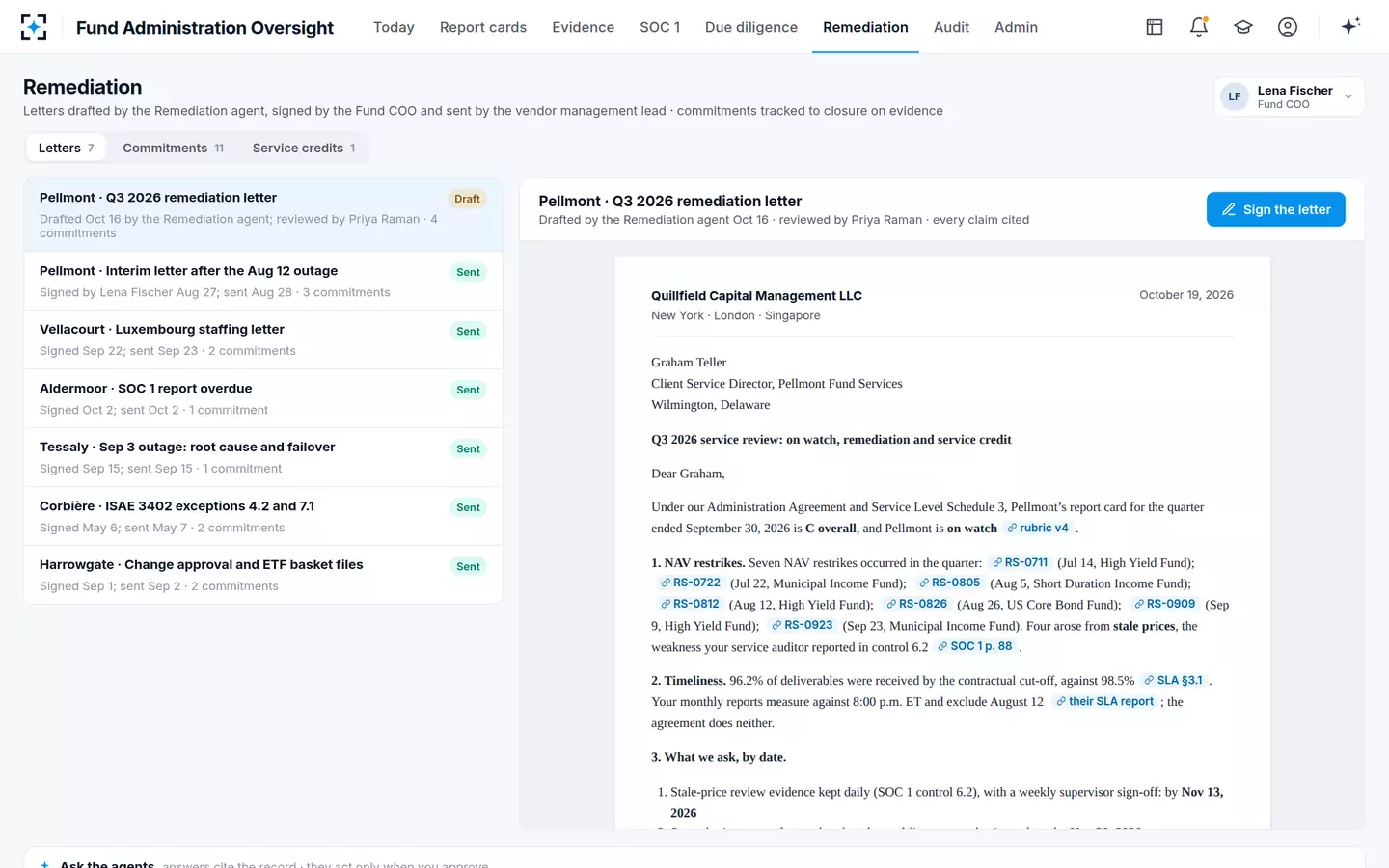
The largest cost of a weak administrator does not appear on its invoice. It is the NAV errors the funds bear, the reprocessing and investor compensation that follow, and the management time spent on both. Take the sample firm in Fund Administration Oversight, the fictional Quillfield Capital: in the third quarter of 2026, seven NAV restrikes at one administrator cost the affected funds $186,400, two of them above $0.01 per share, and four had the same cause as an exception in the administrator's SOC 1 report.
One administrator, one sample quarter: what the errors cost and what the contract returned
7
NAV restrikes in four funds
$186,400
borne by the funds
4
with the same cause as one SOC 1 exception: stale prices nobody investigated
$186,400
service credit computed under the agreement, approved by the COO and claimed by vendor management
Two things turn that loss into a recoverable one. The agreement must say what an error costs the administrator, and the manager must be able to show, error by error, that the administrator caused it. The first is a negotiation, best settled before signing, and the questions for it are in a fund administration RFP that tests NAV errors, SOC 1s and exits. The second is evidence: the restrike notices, the breaks the manager's own checks found, and the link to the control that failed. A manager that keeps a full shadow of the books has some of that evidence already; shadow fund accounting at three depths sets out what each depth costs and finds.
What is a service credit in a fund administration agreement?
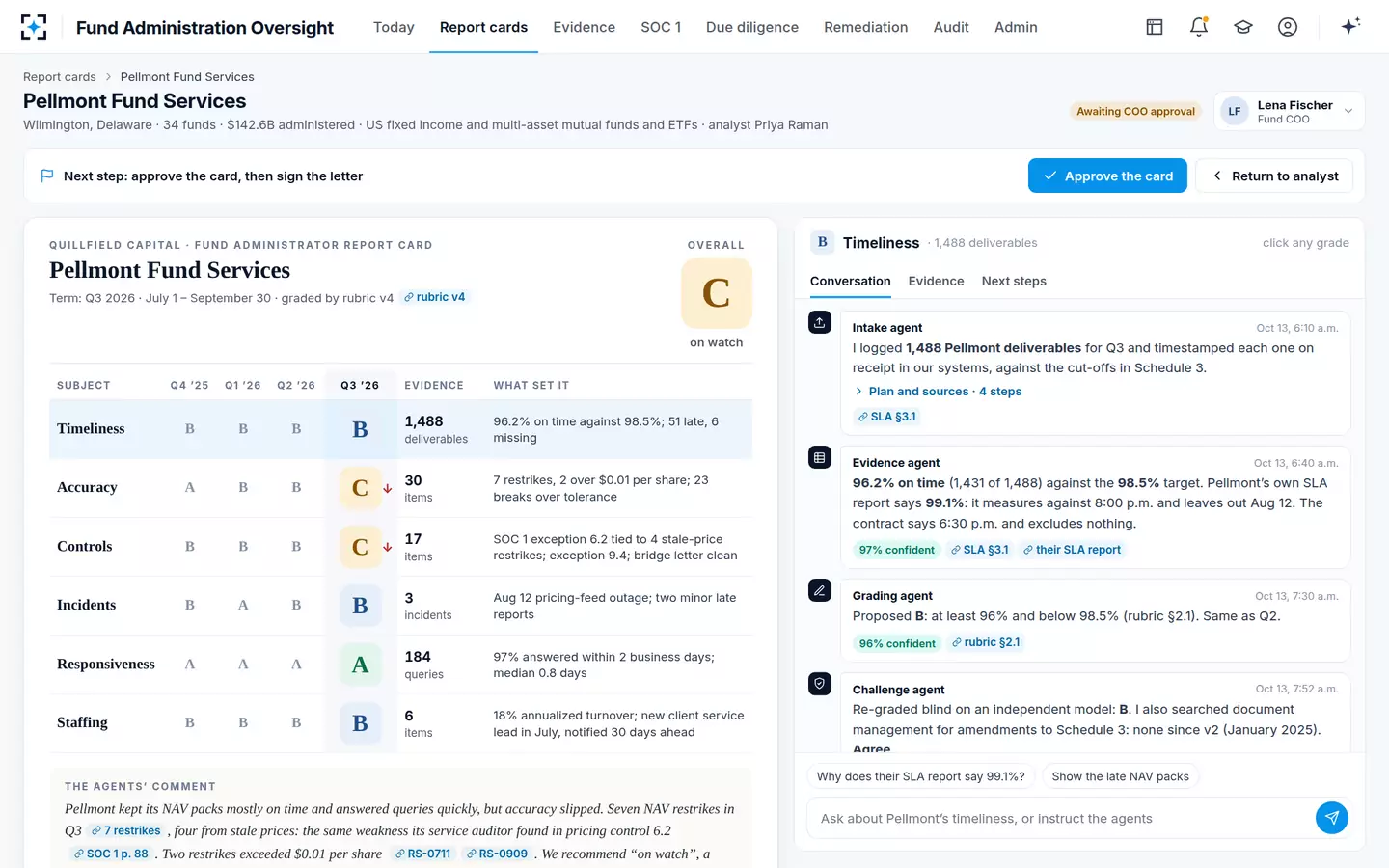
A service credit is a reduction in the administrator's fee, written into the service level schedule, that applies when the administrator misses a service level or causes an error. It is the contract's price for poor service, and it is often left unclaimed because nobody measured the service against the contract's own terms. In the sample quarter, the administrator's own report said 99.1% of deliverables were on time; measured on receipt against the contract's 6:30 p.m. cut-off, with no excluded days, it was 96.2%.
The remediation letter, with every restrike cited and the service credit computed
Where Fund Administration Oversight changes the cost, and where it does not
It does not change the administrator's fee, the fund's expense ratio or what the administrator's own controls cost it. It is built to change three other lines. The hours of checking, because agents collect and timestamp deliverables, measure each subject and draft the letters, the review and the committee papers, leaving people to read evidence and sign. The share of errors whose cause is found, because each SOC 1 exception is joined to the restrikes it explains. And the credits the agreement allows, because the timeliness and error records are measured on the contract's terms rather than the administrator's.
Timeliness measured against the contract clock, not the administrator's
What it needs from the buyer is the material it reads: the administration agreements and service level schedules, the fund's grading rubric, its due diligence questionnaire, and a recent quarter of deliverables and SOC 1 reports. A manager moving to a new administrator should build those in from the start; the 90-day plan for outsourcing fund accounting shows when.
Questions people ask
Why don't fund administrators publish their fees?
Fees are negotiated per client and depend on fund type, size, number of classes and investors, and the services bundled in, so administrators quote privately. No regulator or independent study collects them, which is why a buyer has to compare quotes on a common set of units.
Are fund administration fees part of a fund's expense ratio?
When the fund pays them, yes: they are fund expenses like any other. Under Regulation S-X a registered fund must show separately any expense item above five percent of total expenses, and identify affiliated parties paid five percent or more, so a large administration fee is visible in the statement of operations.
Is a service credit the same as compensating investors for a NAV error?
No. A credit reduces the administrator's fee to whoever pays it, the fund or the manager; investors harmed by a NAV error are compensated under the fund's error policy. Luxembourg's NAV error circular lets the manager, the administrator or another party take over the payments owed to aggrieved investors, which is a separate decision from any credit.
Does better oversight reduce the administrator's fee?
Not directly. It gives the manager a measured record of the administrator's service against the contract, which supports credits, renegotiation and, if needed, a re-tender. The fee itself is set by the agreement.
What does outsourced fund accounting cost compared with in-house?
No regulator or independent study publishes a comparison. Build both on your own numbers: in-house staff hours at loaded rates, systems and data, against the administrator's quoted fee plus the oversight hours outsourcing still requires, which never fall to zero because the manager keeps the accountability.