Shadow fund accounting is the practice of a fund manager keeping its own version of some or all of the fund's books, in parallel with the fund administrator, so that it can check the administrator's work rather than accept it. It comes in three depths. A full shadow book re-records every transaction and produces a second NAV; a shadow NAV recalculates the NAV from independent positions, prices and accruals without keeping a full set of books; and exception-based checking re-performs only the components most likely to be wrong, such as stale or manual prices, large accruals and fee calculations. Which depth a manager needs depends less on the administrator's reputation than on how verifiable the fund's prices are. Botminds' Fund Administration Oversight does not replace any of the three; it takes what the manager's checks find, the breaks over tolerance and the restrikes, and turns them into the administrator's accuracy grade, joined to its SOC 1 exceptions and signed by the fund COO.
Pricing controls explain a slice of smoothed hedge fund returns; illiquidity explains more
Lower end of the study's range
- Style and portfolio · 14%
- Pricing controls · 4.1%
- Not explained · 81.9%
Upper end of the study's range
- Style and portfolio · 24.3%
- Pricing controls · 8.8%
- Not explained · 66.9%
What is shadow accounting in a hedge fund?
In a hedge fund, shadow accounting usually means the manager's operations or finance team keeps positions, prices and accruals in its own system and compares the result with the administrator's monthly or daily NAV before it is released to investors. Differences beyond an agreed tolerance are investigated with the administrator; a difference the administrator cannot explain is a potential error. The manager is not producing an official NAV, and it is not doing the administrator's job: it is producing evidence that the official NAV was checked by someone with a reason to find mistakes.
The reason a manager does it is not distrust of administrators as a class. It is that the risk sits in the prices. Cassar and Gerakos, studying how hedge funds price positions and report performance, found that returns consistent with intentional smoothing were more likely where funds used less verifiable pricing sources and where managers had more discretion over pricing positions (Cassar and Gerakos, SSRN abstract). The same study found that structural controls, such as taking the manager out of setting the NAV or using reputable administrators and auditors, were not associated with less smoothing. A shadow that re-checks the hard prices addresses the risk the research points to; one that re-keys every liquid trade mostly does not.
Three depths of shadow fund accounting, compared
The three depths are not better and worse versions of one thing; they buy different evidence. A full shadow proves the books; a shadow NAV proves the answer; exception checks prove the parts most likely to be wrong. Each has a cost in people and systems and a characteristic blind spot.
Full shadow book, shadow NAV and exception-based checks: what each buys
Full shadow book · Shadow NAV: Full book: every transaction, accrual, fee and price, to a second trial balance. Shadow NAV: total NAV from independent positions, prices and accruals, without a full set of books.
Exception-based checks: Only the risky components: stale and manual prices, large or unusual accruals, fee and performance fee calculations, open breaks, NAV moves outside tolerance.
Full shadow book · Shadow NAV: Booking errors anywhere, including small ones that net out in the NAV; with a shadow NAV, any error large enough to move the answer.
Exception-based checks: The errors that most often cause restrikes, if the risk list is right, and faster than a full rebuild.
Full shadow book · Shadow NAV: Errors both books share, such as a wrong price taken from the same feed; and a shadow NAV can match while two errors offset.
Exception-based checks: Anything not on the list. The list has to be revisited when the portfolio or the administrator changes.
Full shadow book · Shadow NAV: A second accounting team and system: in effect the manager pays for a second set of the administrator's work.
Exception-based checks: An analyst's time per NAV and a clear tolerance policy; most of the work is reading exceptions.
Full shadow book · Shadow NAV: Funds with complex, illiquid or manager-priced assets, or a new administrator in its first months.
Exception-based checks: Funds with mostly verifiable prices and a stable administrator with a clean record.
What is a shadow NAV, and how does it differ from a full shadow book?
A shadow NAV is an independent recalculation of the fund's net asset value, with no attempt to keep a parallel general ledger. The manager takes positions from the custodian or prime broker, applies independently sourced prices and its own accrual estimates, and compares the total and the per-share figure with the administrator's. It answers one question: is the published number right within tolerance?
Luxembourg's rule for administrators describes the standard a good shadow NAV borrows. The administrator "must be able to explain the changes in the accounting balance from one NAV date to the next by keeping and analysing the records of the movements affecting the accounting items" (CSSF 22/811, point 30). A manager's shadow NAV can apply the same test from the outside: does the change in NAV since the last date reconcile to market moves, flows, income and expenses, or is there a residual nobody can name?
The weakness of a shadow NAV is that matching is not the same as being right. If the manager and the administrator take the same bond price from the same vendor, both NAVs agree and both are wrong. The data on how many pricing sources registered funds report shows how common multi-source pricing already is, and also how many funds still depend on one.
Registered funds by number of pricing services reported, 2025
Do we need a full shadow book? Choosing the depth
Probably not for every fund, and possibly yes for a few. The depth should follow the fund's pricing risk and the administrator's record, not the size of the manager's operations team. A long-only fund of listed equities with a long-standing administrator gains little from re-keying trades; a credit fund with manager-marked loans, or any fund in the first months with a new administrator, can justify much more.
Choosing the depth of shadow fund accounting, fund by fund
| Fund profile | Pricing risk | Administrator record | Suggested depth |
|---|---|---|---|
| Listed equities, daily NAV, one class | Low: exchange prices | Stable, few restrikes | Exception checks: NAV moves, corporate actions, accruals |
| Investment-grade bonds | Medium: evaluated prices, stale prices | Stable | Exception checks plus stale-price and second-source tests |
| High yield, loans, emerging markets | High: thin trading, manager input | Any | Shadow NAV on each NAV date, with independent prices for the hard-to-price holdings |
| Hedge fund with performance fees and series | Medium to high | Any | Shadow NAV plus recalculation of fees and investor allocations |
| Any fund in its first quarters with a new administrator | Unchanged | No record yet | Full or near-full parallel run until the error rate is known |
Whatever the depth, write the tolerance down before the first comparison. A shadow without a tolerance either flags every rounding difference, and is soon ignored, or flags nothing, and proves nothing. Set it per fund and per component, record who set it, and review it when the administrator's error record or the fund's holdings change. The NAV error thresholds regulators use for correction and compensation are a separate matter from a shadow's investigation tolerance, which is usually tighter, because its job is to find causes early, before an error is large enough to need correcting.
When to run the shadow: ordinary NAV dates, not audit season
The research adds one warning about timing. Bollen and Pool found that the excess of small reported gains over small losses in hedge fund returns disappears in the three months before an audit, which suggests reporting behaves differently when someone is about to look (Journal of Finance, 2009). A check that runs only at year-end or only before a board meeting sees the fund at its best. A shadow, at whatever depth, should run on the ordinary NAV dates in between.
A depth also has a medium. The CSSF tells administrators that spreadsheets and desktop databases "shall be avoided" for NAV work unless volume and complexity justify them, and that where they are used, specific controls must reduce their risks (CSSF 22/811, point 77). The rule is for administrators, but the logic carries over: a manager's shadow NAV kept in an uncontrolled workbook can introduce as many errors as it catches.
Is shadow accounting required by regulators?
Not as such. In the United States, Rule 38a-1 requires a registered fund's compliance program to oversee its administrator's compliance and its board to approve the administrator's procedures; it does not prescribe a second set of books (17 CFR 270.38a-1). Luxembourg requires the fund or its manager to monitor a delegated administrator and to coordinate and supervise the activity, again without specifying a method. What regulators expect is that the manager can show it checked the NAV in proportion to the risk; shadow accounting at some depth is the usual way to produce that evidence.
What a regulator will not accept is a check that could not have found anything. A shadow NAV that copies the administrator's prices, or an exception list that nobody reads, produces agreement, not evidence. How to review a SOC 1 report makes the same point about controls reports: a clean result means something only if the test could have failed.
What shadow fund accounting software should do, whatever the depth
Whether the manager uses an accounting package, a reconciliation tool or its own build, the software is only useful if it produces evidence an oversight team can act on. The checklist below is what to require of it.
Shadow fund accounting software: six things it must produce
- Independent inputs, recorded as such
Positions from the custodian or prime broker and prices from a source other than the administrator's, with the source stored beside each value.
- A tolerance policy that is a setting, not a habit
Per fund and per component, versioned, with the person who changed it.
- Breaks with an owner and an age
Every difference over tolerance opened as a break, assigned, aged and closed with a reason.
- The link from a break to a restrike
When the administrator restates a NAV, the break that found it, or the fact that none did.
- Coverage you can count
How many NAVs, holdings and fee calculations were checked this quarter, so a missed check shows up as a number.
- Output the administrator's grade can use
Breaks and restrikes by administrator and cause, so oversight can see whether errors repeat.
Where Fund Administration Oversight fits beside a shadow
Fund Administration Oversight sits one step after the shadow, at whatever depth the manager chose. It takes the breaks over tolerance from the manager's own fund accounting checks, the administrator's restrike notices and its SOC 1 report, and asks the oversight question: what do they say about the administrator? Take the sample firm as it runs through it, the fictional Quillfield Capital. For one administrator in the third quarter of 2026, the manager's own checks showed 23 breaks over tolerance, seven of which became NAV restrikes, and four of those seven shared a cause with an exception in the administrator's SOC 1 report: stale prices nobody investigated.
The accuracy grade, built from the manager's own breaks and the administrator's restrikes
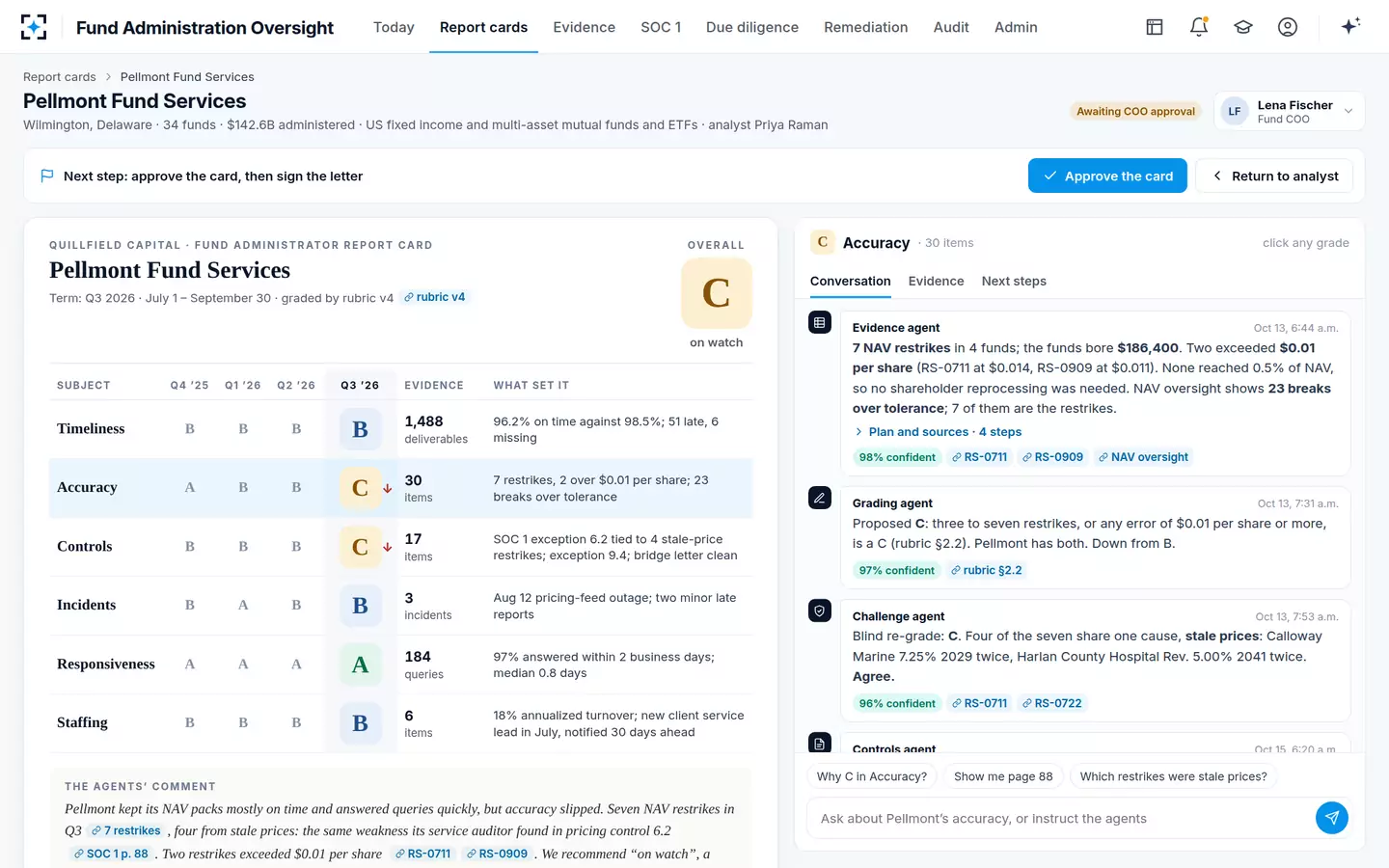
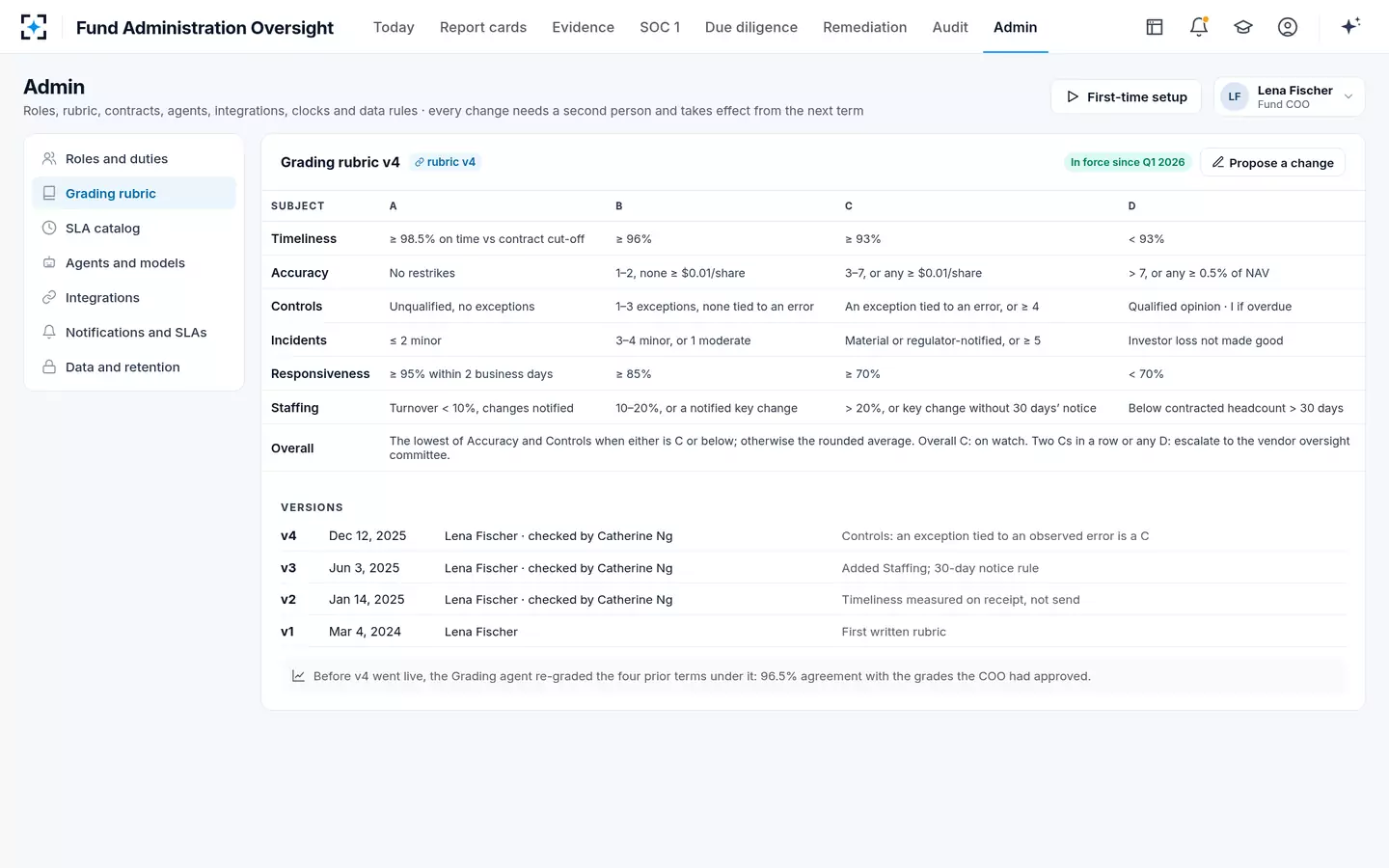
The grade then follows a written rubric, so the depth of shadowing and the consequences for the administrator are linked in a way a board can read. Under the sample firm's rubric, three to seven restrikes, or any of $0.01 per share or more, makes accuracy a C.
The written rubric that turns restrikes and exceptions into grades
For the nightly check of each NAV itself, Botminds' NAV Oversight solution is the companion piece, and NAV oversight beside the administrator sets out how it runs without replacing anyone; for what the administrator does and what stays with the manager regardless of depth, see what a fund administrator does.
Questions people ask
What is a shadow accounting system?
It is the manager's own accounting or reconciliation system, kept in parallel with the administrator's, that reproduces some or all of the fund's books or NAV from independent inputs. Its value lies in the independence of those inputs and in the record of every difference it finds.
How much of the administrator's work should a manager replicate?
Enough to find the errors most likely to matter, which usually means the hard-to-verify prices and the complex calculations rather than every trade. Research on hedge funds links smoothing to less verifiable pricing and manager discretion, so those components deserve the deepest check.
Does a shadow NAV have to match the administrator's exactly?
No. It has to match within a written tolerance, and every difference beyond it must be explained. Rounding, timing of accruals and price snapshots produce small differences; an unexplained one that recurs is the signal.
Is shadow accounting the same as a parallel run?
A parallel run is a temporary full shadow, usually when moving to a new administrator, where both the old and new NAVs are produced for a period. Luxembourg's administrator circular lists a parallel run requirement as one element a transfer process can include. Ongoing shadow accounting is the permanent, usually lighter, version.
Can the administrator do the shadow for us?
Not as independent evidence. An administrator re-checking its own NAV is running its own controls, which its SOC 1 report may already describe. A shadow is useful precisely because someone other than the administrator does it.