NAV oversight solutions are the systems and services an asset manager uses to check the net asset values its fund administrator calculates, before they are published. They come in three depths: a full shadow book, which keeps a second set of accounts and costs a second accounting team; a NAV-level shadow, which rebuilds each share class's NAV from the manager's own positions and independent prices and investigates only the differences; and movement checks on the administrator's own files, which are cheap but cannot see an error the administrator's inputs share. The approach that scales sits beside the administrator rather than replacing any of its work: it reads the files the administrator already sends, adds the manager's books and second price sources, and gives the oversight team an explained difference for every class before the cut-off. Botminds' NAV Oversight is built as that layer, and this guide sets out what to look for in any of them.
An oversight layer beside the administrator: what plugs in, what comes out, what is replaced
Already there
Fund administrator
NAV summary, positions, prices, trial balance and capital activity, by SFTP or API
Portfolio accounting
The manager's own book of record at the close: positions, accruals, expenses
Price and FX vendors
Primary and secondary evaluated prices, dealer quotes, two FX sources
Transfer agent
Subscriptions, redemptions and shares outstanding by class
Corporate-action feed
Issuer notices and distributions, in their own language
Policies and board papers
NAV error policies, administrator agreements, board minutes
The oversight layer
Independent NAV for every share class
Gap split by cause, every driver cited
Main cause re-checked from other sources
Sized under the fund's own policy
Replaces: nothing
What comes out
People decide
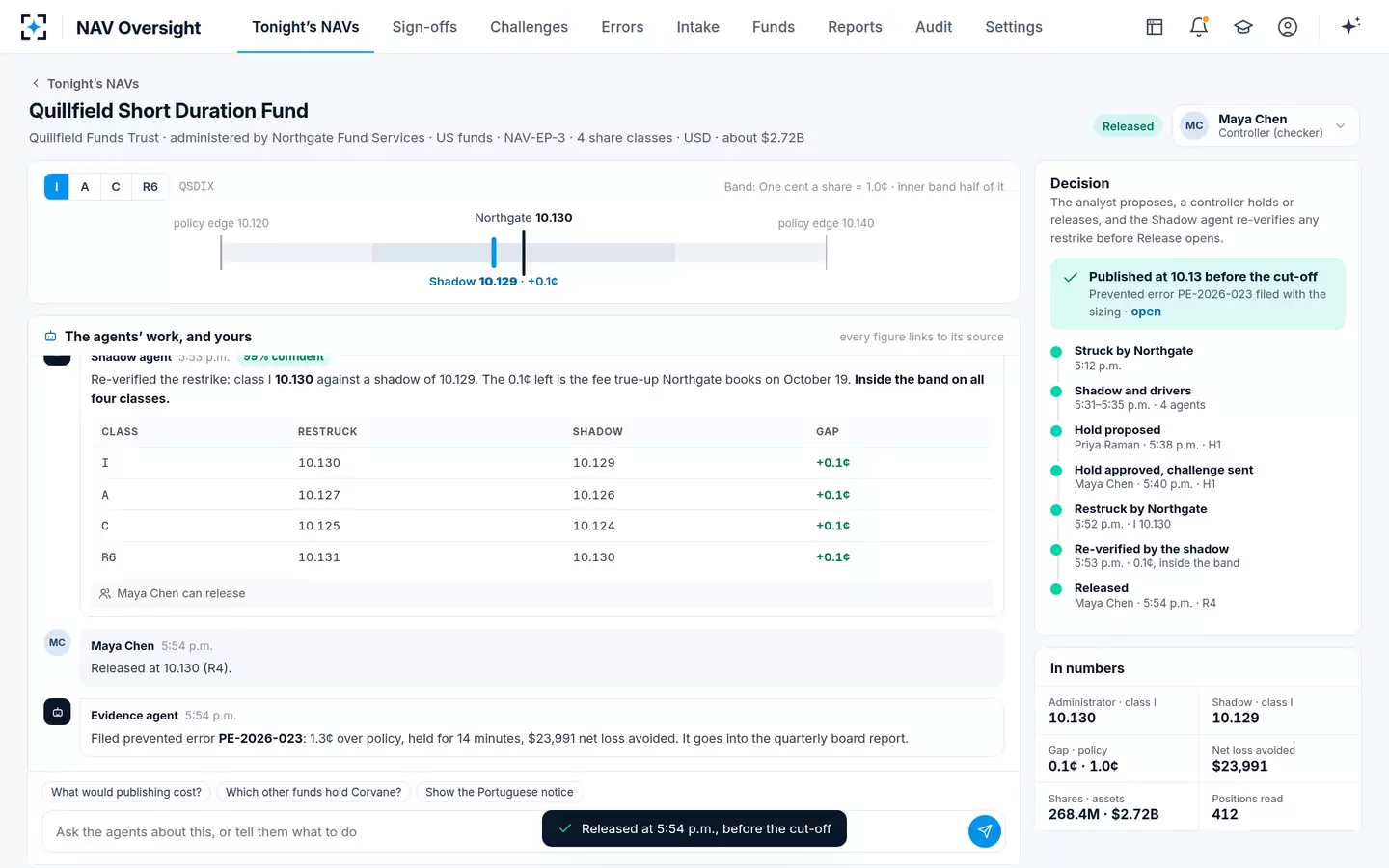
Analyst proposes; a different controller holds or releases
Back to the administrator
Challenges with evidence, after approval; restrikes re-verified
To the board and auditors
Quarterly report, administrator scorecard, exportable evidence
The screens and figures on this page come from NAV Oversight's fictional sample book: Quillfield Funds Trust and its fictional administrator, Northgate Fund Services.
What is NAV oversight, and why does a manager need it?
NAV oversight is the manager's own check of the NAV a third party strikes, because the fund and its manager answer for that NAV. In the US, Rule 38a-1 makes the fund's compliance program cover its administrator and requires the board to approve the policies and procedures of the fund and of each of those service providers, as the Rule 38a-1 service-provider guide sets out. There is no separate SEC rule on oversight of outsourced functions: the SEC proposed one for advisers in 2022 and withdrew it on June 17, 2025, saying it would not adopt a final rule. Oversight of an administrator therefore rests on Rule 38a-1 and the adviser's fiduciary duty.
Luxembourg puts the duty to get the NAV right on the administrator and the responsibility on the fund and its manager, who must supervise their delegates. Either way, someone on the manager's side has to be able to say, every evening, why the NAV the administrator struck can be published. The oversight manager's seat describes that person's job; this guide is about the tools.
Do we need a full shadow book?
Usually not, and having one does not by itself make the check independent. A full shadow book reproduces the administrator's accounting, every trade, accrual and corporate action, at the cost of a second accounting team and a second system, and then still needs someone to compare the two and explain the differences. Its strength is depth; its weakness is that it often uses the same price and FX feeds as the administrator, so it agrees with the administrator's errors.
Research on hedge fund pricing points to what matters instead. Cassar and Gerakos, in the Review of Financial Studies (2011), found that hedge funds priced from harder-to-verify sources, or whose managers had more say over pricing, more often reported returns that looked smoothed, while removing the manager from setting the NAV, or using reputable auditors and administrators, was not associated with less smoothing (Cassar and Gerakos, 2011). Independence of the price, not the existence of a second book, is the control. That argues for the middle depth: an independent NAV per class, built from the manager's own positions and second sources, checked by exception. Fund Administration Oversight covers how much of the administrator's wider work to replicate.
Three depths of NAV oversight, compared
| Full shadow book | NAV-level shadow, by exception | Checks on the administrator's files | |
|---|---|---|---|
| What it rebuilds | The whole set of books: every trade, accrual and corporate action | Each share class's NAV from the manager's positions and independent prices | Nothing; tests movements and totals in the administrator's own data |
| What it catches | Most errors, if its inputs are independent | Price, position, accrual, FX, expense and capital differences, each explained | Jumps and breaks in the administrator's data; not shared input errors |
| What it misses | Errors it shares with the administrator through common feeds | Errors inside positions that net to nothing at class level | Stale prices, slow walk-downs, missed corporate actions |
| People needed | A second accounting team | An oversight team reviewing exceptions | An analyst or two |
| Fits best | Small numbers of complex funds, or a planned administrator exit | Daily-dealing ranges with many classes and a tight cut-off | Low-risk funds with highly verifiable prices |
What data does the administrator send each night?
A NAV summary for each fund and class, the positions with their prices, a trial balance, and the capital activity: subscriptions, redemptions and shares outstanding. These NAV files are what the administrator has already checked. In Luxembourg, CSSF Circular 22/811 lists the minimum controls an administrator must perform on each NAV, starting with “Review of unusual or significant movements of all or some of the NAV components (in particular of the NAV per unit/share, investments, cash, fees, invoices), including using benchmark comparison, when applicable”, followed by reconciliations of investments and cash against reliable and independent sources and of the shares in the accounts against the register.
An oversight layer should not repeat those controls; it should check their result from the other side. The administrator reconciles its positions to the custodian; the manager compares the administrator's positions with its own book of record. The administrator reviews price movements; the manager prices from a second source the administrator did not use. That division of labour is what makes the two checks add up to more than one.
How does a NAV oversight solution plug in without a migration?
Through a data map and a policy, not a conversion. The solution needs read access to the administrator's files as they land, by SFTP or API; the manager's positions, accruals and expenses at the close from its portfolio accounting system; the price and FX feeds it is licensed for; the transfer agent's dealing; and the corporate-action feed. Each administrator's file layout is mapped once. In NAV Oversight, when a new field appears in an administrator's file, the Intake agent proposes a mapping and an operations administrator confirms it; the agent never guesses.
The second input is the policy. Each fund's NAV error policy, threshold, measure and correction rule, becomes a setting the agents read and cite, versioned and approved by the Head of Fund Accounting. Nothing about the administrator's process changes, except that its NAV control team starts receiving challenges with evidence attached.
Oversight across several administrators
Most US registered funds use one administrator, but a growing number use two, and a manager's range often spans several. Form N-CEN data published by the SEC show the funds reporting two administrators rising from 434 in 2019 to 546 in 2025.
US registered funds reporting more than one administrator, 2019 and 2025
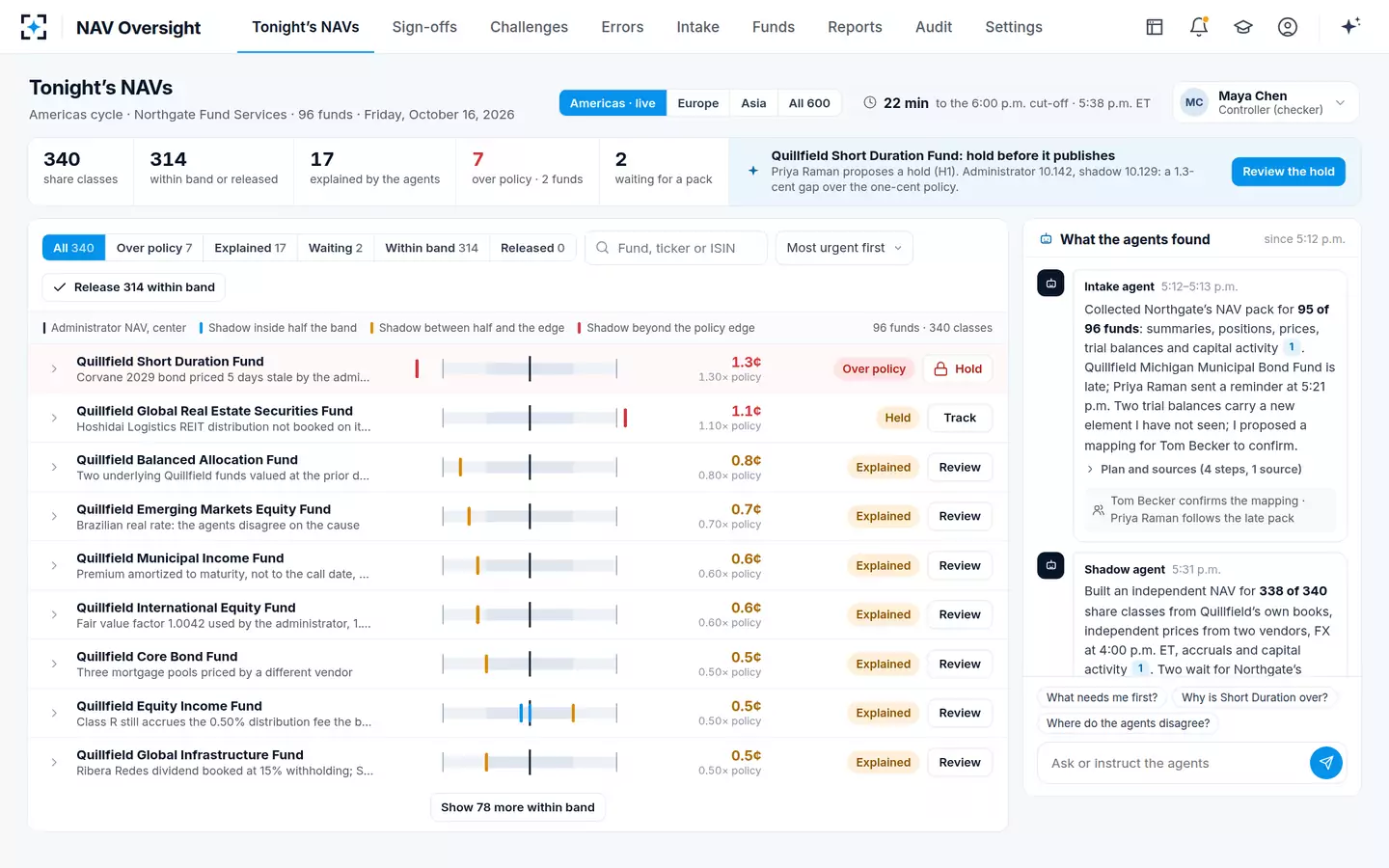
Across administrators, the oversight layer's job is normalisation: one band per class, one way of splitting a difference, one policy per fund, whatever the file format. It is also where a manager can compare administrators on evidence rather than impressions, from breaks per thousand NAVs to the time each takes to answer a challenge.
Every fund on its band before the cut-off, whatever the administrator
The first 30 days: map, policy, back-test, run in parallel
A sensible go-live proves the layer against the administrator's own history before anyone relies on it. We suggest four steps over about a month, and NAV Oversight's first-time setup covers the first three.
A first month that ends with every hold explainable
- Data map: files, books, prices, dealingdays 1–5
- Policies and bands as settingsdays 6–8
- Back-test the last 20 business days, days 9–10
- Parallel run beside the current checkdays 11–30
The parallel run is the step teams skip and regret. For four weeks the new layer runs beside the existing check, and every difference between them is explained: either the layer found something the old check missed, or the layer flagged something that was fine, which is a band to adjust. At the end, the Head of Fund Accounting should be able to say why every hold in the month would have been made. A seeded-break test adds the cases history did not supply.
Working with the administrator: challenges, a portal and a scorecard
The relationship changes from email to evidence. A US fund's valuation designee must already have a process for challenging pricing vendors: the Rule 2a-5 release requires the board or designee to “establish a process for initiating price challenges as appropriate”. A NAV oversight layer extends the idea to the administrator: each challenge carries the gap, the cause, the sources and the deadline, and the administrator answers in one place.
A challenge to the administrator, with its evidence and the answer
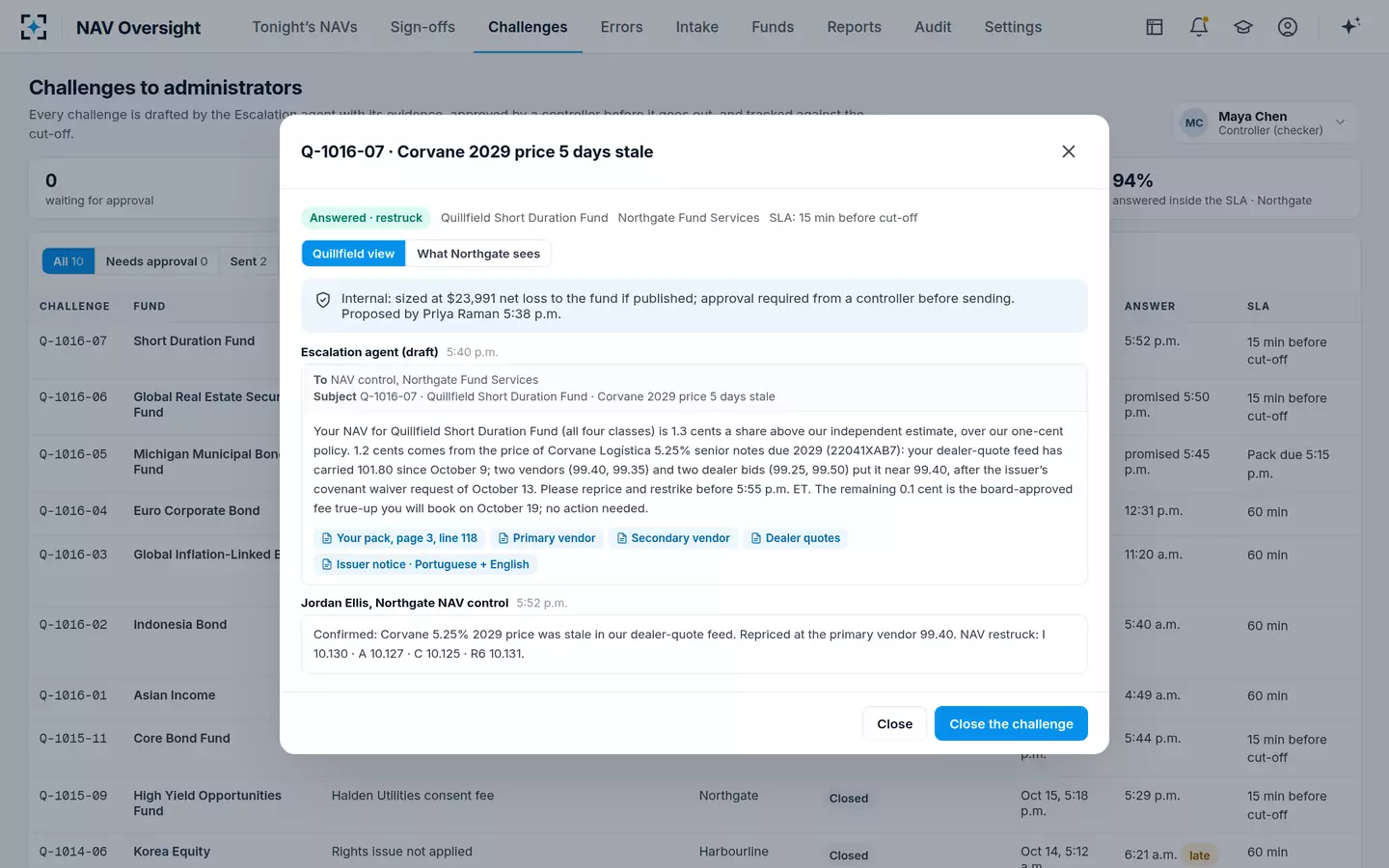
The challenge history also protects the manager when something goes wrong at the administrator. In 2023 the SEC sanctioned a fund administrator for recording a fund's losses as a receivable from its adviser, which kept the NAV from falling, despite red flags. An oversight layer that rebuilds the NAV from the manager's own books does not depend on the administrator's judgement about what is an asset; a challenge history shows what was raised and when.
What to look for in a NAV oversight solution, and where NAV Oversight does not fit
Look for independence, explanation and evidence, in that order. A solution that cannot price from a source the administrator did not use cannot catch the administrator's price errors; one that flags without explaining moves the work rather than removing it; one that does not keep the evidence leaves the manager rebuilding it from email when the board asks.
Buying questions for NAV oversight solutions
- Does it replace anything?
It should not need the administrator to change process, or the manager to change its book of record.
- Is the check independent?
Second price and FX sources, the manager's own positions, and a checker that does not reuse the maker's inputs.
- Does every difference come with a cause?
Split by price, position, accrual, FX, expense and capital activity, each cited to its line.
- Is the policy yours?
Each fund's threshold and correction rule as versioned settings, not the vendor's defaults.
- Who decides?
People hold, release, send and sign; the analyst who proposes never approves.
- What does it keep?
Every check and decision with its evidence, for at least the six years US records rules require.
- Can it prove itself first?
A back-test on your past NAVs and a parallel run before anyone relies on it.
- Where is the data held?
In the regions your funds require, with a legal hold that suspends deletion.
NAV Oversight is a fit for managers with daily-dealing ranges, many share classes, one or more outside administrators and a cut-off that leaves under an hour for checks. It is a weaker fit for a single private fund with a quarterly NAV and no dealing between, where a careful quarterly review may be enough. It does not strike the official NAV, keep the books, set fair values for hard-to-value holdings or act as transfer agent; those stay with the administrator, the valuation designee and the transfer agent.
Records are the last test. Rule 31a-2 requires a US registered fund to keep every schedule supporting a NAV computation for at least six years from the end of the fiscal year, the first two where they can be reached easily. NAV Oversight keeps its audit trail in the fund's region for seven years or more, with legal holds. How its agents are separated and the NAV Oversight page cover the rest.
Released only after the restrike is re-verified
Questions people ask
What does NAV oversight mean?
The asset manager's own check of the NAVs its fund administrator calculates, before they are published, with the authority to hold a NAV and ask for a restrike. It exists because outsourcing the calculation does not outsource responsibility for it, under Rule 38a-1 in the US and the CSSF's circulars in Luxembourg.
What should a Luxembourg-based NAV oversight solution handle?
CSSF Circular 24/856's thresholds by fund type, applied per sub-fund across all classes, aggregation of untreated small errors, and the notification and compensation rules for significant errors, alongside the administrator duties in Circular 22/811. NAV Oversight can hold Luxembourg funds' data in its EU region and applies each sub-fund's threshold as a versioned setting.
What is the difference between a shadow NAV and a shadow book?
A shadow book is a second full set of accounts; a shadow NAV is an independent NAV per share class built from the manager's own positions, prices, FX, accruals and capital activity. The shadow NAV is cheaper and, if its prices come from sources the administrator did not use, often the more independent check.
Does the administrator need to change anything?
No. The oversight layer reads the files the administrator already sends. The administrator's NAV control team receives challenges through a portal where it sees only its own, and answers with a confirmation or a restrike.
How long does a NAV oversight solution take to go live?
It depends mostly on the data map: how many administrators, file formats and price sources. NAV Oversight's first-time setup ends with a back-test over the last 20 business days of the administrator's NAVs; we suggest a parallel run of about four weeks before the old check is retired.