A NAV calculation error is a net asset value that was computed wrongly and used to price a fund's purchases and redemptions; once it is published, every transaction struck at that price was struck at the wrong price, and the fund has to put them right. The correction runs in a fixed order: find and fix the source so tomorrow's NAV is right, rebuild the correct NAV for every day of the error period, work out who was overpaid and who was short-changed, then make the fund whole or reprocess shareholder accounts under the fund's own policy, and tell the board, and in Luxembourg the CSSF, within the time each rule sets. The work is expensive because it reaches every account that traded, often through intermediaries the fund cannot see. Botminds' NAV Oversight sizes each break under the policy before release, so most errors are held and restruck instead of corrected, and keeps the evidence for the ones that are not.
The sample figures on this page come from the solution's fictional sample book, Quillfield Funds Trust and its fictional administrator, Northgate Fund Services. The deadlines and cases are the regulators' own.
The clocks a correction runs on: what the texts fix, and what they leave to the fund
- Fix the source, day 0
- Tell the board of a material NAV error, within 5 business days
- Rebuild NAVs, reprocess or make whole, discloseset by the policy
- Inform manager, administrator, depositary, without delay
- Correct, size, compensate, notify the CSSF4–8 weeks
- Auditor's special report, where requiredwithin 3 months of notification
What happens when a mutual fund's NAV is wrong?
Shareholders who traded at the wrong NAV were paid too much or charged too much, and the fund either lost or gained the difference. Rule 22c-1 requires every sale and redemption of a US mutual fund's shares at a price “based on the current net asset value of such security which is next computed after receipt of a tender”; a wrong NAV breaks that promise for every order processed that day. If the NAV was overstated, redeemers took money that belonged to the shareholders who stayed, and new investors overpaid. If it was understated, redeemers were short-changed and new investors bought cheaply at everyone else's expense.
The size of the bill depends on the day's flows, not only the size of the error. A one-cent error on a quiet day can cost almost nothing; the same cent on a day of heavy redemptions can cost the fund tens of thousands of dollars. That is why a correction starts with data, the transaction records for every day of the error period, before it starts with arithmetic.
Day 0: stop tomorrow's NAV being wrong too
The first step is not the money; it is the source. The CSSF's list of remedial steps begins: “identify with precision the origin of the error and immediately correct the source of the error so as to ensure that the next NAVs are correctly calculated”. An error found in the morning that is still in the evening's NAV is now a longer error period and a larger bill.
The same day, the people who will carry the case need to know. In Luxembourg the fund's procedures must ensure that the investment fund manager, the administrator and the depositary are informed “without delay”. In the UK the authorised fund manager records each instance of incorrect pricing as soon as it is discovered and reports it to the depositary, with the action taken or to be taken to avoid repetition. In the US the clock that matters is the board's.
Who must be told, and when?
In the US, the board. Under Rule 2a-5 the valuation designee must report material NAV errors to the board within a period the board sets, and “in no event later than five business days after the valuation designee becomes aware of the material matter.” The SEC explained that the materiality assessment may take time of its own; once materiality is determined, the five days run. The fund's policy should say whether an error over its correction threshold counts as material for this purpose; the SEC said relying on the industry's one-cent or 0.5% convention would not be unreasonable.
In the UK, the depositary decides whether the FCA hears of a single case. The FCA's guidance says a depositary “should also report to the FCA immediately any instance of incorrect pricing where the error is 0.5% or more of the price of a unit, where a depositary believes that reimbursement or payment is inappropriate and should not be paid by an authorised fund manager.” Every other instance appears, as a count, in the depositary's quarterly return.
In Luxembourg, every significant error goes to the CSSF on its notification form. For an error that needs no payment to investors, the deadline is four to eight weeks after detection at the latest. A complex case with compensation owed to many investors in several countries must still be notified within that window, without waiting for the payment date, and the fund must then report progress on the payments every month.
Does the fund or the shareholder get the money?
It depends on the direction of the error, on which side of the threshold it falls, and on the fund's policy. The table below sets out who is owed what in each direction; below the threshold, many US policies make only the fund whole for its net loss, and the CSSF makes compensation compulsory only on days the error was significant. The NAV impact calculation puts numbers to each line.
Who is owed what after a NAV error, by direction
| NAV overstated | NAV understated | |
|---|---|---|
| Redeemers during the error period | Were overpaid; usually not asked to repay | Were underpaid; owed the difference when the error is over the line |
| Subscribers during the error period | Overpaid for their shares; owed the difference over the line | Bought cheaply; usually not asked to repay |
| The fund (shareholders who stayed) | Lost what redeemers took out too much | Lost what subscribers paid too little |
| Asset-based fees | The adviser and administrator were paid on inflated assets | Fees were computed on understated assets |
| Who pays the bill | The party that caused the error, under its contract; never the fund's other investors | The same |
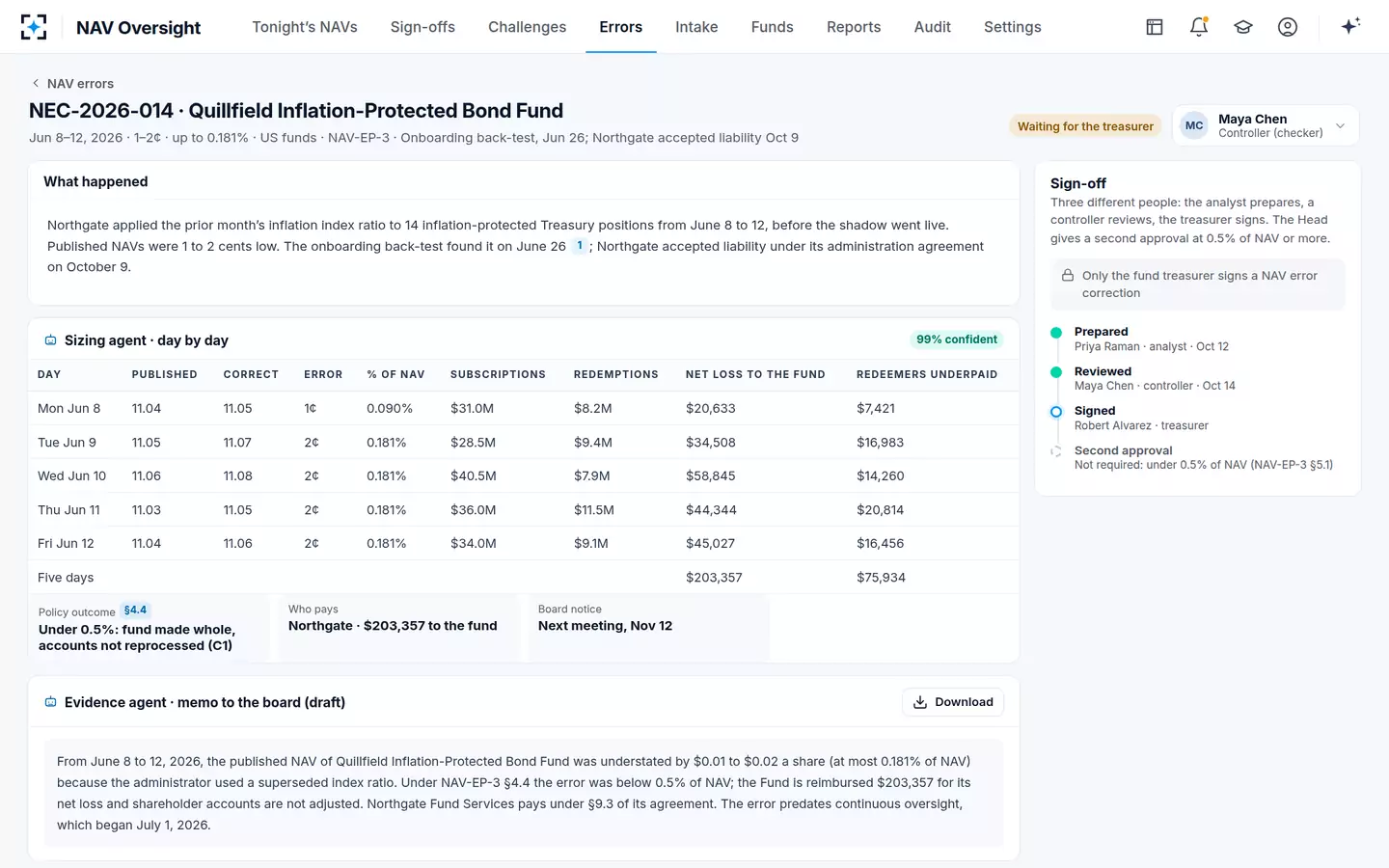
Take the solution's sample correction case. For five days in June, the administrator applied the previous month's inflation index ratio to a fund's inflation-protected Treasury positions, and the published NAVs were one to two cents low, at most 0.181% of NAV. The fund lost $203,357 net, mostly to investors who bought cheaply; redeemers were underpaid $75,934. The fund's policy makes the fund whole below 0.5% of NAV and does not reprocess accounts, so the administrator repays the fund and the redeemers' shortfall stays where it fell.
Each day an error stays in the published NAV adds to the bill
Rebuilding the NAVs: every day, every class, every fee
The arithmetic of a correction is a rebuild of every NAV in the error period, not a single adjustment at the end. The SEC's 2016 order against Calvert Investment Management shows what an examiner can require when a remediation falls short. Calvert had to recompute the fair value of the mispriced bonds for every day from March 18, 2008 to October 18, 2011, produce “Value-Corrected NAVs” for each fund and class, and then adjust them twice.
The first adjustment reflected the cash that flowed in and out at the wrong prices, multiplied by each fund's return that day. The order added a protection for shareholders: “During periods when the Affected Calvert Funds' rate of return was negative, the Performance Adjustment will be assumed to be zero so that the adjustment will not be used to decrease the should-have-been assets under management.” The second adjustment removed the management and administration fees charged on the overstated assets. Each account's gains and losses were then netted across the whole period, and interest at the federal short-term rate, compounded quarterly, was added for the time since.
Not every correction needs that machinery; Calvert's ran for three and a half years. But the elements, a corrected NAV per day and class, the effect of the flows, the fees and the time value of money, are the questions any board or auditor will ask of a correction, and the CSSF's compound method asks the first two for every Luxembourg fund that uses it.
Reaching the shareholders behind the intermediaries
Most fund shareholders hold through brokers, platforms and retirement plans, so the fund's register shows one omnibus account where there are thousands of investors. A correction that stops at the omnibus account pays the platform, not the people. Calvert's undertakings set out one way through: identify every omnibus or disclosed account with an estimated payment of $10,000 or more, ask each intermediary for the underlying account data, give intermediaries 30 days to say whether they will provide it and 60 more to do so, pay their reasonable costs, and have them distribute within 60 days and return what they cannot pay within 180.
Luxembourg now writes this into the circular. The fund, with its distributors, must be able to trace the intermediation chain, and where it cannot pay each final beneficiary itself, it must hand the intermediaries the data to do it: the error period with its start and end dates, the erroneous and the corrected NAV for each day, the subscriptions and redemptions per day and the impact per day. Funds that cannot pay end investors directly must say in their prospectus that those investors' rights may be affected.
Notifying the CSSF, and when the auditor writes a special report
A Luxembourg correction leaves a paper trail outside the fund. The notification form must be complete, with every data field filled in and no change to its frame, and it must carry a quantitative impact calculation that lets the CSSF trace how the impact and the corrections were computed; incomplete notifications are refused. The CSSF does not approve the corrective actions, but it may ask for more information, require different remedial actions, or require better organisation where notifications point to weaknesses.
The CSSF's remedial action plan for a significant NAV calculation error
- Find and fix the source
So that the next NAVs are correctly calculated.
- Determine the corrected NAVs
For every day of the error period.
- Apply them to the dealing
To find what is owed to the fund and to the investors who lost.
- Book it
Record the payments to be received and made in the fund's accounts without delay.
- Inform the investors owed money
Including how the loss will be remedied.
- Pay the fund and the investors
At once, not by instalments or out of the responsible party's future fees.
- Strengthen the controls
A remedial action plan so the error does not recur.
For UCITS and Part II funds, a large case brings the auditor in early. Where total compensation to the fund and investors exceeds EUR 50,000, or any one investor is owed more than EUR 5,000, the fund's approved statutory auditor must carry out an additional control immediately after detection and issue a special report to the fund's directors and the CSSF, in principle within three months of the complete notification. If it runs late, the CSSF must be told of progress monthly.
What should shareholders and the market be told?
Whatever is said must be accurate about the correction itself, not only about the error. Calvert's funds told shareholders that those harmed had been identified and made whole. They had not been, precisely, and the SEC found that the omission was a violation in its own right.
“Calvert and the Calvert Funds never disclosed to investors and prospective investors that the initial remediation did not conform to the Calvert Funds' NAV error correction procedures, nor did they disclose that the process compensated shareholders differently, depending on whether they invested directly or through an intermediary.”
SEC order, In re Calvert Investment Management, Inc., October 18, 2016
The lesson for the fund treasurer drafting a shareholder letter or an annual report note is to describe the method as well as the outcome: the error period, how corrected NAVs were computed, who was paid, who was not and why, and who bore the cost. In Luxembourg the investors owed compensation must be told how the loss will be remedied before they are paid. The policy clauses that settle these choices in advance are the place to start.
Closing the case: evidence, controls and the count
A correction is closed when the money has moved, the controls have changed and the file can be re-performed by someone who was not there. The file holds the corrected NAVs, the transaction-level working, the policy version applied, the approvals and the payments. In the UK the depositary will also count the instance in its quarterly return; in the US it is likely to appear in the chief compliance officer's annual report to the board; in Luxembourg the auditor reviews it at year end.
Every action on a case, by a person or an agent, on one trail
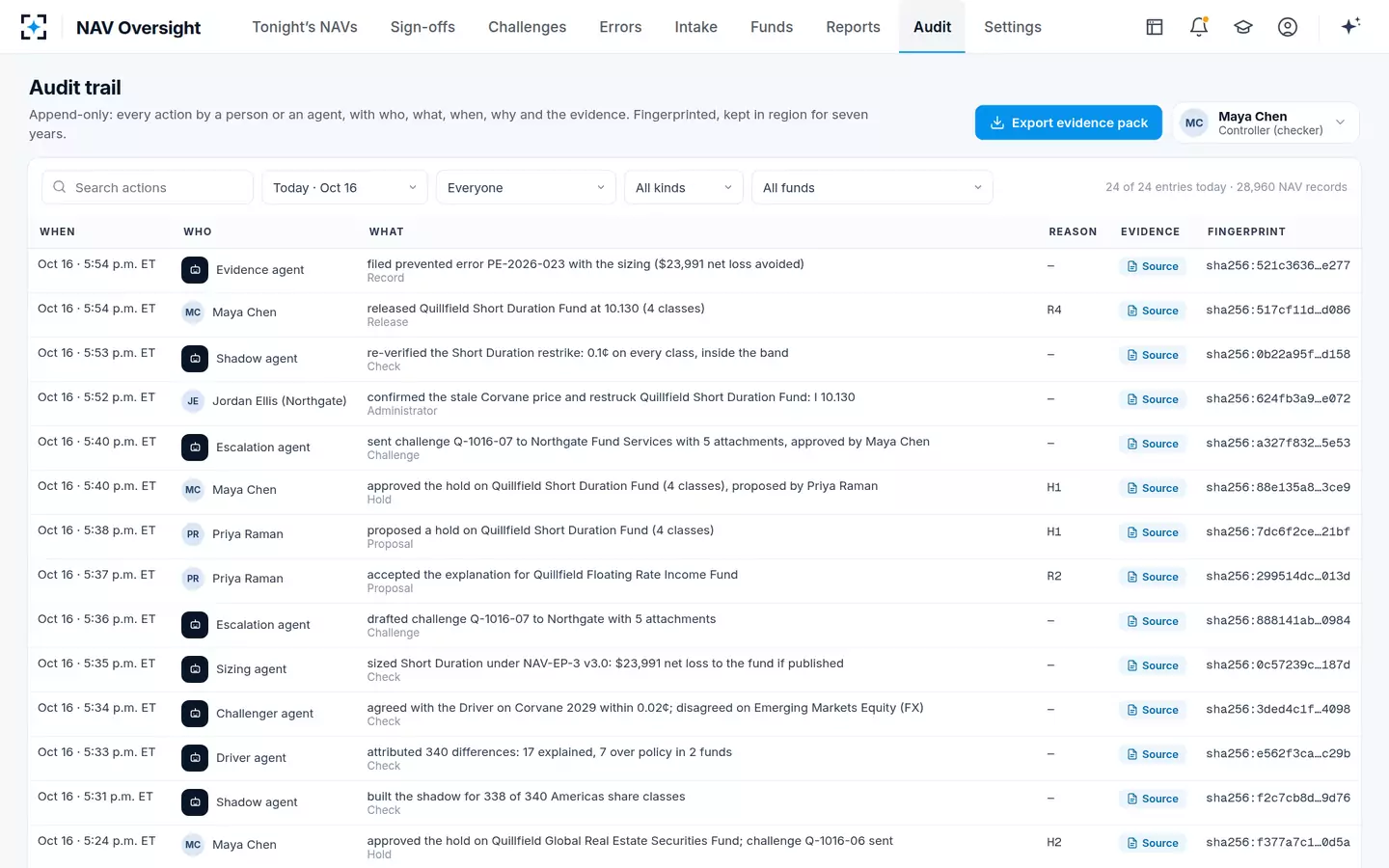
The cheapest correction is the one that never happens. On the solution's sample evening, a 1.3-cent break on a short duration bond fund was found in the half hour before the cut-off, sized at $23,991 if published, held, restruck by the administrator and released after a second check, 14 minutes after the hold. NAV Oversight is designed for that path, with the error-case workflow and its three signatures kept for the errors that still get through. The person who owns that evening is described in its own guide, and the NAV Oversight page shows each screen.
A correction case: sized day by day, who pays, and three signatures
Questions people ask
What does the CSSF require after a NAV calculation error?
For a significant error under Circular 24/856: inform the manager, administrator and depositary without delay, fix the source, compute corrected NAVs for the whole error period, compensate the fund and the investors who lost, notify the CSSF on its form within four to eight weeks of detection, and strengthen controls. Errors below the threshold only need the source fixed.
Which CSSF circular covers NAV calculation errors?
Circular CSSF 24/856, dated March 28, 2024, for errors detected from January 1, 2025. It replaced Circular CSSF 02/77, which still governed errors detected before that date, and it also covers breaches of investment rules and other errors such as wrong swing factors and cut-off breaches.
How is a NAV error corrected?
By recomputing the NAV for each day of the error period, applying it to the subscriptions and redemptions made at the wrong price, and paying the fund and the affected investors the differences, or making only the fund whole where the policy and the threshold allow. The party that caused the error pays, including the cost of the correction.
Does the fund or the shareholder get the money?
Both can. The fund is owed what it lost through redemptions at an overstated NAV or subscriptions at an understated one; shareholders are owed what they overpaid or were underpaid, usually only above the threshold. Below it, many US policies make only the fund whole.
What must the board be told after a NAV error, and when?
In the US, material NAV errors go to the board within the period it sets, no later than five business days after the valuation designee becomes aware of the material matter, with follow-up reports as the board requires. The chief compliance officer's annual report covers material compliance matters, which can include a NAV error.
How long can a correction take?
As long as the data takes. Calvert's order gave it 270 days to submit its proposed calculation to SEC staff and 360 days to make the distributions, for an error period of three and a half years. A one-day error with a clean register and no intermediaries to trace may be closed in weeks.