AI tools for fund accounting fall into two groups. General chat assistants answer questions from the text they were trained on and whatever a user pastes in: they can explain a rule, draft a memo or summarise a policy, but they have no access to tonight's administrator files, the manager's books or current prices, they do not cite where an answer came from, and they keep nothing a board or examiner could use as evidence. Task-specific tools are connected to the fund's data, check each figure against independent sources, apply the fund's own policy and leave the decision to a person. Releasing a net asset value needs the second kind: the inputs, a second source, a rule, a named decision-maker and a trail. Botminds' NAV Oversight is that kind of tool, and you can still ask it questions in plain words; the difference is that every answer is drawn from the files and cites them.
A general chat assistant and a NAV checking tool, on the same evening
General chat assistant: What it was trained on and what is pasted into the window.
NAV checking tool connected to the fund's data: The administrator's NAV files, the manager's books, two price and FX sources, the day's dealing.
General chat assistant: Rarely cited; a confident answer and a wrong one look alike.
NAV checking tool connected to the fund's data: Every figure linked to its file and line, price record, policy section or notice.
General chat assistant: Checks whatever it is given against itself.
NAV checking tool connected to the fund's data: Re-prices from sources the administrator did not use; a second agent may disagree.
General chat assistant: None of its own; will apply whatever threshold the user types.
NAV checking tool connected to the fund's data: The fund's approved policy, versioned, applied class by class.
General chat assistant: Will offer one if asked.
NAV checking tool connected to the fund's data: Never holds, releases, sends or signs; a person decides, and not the one who proposed.
General chat assistant: A chat history, if kept, on the vendor's terms.
NAV checking tool connected to the fund's data: An append-only trail of every check and decision with its evidence.
The examples on this page come from NAV Oversight's fictional sample book: Quillfield Funds Trust, its fictional administrator Northgate Fund Services, and one Friday evening, October 16, 2026.
What can AI tools for fund accounting do today?
Read, compare, explain and draft, quickly and at volume, when they are connected to the right data. That covers a large share of a NAV oversight team's evening: collecting and reading the administrator's files, rebuilding each share class from the manager's books, splitting differences by cause, finding the issuer's notice behind a price move, sizing a break under the policy and drafting the challenge. In the solution's sample evening, those steps covered 340 share classes and left a controller with two funds to decide on.
What they should not do is the accountable part: release a NAV, change a price or a tolerance, decide compensation or sign. Those remain with the people a board, an auditor and a regulator hold responsible. The SEC's examination staff are watching the shift. Its priorities for fiscal year 2027 open their technology section by noting that registrants are building what the SEC calls "super intelligence (SI)" into their businesses. The question an examiner will ask is not whether a firm uses such tools but how it supervises them.
Can ChatGPT calculate a NAV?
It can do the arithmetic if someone gives it every input, which is the part that matters. A NAV is the sum of hundreds of positions at that evening's prices, FX rates at a stated time, accruals to date and the day's capital activity, divided by the shares in issue, class by class. The sample short duration fund held 412 positions. A chat window has none of those numbers unless someone pastes them in, and if they are pasted from the administrator's file, the assistant inherits every error in them, including the stale bond price that caused the sample evening's break.
It also cannot say where an answer came from in a form an auditor accepts, or produce the same answer twice on demand. A NAV check has to be repeatable: the working kept for each computation, and US Rule 31a-2 requires a registered fund to keep every schedule supporting each NAV computation for at least six years from the end of the fiscal year, the first two within easy reach. A conversation is not a schedule.
Four questions a controller might ask, and how each kind of tool answers
“Is tonight's NAV for the short duration fund right?”
General chat assistant
Has no access to tonight's files, books or prices; can only explain how one would check.
Connected NAV checking tool
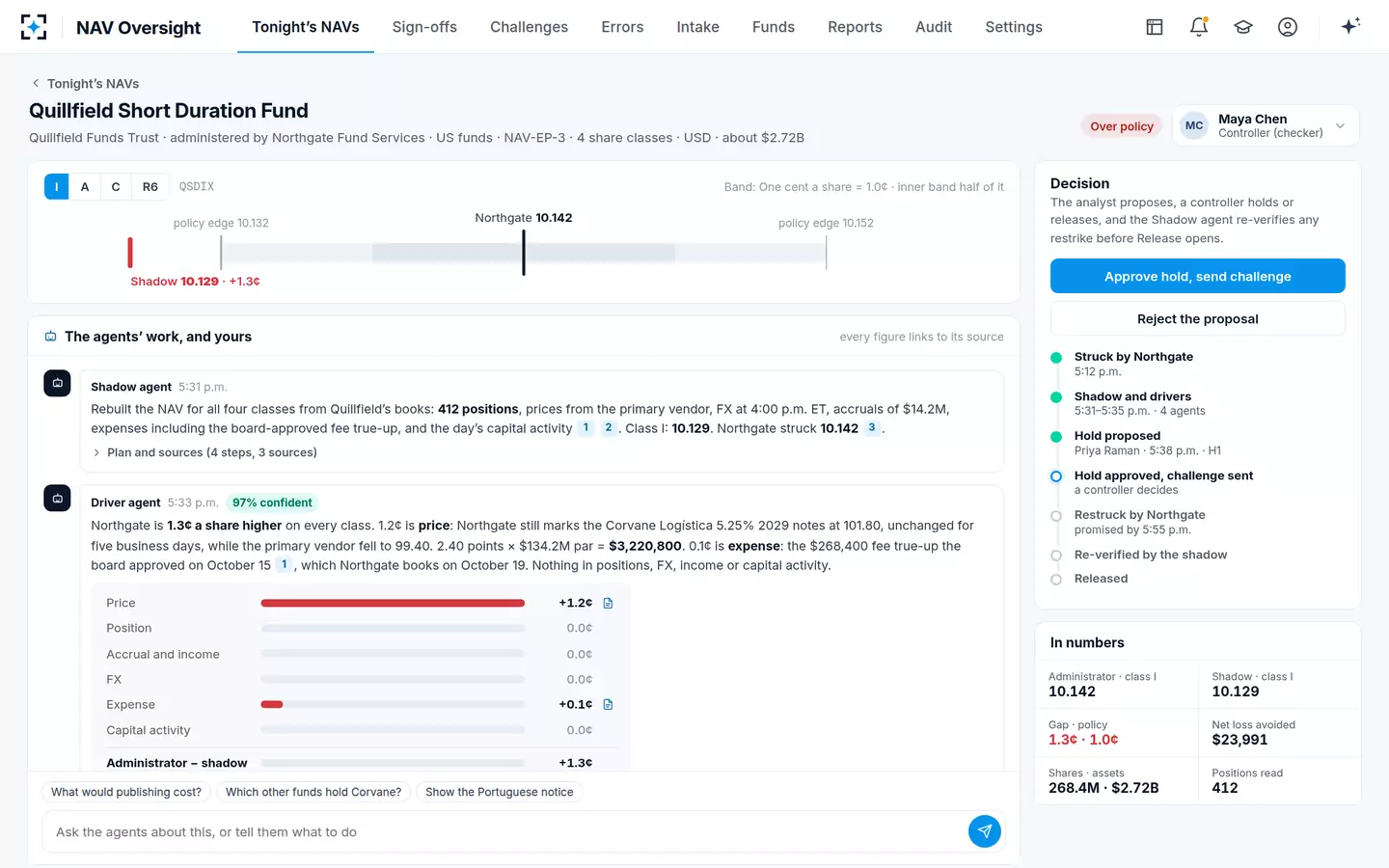
Answers from the files: administrator 10.142, independent NAV 10.129, 1.3 cents over a one-cent policy, from one stale bond price.
“The bond is priced at 101.80. Is that fine?”
General chat assistant
Has only the number it was given; if the input is stale, so is the answer.
Connected NAV checking tool
Re-prices from sources the administrator did not use: two vendors near 99.40, two dealer bids at 99.25 and 99.50.
“What would publishing it cost?”
General chat assistant
Without the day's dealing it must assume flows, and may not say it did.
Connected NAV checking tool
Sizes 1,842 transactions under the fund's policy: $66,047 overpaid to redeemers, $42,056 overpaid by subscribers, $23,991 net to the fund.
“Lower the tolerance for this fund.”
General chat assistant
May rewrite whatever text it is given; it holds no policy and no approvals.
Connected NAV checking tool
Refuses: only the Head of Fund Accounting approves a new policy version; drafts the request with 60 days of gaps attached.
What the research measured about chatbots and accounting questions
The most-cited test is a large one. Wood and over three hundred co-authors, in a peer-reviewed study in Issues in Accounting Education (2023), compared ChatGPT with students on accounting assessment and textbook test-bank questions, using “data from 14 countries and 186 institutions” and 28,085 questions. Students scored 76.7% on average against ChatGPT's 47.5% without partial credit.
ChatGPT on 28,085 accounting questions, January 2023
56.5%
questions answered correctly
9.4%
further questions answered partially correctly
15.8%
of assessments where it beat the student average, with partial credit
76.7%vs 47.5%
student average against ChatGPT, no partial credit
The abstract states it directly: “As of January 2023, ChatGPT provides correct answers for 56.5 percent of questions and partially correct answers for an additional 9.4 percent of questions.” Two cautions apply. The models have changed since January 2023, and newer ones are likely to do better. And textbook questions are not a fund's NAV: they come with every input stated. The harder problem in NAV work is not the arithmetic but knowing that an input is stale, which no score on a textbook question measures.
Why a chat window can't release a NAV
Because releasing a NAV is a decision with five requirements a chat window cannot meet together: tonight's data, an independent second source, the fund's own policy, a named person who decides, and evidence of all four. Even a perfect model fails the first and the last two by design: it sees only what it is given, and it is not the person the board will ask.
ESMA describes the failure mode in the same terms. Its May 2024 statement on AI in retail investment services warns that text-generating tools can produce statements that are factually wrong while sounding entirely plausible. In NAV work, a hallucinated explanation for a break is worse than none, because it closes the question. A design that requires every driver to be cited to a file, and allows the answer “unexplained”, makes an invented cause visible.
Asking in plain words, with every figure tied to its source
Shadow AI: when staff paste fund data into a chatbot
The risk most firms meet first is not a vendor's product but an employee's browser tab. ESMA's statement says its principles apply to “the use by firm staff of third-party AI technologies (such as Chat GPT, Google Bard, and others) with or without the direct knowledge and approval of senior management.” A fund accountant who pastes a trial balance into a public assistant to find a break has moved fund data outside the firm's controls and produced an answer nobody can audit.
The fix is not a ban on asking questions; it is a tool where asking happens inside the controls. ESMA expects firms to keep records of AI use that show how decisions were reached, which data and algorithms were used, and every later change. That is a fair description of what an oversight team's evidence file needs anyway.
What must an AI tool show before a controller relies on it?
Its sources, its limits and its trail, before its answer. A controller deciding at 5:40 p.m. whether to hold a fund needs to see where each number came from, whether a second source agrees, what the policy says, and that the tool will not act on its own.
Before relying on an AI tool for NAV work
- It reads your files, not a summary
The administrator's NAV files, your books, your price and FX sources, tonight.
- It cites every figure
File and line, price record, policy section or notice, one click away.
- It uses a second source
A check from the same feed as the administrator is not a check.
- It says when it is unsure
A confidence threshold, and the word “unexplained” when a gap cannot be accounted for.
- It applies your policy
Your approved thresholds and correction rules, versioned, not defaults.
- It cannot act alone
No release, challenge, price change, tolerance change or signature without a person.
- It keeps the evidence
Every question, answer, check and decision with its evidence, for as long as your rules require.
- It stays inside your controls
Data in your region, access by role, nothing pasted into a public assistant.
Where a general chat assistant does help a fund accountant
Away from the NAV itself, on text that is public and checkable. A chat assistant is useful for reading a long rule quickly, such as the 47 pages of CSSF Circular 24/856, for drafting the first version of a policy clause from the rule's own words, for turning a controller's notes into a clear challenge, or for explaining a term to a new analyst. In each case the output is a draft a person checks against the source, and no fund data leaves the firm.
The checking is not optional. Ask the assistant for the paragraph number behind each statement and read that paragraph yourself; an answer that cannot point to the text should be treated as a guess. The thresholds on these pages are a fair test: a reliable answer gives 0.20%, 0.50% and 1.00% by fund type for Luxembourg, says the US one-cent or 0.5% line is a convention rather than a rule, and dates each one.
How to trial an AI tool for fund accounting on your own NAVs
On last month's files, beside the check you run today, with breaks you know about. A demonstration on the vendor's data proves the tool works on the vendor's data. A trial on your own administrator's NAV files, your books and your price sources shows whether it reads your formats, finds your kinds of breaks and fits your cut-off.
Run it for four weeks in parallel with the existing process and compare every difference: each break the tool found that the team missed, each one the team found that the tool missed, and each flag that turned out to be nothing. Add planted breaks for the causes your history lacks; the seeded-break method sets out how to plant them and score the result by type. Measure three things: the share of each difference the tool explained with a cited source, the minutes from files received to flag, and whether every action left a trail an auditor could follow without asking anyone. NAV Oversight starts the same way, with a back-test over the last 20 business days of the administrator's NAVs.
Will AI replace fund accounting?
Not the accountability, and the rules are why. Luxembourg's circular on fund administrators says the entity calculating the NAV “must ensure that the UCI's NAV is accurate”, and the US rules put the compliance program, board reporting and signatures on named funds, advisers and officers. Software can do much of the comparison and drafting that fills a fund accountant's evening; it cannot carry the duty.
What changes is the shape of the work. In NAV Oversight's design estimate, an oversight team covering about 340 share classes would spend roughly a third of today's analyst-days on a month's checking, with the time moving from comparing every class to deciding the exceptions; that is Botminds' estimate, not a measured result. The oversight manager's role describes the job that remains, and the maker-checker design explains how the agents are kept from checking their own work.
The trail a chat window does not keep
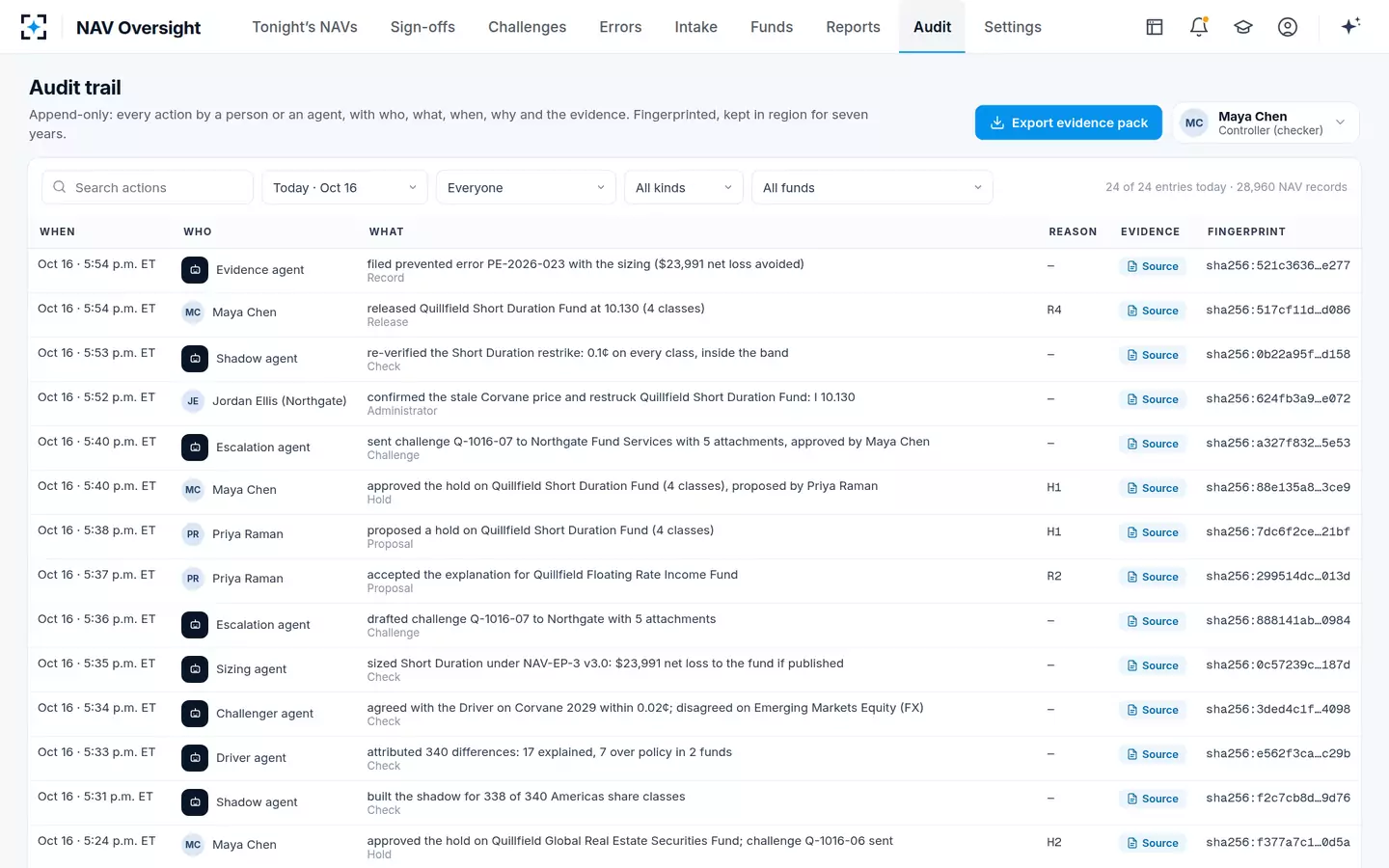
A chat assistant is a fine tool for learning the rules on this page. For deciding whether tonight's NAV goes out, use a tool that reads tonight's files, checks them against sources the administrator did not use, and leaves the decision and the signature with your people. The NAV Oversight page shows that evening from the administrator's files to the board report.
Questions people ask
What should AI fund accounting software be able to do?
Read the administrator's files and the manager's books directly, rebuild or compare each share class, explain each difference with a cited source, apply the fund's own policy, and record every step, while leaving release, challenges and signatures to people. Software that only answers questions about text it is given is a writing aid, not a control.
Is it safe to paste fund data into a public chatbot?
It moves the data outside the firm's controls and leaves no auditable trail, which is why ESMA's 2024 statement extends firms' responsibilities to staff use of third-party AI, with or without management's approval. Use tools that run inside the firm's access controls and keep a record of use.
Are there useful AI courses for fund accountants?
Courses on using AI tools help with drafting and analysis, but no regulator or independent body sets a standard for them. For NAV work the more valuable preparation is the rules a tool must follow, forward pricing, accrual timing, fair value, error thresholds and records, so the user can tell a right answer from a confident one.
How do regulators expect AI output to be recorded?
ESMA expects firms providing investment services to keep records of AI use covering decision-making processes, data sources, algorithms and changes over time. For US registered funds, any schedule supporting a NAV computation must be kept for at least six years from the end of the fiscal year under Rule 31a-2, whoever or whatever prepared it.
What is the difference between AI fund accounting software and a NAV oversight tool?
AI fund accounting software usually helps produce the books and the NAV: booking, reconciling, accruing. A NAV oversight tool checks a NAV someone else produced, from the manager's side, with independent prices and the fund's own policy. A manager whose administrator strikes the NAV needs the second, because the first would duplicate the administrator's work.
What does the SEC call AI in its 2027 examination priorities?
Super intelligence, abbreviated SI. The Division of Examinations' priorities, published on October 23, 2026, say registrants are increasingly incorporating SI into their businesses, and that it will prioritise reviews of policies on monitoring SI, including in back-office operations.