A NAV error correction policy is the fund's written answer, settled before anything goes wrong, to nine questions: how large an error in the net asset value must be before it is corrected, whether small errors add up, who is made whole, how the loss is calculated, which payments are too small to make, who pays, who signs, who is told, and what is kept as evidence. In the United States no rule writes the policy for you; in Luxembourg, CSSF Circular 24/856 writes much of it; in the UK the FCA's handbook sets the tests a depositary applies. The hard part is not drafting the policy but applying it on the day, under time pressure, to a NAV the fund administrator struck. Botminds' NAV Oversight reads each fund's approved policy as settings, sizes every break against it before the cut-off and drafts the correction for the people who sign it.
The examples on this page come from the solution's fictional sample book, Quillfield Funds Trust, whose NAVs are struck by a fictional administrator, Northgate Fund Services.
Nine decisions a NAV error correction policy has to take before the error
- The threshold
Per share, per cent of NAV, or both; measured on the published, rounded price or on the unrounded one.
- Aggregation and scope
Whether small errors on successive days add up, and whether one line covers every share class of a fund.
- Who is made whole
The fund only, or redeemers and subscribers too, and above what size each is paid.
- The calculation method
Compound or simple, how flows through intermediaries are traced, and whether interest is added.
- The de minimis
The amount below which a shareholder is not paid, and the reason that amount was chosen.
- Who pays
The party that caused the error, under which contract clause, and never the fund's other investors.
- Who signs
Who prepares, who reviews, who signs, and which sizes need a second approval.
- Who is told, and when
The board, the regulator, the depositary or auditor, and the clock for each.
- The evidence file
The corrected NAVs, the transaction-level working and the decisions, kept for the period the law sets.
What is a NAV error correction policy, and why does a board approve one?
A NAV error correction policy is part of the fund's compliance program, and in the US that program is a board matter. Rule 38a-1 requires each registered fund to adopt written policies that provide for overseeing the compliance of each investment adviser, the principal underwriter, the administrator and the transfer agent, and to review them “no less frequently than annually”. A NAV is computed by the administrator, priced by the adviser's valuation process and used by the transfer agent to process every purchase and redemption, so a correction policy touches three of the four service providers the rule names.
The policy also answers to Rule 22c-1, which requires every sale and redemption to be made at a price based on the current NAV. When that price was wrong, the policy is how the fund puts the transactions right. The SEC treats the two together: in its 2016 order against Calvert Investment Management, the adviser was found to have caused its funds to violate both Rule 22c-1 and Rule 38a-1.
“Although the Calvert Funds had NAV error correction procedures designed to make the shareholders and the funds whole when a material change to the NAV occurred, the firm failed fully to implement them.”
SEC order, In re Calvert Investment Management, Inc., October 18, 2016
That sentence is why this guide treats each clause as a decision rather than a statement of intent. Calvert's funds held mispriced bonds from March 2008 to October 2011. The adviser contributed $27 million to make investors whole, partly on an estimate, and the order then required it to recompute every day's NAV and every account's transactions over three and a half years. A policy that cannot be applied, quickly and to the account, is the policy an examiner reads against you.
Clause 1: what threshold makes a NAV error material?
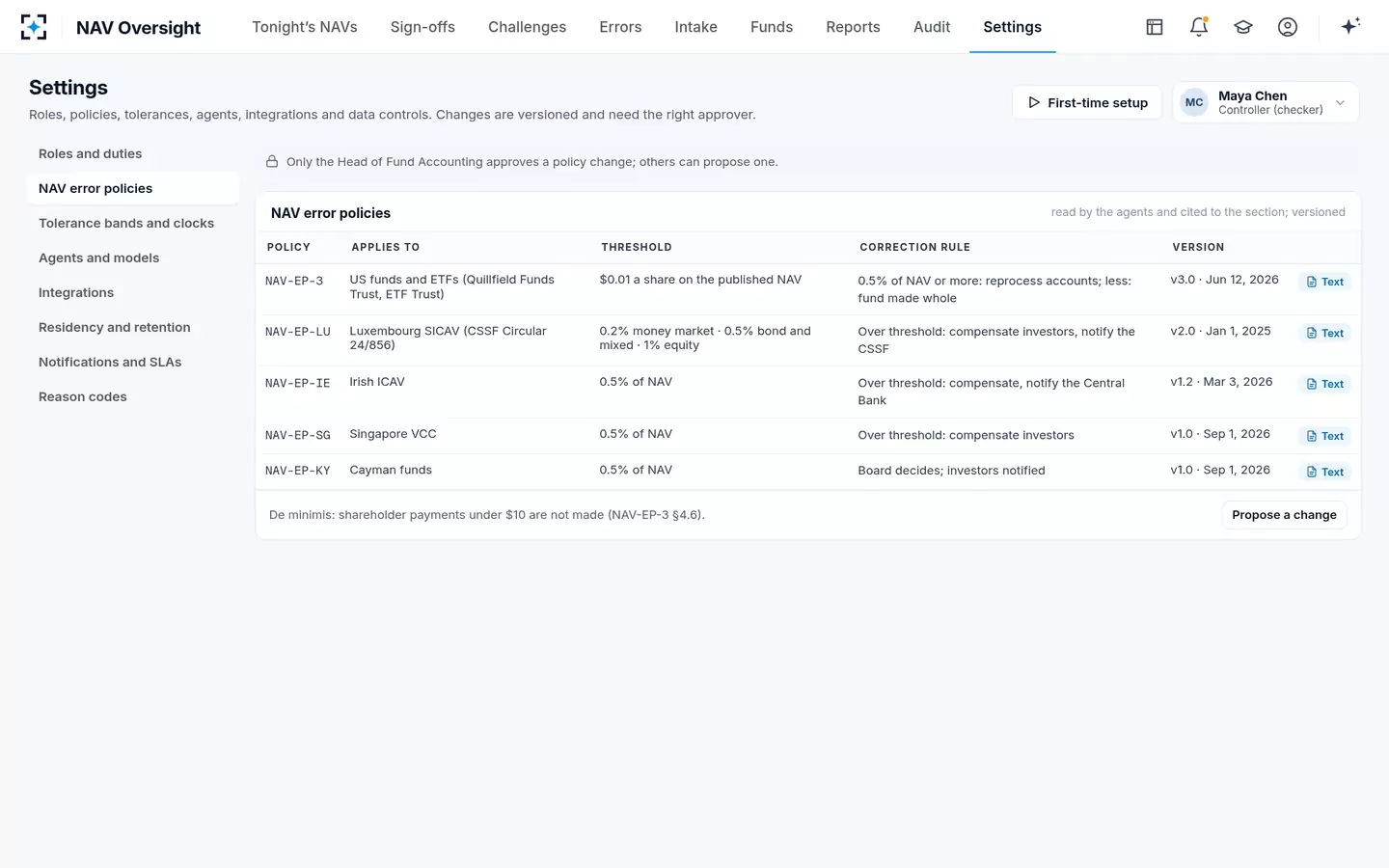
The threshold clause says how large an error must be before the fund corrects past transactions. In the US the common line is one cent a share or 0.5% of NAV, an industry convention the SEC said, in its Rule 2a-5 adopting release (January 2021), it would not be unreasonable to rely on for prompt board reporting; it did not make the convention a rule. Luxembourg fixes thresholds by fund type, and the UK lets a depositary treat an error under 0.5% of the price as minimal. The three regulators' lines are compared in full in a separate guide; the policy's job is to pick one and say how it is measured.
The measurement detail matters more than the number. A NAV per share is struck to more decimals than it is published. In the solution's sample, the administrator struck class I of a short-duration bond fund at 10.142 and the controller's independent NAV said 10.129: a gap of 1.3 cents unrounded. Published to two decimals, 10.14 against a correct 10.13, the error is one cent, and on class C, where the rounding fell the other way, two cents. A policy that says “$0.01 a share” without saying “on the published NAV” leaves the controller to decide which of those numbers counts.
The clause should also say what happens when a per-share line and a percentage line disagree. On a $10 share, one cent is 0.1% of NAV; on a $100 share it is 0.01%. A fund that uses both must say whether either one triggers correction, or only both together, and must apply the same reading every time.
Clause 2: do small errors add up, and does one line cover every share class?
Yes, if the policy says so, and in Luxembourg it must. CSSF Circular 24/856 treats as significant not only a single large error but “simultaneous or successive calculation errors which have not been treated and were each below the tolerance threshold and which, if considered on an aggregate basis, reach or exceed that threshold.” Three days of an accrual booked short, each under the line, can together cross it.
The same circular settles the share-class question. For an umbrella fund the threshold is set per sub-fund: “Where there are several classes or categories of units within one sub-fund, a single tolerance threshold must be applied to all classes or categories.” The FCA takes a different view of time: where incorrect pricing “exists over a period of time, each price should be considered separately”. A policy for a fund range that spans both regimes needs both rules written down, fund by fund, or the controller will apply whichever one she remembers.
Clause 3: who is made whole — the fund, the redeemers or the subscribers?
Every NAV error has two sets of victims, and which set depends on the direction. When the NAV is overstated, redeemers are paid too much, at the expense of the shareholders who stay, and subscribers pay too much for their shares. When it is understated, redeemers are paid too little and subscribers buy too cheaply, diluting everyone else. The policy decides whether the fund alone is restored, or the individual shareholders as well.
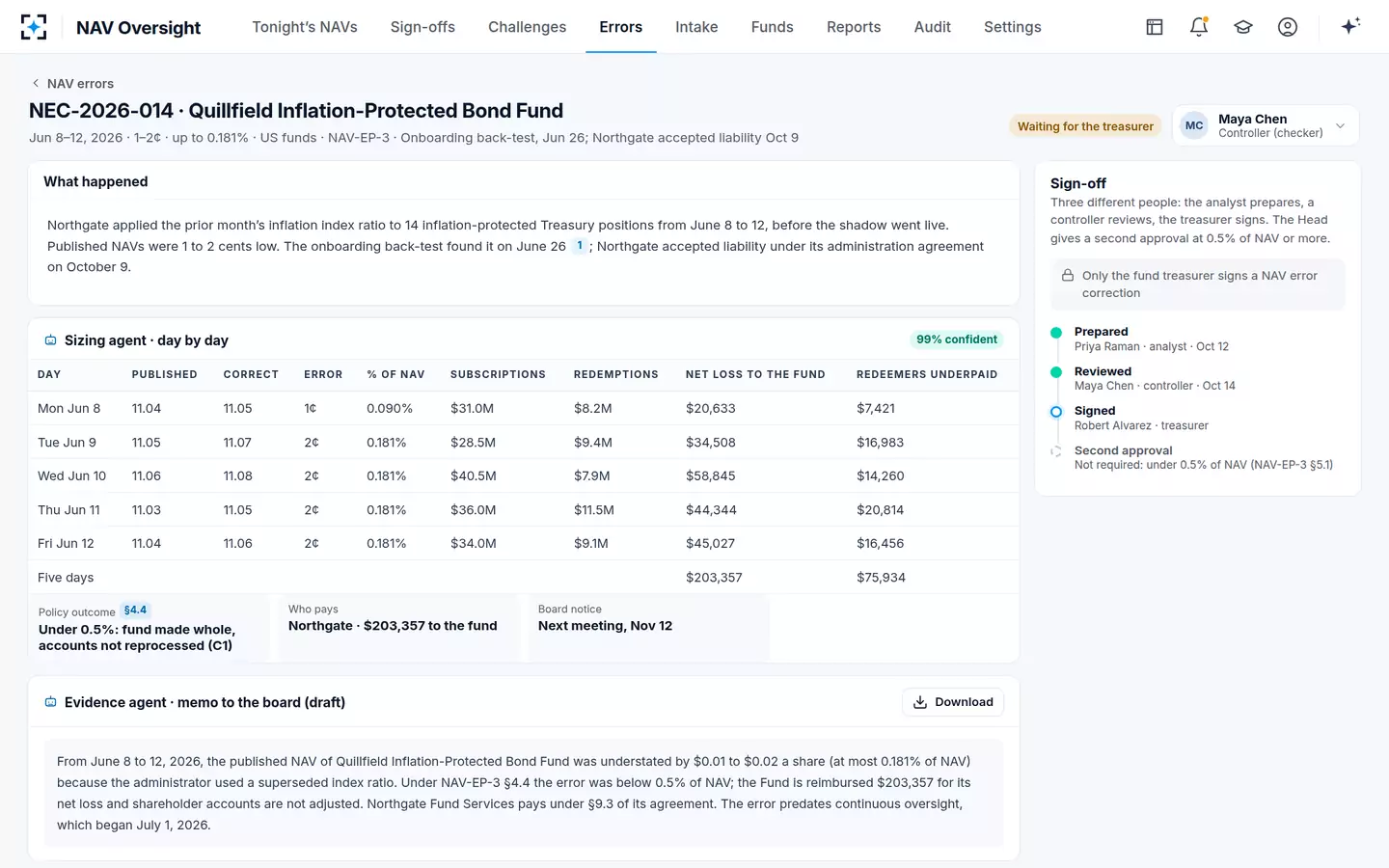
A common US design, and the one the solution's sample policy uses, makes the fund whole for its net loss below 0.5% of NAV and reprocesses shareholder accounts above it. Applied to a real error, that choice has a visible cost. In the solution's sample error case, a fund's NAV was published one to two cents low for five days in June because the administrator used the prior month's inflation index ratio. The fund lost $203,357 net, which the administrator repays. Redeemers were underpaid $75,934 over the same five days, and under that policy they are not paid, because the error never reached 0.5%.
One sample error, two groups of people, two outcomes under the same policy
Who lost money in the sample error · $279,291
- The fund, repaid · $203,357 · 73%
- Redeemers, not repaid · $75,934 · 27%
Neither outcome is wrong. It is a choice, and the board should make it knowingly. Luxembourg makes part of it for you: below the tolerance threshold compensation is not compulsory, and above it both the fund and the affected investors are compensated. On recovering money from investors who gained, the CSSF draws a line by investor type: “For investors that are not well-informed/professional investors, it is, in principle, not appropriate to request from the latter the reimbursement of the amounts unduly perceived.” The FCA notes that recovery “may not be practicable, or in some cases legally permissible”.
Clause 4: how is the loss calculated — compound or not, and through which accounts?
The method clause names the arithmetic. The CSSF recognises two: a compound method, which corrects each day's NAV for the knock-on effect of earlier days' purchases and redemptions at the wrong price, and a non-compound method, which does not. The circular requires the method to be set out in the fund's own procedures, with the circumstances for each if both are allowed. The NAV impact calculation works the formula through on one day's flows.
The harder part of the method is reach: whose transactions are recomputed. Most shareholders buy through intermediaries, so the fund sees one net order where there were hundreds of investors. Calvert's first remediation stopped at that layer. Its process “was based on a netting out of subscription and redemption activity at the intermediary account level,” and the SEC found that this “methodology failed precisely to measure the harm to each underlying shareholder and likely understated the impact of the improper valuation.” A shareholder who bought through a platform could receive a different amount from one who made the identical trade directly. The CSSF now requires funds to trace the intermediation chain, or at least hand the intermediaries the data they need to pay their clients.
Do shareholders owed less than $10 get paid? Clause 5, the de minimis
Usually not, if the policy has a de minimis, but the amount needs a reason. The CSSF explains the purpose: the de minimis “aims to avoid that investors that are entitled to very low compensation amounts end up with no benefit because of the bank charges and other fees they have to bear for the payments by bank transfer.” It must be set per fund, or per sub-fund, by reference to those charges, and the justification must sit in the fund's procedures.
Two limits come with it. The de minimis protects small payments to investors, never the fund: “For compensation to be paid out to the UCI, the de minimis rule is not applicable,” and every amount owed to the fund is paid unless it is less than one monetary unit. And it can be avoided altogether for investors who still hold shares, by allocating additional units instead of sending money. The FCA reaches a similar place in fewer words: sums “reasonably considered by the authorised fund manager and depositary to be immaterial, need not normally be paid.”
The SEC's Calvert order shows a US variant. Shareholders due less than $10 were not paid, but the money was not kept either: the total of those small amounts was redistributed, $10 at a time, to the accounts with the largest provisional payments below $10, until it ran out. A policy that sets a de minimis should say what happens to the money it leaves behind.
The fund's policies as settings: thresholds, correction rules, versions and the de minimis
Clause 6: who pays for the correction?
The party that caused the error pays, and the fund's other investors never do. The CSSF states the principle plainly: “the party having caused an error/non-compliance entailing a loss as a result of non-compliance with the obligations applicable to them, must ensure remediation.” It extends the rule to the cost of the clean-up: “The fees resulting from the corrective actions of an error/non-compliance must not be borne by the UCI and must thus not be withdrawn from its assets,” including staff time, legal advice and the auditor's special report.
In practice the clause points to contracts. If the administrator used a superseded index ratio, the administration agreement decides whether it pays and up to what cap; if the adviser's valuation was wrong, the advisory agreement and the adviser's own balance sheet are in play. In the sample case above, the fictional administrator accepted liability under a named section of its agreement. The policy should list which agreements carry an indemnity, so that the controller sizing the error knows on the day who will be asked to pay.
Who signs a NAV error correction? Clause 7, roles and second approvals
No US rule names the signatory; the policy must. The clause should separate three roles: the person who prepares the sizing, the person who reviews it, and the officer who signs on the fund's behalf, usually the treasurer or principal financial officer. Larger errors deserve a second approval. In the solution's sample, an analyst prepares, a controller reviews, the fund treasurer signs with a stated meaning of the signature, and any error of 0.5% of NAV or more also needs the Head of Fund Accounting.
Luxembourg assigns the drafting to the administrator and the approval to the fund. Under the circular, the administrator, “in cooperation with the other stakeholders, must draw up a remediation plan to be approved by the UCI or its IFM, where applicable, and implement the related corrective measures”. The policy that works in both places writes the roles as people, not job families, and names a deputy for each.
The same nine clauses, read against three rulebooks
| Clause | United States | Luxembourg (CSSF 24/856) | United Kingdom (FCA COLL 6.3) |
|---|---|---|---|
| Threshold | Policy choice; $0.01 or 0.5% of NAV is the convention the SEC called not unreasonable to rely on | 0.20% money market, 0.50% bond and mixed, 1.00% equity UCITS; others by documented analysis | Under 0.5% of the correct price may be of minimal significance, if controls meet the standard |
| Aggregation | Policy choice | Successive sub-threshold errors count when together they reach the line | Each price considered separately |
| Who is made whole | Policy choice: fund only, or accounts reprocessed | Above the threshold, the fund and the affected investors | Unitholders, former unitholders and the fund, unless minimal |
| Method | Policy choice | Compound or non-compound, fixed in the fund's procedures | Not prescribed |
| De minimis | Policy choice | Allowed for investors, justified by bank charges; never for the fund | Immaterial individual sums need not normally be paid |
| Who pays | Contract and fault | The party that caused it; correction costs never charged to the fund | The manager reimburses, unless the depositary considers the error minimal or payment inappropriate |
| Who is told | Board: valuation designee within five business days of a material NAV error | CSSF, depositary, administrator and manager; notification form | The manager records each instance and tells the depositary; the depositary tells the FCA at 0.5% or more if it thinks payment inappropriate, and files a quarterly return |
Clause 8: what the board, the regulator and the auditor hear, and when
The reporting clause sets clocks. In the US, Rule 2a-5 requires the valuation designee to tell the board of material errors in the calculation of NAV within a period the board sets, and no later than five business days after it becomes aware of the matter; the board can shorten that. Rule 38a-1 adds the chief compliance officer's annual written report, which must cover each material compliance matter, and a NAV error the policy failed to catch is a likely one. What happens after a published NAV turns out wrong follows those clocks day by day.
The UK clause is the depositary's. The FCA expects a depositary to record each instance of incorrect pricing and to “make a return to the FCA on a quarterly basis which summarises the number of instances of incorrect pricing during a particular period.” In Luxembourg, every significant error goes to the CSSF on its notification form, and the fund's approved statutory auditor reviews the case. Each regime counts errors, so the policy should also say who keeps the count.
Clause 9: what goes in the evidence file, and for how long
The evidence clause is what lets the board, the auditor and an examiner check the correction without rebuilding it. For registered funds, Rule 31a-2 requires at least six years' retention, counted from the end of the fiscal year, of “all schedules evidencing and supporting each computation of net asset value”, and a correction recomputes many NAVs at once. The file should hold the corrected NAV for every day of the error period, the transaction-level working, the policy version applied, the approvals with their dates, and the payments made.
The file is also the answer to the question Calvert could not answer: whether the remediation followed the procedures. A sizing with every figure tied to its source can be re-performed by a reviewer; a spreadsheet with a pasted total cannot.
A past error, sized day by day under the policy, with the three sign-offs
How do you write a policy that can be applied before the cut-off?
Write every clause so that a second person, reading only the policy and the day's data, would reach the same answer. That means numbers instead of adjectives (“one cent on the published NAV”, not “material”), named roles instead of departments, and a worked example for each direction of error. It also means a version number and an effective date, and a sentence saying which version governs an error that began under one version and was found under the next.
It helps to test the draft on history before the board approves it. Take last year's NAV breaks, apply the draft clause by clause, and see which cases it cannot decide. Most gaps show up in three places: errors that straddle a policy change, errors in one share class only, and errors where the cause is still disputed with the administrator.
What the sample policy decided on one evening, before publication
1.3¢
gap between the administrator's class I NAV and the independent NAV, unrounded
1–2¢
error on the published NAVs after rounding, across four share classes
$23,991
net loss to the fund had the NAVs gone out as struck
14min
the NAV was held before a restruck NAV was released
That is where NAV Oversight sits in the policy's life. The agents read the approved policy, cite its sections, and size each break against it before the NAV is released, so most clauses are exercised on errors that never reach shareholders. They never change a threshold, decide compensation or sign; a change to the policy goes to the Head of Fund Accounting as a new version. Why the checking agent is never the one that built the figure covers the separation behind that, and the NAV Oversight solution page shows the whole evening.
Questions people ask
Is a mutual fund required to have a NAV error correction policy?
No US rule names one, but Rule 38a-1 requires written policies reasonably designed to prevent violations of the securities laws, and Rule 22c-1 requires transactions at the current NAV. Funds therefore keep a correction policy inside the compliance program the board approves and reviews at least annually. In Luxembourg, CSSF Circular 24/856 requires documented thresholds and correction procedures for the funds it covers.
What is the difference between a NAV error policy and a valuation policy?
A valuation policy decides how each holding is priced; a NAV error policy decides what happens when the resulting NAV was wrong. They meet when a mispriced holding causes the error, as in the Calvert case, where the SEC found failures to implement both. The valuation designee's duties under Rule 2a-5 sit with the valuation policy.
What are the common NAV error correction methods?
There are two families: make the fund whole for its net loss, or reprocess each affected shareholder account at the corrected NAV, often with the second used only above a size threshold. Within reprocessing, the CSSF recognises a compound method, which carries the effect of each day's flows into the next day's corrected NAV, and a non-compound method, which does not. The policy must say which applies and when.
Who should sign a NAV error correction?
The fund's principal financial officer, usually the treasurer, after an analyst has prepared the sizing and a controller has reviewed it. Larger errors warrant a second approval from the head of fund accounting or a valuation committee. The point of the separation is that nobody signs a correction they calculated.
How often should a NAV error correction policy be reviewed?
At least annually in the US, as part of the Rule 38a-1 review of the fund's compliance policies, and whenever a rule changes. Luxembourg funds had to move to CSSF Circular 24/856 for errors detected from January 1, 2025, which replaced Circular 02/77. Keep the old version: the CSSF applied the old circular to errors detected before that date, so which text governs depends on dates the policy should define.
Can a fund recover money from shareholders who benefited from a NAV error?
Rarely. The CSSF considers it, in principle, not appropriate for investors who are not professional or well-informed, and the FCA notes that recovery may not be practicable or legally permissible. The fund is usually made whole by the party that caused the error instead.