A NAV impact calculation measures what a NAV error cost: for each share class and each day the wrong NAV was used, the error per share multiplied by the shares redeemed gives what redeemers were overpaid or underpaid, the same error multiplied by the shares issued gives what subscribers lost or gained, and the difference is the net loss or gain to the fund. A one-cent error therefore costs nothing on a day with no dealing and tens of thousands of dollars on a day of heavy redemptions, and if it runs for weeks, or is corrected badly, it can end in an enforcement order. The calculation matters to chief financial officers and audit committees because it is the honest way to price the case for checking NAVs before they go out. Botminds' NAV Oversight runs it for every break before publication, under the fund's own policy, so the controller deciding whether to hold a NAV sees what releasing it would cost.
The cost cascade: what the same error costs at each stage it reaches
1Caught before release
The NAV is held, the administrator restrikes, the corrected NAV is published.
Who paysNobody pays; the cost is minutes before the cut-off.
Example$0
2Published, under the threshold
Fix the source; the fund may be made whole for its net loss, shareholder accounts are not reprocessed.
Who paysThe party that caused it, if the policy makes the fund whole.
ExampleNet loss to the fund
3Published, over the threshold
Rebuild every NAV in the error period, reprocess accounts, pay the fund and the investors who lost.
Who paysThe party that caused it, plus the correction's own cost.
ExampleGross harm, account by account
4Reported outward
Board notice; in Luxembourg a CSSF notification and, above EUR 50,000, an auditor's special report.
Who paysNever the fund: correction costs stay with the responsible party.
ExampleStaff, advisers, auditor
5Corrected wrongly, or late
An examiner finds the remediation did not follow the procedures, or the cause was known.
Who paysThe adviser: remediation redone, plus a civil penalty.
Example$27M paid, then a $3.9M penalty (Calvert)
The figures on this page that are not from regulators come from NAV Oversight's fictional sample book: Quillfield Funds Trust and its fictional administrator, Northgate Fund Services.
How do you calculate the impact of a NAV error?
Measure the error per share on the price actually used, then apply it to the dealing that used it. If the published NAV was too high, every redeeming shareholder received the error on each share redeemed, paid out of the fund, and every subscriber paid it on each share bought, a gain to the fund. If the NAV was too low, the signs reverse. The fund's net loss is the error multiplied by the net shares redeemed that day.
The NAV impact formula: what the fund gains and loses on one class, one day
Overpaid by subscribers
e × shares subscribed
A gain to the fund when the NAV used was too high; a loss when it was too low
Owed to subscribers above the reprocessing line
Overpaid to redeemers
e × shares redeemed
A loss to the fund when the NAV used was too high; a gain when it was too low
Rarely recovered from redeemers
Two details change the answer more than people expect. First, the error is measured on the published price after rounding: a NAV struck at 10.142 when the correct figure is 10.129 is published at 10.14 against a correct 10.13, a one-cent error, but a class struck at 10.137 against 10.124 rounds to a two-cent error. Second, the fund's share count moves during the error period; a calculation that uses the opening share count for every day understates the impact on a fund in heavy outflows.
Why the day's flows matter more than the size of the error
Because the error only costs money when someone trades at it. A fund with 268 million shares outstanding whose NAV is one cent too high has misstated its total net assets by about $2.7 million, but if nobody redeemed or subscribed that day, nobody was paid the wrong amount and the next correct NAV puts the books right. The same cent on a day with five million shares of net redemptions costs the fund $50,000.
That is why the materiality convention and the cost of an error are different questions. One cent a share may be over a fund's threshold and still cost almost nothing; a half-cent error under the threshold may cost more on a day of heavy flows than a two-cent error on a quiet one. A CFO sizing the value of checking NAVs before release should look at flows on the days errors happened, not only at error sizes.
A worked NAV impact calculation: one sample day, four share classes
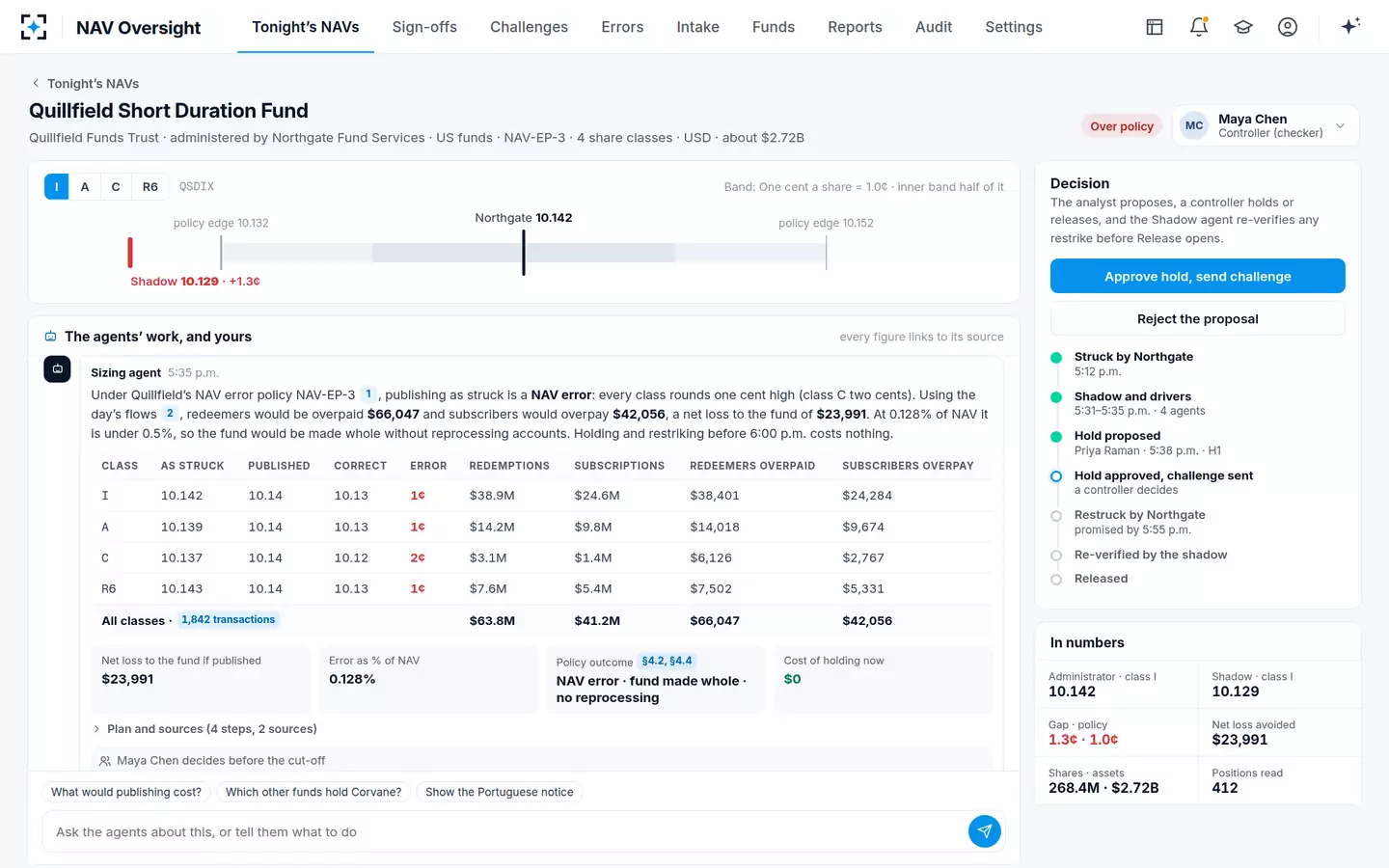
Take the solution's sample evening of October 16, 2026. The administrator struck a short duration bond fund about 1.3 cents a share too high because one bond's price had been left unchanged for five business days while its market fell. Published as struck, every class would have rounded one cent high, class C two cents. The day's dealing was 1,842 transactions.
What publishing the sample NAV as struck would have cost, class by class
| Class | Published vs correct | Error | Redemptions | Subscriptions | Redeemers overpaid | Subscribers overpay |
|---|---|---|---|---|---|---|
| I | 10.14 vs 10.13 | 1¢ | $38.9M | $24.6M | $38,401 | $24,284 |
| A | 10.14 vs 10.13 | 1¢ | $14.2M | $9.8M | $14,018 | $9,674 |
| C | 10.14 vs 10.12 | 2¢ | $3.1M | $1.4M | $6,126 | $2,767 |
| R6 | 10.14 vs 10.13 | 1¢ | $7.6M | $5.4M | $7,502 | $5,331 |
| All classes | $63.8M | $41.2M | $66,047 | $42,056 |
Under the sample fund's policy, which corrects US funds at one cent a share and reprocesses accounts only at 0.5% of NAV or more, publishing would have been a NAV error: the fund would have been made whole for $23,991 and individual accounts left as they were. Holding the NAV and getting a restrike before the 6:00 p.m. cut-off cost nothing. That comparison, $23,991 against $0, is the one the controller saw before deciding.
The sizing a controller sees before deciding to hold
Is the net loss to the fund the whole cost?
No. The net loss is what the fund is owed, but the harm to people is the gross figure. In the sample, redeemers would have been overpaid $66,047, all of it at the expense of the shareholders who stayed, and subscribers would have overpaid $42,056. The fund's net loss of $23,991 nets one group's loss against the other's gain, and if the policy only makes the fund whole, the subscribers' $42,056 is never returned to them.
Gross harm and net loss are different numbers
Gross amounts paid at the wrong price · $108,103
- Redeemers overpaid · $66,047 · 61%
- Subscribers overpaid · $42,056 · 39%
What making the fund whole repays · $23,991
- Net loss to the fund · 22%
- Not repaid to anyone under the policy · 78%
That gap is the reason correction policies have a reprocessing line, and the reason it matters where the line sits. Luxembourg's answer, above its tolerance threshold, is to compensate both: the investors who lost and the fund. The CSSF also requires the fund to receive its compensation at once: “It is not acceptable to make the payment of the compensation over time by instalments, nor to deduct the compensation amounts from any future remuneration to which the party responsible for the error/non-compliance could be entitled.”
When an error runs for days: compound or non-compound?
A multi-day error has knock-on effects: shares issued too cheaply on Monday are still in issue on Tuesday, so Tuesday's correct NAV per share is itself lower than it would have been. The CSSF names the two ways to handle that. Under the compound method each NAV in the period is corrected “by the indirect effect related to the cumulative subscriptions/redemptions made at an erroneous NAV during the period of significant NAV calculation error” as well as by the direct effect; the non-compound method ignores the knock-on. The method must be set in the fund's procedures, with the circumstances for each if both are allowed.
For a short error the two methods give nearly the same answer. For a long one they diverge, and so do other effects: the fund's investment return on cash it should or should not have had, and asset-based fees charged on the wrong assets. The SEC's Calvert order required both a performance adjustment and a fee adjustment for an error that ran from 2008 to 2011. How a correction is rebuilt after publication walks through each step.
Who pays a NAV error, the adviser or the administrator?
Whoever caused it, under their contract, and never the fund's other investors. The CSSF's principle is that the party that caused a loss through failing its obligations must ensure remediation, and that the correction's own costs, from staff time to the auditor's special report, are not charged to the fund. In practice that points to the administration agreement when the administrator booked something wrongly, and to the adviser when its valuation was wrong.
The cases show both. In the solution's sample correction case, the administrator applied a superseded index ratio and accepted liability for the $203,357 owed to the fund. In Calvert, the adviser's own fair values were wrong, and the adviser paid. In 2023 the SEC fined a fund administrator, Theorem Fund Services, $100,000 for recording a fund's trading losses as a receivable due from the adviser, which kept the fund's NAV from falling, without evaluating whether that was appropriate and despite red flags; investors' statements “materially overstated the value of the investors' investments.”
What does the SEC fine for NAV errors?
The SEC orders in this area are not about an honest error caught and corrected under the fund's procedures; they are about valuation failures, policies not applied and corrections that misled. Two cases frame the range. In Heartland, municipal bonds held by two funds were carried above fair value through 2000, and when they were marked down the order records “approximately $60 million in monetary losses to shareholders”; the adviser and its chief executive were ordered to pay a $3.5 million civil penalty jointly, with smaller penalties for others. In Calvert, the adviser contributed $27 million to its funds and shareholders, partly on an estimate, was ordered to redo the distribution account by account, and paid a $3.9 million penalty.
What three SEC NAV and valuation cases cost, in millions of dollars
Wrong NAVs also cost through fees. An overstated NAV inflates every fee charged on net assets, and the Calvert order put it in one sentence: “In addition, Calvert collected inflated asset-based fees.” A complete impact calculation therefore includes the advisory and administration fees accrued on the wrong assets for the whole error period, and the correction returns them.
How do you size the case for checking NAVs before release?
With your own history, because no regulator or independent study publishes how often NAV errors happen or what they cost across the industry; Form N-CEN does not report error counts. The method is the impact formula, applied backwards to last year's breaks.
Pricing the value of checking before release from your own data
- List last year's breaks
Every NAV the administrator restruck, and every one published and later found wrong, by fund and class.
- Size each one as if published
Error per share on the rounded price times net shares redeemed, using that day's actual dealing.
- Add the gross harm
Redeemers and subscribers overpaid or underpaid, which reprocessing would return.
- Add the correction cost
Staff days, transfer agent reprocessing, intermediary outreach, auditor and legal time.
- Add the days it ran
An error found a week late multiplies every line above by the days of dealing.
- Compare with the cost of the check
People and systems to check every class before the cut-off, and the minutes a hold takes.
The solution's first-time setup does a version of this: a back-test over the last 20 business days of the administrator's NAVs, to find anything already published over policy. In the sample book it found one past error, the five-day inflation-index case above. The quarter that followed, 14 breaks over policy were caught before publication across 21,760 share-class NAVs and none was published over policy. How to test that a NAV check catches what it should is the companion question.
When an error does get out: the correction sized day by day
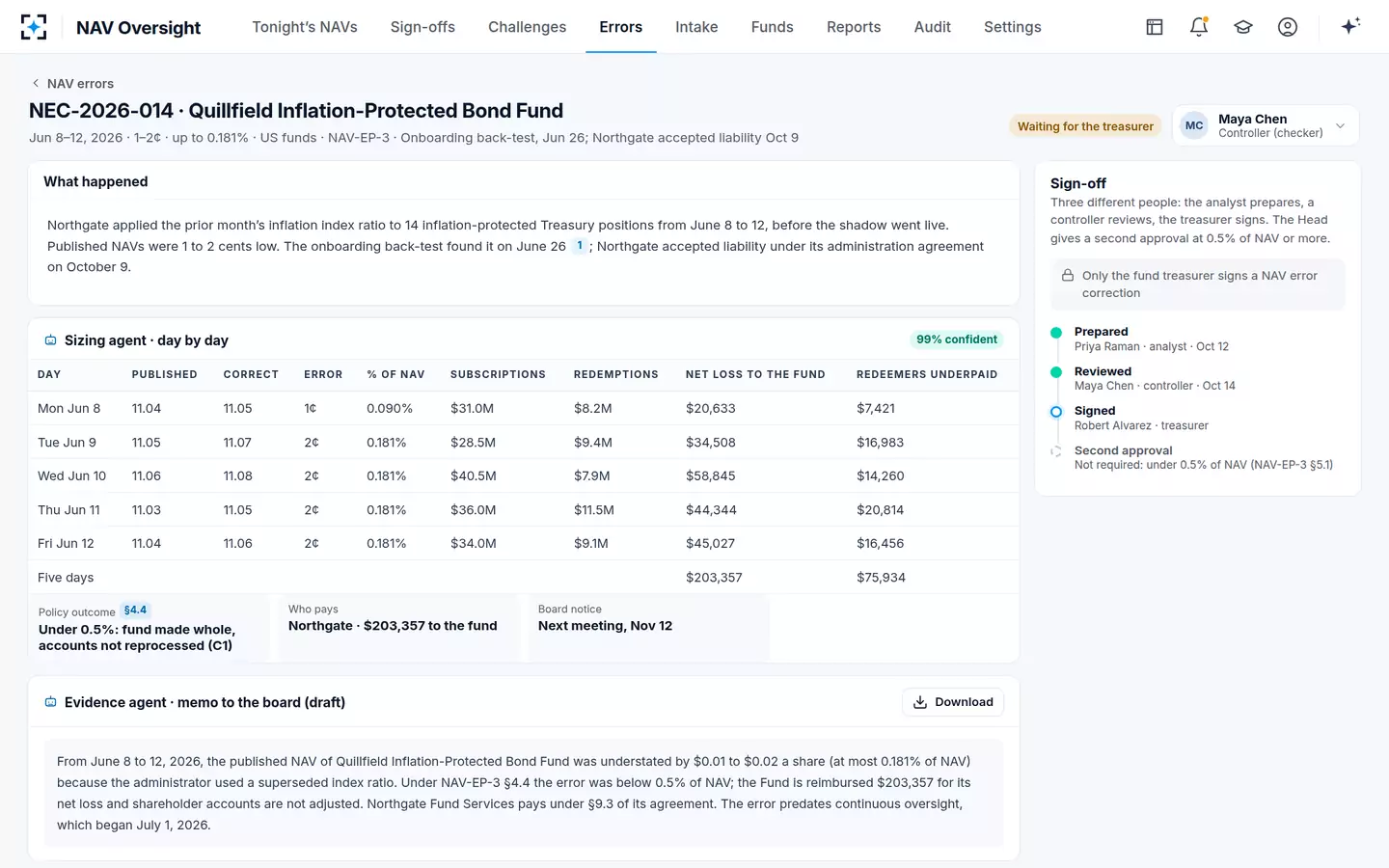
That is the economic argument for NAV Oversight in one comparison: an error held before the cut-off costs minutes, an error published for five days costs a correction case, and an error corrected wrongly costs a regulator's order. The policy clauses that decide who is repaid and the NAV Oversight page show the rest.
Questions people ask
What is the NAV impact formula?
For each class and day: error per share on the price used, multiplied by shares redeemed, gives the redeemers' overpayment or shortfall; multiplied by shares subscribed, the subscribers'. The fund's net loss is the error times net shares redeemed, summed over the error period. Long errors add the compound effect of earlier days' dealing and the fees charged on wrong assets.
How is a NAV error calculated as a percentage?
The error per share divided by the correct NAV per share. In the sample, 1.3 cents on 10.142 is about 0.128%; a one-cent error is 0.1% of a $10 NAV and 0.01% of a $100 one. Luxembourg's thresholds are set in this unit, per cent of NAV.
How is the loss to the fund calculated?
As the error per share times the net shares redeemed at the wrong NAV: an overstated NAV loses money through redemptions, an understated one through subscriptions. It is a net figure, smaller than the gross amounts individual shareholders were overpaid or underpaid.
Does a NAV error change the fees the fund paid?
Yes. Fees accrued on net assets were computed on the wrong figure, so an overstated NAV overcharges advisory and administration fees and the correction should return them. The SEC's Calvert order required a fee adjustment for each day of the error period.
Who pays when the administrator caused the error?
Usually the administrator, under the liability and indemnity clauses of its administration agreement, and never the fund's other investors. The CSSF also bars charging the correction's own costs to the fund. The agreement's caps and exclusions decide how much the administrator bears.