A fund accounting AI agent is software that does part of a fund accountant's work on its own: reading an administrator's NAV files, rebuilding a NAV, explaining why two NAVs differ, sizing an error or drafting a challenge. The design question that decides whether it can be trusted is not how clever it is but who checks it. Fund accounting already runs on maker-checker controls, because the person who built a figure is the worst-placed to find its errors, and an AI agent that checks its own NAV removes the control while appearing to add one. The safe design keeps the separation: one agent builds, a second agent re-checks from independent sources and is allowed to disagree, and a person, who did not propose the decision, holds or releases the NAV. Botminds' NAV Oversight is built that way, with seven agents that propose and people who decide.
Who makes, who checks and who decides, on one NAV in NAV Oversight
Agent
Intake agentCollects the administrator's NAV files and checks each against the delivery calendar and its layout.
Never: Never edits a file or guesses a mapping
Agent
Shadow agentRebuilds every share class from the manager's own books, approved prices and FX.
Never: Never publishes
Agent
Driver agentSplits the gap into price, position, accrual, FX, expense and capital activity, each cited.
Never: Must explain 90% of a gap or say “unexplained”
Agent
Challenger agentRe-checks the main cause from a source the Driver did not use; agrees only within 0.1 cent.
Never: Never overrules the Driver
Agent
Sizing agentApplies the fund's approved NAV error policy to the day's dealing.
Never: Never decides compensation or signs
A person decides
NAV oversight analystProposes a hold or release with a reason code.
A person decides
Fund controllerA different person approves or rejects the proposal; releases only after the restrike is re-verified.
What is a fund accounting AI agent, and what should it never do?
An agent is software given a goal, tools and data, which decides its own next steps toward the goal; in fund accounting the goal might be “explain why tonight's NAV differs from ours”. What it should never do is the part of the job that carries accountability: release a NAV, send a challenge to the administrator, change a price or a tolerance, decide who is compensated, or sign. Those stay with named people because a regulator, a board or an auditor will ask who decided, and the answer cannot be a model.
Between those limits there is a great deal an agent can do, faster than a team: read hundreds of files as they land, rebuild hundreds of share classes, and trace a difference to the line it came from. The design question is how to make that work checkable. In NAV Oversight each agent has a narrow job, cites every figure to its source, states its confidence, and hands to a person when it is below its threshold.
Why independence is the control that makes a NAV check work
Because two people, or two systems, using the same inputs make the same mistakes. Research on mutual fund bond pricing shows how far marks on identical securities can drift apart and why. Cici, Gibson and Merrick studied “the dispersion of month-end valuations placed on identical corporate bonds by different mutual funds” and found patterns consistent with smoothing:
“Funds with ambiguous marking policies and those holding “hard-to-mark” bonds appear more prone to smooth reported returns.”
Cici, Gibson and Merrick, working-paper version of the Journal of Financial Economics article (2011)
A check that re-prices a hard-to-mark bond from the same vendor feed the administrator used will agree with the administrator every time, including on the days both are wrong. The regulators build independence into the rules where it matters most. Rule 22c-1, which permits swing pricing, requires that its administration “must be reasonably segregated from portfolio management of the fund and may not include portfolio managers”. Luxembourg requires fund administrators to staff so that “the four eyes principle (maker/checker) is enforced at all times, taking into account back-up scenarios in case of absences”.
How do you stop an AI agent agreeing with itself?
Give the checker different evidence, a narrow test and the right to disagree. In NAV Oversight the Challenger agent re-checks the Driver agent's main cause from a source the Driver did not use: the secondary price vendor, dealer quotes or a second FX source. It agrees only if its own figure lands within 0.1 cent of the Driver's; otherwise it says it disagrees, with both workings shown, and the item goes to an analyst.
A second agent re-prices the bond without the first agent's source
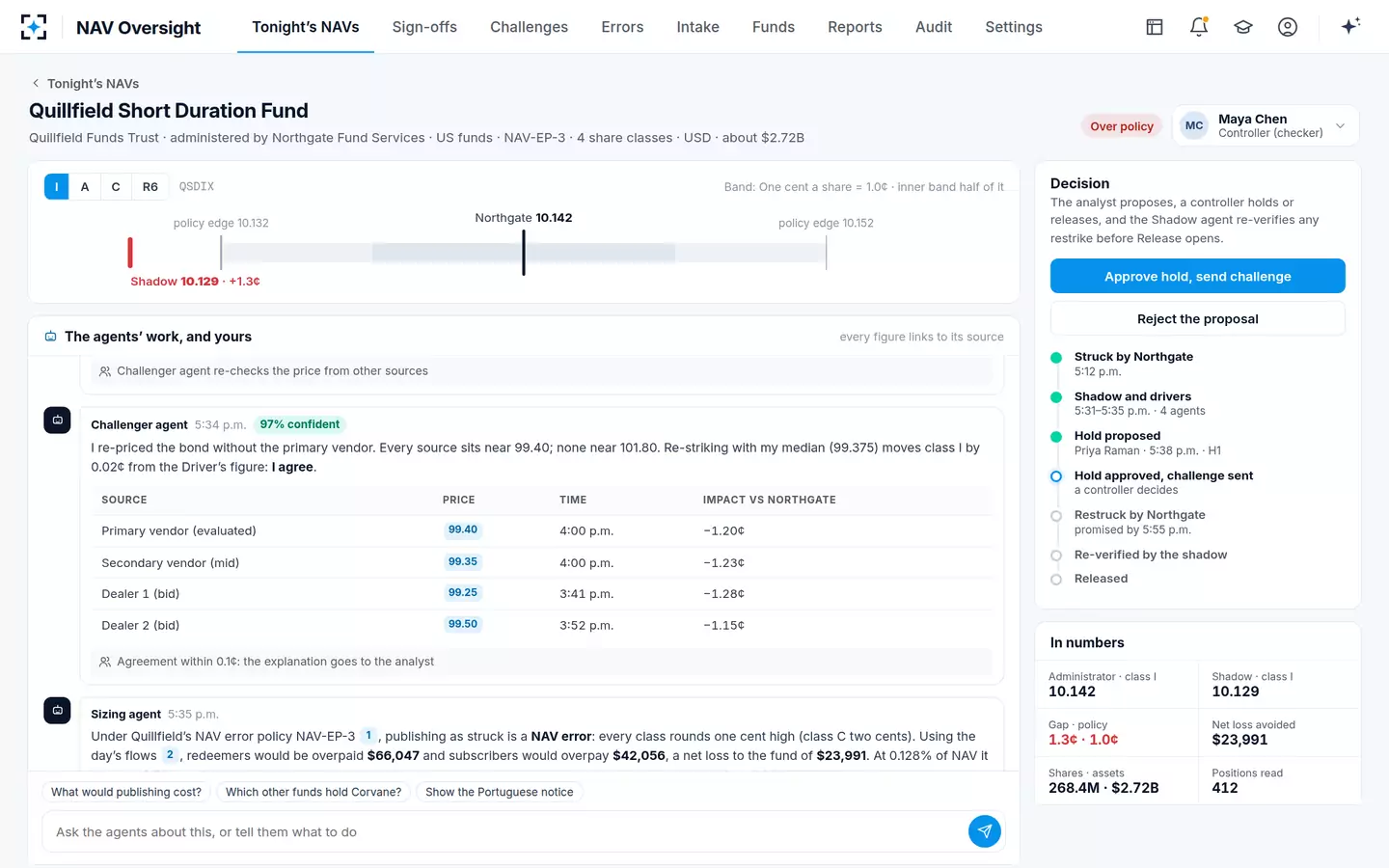
Three design choices do the work. The sources are disjoint, so a shared error cannot pass both checks. The test is numeric and set in advance, so “agreement” cannot drift. And disagreement is a normal output, not a failure, so the agent has no reason to converge on the first answer. A single model asked to “double-check” its own reasoning has none of the three.
When the agents disagree, a person decides
Disagreement is where the separation pays for itself. On the sample evening, an emerging markets equity fund sat 0.7 cents from the administrator, inside its one-cent policy. The Driver agent blamed the administrator's FX rate for the Brazilian real, a London 4:00 p.m. rate of 5.4120, against the 4:00 p.m. ET rate in the manager's books, 5.4385. The Challenger, 71% confident, disagreed: a second ET source said 5.4150, close to the administrator, so the books' rate looked like the outlier, captured during a two-and-a-half-minute spike.
Two workings side by side, and three choices left to a person
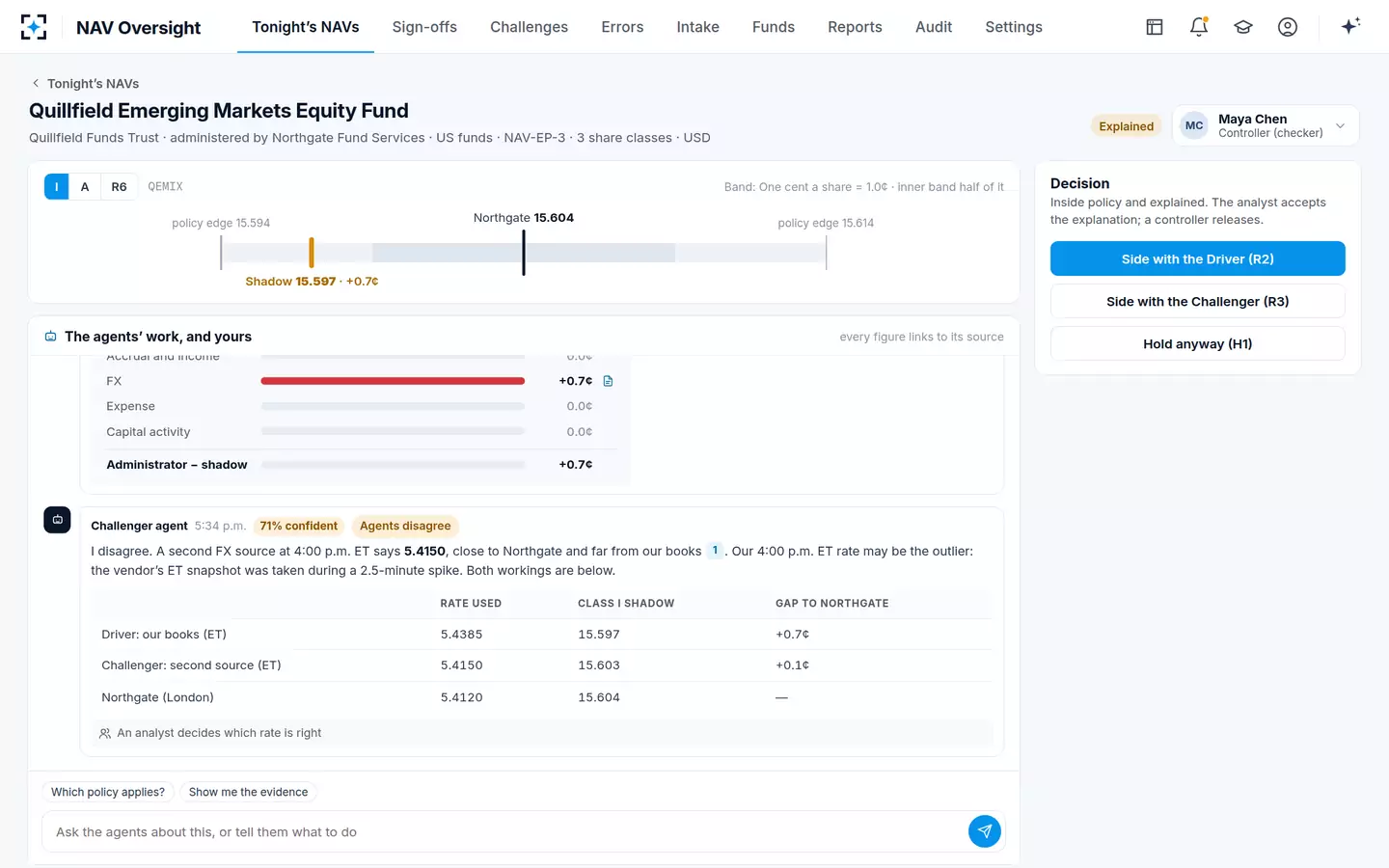
An agent forced to produce one answer would have picked one rate and sounded certain. Here the analyst sees both, chooses, and records why. If the books' FX snapshot really was taken during a spike, the finding belongs in a control change, not only in tonight's release.
Can an AI agent sign off a NAV?
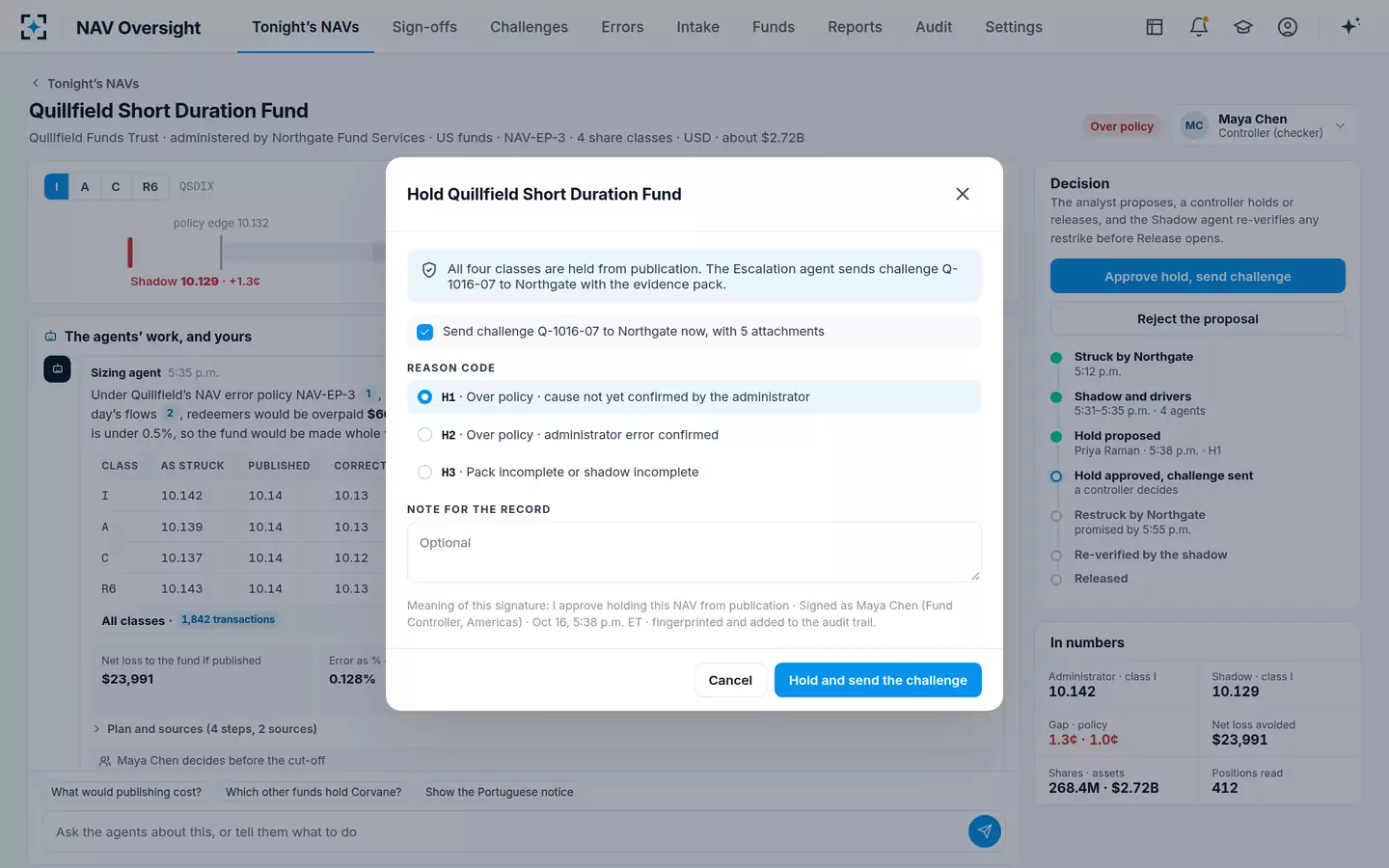
No, and a well-designed one cannot be configured to. Releasing a NAV is a decision a fund's board, auditors and regulators attribute to a person, and the maker-checker principle applies to people too: in NAV Oversight the analyst who proposes a hold or release can never be the controller who approves it, and a NAV error correction needs three different people, the analyst who prepares it, the controller who reviews it and the treasurer who signs, with a second approval from the Head of Fund Accounting at 0.5% of NAV or more.
Relying on a tool without controls around it is itself a finding. The SEC's order against Calvert Investment Management, whose fair values for a set of illiquid bonds came largely from a third-party analytical tool that turned out to be flawed, found the adviser had not ensured its procedures “were reasonably designed to establish appropriate controls related to its reliance on a third-party analytical tool in fair valuing securities.” An AI agent is a tool in exactly that sense, and the controls around it are what an examiner will read.
A person approves the hold, with the meaning of the signature
What regulators expect of AI in the back office
Supervisors are moving from interest to examination. The SEC's Division of Examinations, in its priorities for fiscal year 2027, notes that registrants now use what it calls "super intelligence (SI)" in core operations from investment analysis to code, and that it will prioritise reviews of “policies and procedures relating to monitoring SI, including its use in fraud prevention and detection, back-office operations”. NAV checking is back-office operations.
ESMA's May 2024 statement on AI, addressed to firms providing retail investment services, makes the same point about testing. It expects firms to “establish robust governance structures, conduct regular AI model testing, and monitor AI systems to identify and mitigate potential risks and biases.” Neither text writes rules for fund accounting agents; both tell a buyer what the first examination will ask: what the agent does, how it is monitored, and who is accountable for its output.
Testing the agents: versions, confidence and the word “unexplained”
An agent should be tested like any other control, before it goes live and every time it changes. In NAV Oversight, a change to an agent's model or instructions is run against 1,200 past NAV files and becomes a new version for the Head of Fund Accounting to approve; the thresholds it works to, such as the 90% of a gap the Driver must explain, the 0.1-cent agreement band and the 95% confidence required to map a new field in the administrator's files, are settings with versions of their own.
The most important output an explaining agent can give is “unexplained”. An agent that always finds a cause will, on the hard nights, invent one. Requiring the Driver to account for 90% of a gap or say it cannot, and requiring every driver to be cited to a file, a price record, an issuer notice or a board minute, makes a fabricated explanation visible. How to test a NAV check with planted breaks applies the same discipline to the whole process.
One agent that checks itself, against maker and checker agents
A single agent, self-checking: Re-reads its own inputs; a bad price passes twice.
Separate maker and checker agents: The checker uses sources the maker did not: second vendor, dealer quotes, second FX.
A single agent, self-checking: Agrees with itself by construction.
Separate maker and checker agents: Agrees only within a numeric band set in advance, here 0.1 cent.
A single agent, self-checking: Resolved silently inside one answer.
Separate maker and checker agents: Shown with both workings and handed to a person.
A single agent, self-checking: Always produces a cause.
Separate maker and checker agents: Must explain 90% of a gap or say “unexplained”.
A single agent, self-checking: Often allowed to release or close an item.
Separate maker and checker agents: Never holds, releases, sends, signs or changes a price or tolerance.
A single agent, self-checking: Model updates go live with the vendor's release.
Separate maker and checker agents: Each change is tested on past NAV files and approved as a new version.
What to ask before buying a fund accounting AI agent
Ask questions that a demonstration cannot answer by itself. A vendor can show an agent explaining a break; the questions below show whether it can be relied on when nobody is watching, and whether it leaves the fund's controls stronger or weaker.
Ten questions for any fund accounting AI agent
- Who checks the agent's figure?
A second agent with different sources, a person, or nobody.
- Which sources may the checker not use?
If the answer is none, the check is not independent.
- What does it do when it is unsure?
It should say so, with a threshold you can see and change through approval.
- Is every figure cited?
To the administrator's file and line, the price record, the policy section or the notice.
- What can it never do?
Release, send, sign, change prices or tolerances: these should be impossible, not discouraged.
- Can one person propose and approve?
The workflow should prevent it.
- How is a model change tested?
On your past NAV files, before it goes live, as a version you approve.
- What does the trail keep?
Who or what did each step, when, why, and on what evidence, for as long as your records rules require.
- Does it work beside your administrator?
From the files the administrator already sends, without replacing its books.
- What will it not do?
An honest vendor names it: fair value models, compensation decisions, the administrator's own reconciliations.
Where an AI agent fits in fund accounting, and where it does not
It fits where the work is high-volume, rule-bound and checkable: comparing every share class with an independent NAV, tracing differences to their source, applying a written policy to the day's dealing, drafting a challenge with its evidence, and keeping the trail. It does not fit where the work is judgement the fund has assigned to a person or a committee: setting fair values for hard-to-value holdings, deciding compensation, approving policy changes, or accepting the administrator's explanation of a dispute.
NAV Oversight stays on the first side of that line. It does not replace the administrator, which still keeps the books and strikes the NAV, or the valuation designee, which still owns fair value. Why a general chat assistant cannot do this job covers the other common question from buyers, and the NAV Oversight page shows all seven agents at work on one evening.
Questions people ask
How is AI used in fund accounting today?
Mostly to read and compare: extracting data from administrator and custodian files, reconciling, explaining differences and drafting reports, with people approving the results. The SEC's 2027 examination priorities name back-office operations among the uses of what it calls super intelligence that it will review.
What is an AI agent for accounting, as opposed to accounting software with AI features?
An agent pursues a goal across several steps, choosing its own next action and using tools, such as reading a file, querying a price source or drafting a message. Software with AI features answers one request at a time inside a fixed workflow. The more an agent can do by itself, the more its limits need to be enforced by the system rather than by instruction.
Can an AI agent sign off a NAV?
It should not be able to. Releasing a NAV and signing a correction are decisions boards and regulators attribute to named people. In NAV Oversight the agents never hold, release, send, sign or change a price or tolerance, and the person who approves is never the one who proposed.
What happens when the agent is not confident?
It says so and hands the item to a person instead of guessing. In NAV Oversight the Driver agent must explain at least 90% of a gap or report it as unexplained, and a proposed mapping for a new field in the administrator's files waits for the operations administrator to confirm it.
Do AI agents replace the fund administrator?
No. The administrator keeps the books, reconciles and strikes the NAV under its agreement and, in Luxembourg, under CSSF Circular 22/811. Oversight agents check the administrator's output from the manager's side, using the files the administrator already sends.