A NAV error materiality threshold is the size of error in a fund's net asset value at or above which the fund must correct the transactions struck at the wrong price, and it is set differently in each of the three main fund domiciles. In the US, funds rely on an industry convention of $0.01 a share or 0.5% of NAV, which the SEC declined to write into a rule but said it would not be unreasonable to rely on when deciding which errors to report promptly to the board. In the UK, the FCA lets a depositary treat an error below 0.5% of a unit's correct price as of minimal significance, price by price. In Luxembourg, CSSF Circular 24/856 sets 0.20% of NAV for money market funds, 0.50% for bond and mixed funds and 1.00% for equity funds, for errors detected from January 1, 2025. A manager running funds in all three must test each fund against its own line, every day, which is what Botminds' NAV Oversight does before the administrator's NAV is published.
Three regulators, three NAV error lines
| United States (SEC) | United Kingdom (FCA) | Luxembourg (CSSF) | |
|---|---|---|---|
| Source | Industry convention noted in the Rule 2a-5 adopting release, 86 FR 748 (January 2021) | COLL 6.3.6G guidance, with the rectification rule in COLL 6.6.3R | Circular CSSF 24/856, in force for errors detected from January 1, 2025 |
| Line | $0.01 a share or 0.5% of NAV | Under 0.5% of the correct price of a unit may be of minimal significance | 0.20% money market · 0.50% bond and mixed · 1.00% equity and other assets (UCITS) |
| Status | Not a rule; relying on it “would not be unreasonable” | Guidance to the depositary, conditional on control standards | Guidelines the CSSF expects funds to follow; lower lines allowed, higher ones only by documented analysis where the circular permits |
| Measured on | Per share, or per cent of NAV | Per cent of each unit price, each price separately | Per cent of NAV, one line for all classes of a sub-fund |
| Above the line | Correction under the fund's own policy; material errors reported to the board | Reimbursement of unitholders, former unitholders and the fund | Correction, compensation of the fund and investors, CSSF notification |
Is there a standard NAV error materiality threshold?
No. The three regulators that supervise most of the world's cross-border fund ranges use three different lines, set by three different kinds of text: an SEC comment on industry practice, an FCA guidance table addressed to depositaries, and a Luxembourg circular with numbered tables. They also measure differently, per share, per unit price or per cent of a sub-fund's NAV, so the same error can be material in one domicile and not in another.
What the three share is the idea of tolerance. The CSSF puts it most directly: “It is generally agreed that the NAV calculation process of a UCI is not an exact science and that the result of the calculation constitutes the closest possible approximation of the real value of a UCI.” Below the line, an error is fixed at the source and not re-litigated across thousands of shareholder accounts; above it, the fund corrects. A threshold set too low turns every rounding difference into a remediation project, one set too high leaves shareholders carrying losses they did not cause.
The US line: one cent or half a per cent, by convention rather than rule
The US has no NAV error threshold in any rule. What it has is a sentence in the SEC's release adopting Rule 2a-5, the fair value rule, about when a valuation designee must report a NAV error to the board. Commenters asked the SEC to adopt the industry's threshold, and the SEC answered in two sentences that fund policies have leaned on ever since:
“Some commenters had suggested that we set an NAV error threshold, similar to that generally utilized in the industry at $0.01 a share or 0.5% of the NAV, as the threshold for prompt reporting. While we decline to establish that specific standard as what constitutes a ‘material error in the calculation of net asset value’ for purposes of the final rule, we agree that relying upon that standard would not be unreasonable.”
SEC, Good Faith Determinations of Fair Value, 86 FR 748 (January 6, 2021)
Three things follow from the text. The convention is the industry's, not the SEC's. The SEC discussed it as a line for prompt board reporting, not as a correction rule; the correction itself is left to each fund's own NAV error policy. And the sentence joins the two measures with “or” without saying how they combine, so a fund policy has to choose: correct when either is reached, or only when both are.
Do not confuse it with the other US one-cent line. Rule 2a-4 lets a fund leave expense and income accruals out of a day's NAV if, “cumulatively, when netted, they do not amount to as much as one cent per outstanding share.” That is a tolerance for bookkeeping, not a threshold for errors; an accrual left out under Rule 2a-4 is not a NAV error at all.
Is a one-cent error material for an ETF or a high-priced share?
Under the convention, yes, at any share price, which is why the choice between “either” and “both” matters. One cent is a large share of a $10 NAV and a trivial share of a $250 one. A policy that triggers on one cent alone will treat a 0.004% error on a high-priced share class as material; a policy that waits for 0.5% will let a $10 fund publish four cents wrong without correction.
What one cent is, as a share of NAV, at five share prices
Exchange-traded funds change who is touched, not the threshold question. Most investors buy and sell ETF shares on an exchange at market prices, while creations and redemptions with the fund itself happen at NAV, so the transactions a NAV error puts at the wrong price are fewer than in a mutual fund of the same size. The fund's reported performance and its asset-based fees are still computed from the wrong NAV, so the error still has to be sized and the source fixed.
The UK line: half a per cent of the price, price by price
The UK puts the duty on the authorised fund manager and the judgement on the depositary. The rule, COLL 6.6.3R, requires the manager to rectify any breach of the pricing rules, including reimbursing unitholders, former unitholders and the fund, but it adds that rectification “need not, unless the depositary so directs, extend to any such reimbursement or payment where it appears to the depositary such breach, is of minimal significance.”
The 0.5% figure sits in the guidance that tells the depositary how to judge minimal significance. A depositary may consider an instance “of minimal significance if: the authorised fund manager and depositary meet the standards of control set out in Section 2 and Section 3 of this Table; and the error in pricing of a unit is less than 0.5% of the correct price.” Two conditions, not one: a manager whose pricing controls fall short of the FCA's list cannot shelter behind the 0.5% line. And the depositary may still require payment below it.
The UK also measures more finely in time. Where an error is caused by several factors or runs across several days, the guidance tells the depositary to consider each price on its own rather than averaging a run of small errors into one. That is the opposite of Luxembourg's aggregation rule, and it is the difference most likely to trip a team that runs both ranges from one spreadsheet.
Luxembourg's lines: 0.20%, 0.50% and 1.00% by fund type
Luxembourg is the only one of the three to tabulate its thresholds. CSSF Circular 24/856, dated March 28, 2024, replaced Circular 02/77 and applies to errors detected from January 1, 2025. Money market funds use 0.20% of NAV. UCITS that invest mainly in bonds, or that pursue a mixed policy, use 0.50%. UCITS that invest mainly in shares, or in other eligible assets, use 1.00%. Part II funds open to retail investors, and ELTIFs, use the same table by default.
The CSSF's tolerance thresholds, in per cent of NAV
0.20%
money market funds under the MMF Regulation
0.50%
bond and mixed UCITS, and retail Part II funds of those types
1.00%
equity UCITS and those investing in other eligible assets
5%
the ceiling for funds reserved to professional or well-informed investors
Funds reserved to professional or well-informed investors, SIFs, SICARs, EuVECAs and EuSEFs set their own lines, by a documented analysis of the fund's dealing frequency, investments, risk profile and valuation policy, using Table 3 as the reference. The ceiling is explicit: “The tolerance threshold must not exceed 5% of the NAV. In no case are UCIs permitted to use by default the 5%-threshold”. A line above Table 3 must be disclosed to investors through the fund's usual channels.
Four procedural rules sit beside the numbers. The threshold is set per sub-fund and applies to all its share classes. It must be fixed, on a documented basis, before the first NAV is published. A fund of funds, an index tracker or a feeder takes its threshold from what it holds or tracks, not from its own label. And a fund marketed in a country with a stricter line must apply the stricter one, to everybody: it “must apply to the UCI (or UCI sub-fund) as a whole and to all investors of this UCI (or UCI sub-fund) which, regardless of their country of origin, are treated equally in case of NAV calculation errors.”
Does a lower internal threshold change what is reported to the CSSF?
Yes. A fund may adopt a tighter line than the circular's tables, and once it does, the tighter line governs everything. The CSSF's FAQ of December 24, 2024 is unambiguous: “In that case, all provisions of Circular CSSF 24/856 have to be applied based on the lower threshold as determined for the UCI.” An equity UCITS that sets 0.50% internally, for comfort, will notify, compensate and involve its auditor at 0.50%, not at 1.00%.
The same FAQ answers two questions that come up in every implementation. A significant error with no subscriptions or redemptions during the error period still needs a notification, with the source of the error and the measures taken to stop it recurring. And closed-ended funds sit outside the threshold chapter altogether, though the CSSF recommends they define an internal line to decide which errors need correcting.
How the same error reads in the US and in Luxembourg
A US fund under the convention: Over one cent: material under a one-cent policy, corrected under the fund's own method.
A Luxembourg bond UCITS under CSSF 24/856: Under 0.50%: not significant; fix the source, compensation not compulsory.
A US fund under the convention: Each day judged under the fund's policy; aggregation only if the policy says so.
A Luxembourg bond UCITS under CSSF 24/856: Aggregated, the run reaches the line and is treated as significant.
A US fund under the convention: Policy decides per class; one-cent tests are usually per class.
A Luxembourg bond UCITS under CSSF 24/856: One threshold for the whole sub-fund applies to all classes.
A US fund under the convention: Board reporting and correction under the policy; nothing to reprocess.
A Luxembourg bond UCITS under CSSF 24/856: Significant: notify the CSSF, with the source and the fix, even with nothing to pay.
What the thresholds leave out
A threshold decides when a NAV error is corrected through past transactions. It does not decide everything else. Under the CSSF circular, fees paid by a fund in breach of its documents are corrected whatever their size: for those, “The tolerance thresholds provided for in Chapter 4 do not apply in this case.” A swing factor applied wrongly is tested against the threshold using the gap between the NAV applied to dealing and the NAV the correct swing would have produced.
Below the line, the source still has to be fixed. The CSSF says that for errors under the threshold “it is sufficient to correct the source of the error that occurred and to take all necessary measures to prevent such an error from reoccurring in the future.” The FCA's guidance similarly expects the manager to record every instance of incorrect pricing, large or small. A team that only looks at errors over the line is not running oversight; it is running a claims desk. How to test that the checks catch small breaks too is covered in its own guide.
Every share class on its own band, with its own policy at the edges
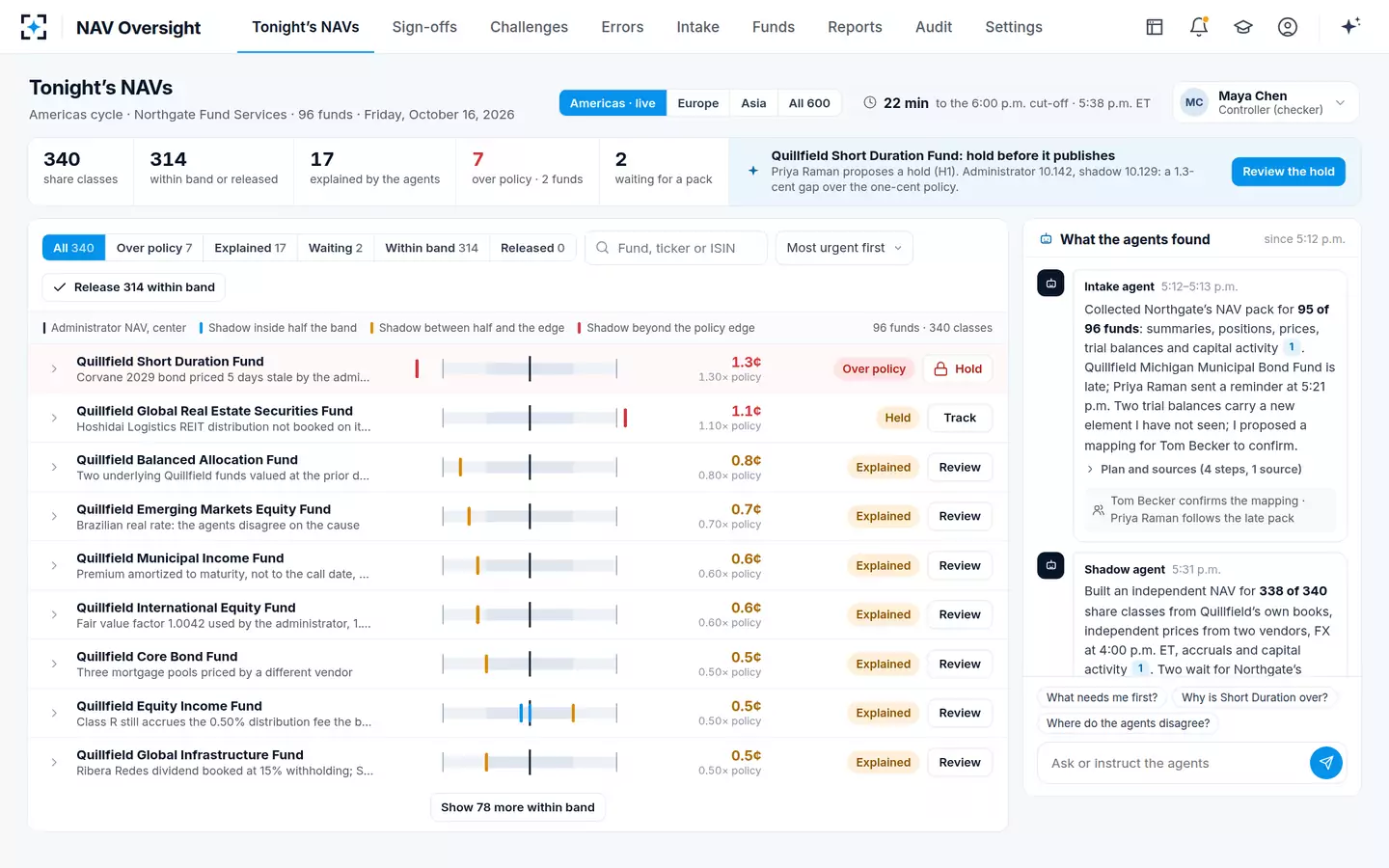
How should a multi-domicile fund range set and test its lines?
Set one line per fund, from the fund's own regime and prospectus, and test every NAV against it before publication. The common failure is not a wrong number but a right number applied to the wrong fund: a Luxembourg equity sub-fund checked against a bond line, or a UK fund's daily errors summed as if it were in Luxembourg.
Setting NAV error lines across a fund range
- Map each fund to its regime
Domicile, legal form and the prospectus's principal investment policy decide the table, not the fund's name.
- Record the line before the first NAV
The CSSF requires it on a documented basis; it is good practice everywhere.
- Write the unit of measure
Cents per share on the published NAV, per cent of the unit price, or per cent of NAV, and the rounding.
- Write how errors combine
Aggregated across days in Luxembourg; price by price in the UK; your choice, written down, in the US.
- Check marketing countries
A stricter foreign line applies to the whole Luxembourg sub-fund and all its investors.
- Record internal lines as the binding ones
A tighter internal line becomes the reporting line in Luxembourg.
- Version every change
A correction must say which line was in force on each day of the error period.
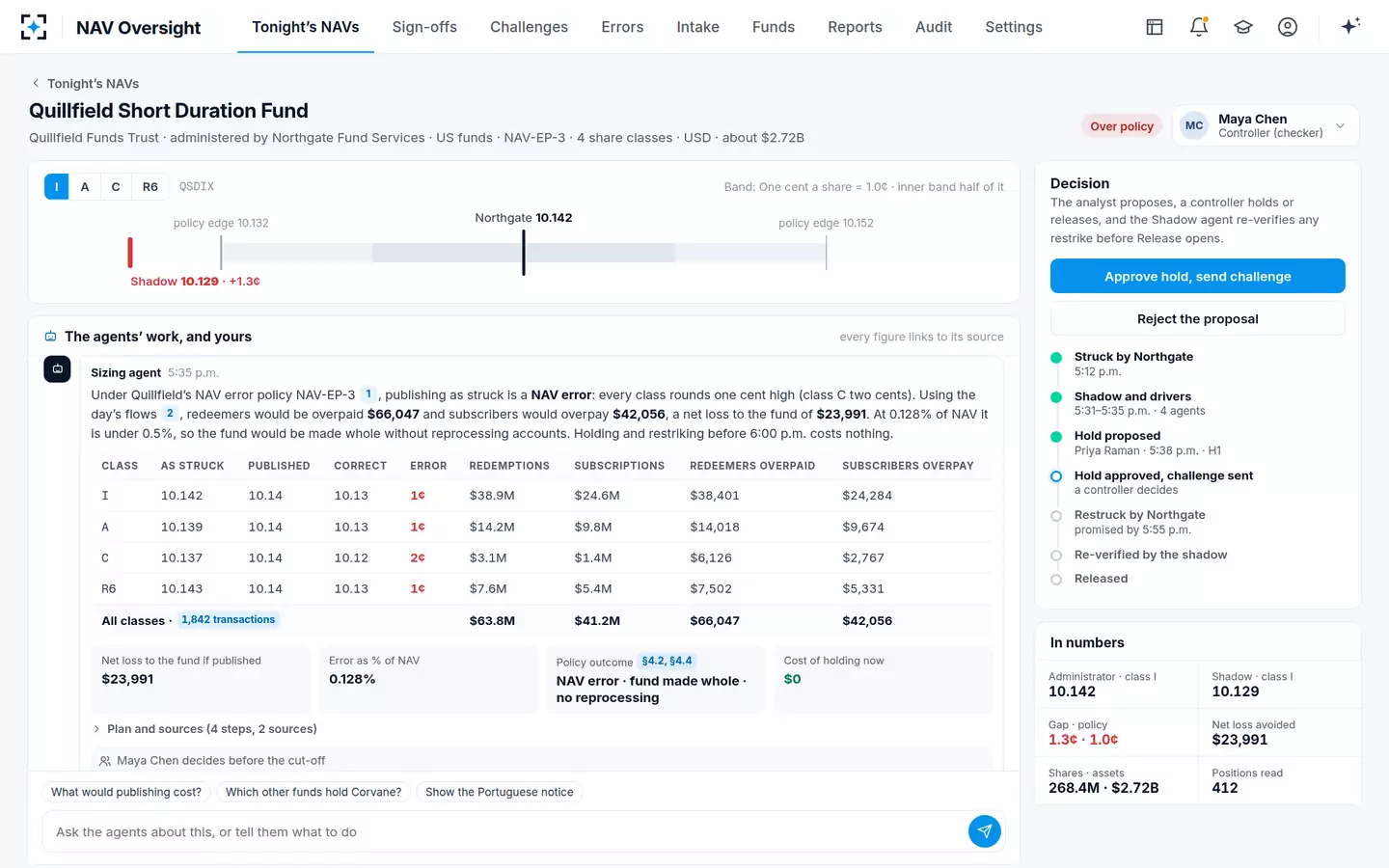
In NAV Oversight each fund's line is a setting read from its approved NAV error policy and cited to the policy's section. The agents show every gap in cents and as a multiple of that line, size it under the right regime, and hand any decision to a person. A change to a line is a new policy version for the Head of Fund Accounting to approve. The policy clauses around the threshold are written out one by one, and what an error over the line costs is worked through with the impact formula.
One break sized against the fund's own line before it is published
Questions people ask
What is the NAV error threshold under CSSF Circular 24/856?
0.20% of NAV for money market funds, 0.50% for bond and mixed UCITS, and 1.00% for equity UCITS and those in other eligible assets, applied to errors detected from January 1, 2025. Retail Part II funds and ELTIFs use the same table by default. Funds for professional investors set their own line by documented analysis, never above 5% of NAV.
What is the NAV error materiality threshold in Luxembourg for a fund that sets a lower one?
The lower one. The CSSF's FAQ says all provisions of the circular apply based on the lower threshold the fund has determined, so notification, compensation and the auditor's work all start there.
What does the CSSF FAQ on Circular 24/856 add?
Version 1, published December 24, 2024, confirms that RAIFs are outside the circular unless they fall in a covered category, that a significant error with no dealing still needs a notification, that a lower internal threshold binds, and that closed-ended funds should still define an internal line. It also covers investment-rule breaches such as the 20% deposit limit.
Where is the CSSF 24/856 notification form, and what must it include?
The form is published on the CSSF's website, and the circular requires every data field to be completed without changes to its frame. A quantitative impact calculation that lets the CSSF trace how the impact and the corrections were computed must be attached, and incomplete notifications are refused. The notification deadlines are covered with the rest of the correction timeline.
What is a NAV error tolerance?
The same thing as a threshold, in the CSSF's vocabulary: the share of NAV at or above which an error is significant and must be corrected and notified. Some managers also use “tolerance” for the narrower internal bands a controller uses to decide which NAVs to investigate before release, which should sit well inside the correction line.
Is the 0.5% UK line a rule?
No. It is guidance in COLL 6.3.6G on how a depositary may judge minimal significance under the rule in COLL 6.6.3R, and it applies only if the manager and depositary meet the FCA's control standards. Below it, the depositary can still require payment.