A fund accounting oversight manager is the person on the asset manager's side who answers for net asset values that an outside fund administrator calculates. The administrator keeps the books and strikes the NAV; the oversight manager decides whether it is right enough to publish, challenges the administrator when it is not, sizes any error under the fund's NAV error policy, and gives the board and the auditors the evidence that every NAV was checked. The seat exists because outsourcing the calculation does not outsource the liability, and it is hard because the check happens in the minutes between the administrator's files arriving and the publication cut-off, across hundreds of share classes. Botminds' NAV Oversight is built for this seat: its agents prepare the checks and the evidence, and the oversight team holds, challenges and releases.
The evening described below comes from the solution's fictional sample book: Quillfield Funds Trust, administered by the fictional Northgate Fund Services, with Maya Chen as the controller on duty. The rules and statistics are the regulators' own.
The fund accounting oversight team: who carries a NAV someone else struck
Today
Spends the first half hour finding which price, rate or accrual moved, in spreadsheets and email.
With agents
Starts from each difference already split by cause and cited; proposes a hold or a release with a reason code.
Still theirs: The proposal, and the call where two explanations disagree
Today
Cannot re-check every class before the cut-off, so samples and hopes.
With agents
Works the classes outside their band first, with the cost of publishing beside each one.
Still theirs: Every hold, release and challenge to the administrator
Today
Signs corrections built in workbooks after the event.
With agents
Signs a correction prepared and reviewed by two other people, under a cited policy section.
Still theirs: The signature on every NAV error correction
Today
Owns the NAV error policies and learns of breaches from the morning report.
With agents
Approves policy versions and tolerances, and gives the second approval on large errors.
Still theirs: The policy, and any change to it
Today
Rebuilds the evidence from email when the board or an examiner asks.
With agents
Filters and exports the trail of every action, by person, fund or day.
Still theirs: Independence: reads, changes nothing
What does a fund accounting oversight manager do?
The oversight manager runs the manager's own check of every NAV the administrator produces, and owns what happens when a NAV fails it. On a typical day that means four things: deciding which NAVs can be released as struck, sending the ones that cannot back to the administrator with evidence, sizing any error that has already reached shareholders under the fund's policy, and building the evidence the board, the auditor and an examiner will ask for.
The job is mostly exceptions and evidence, not recalculation. The administrator has already reconciled positions and cash and computed every accrual. The oversight manager's value is independence: a second view of the price, the FX rate, the corporate action and the capital activity, from sources the administrator did not use, and the authority to stop a NAV going out.
Why the seat exists: the NAV is outsourced, the liability is not
Every regulator that supervises fund administration says the same thing in different words: the fund and its manager remain responsible for what they delegate. In the US, Rule 38a-1 places the administrator inside the fund's compliance program, and its definition of a material compliance matter the board must hear about includes “A violation of the Federal securities laws by the fund, its investment adviser, principal underwriter, administrator or transfer agent”. A wrong NAV struck by the administrator is the fund's problem before it is anyone else's.
Luxembourg is blunter. CSSF Circular 24/856 reminds investment fund managers that when they delegate, “the IFM's responsibility is not affected by the fact that it has delegated any functions to a third party”, and that delegations must not prevent the manager from executing its own obligations. The scale is large: 12,944 US registered funds reported at least one administrator on Form N-CEN for 2025, according to the SEC's annual registered fund update. Each of them needs someone on the manager's side who can say why that day's NAV was right.
How is NAV oversight different from fund accounting?
Fund accounting produces the NAV; oversight decides whether to rely on it. The CSSF's circular on fund administrators sets out what the producer must do, and the list is demanding: the administrator “must be critical of the information received (for example: identify unusual movements or assess the reliability of documents received). The sole compilation/input of accounting information is not sufficient to comply with the duties of the UCI administrator.”
The oversight manager does not repeat that work line by line. A full second book, a shadow of every position and accrual, doubles the cost of accounting and still needs someone to compare the two. What the seat needs is narrower and sharper: an independent NAV for every share class built from the manager's own books and prices, a band around the administrator's figure set by the fund's policy, and a fast way to see why any class sits outside it. How oversight sits beside the administrator covers the integration in detail.
One evening in the seat, minute by minute
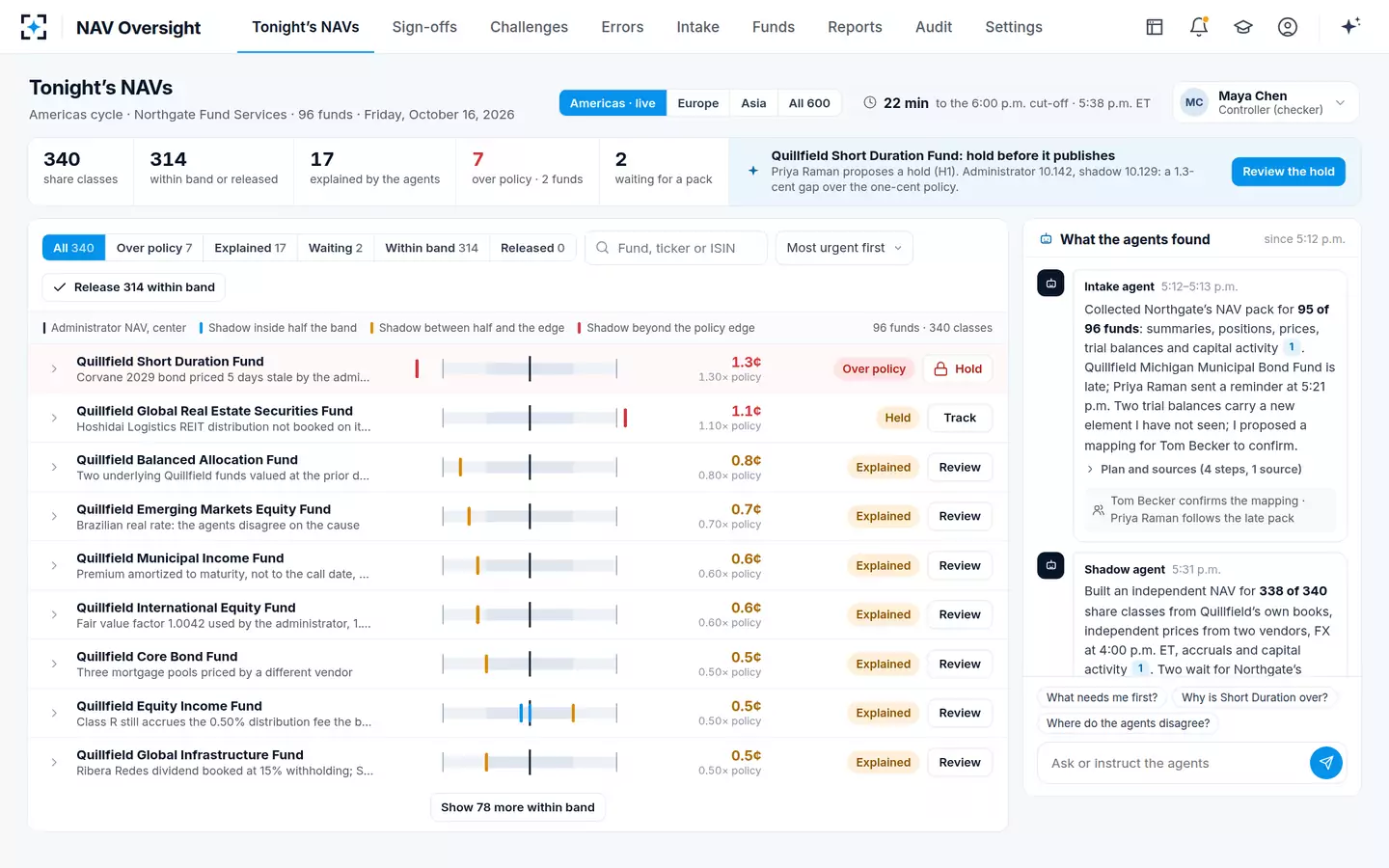
Most of an oversight manager's evening is waiting, and the danger is in the few minutes that are not. Take the sample book's Friday, October 16, 2026: 96 funds and 340 share classes struck by the administrator for a 6:00 p.m. ET cut-off. At 5:38 p.m. the controller has 22 minutes left; 314 classes are within band, 17 are explained, 7 classes in two funds are over policy and two funds are still waiting for their files.
Most of the evening is the administrator's turn; the decision takes two minutes
- Files in, read, independent NAV built5:12–5:31
- Gap split by cause, re-checked, sized5:31–5:38
- Hold proposed and approved, 5:38–5:40
- Administrator reprices and restrikes5:40–5:52
- Restrike re-verified and released, 5:52–5:54
On that evening, one fund mattered. The administrator had struck the short duration fund's class I at 10.142; the independent NAV said 10.129, a 1.3-cent gap on a one-cent policy. 1.2 cents of it came from one bond the administrator had carried at an unchanged price for five business days while the primary price vendor had it 2.40 points lower; the remaining 0.1 cent was a board-approved fee true-up the administrator would book three days later. Published as struck, the NAV would have cost the fund $23,991 net. The analyst proposed a hold; the controller, a different person, approved it; the administrator repriced and restruck; the restrike was checked again and released at 5:54 p.m.
The rest of the 340 classes took almost none of her attention, which is the point. Had the NAV gone out as struck, the same 1.3 cents would have become a correction case involving the treasurer, the board and every account that traded that day.
Tonight's NAVs: every share class on its band, the cut-off counting down
How many share classes can one controller check before the cut-off?
No regulator or independent study publishes a figure, because it depends on how the checking is done. By hand, it is a question of minutes per class: at one minute each, 340 share classes take more than five hours, so a team with under an hour samples, or checks only the funds that moved most. By exception, the question becomes how many classes fall outside their band on a given night. On the sample evening, 24 classes needed a person, 7 over policy and 17 explained but worth a look, out of 340.
The solution's own design figures make the same point with time. Botminds estimates that an oversight team covering one cycle of about 340 share classes spends about 23.5 analyst-days a month checking by hand and about 7.5 with the agents doing the comparison and the first explanation. That split is Botminds' design estimate, not a measured result, and the target behind it is three times the share classes per controller.
Where an oversight team's month goes, by hand: an estimate
What the board expects from the oversight seat
The board expects three things: to hear about material NAV errors promptly, to see that the check runs every day, and to be told when a service provider's controls are weak. US fund boards set the period within which the valuation designee must report material NAV errors, no longer than five business days, and receive the chief compliance officer's annual report on the administrator's policies. A quarterly NAV oversight report is how the oversight manager shows the work in between.
The FCA's guidance explains why the evidence matters as much as the catch. A manager must be able to demonstrate effective pricing controls, and “Evidence of persistent or repetitive errors in relation to these matters, and in particular any evidence of a pattern of errors working in an authorised fund manager's favour, will make demonstrating effective controls more difficult.” A count of breaks by cause, kept quarter after quarter, is how the seat shows there is no such pattern, or finds one.
The quarterly board report, drafted from the trail of every hold and release
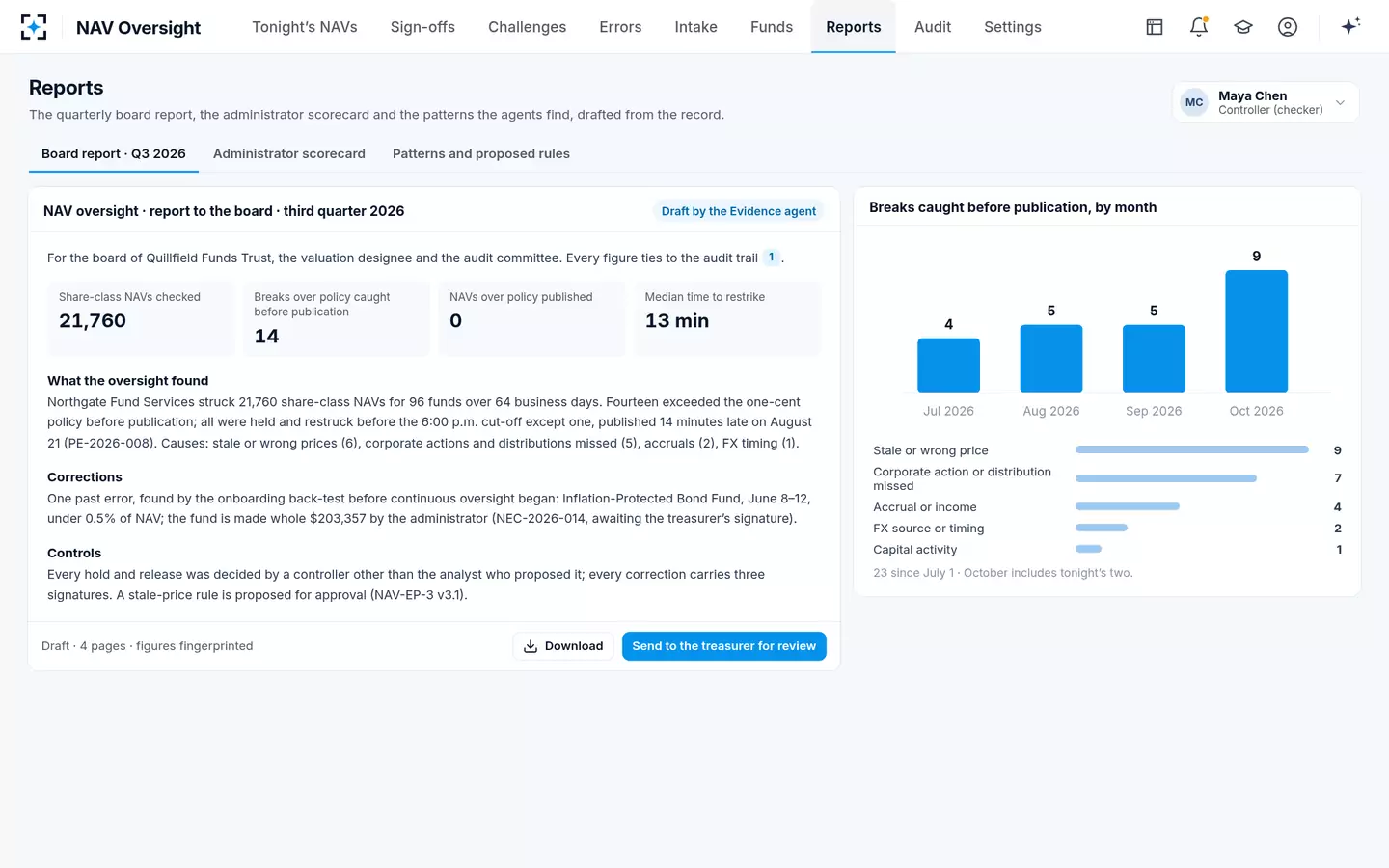
The same history finds repeat causes. In the sample book, six of the nine price breaks since July came from one feed of dealer quotes at the administrator, and the solution proposes a stale-price rule for the Head of Fund Accounting to approve. That is the oversight manager's other job: turning a quarter of exceptions into one change in the controls.
Pay and headcount: what the government data can and cannot say
The US Bureau of Labor Statistics has no occupation called fund accountant or oversight manager. The nearest are accountants and auditors, financial and investment analysts, and financial managers, and the Bureau's Occupational Outlook Handbook gives the median wage of each in the industries where asset managers and fund administrators sit.
The nearest government pay figures for the oversight seat, May 2025
$93,290
median annual wage of accountants and auditors in finance and insurance; $83,680 across all industries
$124,370
median annual wage of financial and investment analysts in securities and other financial investments
$169,980
median annual wage of financial managers in finance and insurance
5%
projected growth in accountant and auditor jobs, 2025 to 2035, from about 1.6 million
Treat these as a frame, not a benchmark. Accountants and auditors in finance and insurance include fund accountants at administrators, oversight staff at managers and corporate accountants at both, and financial managers include heads of fund accounting alongside many other roles; no public series separates them. The oversight analyst who watches sub-advisers follows a similar path on the investment side.
Fund accounting oversight jobs: what the job description should say
A job description for the seat should name decisions, not tasks. “Reviews daily NAVs” describes a fund accountant; “holds or releases each share-class NAV before the cut-off, under the fund's NAV error policy” describes the oversight manager. The checklist below is a starting point for a hiring manager writing one, or a candidate reading one.
What a fund accounting oversight manager's job description should contain
- Decision rights
Who may hold, release or challenge a NAV, and who may not: the analyst proposes, the manager decides.
- The policies owned
The NAV error policy and tolerances for each regime the funds sit in: US, UK, Luxembourg or others.
- The administrator relationship
Challenges, service levels, a scorecard, and the evidence behind any claim under the administration agreement.
- Correction work
Sizing errors under the policy and preparing corrections for the treasurer's signature.
- Reporting
Board and committee reports, notifications to regulators where the regime requires them, auditor requests.
- Evidence
Keeping the evidence of every check and decision for the period the law sets, at least six years for US registered funds' NAV schedules.
- Craft
Price hierarchies and stale prices, FX fixing times, corporate actions in the issuer's own language, accruals and capital activity.
NAV Oversight is designed around those decision rights. Its seven agents collect the administrator's files, build the independent NAV, split each gap by cause, re-check the main cause from other sources, size it under the policy, draft the challenge and keep the trail. They never hold, release, send, sign, change a price or change a tolerance; why the checking agent is never the one that built the number explains the separation, and the NAV Oversight page follows the whole evening screen by screen.
Questions people ask
What do fund accounting oversight jobs involve?
Checking the NAVs an outside administrator calculates before they are published, challenging the administrator when a NAV is outside the fund's tolerance, sizing errors under the fund's policy and reporting to the board. The roles sit on the asset manager's side, often titled NAV oversight analyst, fund controller or oversight manager.
What does a fund accounting oversight specialist do differently from a fund accountant?
A fund accountant produces the books and the NAV; an oversight specialist decides whether to rely on them. The CSSF's rules for administrators require the producer to be critical of its own inputs; the specialist adds an independent second view and the authority to stop a NAV going out.
What does a fund accountant do?
A fund accountant records a fund's trades, income, expenses and capital activity, reconciles positions and cash, and calculates the NAV per share for each class, usually at an administrator. US rules set the frame: holdings changes reflected by the first calculation on the next business day, expenses and income accrued to the date of calculation.
What belongs in a senior fund accountant job description?
Ownership of a set of funds' daily NAVs, review of junior staff's reconciliations and accruals, resolution of breaks with custodians and brokers, and preparation of financial statements and audit support. Senior roles on the manager's side add oversight duties: challenges to the administrator, error sizing and board reporting.
What does a fund accounting analyst do?
An analyst prepares the daily work a senior accountant or controller reviews: pricing exceptions, reconciliations, accrual checks and NAV files. In an oversight team, the analyst proposes holds and releases with a reason, and a different person decides.
How many share classes can one controller check before the cut-off?
No regulator or study publishes a number. By hand, at about a minute a class, about sixty in an hour; by exception, as many as the independent NAV can cover, because the controller only reads the classes outside their band. On the solution's sample evening, 24 of 340 classes needed a person.