A fund administrator due diligence questionnaire (DDQ) is the set of questions a fund manager sends its administrator each year, or before appointing one, about its organisation, staffing, NAV and pricing processes, reconciliations, controls reports, technology and business continuity. Its weakness is built in: every answer is the administrator's own claim, and a questionnaire can be answered "yes" throughout by a firm that had a bad year. The better method starts from the other end. Most questions about how an administrator performs can be answered from what it delivered over the year: its NAV files and their timestamps, its restrikes, its incident notices, its SOC 1 report and its staffing notices. The questions that remain are the real gaps, and those are the ones to send. Botminds' Fund Administration Oversight works this way: its Due diligence agent drafts the annual review from the year's evidence, cites the administrator's own response only where nothing else exists, and lists the gaps for a person to send.
One sample annual review, drafted from the year's evidence
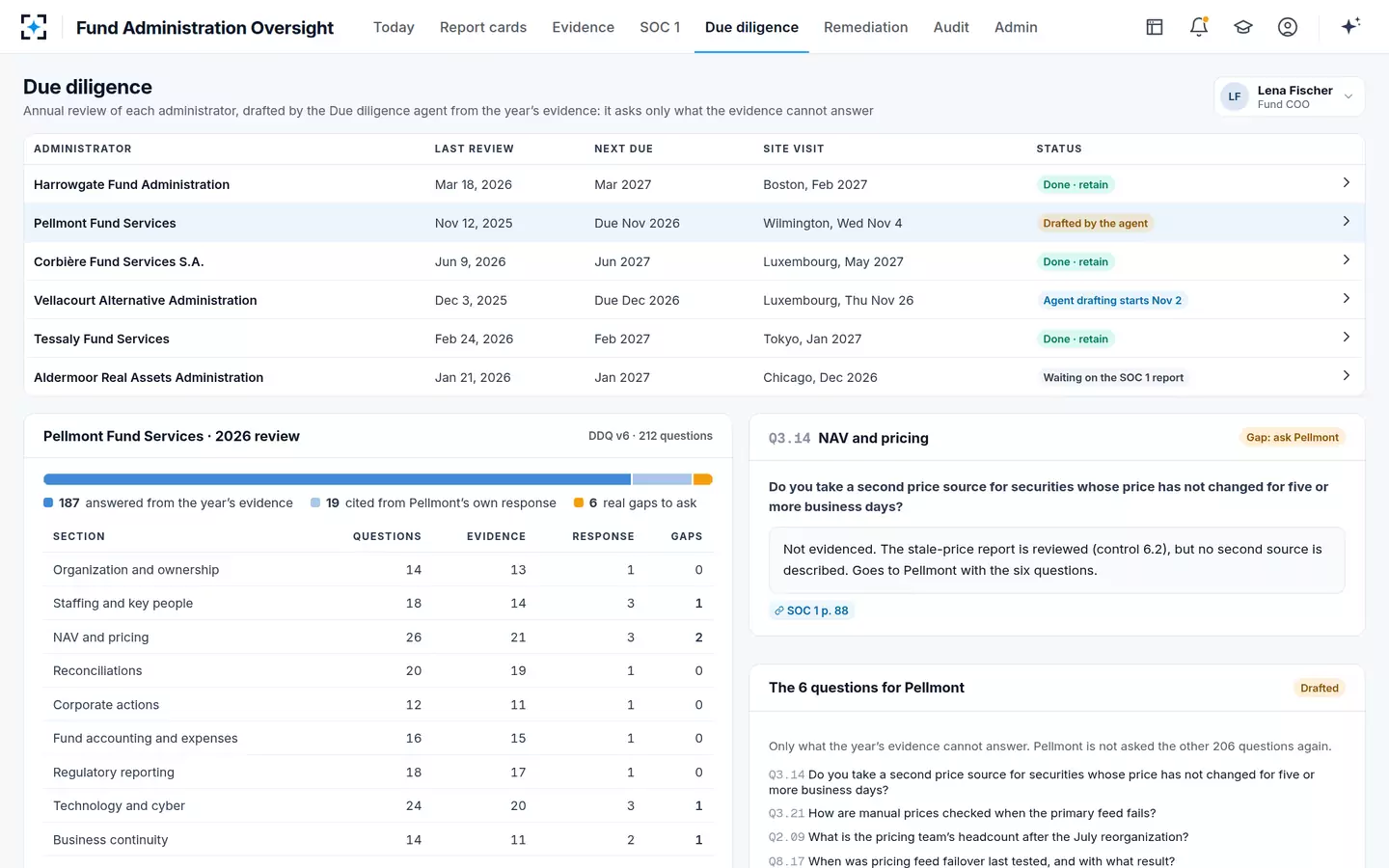
212
questions in the sample firm's administrator questionnaire
187
answered from the year's deliverables, restrikes, incidents, SOC 1 report and staffing records
19
answerable only from the administrator's own prior response, and cited as such
6
real gaps sent to the administrator
What is a due diligence questionnaire, and why is it the weakest evidence in the file?
A due diligence questionnaire is a structured list of questions one firm sends another before relying on it, answered in writing by the firm being assessed. For administrators it is usually sent once before appointment and again each year. It is the weakest evidence in an oversight file because it is unverified self-report, and because nothing in its format distinguishes a true "yes" from a hopeful one.
There is also evidence that the information it gathers is underused. Studying the SEC's short-lived requirement for hedge funds to register and file Form ADV, Brown, Goetzmann, Liang and Schwarz found that operational risk disclosed in those filings did not change how investors' money followed performance; investors, the authors concluded, either did not have the information or did not think it mattered (Journal of Finance, 2008). Collecting operational answers is not the same as using them. A DDQ that is filed rather than tested repeats that pattern inside one firm.
The same weakness applies to every operational questionnaire, not only the administrator's. The Operational Due Diligence series measures how many planted errors a questionnaire review catches, in testing an operational due diligence questionnaire; this page is about the administrator's questionnaire, and about answering it before it is sent.
What evidence should back each DDQ answer?
Every answer should point to something the administrator produced in the ordinary course of the year, or to an independent document, before it points to the administrator's word. The table below pairs the main sections of an administrator questionnaire with the evidence that answers them without asking.
Fund administrator due diligence checklist: each section, and the evidence that answers it
| DDQ section | Typical question | Evidence that answers it | Ask only if |
|---|---|---|---|
| NAV and pricing | Are NAVs delivered on time and accurately? | Timestamps of every NAV file against the contract cut-off; restrike notices and their causes | A restrike cause is unexplained |
| Pricing sources | Do you challenge stale or unchanged prices? | Price challenge logs; SOC 1 controls and exceptions on stale-price review | The SOC 1 tests the control but not the second source |
| Reconciliations | Are positions and cash reconciled daily? | Reconciliation deliverables; breaks over tolerance and their age | Breaks age beyond the agreed limit |
| Controls report | Do you have a current SOC 1 or ISAE 3402 type 2? | The report, its period, its exceptions and the bridge letter | The bridge letter is missing or old |
| Staffing and key people | Has the team changed? | Staffing reports and change notices received in the year | A reorganisation was announced without numbers |
| Incidents and continuity | Have you had outages, and was failover tested? | Incident notices, root-cause letters and their dates | Failover was never evidenced |
| Subservice providers | Which vendors do you rely on? | The SOC 1 description: inclusive or carved out | A carved-out provider's report is not reviewed |
| Regulatory and legal | Any regulatory findings or litigation? | Public regulator orders and releases | Always confirm in writing; public records can lag |
Questions to ask a fund administrator that the evidence cannot answer
What is left after the evidence pass is short and specific, and it is better for being short: an administrator answering six precise questions can be held to its answers. In the sample review in Fund Administration Oversight, the six that went to the administrator included whether it takes a second price source for securities whose price has not changed for five or more business days, how manual prices are checked when the primary feed fails, what the pricing team's headcount is after a July reorganisation, and when pricing feed failover was last tested and with what result.
Each of those questions came out of the year's evidence. Four of the administrator's seven restrikes in the third quarter came from stale bond prices; its SOC 1 report showed that the daily stale-price review had no evidence for 3 of 40 days sampled; its incident log showed a pricing-feed outage in August. A generic questionnaire asks whether the administrator has a pricing policy. A questionnaire drafted from evidence asks why the policy did not stop these four restrikes.
Where the sample review's gaps came from: questions answered by section
An agent that asks instead of guessing
The value of drafting a questionnaire with agents depends on one behaviour: when the evidence does not answer a question, the agent must say so rather than produce a plausible answer. A generated "yes, we take a second price source" is worse than a blank, because it looks like evidence. In Fund Administration Oversight that rule is written into each agent's limits: the Evidence agent never fills a missing value, the Due diligence agent never sends a question to the administrator on its own and never concludes, and every drafted answer cites the deliverable, the restrike, the SOC 1 page or the administrator's own response behind it.
Fund Administration Oversight's annual review: from 212 questions to 6, with a person at each decision
Agent
Due diligence agentAnswers each question from the year's deliverables, restrikes, incidents, SOC 1 report and staffing records, citing each source.
Never: Never answers without a citation
Agent
Due diligence agentWhere only the administrator's own prior response exists, cites it and marks the answer as the administrator's claim.
Never: Never presents a claim as evidence
Agent
Due diligence agentLists the questions the evidence cannot answer, with the reason each is open.
Never: Never sends a question on its own
A person decides
Oversight analystChecks the draft and the gap list, edits the questions and sends them.
Never: Does not approve the review they drafted
A person decides
Fund COOReads the answers to the gaps and approves the conclusion: retain, retain on watch, or re-tender.
Never: The agent proposes a conclusion; only the COO approves it
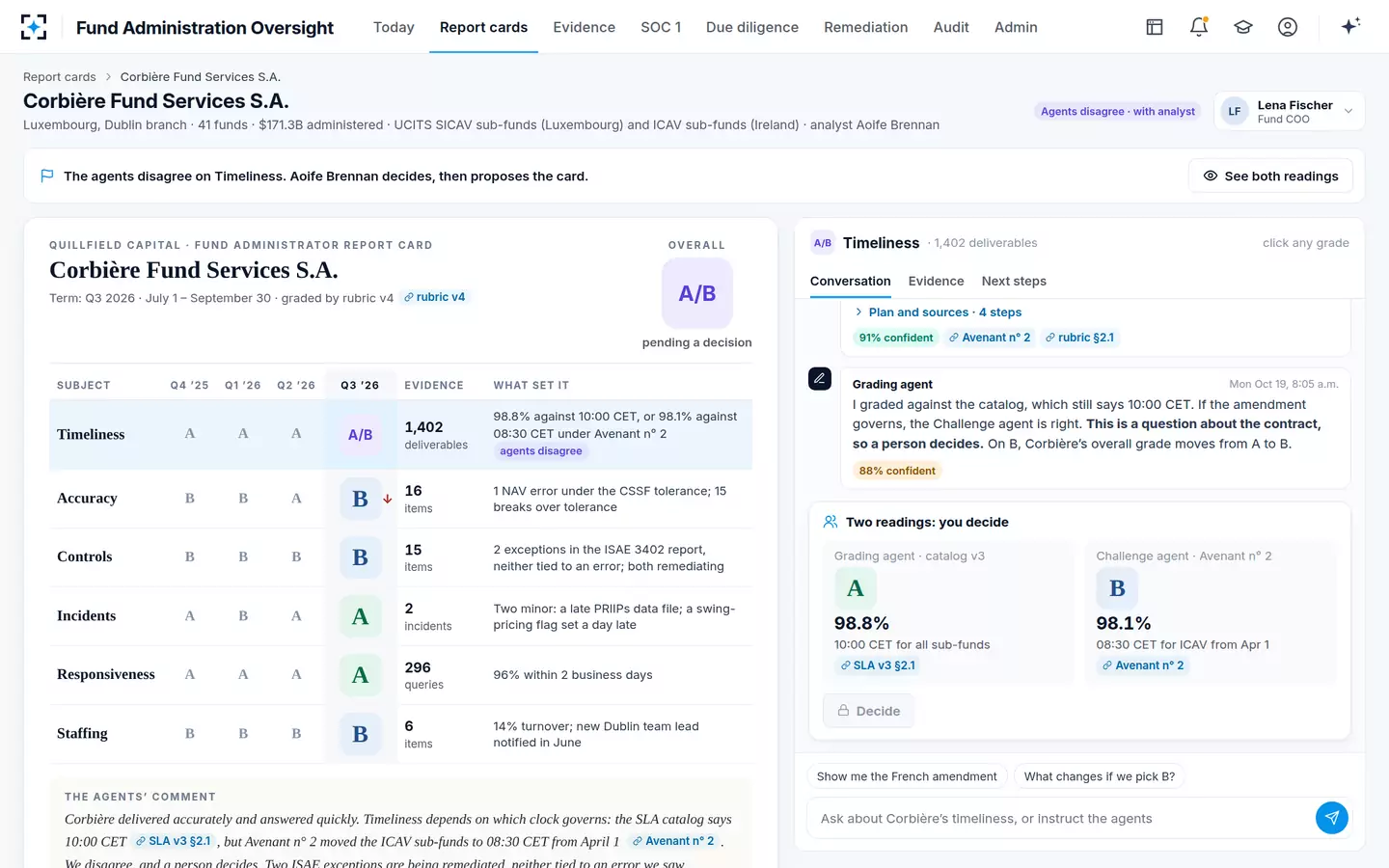
The same habit governs disagreements. When two agents read the same contract differently, the solution does not pick one. In the sample quarter, the Grading agent measured an administrator's timeliness against the cut-off in the service level catalog, while the Challenge agent, searching for amendments in any language, found a French amendment that had moved one fund range's cut-off earlier. The Grading agent's note reads: this is a question about the contract, so a person decides.
Two readings of one contract, side by side, for a person to decide
Regulators expect this kind of restraint from firms using such tools. The SEC's examination priorities for fiscal 2027 say the Division of Examinations will prioritize firms' policies and procedures for monitoring what it calls "super intelligence (SI)", including its use in back-office operations, fraud prevention and trading (SEC, Examination Priorities FY2027). An oversight program that uses agents to draft its due diligence should be able to show, for each answer, where it came from and who approved it.
How often should you re-review a fund administrator?
At least annually, with the depth set by the year's evidence. Rule 38a-1 requires a registered fund to review, no less than annually, the adequacy of its administrator's policies and procedures and how effectively they were implemented (17 CFR 270.38a-1(a)(3)). An administrator with a clean year and a current controls report needs a lighter review than one with a run of restrikes or a new SOC 1 exception, and an event, such as a system migration, an acquisition or a key person leaving, justifies a review out of cycle.
The site visit, and what the administrator must hand over
The review should include a visit. Luxembourg requires administrators to allow the fund or its manager on-site visits "at a frequency and under the terms to be laid down in the contract, for the purposes of exercising its due diligence and ongoing monitoring activities", and obliges the administrator to "communicate proactively the information, documents and data necessary to perform its duties" (CSSF 22/811, point 40). An evidence-drafted questionnaire makes the visit shorter and sharper: the agenda is the six open questions, not two hundred.
A fund administrator due diligence checklist for the site visit
The visit is where a questionnaire's remaining claims are tested in person, so its agenda should come from the open questions, not from a tour. Five things are worth seeing on any visit, whatever the questionnaire said.
- One NAV, start to finish. Ask the team that runs your funds to walk through a recent NAV, including the exception reports they cleared and who signed off. Compare it with the controls described in the SOC 1 report.
- The stale-price and manual-price queue. See how challenges are raised, who answers them and how long they stay open, and whether the queue matches what you receive.
- The error log. Ask to see it for your funds and for the team as a whole, with causes, and check it against the restrikes you were notified of.
- The people. Meet the named team and its manager; check headcount against the staffing notices received in the year, and ask who covers absences.
- Continuity, evidenced. Ask for the last failover test of the pricing feed and the NAV system, with its date and result, rather than the plan document.
Each item produces something to file: a walkthrough note, a queue extract, a log extract, a team list, a test result. That is the difference between a visit that confirms a questionnaire and one that tests it. In the sample firm in Fund Administration Oversight, the six open questions, among them the second price source and the feed failover test, are the visit's agenda.
What a controls report adds to the questionnaire, and what it does not
The administrator's SOC 1 or ISAE 3402 report answers many DDQ questions better than the administrator can, because an auditor tested the controls. It also contains a list worth borrowing. Before issuing the report, the service auditor must ask the administrator for written representations that it has disclosed any "non-compliance with laws and regulations, fraud, or uncorrected deviations attributable to the service organization that may affect one or more user entities", design deficiencies, and instances where controls did not operate as described (ISAE 3402, paragraph 38). A DDQ that asks the same four questions, for the fund's own services and for the months since the report's period ended, asks what the administrator has already had to consider for its auditor.
What the report does not answer is how the administrator performed for your funds. That comes from your own records, which is why reviewing a SOC 1 report ends with putting your errors beside its exceptions.
What is fund administration oversight, and where does the questionnaire fit?
Fund administration oversight is the ongoing work of showing that the firm keeping a fund's books did it well: service levels measured against the contract, NAV errors found and their causes fixed, the controls report read, the fund's own complementary controls run, and a due diligence review each year. The questionnaire is the annual part, and it is only as good as the quarterly parts beneath it. A manager that measured the administrator every quarter has most of the DDQ already answered.
The annual review drafted from the year's evidence, with the six questions for the administrator
When the review concludes that the administrator should be replaced or the contract re-tendered, the same evidence becomes the basis of the selection. A fund administration RFP that asks for things that can fail uses it to write questions candidates cannot answer with a simple yes.
Questions people ask
Can AI answer a fund administrator due diligence questionnaire?
It can draft answers from evidence and cite each source, which is most of the work. It should not invent answers where the evidence is silent, send questions on its own or conclude the review; in Fund Administration Oversight those steps stay with the analyst and the COO.
Should the administrator answer the same questionnaire every year?
Only the questions that changed or that the year's evidence cannot answer. Re-sending two hundred questions invites copied answers; sending the six that matter invites specific ones, and the rest are already answered from the administrator's own deliverables.
Who should sign off a fund administrator due diligence review?
Someone other than the person who drafted it. In the sample firm the analyst drafts and sends, and the fund COO approves the conclusion; for a registered fund the CCO then reflects it in the annual report to the board required by Rule 38a-1.
Is an operational due diligence questionnaire the same as an administrator DDQ?
No. An operational due diligence questionnaire is sent by an investor to a fund manager about its whole operation; an administrator DDQ is sent by the manager to its administrator about the services it provides. They overlap where the investor asks about the administrator, and the manager's evidence-backed review is the best answer to that question.
What should happen to the answers after the review?
Each open answer becomes either a commitment with a date, tracked to closure on evidence, or a reason to change the administrator's grade. Answers that are filed without consequence teach the administrator that the questionnaire does not matter.