In fund administration outsourcing, the administrator does the fund's operational accounting: it records every transaction in the fund's books, values the portfolio under the fund's valuation policy, calculates the net asset value (NAV) per share or unit, reconciles positions and cash against independent sources, and usually keeps the investor register, processes subscriptions and redemptions, and drafts the financial statements and investor statements. What it does not do is take over the manager's responsibility for any of those results. The manager still sets the valuation policy, still answers to investors and regulators for the NAV, and still has to show that it supervised the firm doing the work. That is the gap Botminds' Fund Administration Oversight is built for: its agents measure each administrator on the files it actually delivered, read its SOC 1 report against the errors the fund saw, and put a quarterly grade in front of the fund COO, who signs it.
The clearest public map of an administrator's job is Luxembourg's, because the regulator wrote it down task by task in Circular CSSF 22/811 (2022, as amended by Circular CSSF 25/900). This guide uses that map, the SEC's rules and one SEC case against an administrator to show where the work goes and where the accountability stays.
Most funds hand the books to an administrator
78%
of advisers to private funds reported at least one third-party administrator on Form ADV (July 2022)
3%
reported an administrator that is a related party
12,944
registered funds reported an administrator on Form N-CEN for 2025
3
functions Luxembourg splits administration into: register, NAV and accounting, investor communication
What does a fund administrator do? The three functions, task by task
Fund administration is three jobs that are often sold as one. The CSSF names them: the registrar function, covering "all tasks necessary to the maintenance of the UCI's unit-/shareholder register"; the NAV calculation and accounting function, which "covers the legal and fund management accounting services and, the valuation and pricing (including tax returns)"; and the client communication function, "the production and delivery of the confidential documents intended for investors" (CSSF 22/811, point 10). A fund may give all three to one firm, or split them, but each function has one responsible provider.
For an oversight team the useful version is a grid: for each task, what the administrator does, what the manager keeps, and what evidence the manager should be able to see without asking. The rows below follow the CSSF's task list; the manager and evidence columns are ours.
What a fund administrator does, what the manager keeps, and the evidence to see each quarter
| Task | The administrator does | The manager keeps | Evidence to see |
|---|---|---|---|
| Bookkeeping | Records every movement against proper instructions and supporting documents | The instructions themselves, and who may give them | Unusual entries, manual journals, entries booked on the manager's say-so |
| Valuation and pricing | Prices liquid holdings from reliable sources; checks or records values for illiquid ones | The valuation policy and every judgment price | Stale prices, overrides, price challenges and how each was resolved |
| NAV calculation | Calculates total NAV and NAV per share or unit, by class | Approval of the NAV, and the error policy if it is wrong | Timeliness against the contract cut-off; restrikes and their causes |
| Reconciliation | Reconciles positions and cash against custodian and broker records | Resolution of breaks that need the manager | Breaks over tolerance, their age, who closed them |
| Fees and expenses | Accrues and allocates fees, commissions and taxes | The reading of the fee terms in the documents | Fee calculations, expense allocations, accrual changes |
| Register and dealing | Keeps the register; processes subscriptions, redemptions, transfers, distributions | Investor eligibility decisions it is asked to make | Dealing errors, late settlements, register-to-books reconciliation |
| Reports to investors | Drafts statements, financial reports and notices, with the fund | Sign-off on what investors are told | Draft-to-final changes; delivery confirmations |
| Regulatory reporting | Prepares or supports filings | The filing and its certification | Deadlines met; corrections filed |
What does a hedge fund administrator do, compared with a private equity or mutual fund administrator?
The tasks are the same family; the rhythm and the hard part differ. A mutual fund administrator works to a daily clock, because a registered open-end fund must price its shares at the NAV next computed after an order and compute that NAV no less often than once daily, Monday through Friday. A hedge fund administrator works to a monthly one: in the SEC's case against Theorem Fund Services, the administrator was "responsible for, among other things, calculating the Fund's monthly Net Asset Value (“NAV”), allocating gross profit to investors, and calculating performance statistics for the Fund and investors" (SEC, In re Theorem Fund Services, 2023). A private equity administrator works to the calls and distributions, with quarterly capital account statements in between.
Three kinds of fund administrator: where the hard part sits
What the administrator must get right: A daily NAV to a fixed cut-off, every business day, for every share class; dealing at that price; often a separate transfer agent for the register.
What the manager should watch: Timeliness against the contract clock, NAV errors per share, stale prices, and agreement between the administrator's books and the transfer agent's register.
What the administrator must get right: A monthly NAV with performance fees, series or equalisation, allocations of profit to each investor's capital account, and investor statements.
What the manager should watch: How hard-to-price positions are valued and who chose the price, manual adjustments to the NAV, and whether investor statements match the books.
What the administrator must get right: Capital calls and distributions per the agreement, capital accounts, fee and carried interest calculations, quarterly reporting and audited statements.
What the manager should watch: Fee and expense allocations, waterfall inputs, the timing of valuations and the evidence behind each investor's balance.
A private fund's administrator can also do the work a registered fund splits between an administrator and a transfer agent, keeping the register of investors as well as the books. That difference, and how the custodian fits in, is set out in fund administrator vs custodian vs transfer agent.
What stays with the manager when fund administration is outsourced?
Responsibility for the result stays, and so does the duty to supervise. The CSSF says it directly: where administration "has been wholly or partially delegated by the UCI or its IFM", the fund or its manager "must monitor the delegate(s)" and "must ensure the coordination and supervision of the UCI administration activity" (CSSF 22/811, point 2). In the United States, Rule 38a-1 puts the administrator inside the fund's own compliance program, with board approval of its procedures and an annual report from the CCO on how they operated.
The SEC explained in 2003 why that is not a formality. "Funds today typically have no employees, and delegate management and administrative functions, including the compliance function, to one or more service providers" (68 FR 74714). A fund with no staff of its own has nobody else to look at what its providers do. The manager is the only party with both the duty and the information to do it.
Five things a manager keeps when the administrator does the work
- The valuation policy, and every price that needs judgment
The administrator values liquid holdings from reliable sources; for illiquid ones the CSSF expects it either to value them independently or to check that the manager's valuation follows the policy.
- Approval of each NAV, and the policy for when it is wrong
Who may release a NAV, the tolerance for errors, who decides on a restrike and who is compensated.
- The meaning of the fund's documents
Fee terms, expense caps, investor eligibility: the administrator applies them; the manager answers for how they were read.
- What investors are told
Statements and reports are produced "in cooperation with" the fund or its manager, never by the administrator alone.
- The oversight itself
Measuring the administrator, reading its controls report, running the fund's own complementary controls and reporting upward. It can be helped; it cannot be delegated back to the firm being overseen.
Who is liable for a NAV error the administrator made?
Toward investors, the fund and its manager answer first; between the manager and the administrator, the administration agreement decides who pays; and an administrator can be liable to regulators in its own right. Luxembourg's NAV error circular shows the order. Errors are recorded, monitored and, where appropriate, corrected by the administrator "upon approval by the UCI or its IFM", and compensation can come from more than one pocket: "the IFM, where applicable, the UCI administrator or another party involved in the functioning of the UCI may decide to take over the payments necessary to compensate the aggrieved investors" (CSSF 24/856, points 23 and 43, applying to errors detected from January 1, 2025).
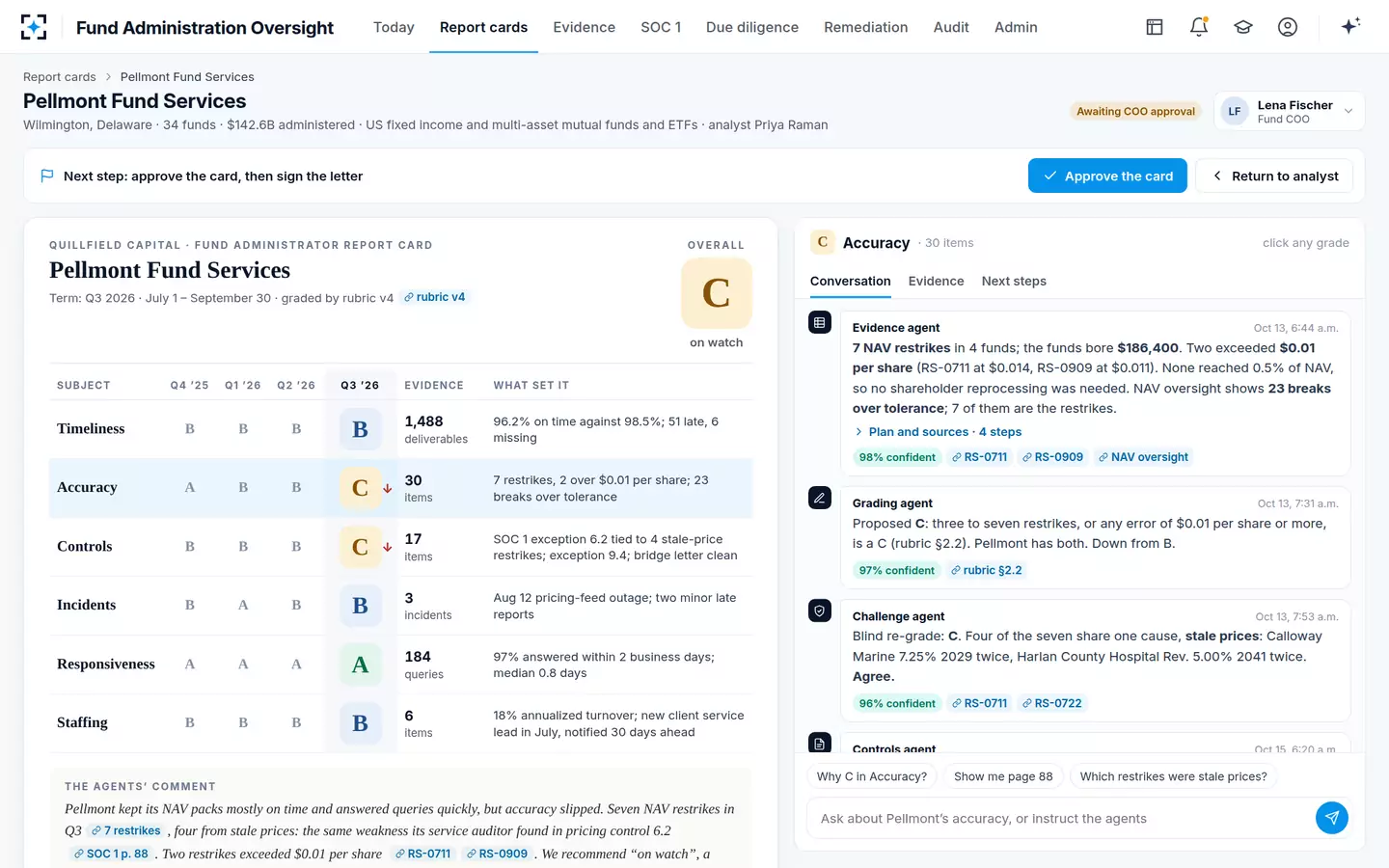
The administration agreement is where the private allocation happens: the standard of care, the cap on liability, what counts as the administrator's error and what counts as an input the manager supplied. A manager who has never read its own agreement's error clause against a real restrike does not know who pays for the next one. In the sample quarter in Fund Administration Oversight, seven restrikes at one administrator cost the funds $186,400, and the agents computed a service credit of the same amount under the agreement's SLA schedule for the COO to approve.
An administrator must question what it is given: the Theorem case
Regulators expect an administrator to be more than a calculator. The CSSF requires an administrator to question the information it receives, for example by spotting unusual movements and judging the reliability of documents, and states plainly that merely compiling or keying in accounting information does not meet its duties (CSSF 22/811, point 28). The SEC's 2023 order against Theorem Fund Services shows what happens when an administrator only compiles.
Theorem administered a small hedge fund from about January 2018 to March 2019. When the fund lost money trading, the advisers told Theorem to book the losses as a receivable from the manager, and it agreed: it "recognized an expense reimbursement as a receivable “due from [EIA]” (an asset of the Fund), which offset the effect of the loss, resulting in no decrease to the Fund's NAV". It did so "without evaluating whether this was appropriate and despite the existence of red flags." Its procedure was to present each monthly NAV "to the Advisers for review and approval" before publishing investor statements, so the manager's approval, which should have been a control, was the channel for the error.
Theorem Fund Services: fifteen months from onboarding to exit
- Onboarding: no bank access, no auditor confirmed
- Losses booked as a receivable, monthly
- Questions raised; termination letter
What the Theorem case teaches anyone relying on an independent administrator
Two lessons sit on opposite sides of the contract. For the administrator: compiling what the manager sends, and having the manager approve it, is not a NAV control. For an investor or a board relying on an "independent" administrator: the label proves nothing about what the administrator checks. Theorem produced two versions of each month's fact sheet, one at investor level and one at account level, for about seven months and handed both to the advisers, without asking for support for the receivable that separated them.
The controls an administrator runs on its own NAV, and why the manager should see them
A good administrator checks its own work before the NAV leaves the building, and those checks are the first thing a manager should ask to see. The CSSF lists the minimum: review of unusual or significant movements in the NAV components, comparison of NAV per share, reconciliation of investments and cash against "reliable and independent sources", reconciliation of units in the books to the register, oversight of accruals and provisions, control of performance fee and carried interest calculations, review of liquidity management tools such as swing factors, and the total expense ratio (CSSF 22/811, point 29).
Each of those checks produces an exception list, and the exception lists are better oversight evidence than any SLA percentage. A manager who receives only the final NAV and a monthly service report sees the outcome of the administrator's controls, not the controls. How much of that work the manager should repeat itself, from a full second set of books to targeted checks on the riskiest numbers, is the question behind shadow fund accounting.
How Fund Administration Oversight shows what each administrator did
The solution turns the administrator's output into a quarterly report card with six subjects: timeliness, accuracy, controls, incidents, responsiveness and staffing. Take the sample firm as it runs through it: Quillfield Capital, a fictional manager with 180 funds and $745.2 billion spread across six administrators. Each subject is measured from the fund's own records, graded by a written rubric, re-graded blind by a second agent on an independent model, proposed by an analyst and approved by the fund COO.
Six administrators, six subjects: what each one did this quarter
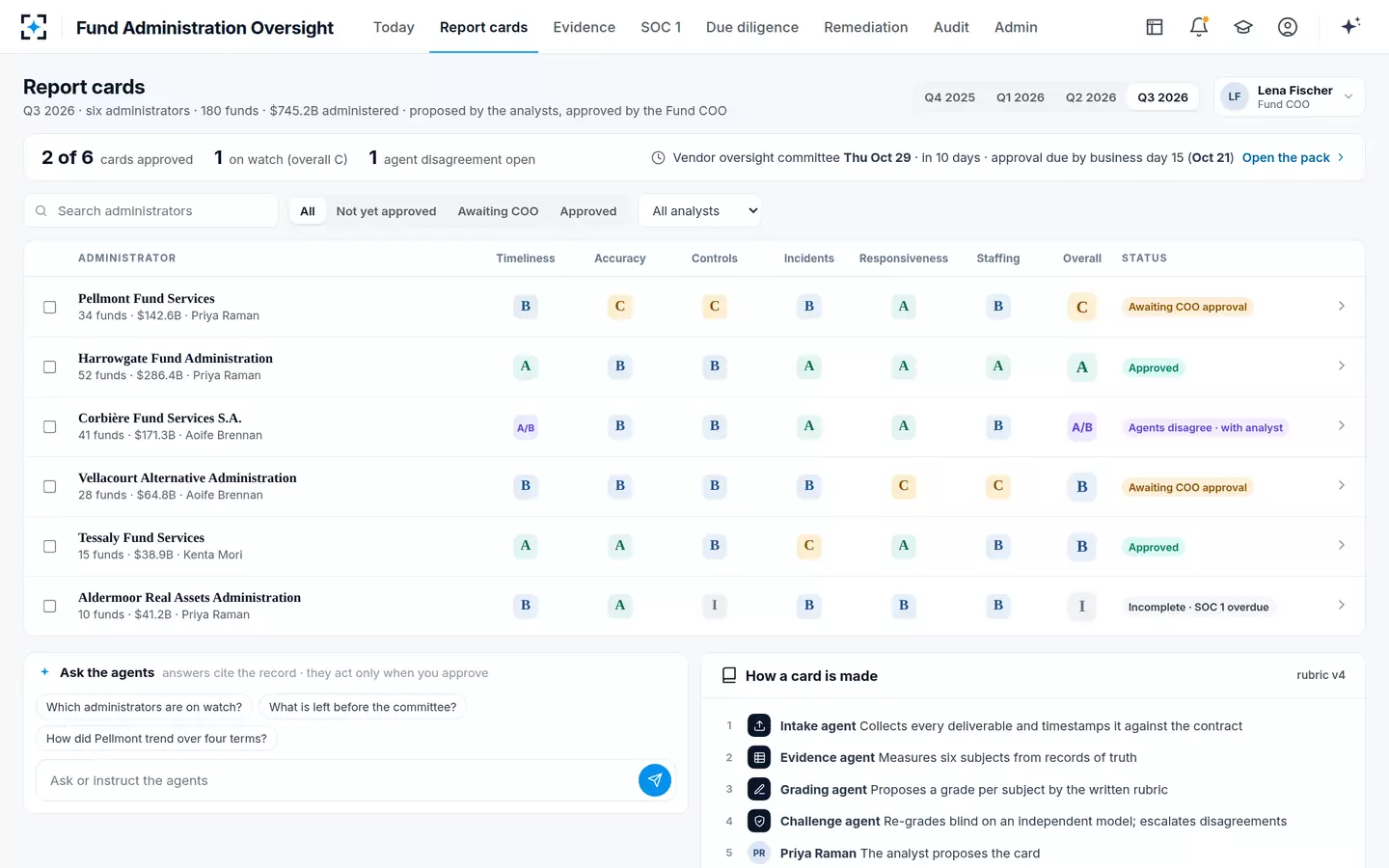
Clicking a grade opens the evidence and the agents' reasoning. For the sample administrator Pellmont, the accuracy grade rests on seven restrikes in four funds, two above $0.01 per share, and the controls grade on an exception in its SOC 1 report that matches four of them.
One administrator's report card, and the evidence behind the C
When a manager is about to hand its books to an administrator for the first time, or move them to a new one, the question changes from what the administrator does to what must be in place on day one. Outsourcing fund accounting, week by week covers that plan.
Questions people ask
What is fund administration?
Fund administration is the operational accounting and record-keeping of an investment fund: bookkeeping, valuation and NAV calculation, reconciliation, the investor register and dealing, and the production of investor and regulatory reports. Luxembourg's CSSF divides it into three functions, the register, NAV calculation and accounting, and investor communication, and lets one provider hold each.
Does a fund administrator value the fund's assets?
It prices what has a reliable market source, and for complex or illiquid assets it either values them independently or checks the manager's or an external valuer's figures against the valuation policy. The CSSF notes that an administrator that only incorporates values from the manager, pricing sources or a valuer into the NAV is not itself an external valuer.
Is a fund administrator independent of the manager?
Usually, but not always. On Form ADV data from July 2022, 78% of advisers to private funds reported a third-party administrator and 3% a related-party one. An administrator inside the manager's group can do good work, but its independence cannot be assumed and its oversight has to be direct.
How many administrators does a fund use?
Most registered funds use one. For 2025, 12,365 funds reported one administrator on Form N-CEN, 546 reported two and 33 reported three. Each additional administrator is another set of deliverables, another controls report and another contract clock to oversee.
Can an administrator monitor the fund's investment restrictions?
Yes, if it is delegated. The CSSF allows the administrator to perform compliance monitoring of the investment policy and restrictions by delegation, with the limits agreed in the contract, and requires it to notify the fund or its manager without delay of any breach it finds. The manager still owns the result.