To outsource fund accounting, a manager hands the fund's bookkeeping, valuation and NAV calculation to a fund administrator, under a written agreement, and keeps the duty to oversee that work. The transfer itself is a project of about a quarter for a straightforward fund range: settle the contract and the service levels, map the administrator's controls report to the controls the manager must run, move the books and records, run the old and new NAVs in parallel until they agree, and go live. The part most plans leave late is the oversight, the measuring of the new administrator against the contract from its first NAV. Botminds' Fund Administration Oversight is built to be live from that day: its agents timestamp every deliverable against the contract's cut-offs, measure restrikes and breaks, read the administrator's SOC 1 report and grade the first quarter for the fund COO to sign.
A 90-day plan to outsource fund accounting with oversight live on the first NAV
- Contract, SLA, data map
- Migration and opening balances
- Parallel NAVs
- Go live
- Policies, tolerances, rubric
- SOC 1 review, controls mapping
- Measure the parallel run
- First grade
What outsourcing fund accounting moves, and what it does not
It moves the daily work: recording transactions, pricing the portfolio, accruing income and expenses, reconciling with the custodian and calculating the NAV. It does not move responsibility for the result, and every regulator that writes about it says so. For registered funds, Rule 38a-1 makes the administrator one of the service providers whose compliance the fund must oversee and whose policies the board must approve (17 CFR 270.38a-1). In Luxembourg, a fund or manager that delegates administration must monitor the delegate and coordinate and supervise the whole administration activity (CSSF 22/811, point 2).
The most common route for private funds is already outsourcing. In Form ADV data from July 2022 that the SEC analysed for a 2022 rule proposal, 78% of advisers to private funds reported at least one third-party administrator (SEC, 87 FR 68816). That proposal, which would have set conditions on advisers' outsourcing, was withdrawn on June 17, 2025, and the SEC said any future action would begin with a new proposal (90 FR 25531). The oversight duties that exist today are the ones in the existing rules and in the adviser's fiduciary duty; the plan below is built on those.
Four numbers that set the plan's fixed points
78%
of advisers to private funds reported a third-party administrator (Form ADV, July 2022)
6yrs
that a registered fund must keep many of its books and records, the first two easily accessible
1
board approval of the new administrator's policies and procedures, for a registered fund
0
parts of the oversight duty that move to the administrator with the work
Weeks 1–3: the contract, the clock and the tolerance policy
The first three weeks decide what can be measured for the rest of the relationship. The administration agreement and its service level schedule must say, for each deliverable, the cut-off, where it is measured, what is excluded and what a miss costs. If the schedule lets the administrator measure against its own clock, the oversight program will spend years arguing about it; in the sample firm in Fund Administration Oversight, an administrator's own report showed 99.1% on time against 8:00 p.m., where the contract's 6:30 p.m. cut-off gave 96.2%.
In the same weeks the manager writes the policies the administrator will work to and be graded against: the NAV error and tolerance policy, the valuation policy's division of labour, the authorised signatory list, and the grading rubric. Writing the rubric before go-live, and sharing it with the administrator, means the first quarter's grade surprises nobody. For a registered fund, this is also when to schedule the board's approval of the new administrator's policies and procedures, which Rule 38a-1(a)(2) requires and which needs a CCO summary to rest on.
Weeks 4–7: the SOC 1 review, the controls mapping and the data
Before the administrator touches a live NAV, the manager should have read its controls report and mapped every control the report expects the manager to run. The report's period matters here more than at any other time: a new administrator's latest SOC 1 or ISAE 3402 report covers a period before your funds arrived, and possibly a system or team your funds will not use. The auditing standard warns that where the service auditor's testing period is completely outside a client's reporting period, a client's auditor cannot rely on those tests alone (ISA 402, paragraph A35). Plan for a first year in which the manager's own evidence carries more of the weight.
The mapping of complementary controls is the step most often missed, because the controls belong to teams that may not have been part of the selection. Each one needs an owner and evidence on a schedule before go-live; complementary user entity controls, with examples lists the usual ones, from price challenge approvals to signed instructions.
The data side runs in parallel. Luxembourg's rule for changing administrators is the most specific public text: the outgoing administrator, the incoming one and the fund or manager "must agree upon a transfer process (proportionate to the size and complexity of the migration and including elements such as, for instance, a parallel run requirement, etc.) which should be adequately documented" (CSSF 22/811, point 67). The process document must cover, for each service, the transfer date and each party's duties, the transfer of electronic and physical data so the new administrator has everything needed to establish the register, the books, the records and the NAV, and continued access to historical data held by the outgoing administrator.
What must be in place before the first live NAV
- A signed agreement with a measurable SLA schedule
Cut-offs measured on your receipt, exclusions written down, credits per miss.
- A written NAV error and tolerance policy
Thresholds, who decides on a restrike, who is compensated and who tells investors and the board.
- Board approval of the administrator's procedures, for a registered fund
Based on the CCO's summary and, where used, a third-party report.
- The SOC 1 or ISAE 3402 report read, and its gap noted
Period, opinion, deviations, carve-outs; how the first year will be evidenced.
- Every complementary control owned
An owner and an evidence schedule for each control the report assumes you run.
- Records ownership in writing
The records the administrator keeps are the fund's and are surrendered on request; history from the previous provider stays accessible.
- Opening balances reconciled
Positions, cash, accruals, capital and shares outstanding agreed across the old books, the new books, the custodian and the register.
- A parallel run with an exit criterion
A number of consecutive NAVs within tolerance, agreed in advance, not a calendar date.
- An escalation path with clocks
Who the administrator calls when a NAV is late or wrong, within how long, and who decides.
- Oversight measuring from day one
Deliverables timestamped and errors logged from the first live NAV, so the first quarter can be graded.
How long do parallel runs last when changing administrator?
As long as it takes for the new NAVs to match within tolerance for an agreed number of consecutive runs, which is why the exit criterion matters more than the start date. No regulator or independent study publishes a typical length, and Luxembourg's text asks only that the transfer process, of which a parallel run may be one element, be proportionate to the size and complexity of the migration. A daily-priced equity range might reach its criterion in a few weeks; a range with illiquid holdings, performance fees or many share classes takes longer.
The parallel run is also the first test of the oversight program. Every difference between the old and new NAV is a break with a cause; logging each one, with the cause and who closed it, gives the manager a baseline before any investor is affected. A manager that waits until go-live to start measuring has thrown away the cheapest evidence it will ever get. Depth matters too: for funds with hard-to-price assets, the parallel run can become a permanent, lighter shadow afterwards, as described in shadow fund accounting.
Who does what during the transition
A transition fails at handoffs, so name the people. The roles below are the ones in the sample firm in Fund Administration Oversight, with what each role's week holds during a transition and what it holds once oversight is running.
The people who carry an administrator transition, and what changes once oversight runs
Today
Owns the transition plan and signs the agreement; approves the tolerance policy and the rubric.
With agents
Approves each quarter's report card with a reason code and signature, and the service credits.
Still theirs: accountability for the administrator
Today
Logs every parallel-run break and its cause; builds the deliverable catalogue from the SLA schedule.
With agents
Checks what the agents measured and proposes the card; cannot approve it.
Still theirs: proposal, never approval
Today
Prepares the board's approval of the administrator's procedures; reviews the controls report.
With agents
Co-signs the complementary-controls attestation; edits and signs the board's annual review.
Still theirs: the board reporting line
Today
Negotiates the SLA schedule, credits and exit terms.
With agents
Sends signed letters, claims approved credits, tracks commitments to closure.
Still theirs: the contract
Today
Agree the complementary controls they will run and how they will evidence them.
With agents
Attach evidence each quarter; gaps are disclosed with an owner and a date.
Still theirs: their half of the controls report
In-house vs outsourced fund accounting: what changes in the risk
The decision is usually argued on cost and scale, but the risk changes shape too. In-house, errors are the manager's own and visible to it directly; outsourced, errors happen inside another firm and reach the manager as deliverables, notices and a yearly controls report. The manager trades control over the process for reliance on evidence, and the oversight program is the price of that trade.
In-house vs outsourced fund accounting: where the accountability and the evidence sit
In-house: The manager's own accountants and systems
Outsourced: The administrator's team, in its locations, on its systems
In-house: The manager
Outsourced: Still the manager, with the administrator answerable under its contract and, in some cases, to regulators
In-house: Directly, in the manager's own controls
Outsourced: Through deliverables, restrike notices, incident reports and the manager's own checks
In-house: The manager's own testing and the fund auditor's
Outsourced: The administrator's SOC 1 or ISAE 3402 report, plus the manager's complementary controls
In-house: Staff, systems, data
Outsourced: The administrator's fee, plus the oversight team's hours, plus errors not recovered
How much does it cost to outsource fund accounting?
The cost comparison has to include that last line. No regulator or independent study publishes what it costs to outsource fund accounting, so build both sides on your own numbers, including the oversight hours outsourcing still needs. Fund administration fees and what oversight adds sets out a method using the SEC's own staff rates.
Day 90 and after: the first quarter's grade
The plan ends with a grade, not a go-live party. The first live quarter is when the administrator's performance against the contract is measured for real, and when the manager learns whether the controls it mapped are being run. In Fund Administration Oversight the agents collect and timestamp each deliverable from the administrator's portal or file transfer, measure the six subjects, propose grades by the rubric written in week one, and re-grade blind; the analyst proposes the card and the COO approves it.
The first quarter, graded: every administrator on one page
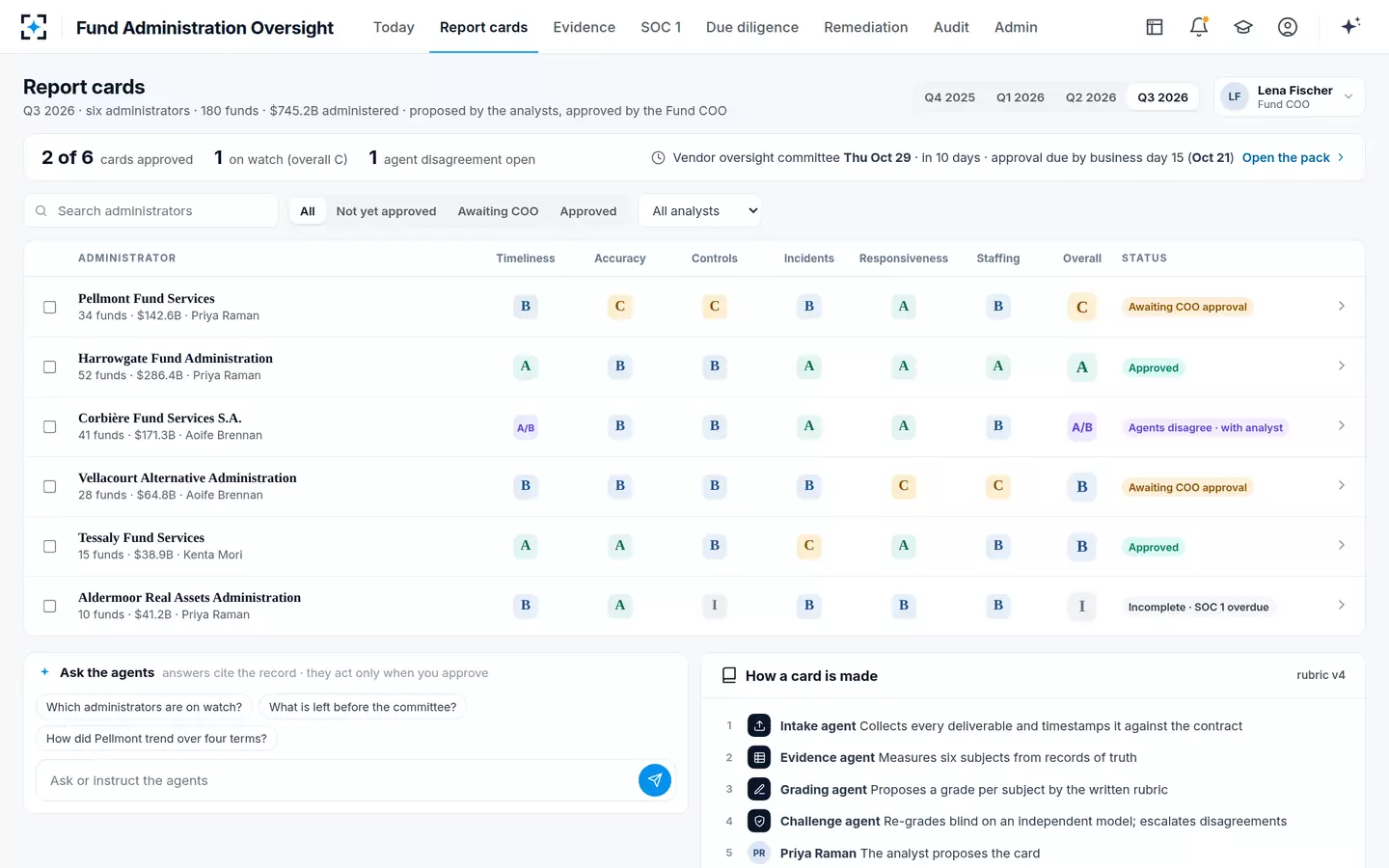
Most of what follows is routine, which is the point: quarterly cards, an annual review drafted from the year's evidence, and a board report built from approved cards. When an administrator's grade falls, the evidence already holds what a remediation letter or a re-tender needs. The board's view of the whole chain, from administrator to CCO, is set out in Rule 38a-1 service providers and the administrator.
What the COO sees each morning once oversight is running
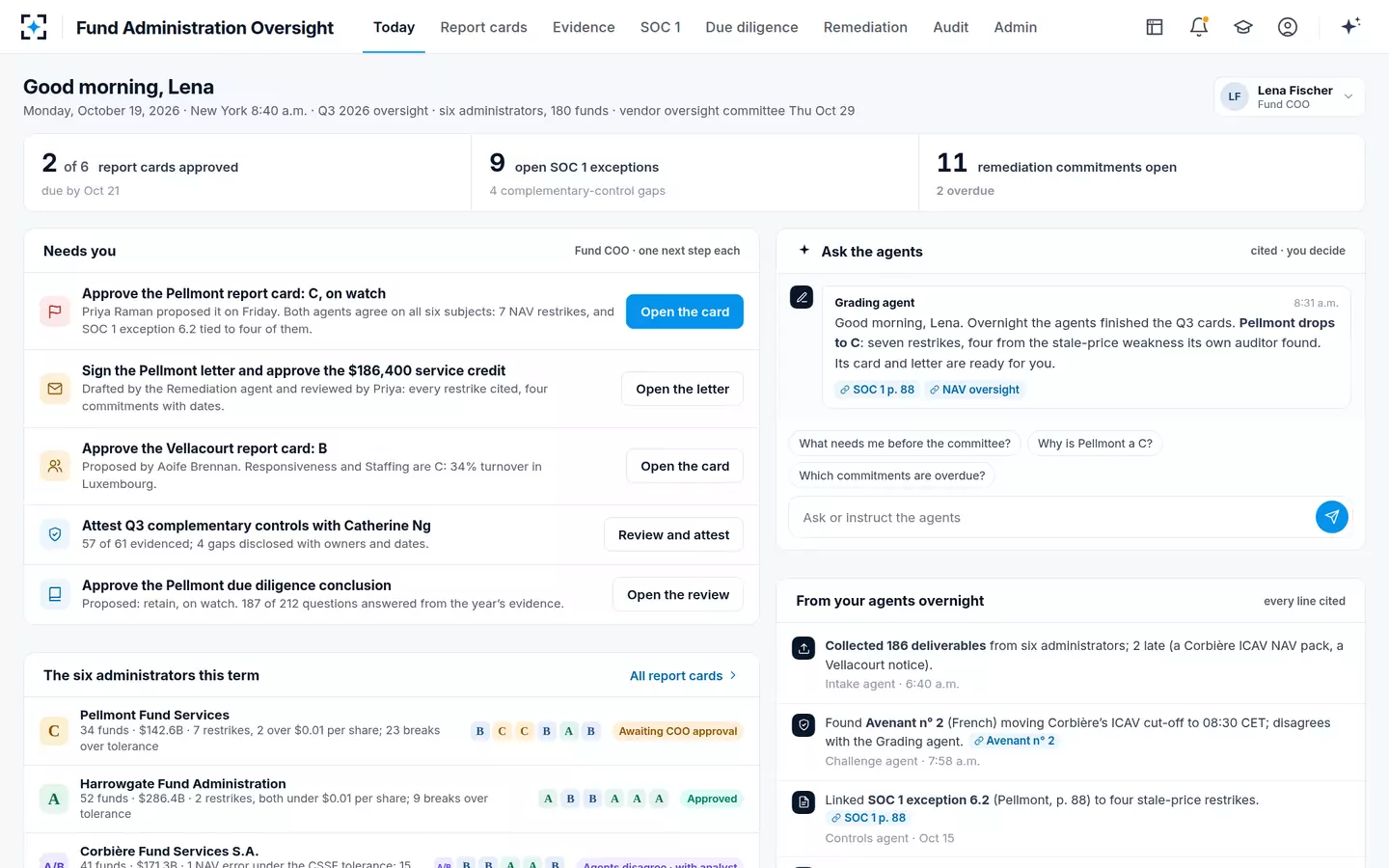
Questions people ask
What is financial outsourcing in fund management?
It is the transfer of operational finance work, such as fund accounting, NAV calculation, investor servicing and reporting, to a third party under contract. The work moves; the manager's and the fund board's responsibility for the results does not, which is why each outsourced function needs an oversight program.
What must be in place before the first NAV with a new administrator?
A signed agreement with measurable service levels, a written error and tolerance policy, the administrator's controls report reviewed with the manager's complementary controls owned, reconciled opening balances, records ownership in writing, and for a registered fund the board's approval of the administrator's procedures. And measuring has to start on day one.
How much does it cost to outsource fund accounting?
No regulator or independent study publishes administrators' prices, which are negotiated per client. Compare quotes on common units, rate, minimums, activity charges and out-of-pocket costs, and add the manager's own oversight hours, which outsourcing reduces but never removes.
Can we change fund administrator without a parallel run?
It is possible for a simple fund, but rarely wise. Luxembourg lists a parallel run requirement as an element a transfer process can include, and the parallel run is the only point at which old and new NAVs can be compared before investors depend on the new one.
Who is responsible when fund accounting is outsourced and the NAV is wrong?
Toward investors and regulators, the fund and its manager first; between manager and administrator, the agreement allocates the cost; and an administrator can face regulatory action itself. The SEC found an administrator a cause of an adviser's violations in 2023 after it booked trading losses as a receivable at the adviser's direction.