Transfer agency services are the work a fund's transfer agent does to keep its register of investors and move money and shares in and out of it: recording who owns what, processing subscriptions, redemptions, switches and transfers, applying the fund's price, paying redemption proceeds and distributions, confirming each trade, answering investors and keeping the records a regulator will examine. In redemption processing most of the hours go into reading requests and matching them against signatures, fund terms and payee records, and that is the work AI agents can now take. What they should not take is the decisions: releasing a payment, applying a redemption gate, approving a new bank account and deciding that a request is fraud stay with named people, and the division between the two is what a buyer of transfer agency services or software should look at first. Botminds' Redemption Processing is an agentic solution built on that division: eight agents read, check and call back on every request, a processor prepares and a dealing supervisor releases.
Examples come from sample data on a fictional manager, Quillfield Capital; rules and findings come from the SEC, FinCEN, the European Commission and FINRA, linked where they appear.
What are transfer agency services?
In US law they start with five statutory functions. The SEC's 2026 proposal lists them: "countersigning securities upon issuance, monitoring for overissuance, registering the transfer of securities, exchanging or converting securities, and transferring record ownership of securities by bookkeeping entry" (SEC, 91 FR 56946). Around that core most transfer agents add paying agent work, which the SEC says "at least one-third" of them do, covering dividends, interest, "mutual fund redemptions, and corporate action and other payments to securityholders".
For funds the services go further. Mutual fund transfer agents act as administrators for the funds they serve, calculating dealing prices and "aggregating and providing order routing services to handle all aspects of enrollment and ongoing account servicing" (same release). Private funds buy the equivalent from fund administrators. There were an estimated 327 registered transfer agents in the United States on 30 June 2026, and the number filing annual reports has fallen from 287 in 2016 to 253 in 2025, according to the SEC.
Transfer agency services on one redemption: eight agent steps, four human decisions
Agent
Intake agentReads the request in any language, extracts every field with its citation, keeps the original unchanged and finds duplicates across channels.
Never: pass a field below 0.90 confidence without a person
Agent
Signature and fund terms agentsMatch signatures, seals and signers; apply the notice period, lock-up, fees and side letters from the fund's own clauses.
Never: apply a term without a cited clause
Agent
Gating agentTotals the dealing date, recalculates headroom and proposes the pro rata factor when a redemption gate binds.
A person decides
Dealing supervisor decides the redemption gateApproves or declines the allocation; nothing is scaled until they do.
Agent
Fraud and call-back agentsCompare sender and payee with the records on file; ring the number of record for any new or changed account.
Never: clear their own alert or dial a number from the request
A person decides
Fraud analyst and payments control decideThe fraud analyst decides fraud; payments control approves a genuine change of payment details.
A person decides
Dealing supervisor releasesA person who did not prepare the request releases it, seeing every check behind it.
Agent
Confirmation agent and desk orchestratorDraft confirmations in the investor's language after release, and the daily dealing report for the head of investor services to sign.
Never: send before release
What are transfer agency operations, day to day?
Transfer agency operations are the daily cycle that delivers those services: requests in, checks, pricing, release, posting, payment, confirmation, and reconciliation of what was paid against what was booked. On a fund dealing desk the cycle runs to the cut-off clock, and on a notice-deadline day it runs at double volume. In the sample, 2,146 redemption and switch requests worth $1.84 billion arrive by 11:42 on deadline day, through portal, email, fax and order network, for a 14:00 cut-off.
Most of the effort is not decision but verification. Botminds' estimate for that sample day is about 12 minutes of a person's time per request done by hand, roughly 54 person-days, against about 1.5 minutes to confirm a request the agents have prepared. That is an estimate on fictional data, not a measured result; a desk can measure its own figure by timing a sample of requests through each stage.
Which redemption tasks can AI agents take?
The ones whose output can be checked against a source: reading, matching, applying a written term, adding up, comparing with a record and calling a number on file. Each produces something a person can verify in seconds because it points to where it came from. The tasks that should stay with people are the ones whose output is a judgement or an authorisation, where the regulator, the board or the investor expects a named person to have decided.
Tasks, re-divided: what the agents do and what people keep
Reading each request
Agents doReads fax, email, portal and order-network requests in the investor's language and cites every value to its line
People keepReviews any field below the confidence threshold
Finding duplicates
Agents doMatches the same request arriving by two channels before either is paid
People keepConfirms which copy stands
Signatures and signers
Agents doScores signatures and seals against specimens; checks signers against the authorised list and signing rule
People keepDecides anything below the threshold; returns requests not in good order
Fund terms
Agents doApplies notice period, lock-up, fees and side letters from the cited clause
People keepVerifies the terms when they are first read; rules on exceptions
Redemption gate
Agents doTotals requests, recalculates headroom with each one, proposes the pro rata factor and drafts the notices
People keepDecides whether to apply the redemption gate and approves the allocation
Sender and payee
Agents doCompares the sender domain and payee with the records on file and holds any new or changed account
People keepDecides fraud; approves a genuine payee change
Call-back
Agents doRings the number on file, follows the script, records and transcribes
People keepListens to the call and decides what it shows
Release and reporting
Agents doGroups prepared requests for the checker; drafts confirmations and the daily dealing report
People keepReleases, never on their own work; signs the report
There is independent evidence that this kind of split helps the people who stay in the loop. A peer-reviewed study of a generative AI assistant used by 5,172 customer-support agents found it raised issues resolved per hour by 15% on average, and that less experienced and lower-skilled workers improved both the speed and quality of their work (Brynjolfsson, Li and Raymond, Quarterly Journal of Economics, 2025). That was customer support, not transfer agency, and no study has measured agents on redemption desks; the gains a desk will see are the ones it measures in its own pilot.
Who releases a redemption payment?
A person who did not prepare it. Maker-checker is the oldest control in transfer agency, and the SEC's exam staff still find it missing: a 2019 risk alert on transfer agents acting as paying agents found some where one person could move issuer money without anyone else confirming it (SEC OCIE Risk Alert, 2019). Agents change who prepares, not who releases.
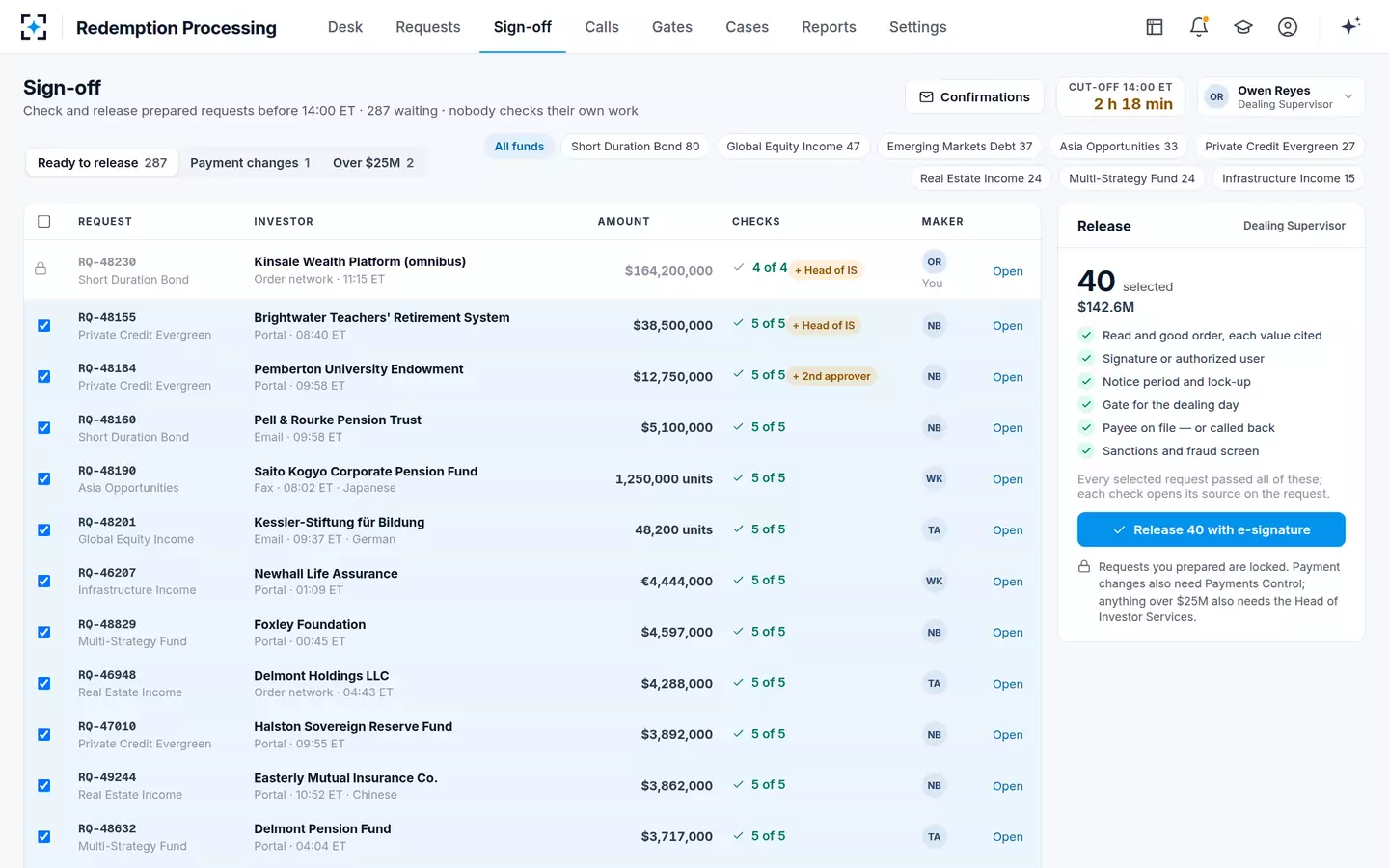
In the sample, a processor prepares, the dealing supervisor releases, and a request the supervisor prepared is locked for him. A change of payment details also needs payments control, and anything over $25 million the head of investor services. The supervisor selects 40 prepared requests worth $142.6 million and releases them with one e-signature, but only after seeing what was checked on each: good order with each value cited, signatures, notice period and lock-up, the redemption gate, the payee on file or called back, sanctions and fraud screening.
Release by a person who did not prepare the work
Who decides a redemption gate?
The fund's manager or board, as the documents say, through a dealing supervisor on the desk; never the software. The European rules make the decision explicit: when the threshold is exceeded, the manager decides whether to apply redemption gates or to pay the orders in full anyway, weighing liquidity, market conditions and investors' interests (Delegated Regulation (EU) 2026/465, recital 3; the mechanics are in what is a redemption gate). In the sample the gating agent proposes one pro rata factor for all 96 requests to a real estate fund whose limit binds, with the offering memorandum's clause beside it, and the allocation is applied only when the dealing supervisor approves.
What the agent contributes is arithmetic that can be trusted and repeated: the same requests always produce the same allocation, and headroom is current with every new request rather than totalled in a spreadsheet at noon. The arithmetic itself is set out in what is a redemption gate.
Who decides whether a redemption is fraud?
A fraud analyst, and above them the financial crime officer for any regulatory report. Agents find and assemble; they do not conclude. A mutual fund must file a suspicious activity report on a transaction of at least $5,000 where it knows or suspects, or has reason to suspect, that the transaction involves illegal funds or another listed concern (31 CFR 1024.320), and that suspicion is a person's.
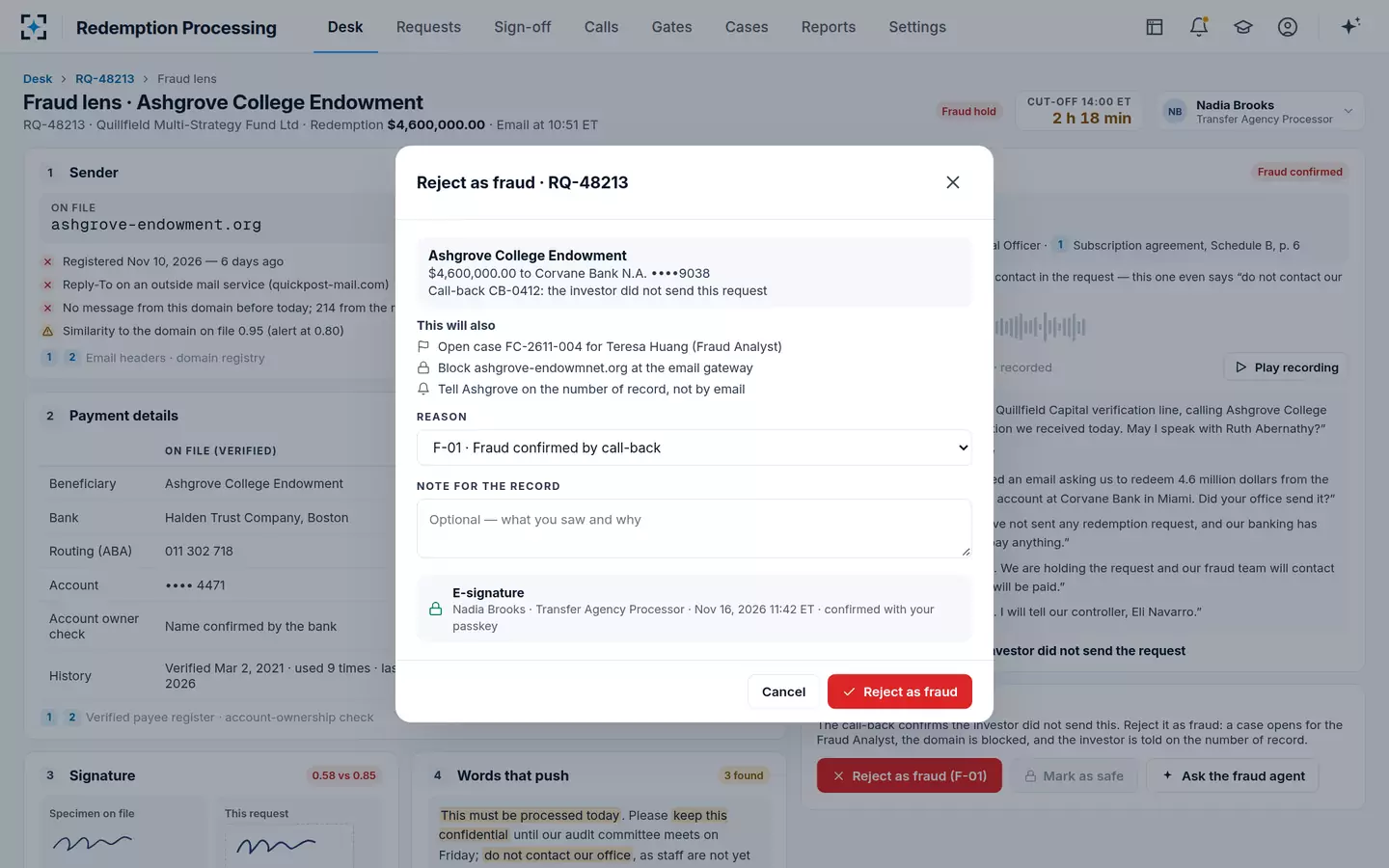
In the sample, the fraud agent holds a $4.6 million request from a lookalike domain and the call-back agent reaches the investor's chief financial officer on the number on file, who says no request was sent. The processor rejects it as fraud with a reason code and e-signature, which opens a case for the fraud analyst with the evidence and a look-across to other investors; whether to file a report is the financial crime officer's decision. The fraud itself, and the call-back that stops it, are in the change of bank details on a fund redemption.
Rejected as fraud by a person, with a reason and a signature
What changes for the people on the desk
The work shifts from verification to judgement, and the skills that matter shift with it. A processor who spent the morning re-keying faxes now spends it on the 145 requests, out of 2,146 in the sample, that the agents could not clear: a signer not on the list, a side letter that conflicts with the prospectus, an amount larger than the holding, a payee the investor has not yet confirmed. Those need knowledge of the fund documents and of fraud patterns more than typing speed, and training should follow.
The checker's share of the day grows. In Botminds' estimate for the sample day, the four-eyes check and release becomes the largest single block of remaining human time, about 1.8 of 6.6 person-days, because every release is still a person reading what was checked. A desk planning headcount should staff the checker and the second approvers for the deadline, not only the processors. And the fraud analyst moves from assembling evidence to deciding cases, which is the part of the job that cannot be delegated.
Transfer agency roles and responsibilities, before and after agents
Today
Reads and re-keys every request; looks up terms, specimens and payees in separate systems.
With agents
Works the exceptions the agents could not clear, starting with the ones that can hurt the fund before the cut-off.
Still theirs: Preparing; returning; rejecting fraud with a reason
Today
Spot-checks batches and totals the redemption gate by hand.
With agents
Releases with every check visible; approves the pro rata allocation.
Still theirs: Release; redemption gate decisions
Today
Assembles evidence from inboxes, call logs and screenshots.
With agents
Receives cases built with the call recording, transcript and look-across.
Still theirs: Deciding fraud
Today
Approves payee changes without seeing the verification call.
With agents
Approves in a locked lane with the call attached.
Still theirs: Second approval of payment changes
Today
Samples files after the fact and rebuilds what was checked.
With agents
Reads the record of every check, approval and override with who, when and why.
Still theirs: Independent assurance
What regulators expect when agents do the work
That the rules apply as before, and that people can show they supervise what the agents do. The SEC's 2026 transfer agent proposal says transfer agents adopting AI must ensure "effective oversight of automated processes" (91 FR 56946). The SEC's Division of Examinations, in its fiscal 2027 priorities, uses the term "super intelligence" and says it will look at firms' procedures for monitoring it, including in fraud prevention and back-office operations (SEC, FY2027 examination priorities). FINRA's 2026 oversight report lists the risks of AI agents for broker-dealers, among them autonomy without human validation, acting beyond intended scope, and multi-step reasoning that makes outcomes hard to trace and audit (FINRA, 2026 Annual Regulatory Oversight Report).
Each risk has a design answer a buyer can test. Autonomy: agents that cannot release, approve or clear their own alerts. Scope: limits written into each agent and enforced by the system, not by instruction alone. Traceability: every value and every agent statement cited to the page, line or clause it came from, and a record of every action by people and agents that cannot be edited. The SEC's proposal would also give each transfer agent's board an annual review of compliance policies, which is where those design answers would be examined.
What to ask before buying transfer agency services or software with agents
Ask what the agents may not do, before what they can. The questions below separate a system that prepares work for people from one that makes decisions it cannot explain.
Ten questions for a transfer agency provider or software vendor
- Can any agent release a payment, approve a payee or clear a fraud alert?
The answer should be no, enforced by the system.
- Does every extracted value point to the page and line it came from?
Including in the investor's own language, beside the original.
- Where does the call-back number come from?
It should be the number on file before the request, never one in it.
- Are thresholds versioned, and replayed before a change applies?
Signature scores, call-back triggers and approval limits change misses and false holds.
- Is the redemption gate allocation deterministic?
The same requests must always give the same factor, with the clause cited.
- Can a person who prepared a request release it?
Maker-checker should be enforced, not advised.
- What is kept, for how long, and can it be edited?
Who, what, when, why and the evidence, for the period your rules require.
- How does it work with the transfer agency system of record?
Register, holdings and trades should flow both ways; the agents should not become a second register.
- Can we replay last quarter before go-live?
On our own requests, with our own outcomes.
- Where is each fund's data held?
By region, with access limited to the roles that need it.
Where Redemption Processing fits, and where it does not
It fits the checking of redemption and switch requests between receipt and release. It works with the systems a dealing day already runs on: the transfer agency system of record for the register, holdings and trades; mailboxes, fax and the investor portal for requests; document management for offering documents and specimens; fund accounting for NAV; telephony for call-backs; and the payments hub, sanctions screening and bank-account validation after release.
It is not a transfer agency system of record, a fund accounting engine or a payments system, and it does not replace them. Investor onboarding, KYC and AML reviews are separate work, covered by Botminds' Investor KYC/AML Onboarding, and answering investors' questions by Investor Relations AI. Under the one-business-day turnaround and posting standards the SEC has proposed, set out in the SEC transfer agent proposal, the division of work above decides whether a desk can keep up. The full desk is on the Redemption Processing page.
Questions people ask
What is the difference between a transfer agent and a fund administrator?
A transfer agent keeps the official register of a fund's investors and processes changes to it; in the US a mutual fund's transfer agent must be registered with the SEC or a bank regulator. A fund administrator provides accounting, valuation and investor services, often including subscriptions and redemptions for private funds, which may not use a registered transfer agent. Many firms do both.
Can transfer agency services be fully automated?
The reading, matching and arithmetic can be; the decisions should not be. Releasing payments, applying a redemption gate, approving payee changes and deciding fraud are authorisations that regulators, boards and investors expect a named person to make, and maker-checker requires two.
Do AI agents change who is responsible for an error?
No. The transfer agent and the fund remain responsible for complying with their rules whatever tools they use, and the SEC's 2026 proposal expects firms using AI to ensure effective oversight of automated processes. Agents make responsibility easier to show, if every step they take is recorded and cited.
What are the main transfer agency roles and responsibilities?
On a dealing desk: the processor who prepares requests, the dealing supervisor who checks and releases, the fraud analyst who decides holds, payments control for payee changes, and the head of investor services who owns the service level and reports to fund boards. Compliance, internal audit and the financial crime officer sit around them.
Can agents handle requests in other languages?
Yes, if each value is shown beside the original and cited to its line, so a person can check it without trusting a translation. In the sample, requests arrive in Japanese, German, French and other languages; the original is kept unchanged, and any field below 0.90 confidence goes to a person.
How many transfer agents are there in the US?
The SEC estimated 327 registered transfer agents on 30 June 2026, of which it is the regulator for 272; the rest answer to the OCC, the Federal Reserve or the FDIC. Annual report filers have fallen from 287 in 2016 to 253 in 2025.