Transfer agency software keeps a fund's register of investors and runs the dealing, payment and servicing work around it; newer software adds agents that read and check requests before people release them. Whatever a firm buys, the business case rests on a few measured numbers, and the board will believe them only if they are defined the same way every quarter: how fast requests are turned around and posted, how many arrive in good order, how many errors the checks miss and how many good requests they hold, whether every new bank account was verified, how much fraud was stopped and lost, and what a request costs to process. No regulator or independent study publishes a benchmark for any of these, and vendors' figures are not independent, so the comparison is the desk against itself, before and after. Botminds' Redemption Processing is an agentic solution whose daily dealing report links every figure to the requests behind it, which is what makes these measures auditable.
Sample figures on this page come from fictional data in the solution; rules, losses and findings come from the SEC and the FBI.
Measure by channel: the sample deadline day's 2,146 requests by how they arrived
Requests by channel, notice-deadline day
- Investor portal · 55.2%
- Email · 29.7%
- Fax · 9.1%
- Order network · 6%
What does transfer agency software do?
At its core it is the system of record: the register of holders, their positions and transactions, the prices at which they dealt, and the payments made to them. Around that core sit the services the SEC describes transfer agents performing for funds, from calculating dealing prices to routing orders and handling enrolment and ongoing account servicing end to end (SEC, 91 FR 56946; the services are taken seat by seat in transfer agency services with agents). The money involved is large: the SEC reports that transfer agents distributed "nearly $4.4 trillion in dividend disbursements and interest payments" in 2024, a figure that excludes mutual fund transfer agents, and that gross purchases and redemptions at some of the largest mutual fund transfer agents have reached almost $10 trillion in one year at one firm.
Software that checks redemption requests sits in front of that system of record. It does not hold the register; it reads each request, checks it against the fund's terms, the investor's specimens and the verified payee, and hands prepared requests to people for release, writing the result back. The KPIs below apply to both layers, but the business case for the second rests mostly on four of them: turnaround, misses, payee control coverage and cost per request.
What KPIs should a transfer agent track?
Eight, each with a formula that does not change from quarter to quarter and a source the board can audit. They are chosen so that no single number can be improved by hurting another without the report showing it: faster turnaround that comes from skipping checks shows up as misses, and fewer misses that come from holding everything show up as false holds and slower turnaround.
Eight transfer agency KPIs, each defined so a board can compare quarters
Turnaround
Business hours from system receipt to acceptance or return
Split by channel and by routine and non-routine. The SEC has proposed one business day for routine items.
Posting time
Business days from pricing to posting on the shareholder file
Five business days for fund transfer agents today; one under the SEC proposal.
First-pass good order
Requests accepted as received ÷ all requests
No regulator publishes a benchmark; your own trend is the comparison.
Return speed
Share of not-in-good-order requests returned, with reasons, before the cut-off
The SEC has proposed written reasons within one business day.
Misses and false holds
Per thousand requests, by check, after adjudication
Report both: tuning one moves the other.
Payee control coverage
New or changed payees called back on the number on file and approved by a second person ÷ all of them
The board should expect every one.
Fraud stopped and lost
Attempts and dollars stopped; dollars paid to fraud; time from receipt to hold
Attempts without losses shows the controls working.
Cost per request
Person-minutes per request by stage × loaded cost, plus error costs, ÷ requests
Measured on a sample; split by channel.
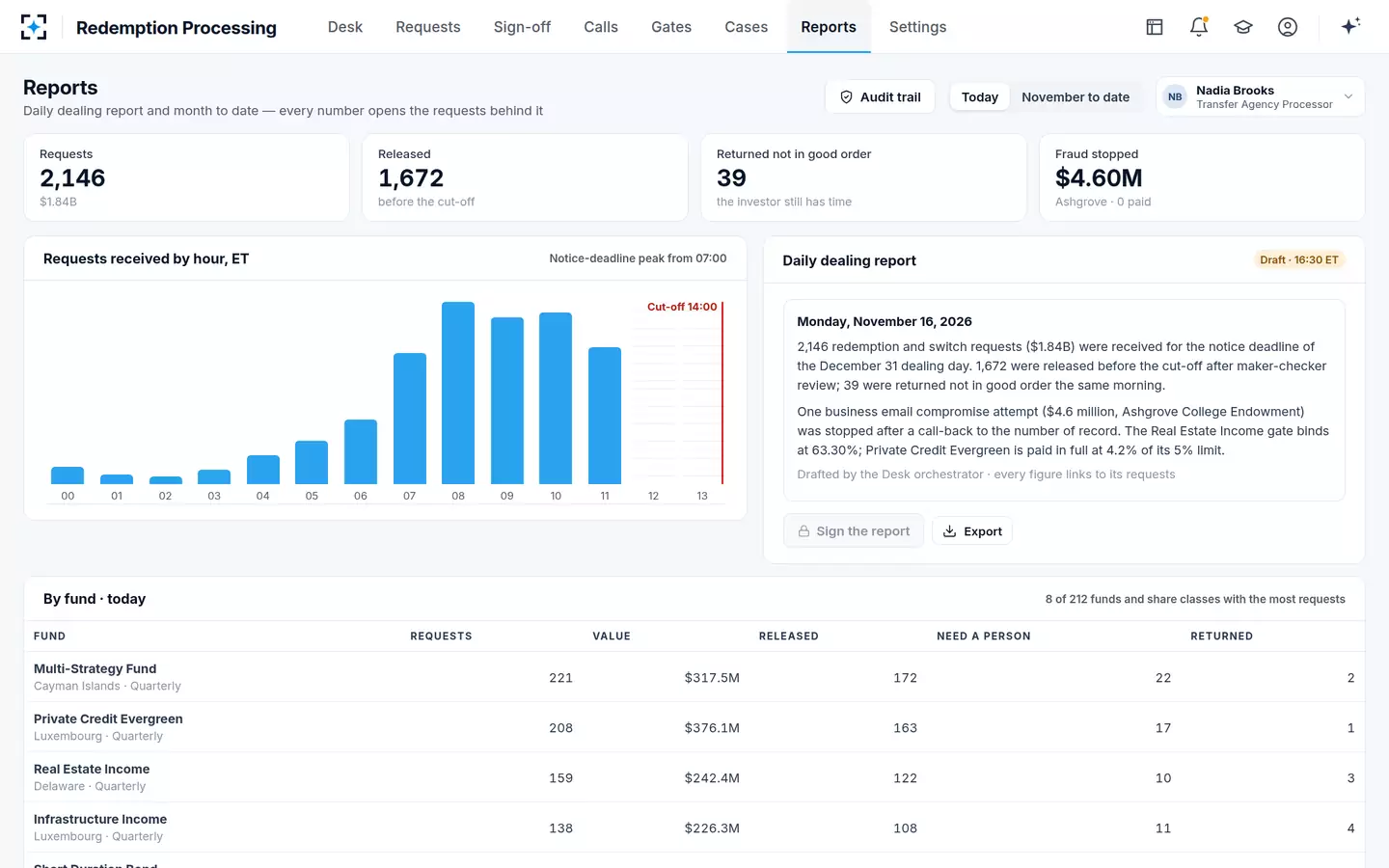
Every KPI should be reported twice: for the quarter as a whole and for its notice-deadline days. The deadline is when volume doubles, when shortcuts are tempting and when fraud is timed, so a desk that looks fine on average may be failing exactly when it matters. In the sample, 2,146 requests arrive on the deadline day against about half that on a normal day.
How do you measure transfer agency turnaround?
From the moment the firm's systems receive a request to the moment it is accepted for processing or returned with reasons, in business hours, by channel. The definition matters because the rules use more than one. Today Rule 17Ad-2 measures turnaround of routine items in business days, with items received after noon deemed received at noon the next business day, and requires 90% within three business days (17 CFR 240.17Ad-2); fund shares are currently exempt. Posting to the shareholder file must be done within five business days for fund transfer agents (17 CFR 240.17Ad-10(a)(2)).
The SEC's September 2026 proposal would tighten both: routine items turned around within the shorter of one business day or T+1, with no noon convention, every redemption posted within the same period, and a notification to the SEC when more than 3% of items miss (91 FR 56946). It is a proposal, and whether fund redemptions would count as routine is a question the SEC asked, worked through in the SEC transfer agent proposal. A desk that already measures in business hours, from system receipt, can report against any version the SEC adopts.
What is the cost of a redemption fraud loss compared with controls?
A single successful payee fraud can cost more than a year of the control that would have stopped it. The FBI's Internet Crime Complaint Center received 24,768 business email compromise complaints in 2025 with $3,046,598,558 in reported losses (IC3, 2025), an average of about $123,000 per complaint. A transfer agent's exposure is larger per incident, because redemption proceeds are large: the SEC found that Equiniti Trust Company's control failures cost clients more than $6.6 million, and the firm paid an $850,000 penalty on top (SEC, 2024).
One stopped payee fraud is worth more than the average complaint by an order of magnitude
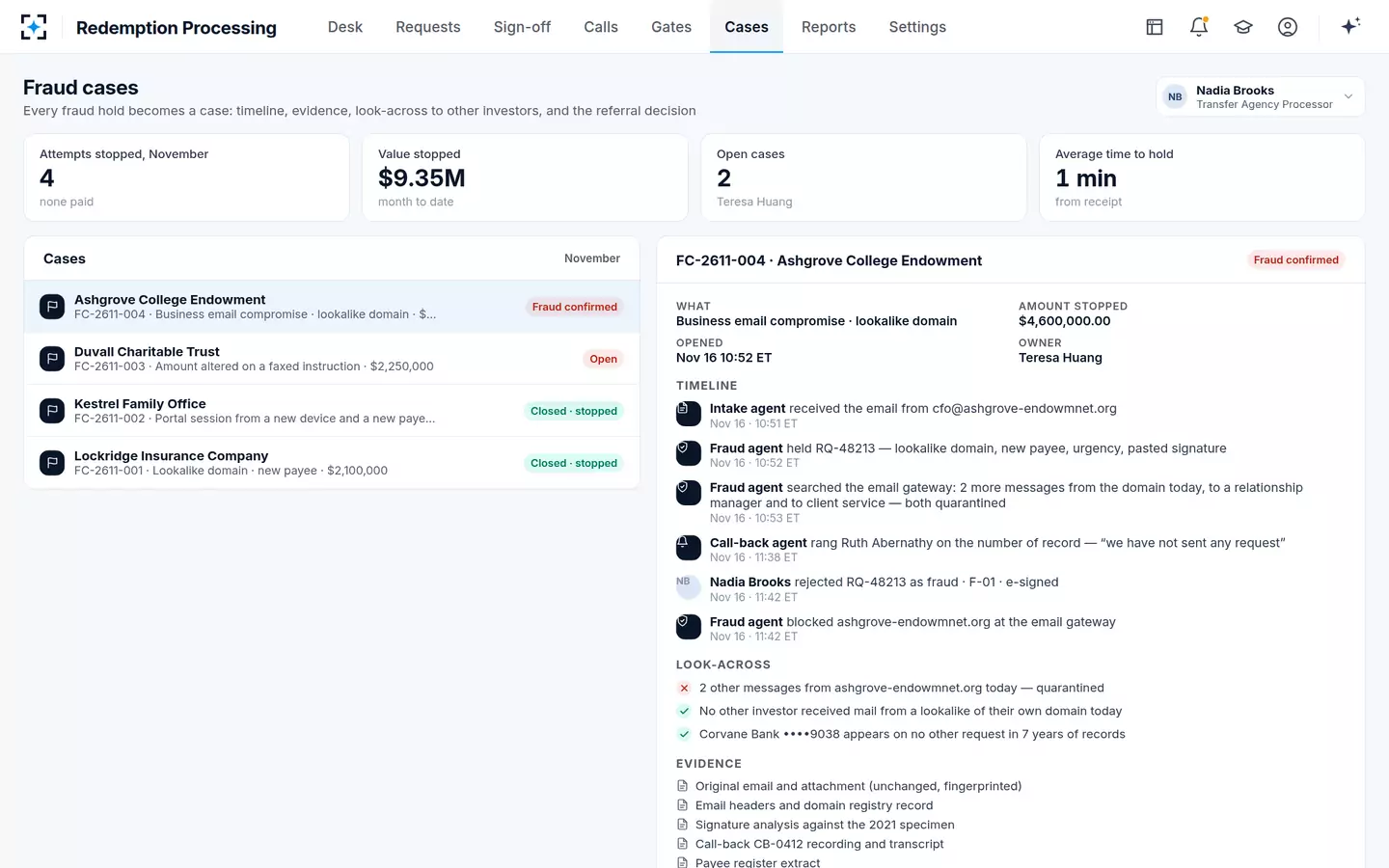
The control's cost is small by comparison and can be measured: the minutes per call-back, the number of call-backs per quarter, and the second approver's time. In the sample, 64 call-backs on the deadline day confirmed 58 payees, found one fraud and one altered amount, and left 4 retrying. The KPI that ties them together is payee control coverage, reported beside fraud stopped and lost, so the board sees both the work and its result.
How do you measure cost per redemption?
By timing a sample of requests through each stage, multiplying by the loaded cost of the people involved, and adding the cost of errors and systems, split by channel. No regulator or independent study publishes a cost per redemption for transfer agents, and vendors do not publish prices, so this is the only comparison that holds. A fax that needs re-keying and a signature comparison costs more than a portal request from an authenticated investor, and a cost per request that ignores the mix will mislead.
The person-time is the largest element and the easiest to measure. Botminds' estimate for the sample deadline day is about 12 minutes of a person's time per request by hand, roughly 54 person-days for 2,146 requests, against about 1.5 minutes to confirm a request the agents prepared; that is an estimate on fictional data and should be replaced by the desk's own timings. Error costs come from the replay of a closed quarter: NAV corrections, fees not charged, redemption gate allocations recalculated and payments recovered, described in redemption processing, replayed on last quarter's requests.
How do you show transfer agency software ROI to a board?
With the same eight measures before and after, on the desk's own requests, and with the benefits that cannot be priced named rather than guessed. The SEC itself takes that approach: in its transfer agent proposal it estimates a present value of compliance costs of $318,599,704 over ten years at a 3% discount rate, and says plainly "we are not able to monetize benefits" (91 FR 56946, section V). A board will trust a case that does the same more than one that converts every avoided risk into dollars.
In practice the case has three parts. Hours: person-time per request by stage before and after, from timed samples, converted to cost. Errors: misses and their cost from a replayed quarter, before and after, with false holds alongside. Controls: payee control coverage and maker-checker exceptions before and after, which may carry no cost line at all but are what an examiner and the board's risk committee will ask about. SEC exam staff found transfer agents where issuer money could move on one person's say-so (SEC OCIE Risk Alert, 2019); showing that every payment change had two approvers is a benefit a board understands without a price.
What does the SEC transfer agent proposal add to measure?
Four new numbers, if it is adopted as proposed. The share of routine items turned around within one business day, and whether misses exceed 3%. The time from pricing to posting for every redemption, against one business day. For every rejected item, whether written reasons reached the presentor within one business day; the SEC asks whether firms should also keep data on each rejection, its reasons and how quickly the presentor was told. And on Form TA-2, the dollar amounts of open-end fund purchases and redemptions processed in the year (91 FR 56946).
A desk that builds its KPIs now on business-hour timestamps, reason codes for every return, and posting times will have those numbers when the rule is final, whatever its final form. The proposal also asks each registered transfer agent's board to approve its compliance policies annually; the KPI report is a natural attachment to that review.
A daily dealing report in which every figure opens its requests
Transfer agency software companies: how to compare them
Compare them on your requests and your KPIs, not on feature lists. The market divides into platforms that are the system of record, and tools that sit in front of one to read, check and route work; a firm may need either or both, and the business case for each is different. A system-of-record replacement is a multi-year project whose case rests on platform cost and resilience. A checking layer can be piloted in weeks on a closed quarter and a shadow run, and its case rests on the KPIs above.
Whichever kind, four questions decide. Will it report the eight KPIs from its own records, with each figure traceable to requests? Can it be replayed on a closed quarter before purchase? Does it enforce maker-checker and payee controls in the system rather than in procedure? And will it produce the numbers the SEC's proposal would ask for, if adopted? How to run the trial is in redemption processing software, proved in a shadow run.
Where Redemption Processing fits in the business case
It is a checking layer for redemption and switch requests, working with the transfer agency system of record, not replacing it. It contributes to the case through the four KPIs it moves most directly: turnaround, because agents prepare each request as it arrives; misses, because every check runs on every request with its evidence; payee control coverage, because every new or changed account is held and called back on the number of record, with zero unverified payments as the design target; and cost per request, measured in a pilot. Fraud stopped is reported from its cases: in the sample, four attempts in November worth $9.35 million, none paid. The full desk is on the Redemption Processing page.
Fraud stopped and lost, from the cases themselves
Questions people ask
What is a good turnaround time for fund redemptions?
No benchmark is published. The current SEC turnaround rule does not apply to fund shares; the September 2026 proposal would end that exemption and set one business day for routine items and for posting every redemption to the shareholder file. A desk should measure its own turnaround in business hours from system receipt and track the trend, separately for notice-deadline days.
What is the straight-through processing rate in transfer agency?
It is the share of requests that pass from receipt to release without a person handling them beyond the release itself. It is a useful measure only beside misses and false holds, because a high straight-through rate achieved by loosening checks is a worse result, not a better one.
How often should transfer agency KPIs go to the board?
Quarterly, with the notice-deadline days broken out and any control exception named. Boards of registered transfer agents would, under the SEC's proposal, review compliance policies at least annually, and a quarterly KPI report gives that review its evidence.
Should fraud KPIs count attempts or losses?
Both. Losses show outcomes but are rare and lumpy; attempts stopped, time to hold and payee control coverage show whether the controls are working every day. A quarter with attempts and no losses is evidence for the controls, not a reason to relax them.
Is cost per redemption comparable between firms?
Only if both measure the same stages, the same channel mix and the same costs, which is rarely true. Use it to compare your desk with itself over time, and with a pilot, rather than with another firm's published figure.