A redemption gate is a limit, written into a fund's own documents, on how much the fund will pay out to redeeming investors on a single dealing date. When the requests for that date stay under the limit, everyone is paid in full. When they exceed it, the manager may activate the redemption gate: each investor receives the same proportion of what they asked for, and the unpaid part is carried to a later date or cancelled on terms set out in advance. Redemption gates are common in hedge funds, real estate and private credit funds, and in European funds, which from April 2026 must choose at least two liquidity tools from a list that includes them; a US mutual fund cannot use one. Applying a redemption gate looks like arithmetic, but it lands on a dealing desk on the busiest day of the quarter, with hundreds of requests still arriving. Botminds' Redemption Processing is an agentic solution for that desk: its agents total every request against the fund's limit as it arrives, propose the pro rata allocation from the fund's clause, and leave the decision to a dealing supervisor.
The examples on this page come from sample data on a fictional manager, Quillfield Capital, as its December 31, 2026 quarterly dealing day runs through the solution. The rules come from the SEC, the European Commission, ESMA and the FCA, linked where they appear.
Where redemption gates sit in the rules, in four numbers
7days
the most a US registered fund may postpone paying a redemption, outside emergencies, so it cannot impose a redemption gate
2
liquidity tools, at least, that every EU UCITS and open-ended AIF must select, a redemption gate among the options
10%
of a UK authorised fund's value, unless its prospectus sets another level: above it, redemptions may be deferred to the next valuation point
2027
the year until which AIFs set up before 16 April 2026 are deemed to comply with the EU tool standards
What is a redemption gate, in the regulator's terms?
A redemption gate is a temporary, partial restriction on redemptions, triggered when requests pass a threshold the fund disclosed in advance. The clearest legal definition is now European. Commission Delegated Regulation (EU) 2026/465, which sets out how each liquidity tool must work for alternative investment funds, says a manager that activates redemption gates "shall apply those redemption gates uniformly to all investors of the AIF" and that each redemption gate "shall have an activation threshold below which the redemption gate cannot be activated" (Article 2).
Three features follow from that text and separate a redemption gate from the other tools a fund may hold. It is partial: some money still goes out on the dealing date. It is uniform: no investor is paid more of their request than another because of who they are. And it is pre-committed: the threshold, and what happens to the unpaid balance, are in the fund rules before anyone asks to leave. A suspension is different in kind. Under the same regulation a suspension stops subscriptions, repurchases and redemptions together, "simultaneously, for the same period and for all investors" (Article 1), while a redemption gate keeps the fund dealing at a reduced rate.
The threshold can be set in three ways. A fund-level gate looks at total net or gross redemption orders for the dealing date, expressed as a share of net asset value, a money amount, a share of liquid assets, or a combination. An investor-level gate looks at each investor's own order, as a percentage of that investor's holding or of the fund's net asset value. A combined gate uses both. Article 2 then adds the rule that makes a redemption gate fair: once it is activated, the orders of all investors for that dealing date are executed pro rata, for an amount at least equal to the threshold.
How a redemption gate works on one dealing date
On the day, a redemption gate is a sequence of checks with one decision in the middle. Requests are totalled for the dealing date, the total is compared with the threshold, and only if it passes does anyone have to decide whether to apply the redemption gate. The decision is the manager's: the European regulation's recitals say that when the threshold is exceeded the manager "should be able to decide to activate redemption gates or to still execute redemption orders", having regard to liquidity, market conditions and investors' interests (recital 3).
A redemption gate, from the first request to the investor notice
Agent
Total the dealing dateEvery request for the date is added as it arrives, net or gross as the fund rules say, and converted to the threshold's unit: share of NAV, money amount or share of a holding.
Never: count a request twice when it arrives by fax and by email
Agent
Test the thresholdHeadroom is recalculated with each request; the fund-level gate is reported as open, close or binding, and each investor-level gate per holder.
Agent
Propose the factorIf requests pass the threshold, the pro rata factor is the threshold amount divided by the total, applied to every request, with the clause cited.
Never: vary the factor by investor
A person decides
Decide to apply itA dealing supervisor, or the board where the fund rules say so, decides whether to activate the redemption gate or pay in full, and records why.
Agent
Carry or cancel the balanceThe unpaid part of each request is carried to the next dealing date, with or without priority, or cancelled, exactly as the documents say.
A person decides
Tell the board and investorsThe notice to each investor states the factor, the amount paid and what happens to the rest; the supervisor approves it before it goes.
Two practical problems sit inside that sequence. The first is timing. Most redemption gates are measured against the net asset value of the dealing date, which is not known when the notice deadline passes, so the factor proposed on notice day is an estimate that must be re-run when the price is struck. The second is information. ESMA's guidelines warn managers to handle the level of orders received so that no investor gains from knowing how likely a liquidity tool is to be activated, and give the activation threshold of redemption gates as the example (ESMA guidelines, paragraph 18). A desk that tells one large investor the redemption gate is close has handed that investor a reason to redeem first.
How is a gated redemption paid pro rata?
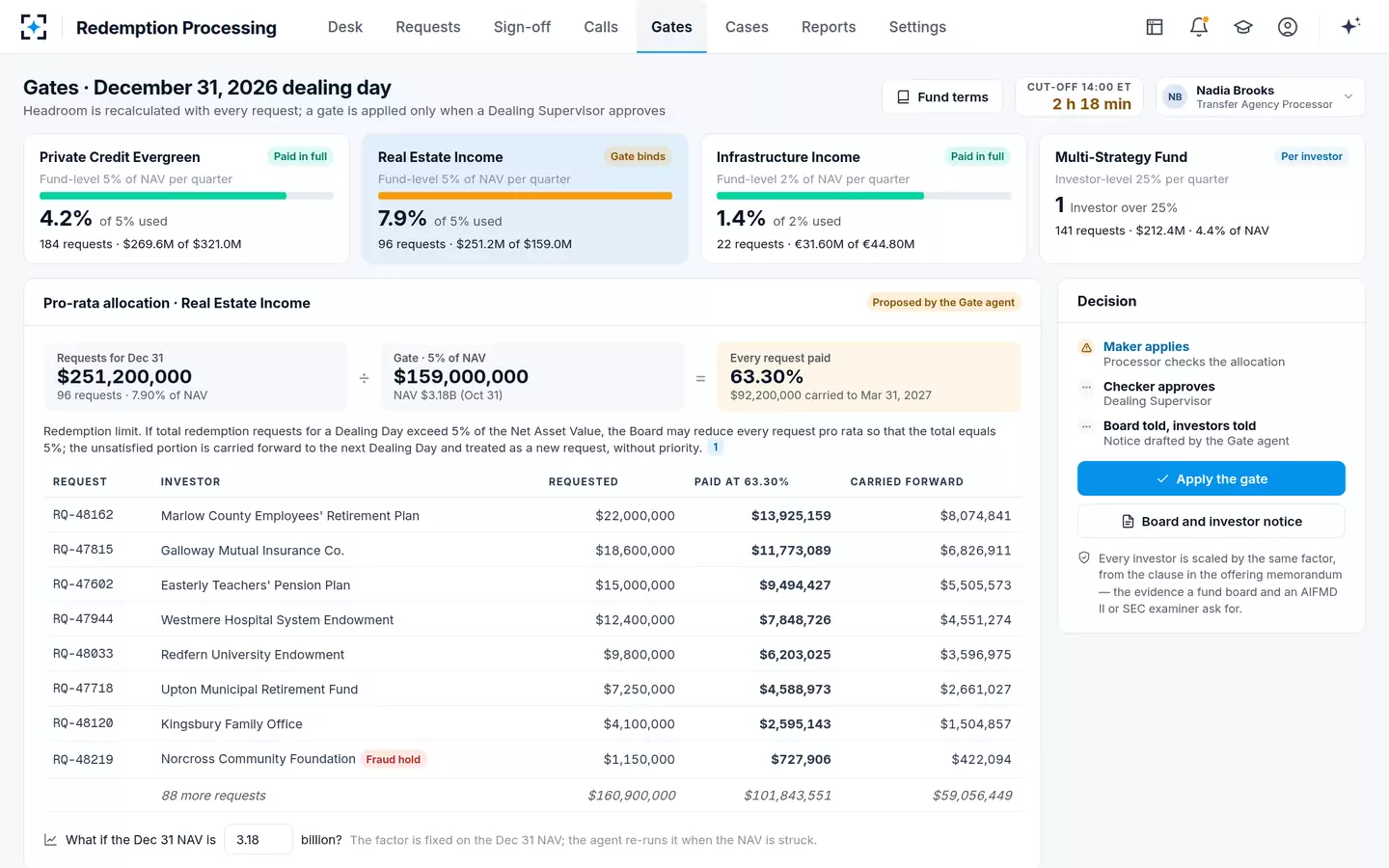
Every redeeming investor is paid the same fraction of their request: the threshold amount divided by the total requested. Take the sample Real Estate Income fund, which allows redemptions of up to 5% of net asset value per quarter. For December 31, 96 requests total $251.2 million, 7.9% of a $3.18 billion NAV, against a limit of $159.0 million. The factor is $159.0 million divided by $251.2 million, or 63.30%.
When the redemption gate binds, every request is cut by the same factor
Real Estate Income, December 31 requests: $251.2 million
- Paid on the dealing date · 63.3%
- Carried to March 31, 2027 · 36.7%
Marlow County Employees' Retirement Plan: $22,000,000 requested
- Paid, $13,925,159 · 63.3%
- Carried, $8,074,841 · 36.7%
The largest request in the sample, from a fictional county retirement plan, asked for $22,000,000 and is paid $13,925,159, with $8,074,841 carried forward. The smallest of the 96 is scaled by exactly the same factor. That is the point of pro rata: no investor gains by being early, large or well connected, which is why the European regulation insists on it and why a fund board will ask to see it proved line by line.
Two details trip up hand calculations. Rounding has to be done at the end, on each investor's amount, not on the factor: a factor rounded to 63.3% would pay the Marlow plan $13,926,000, $841 more than its share, and the error multiplies across 96 lines. And the factor must be applied to the amount the investor actually holds and is entitled to redeem after lock-ups, fees and minimum holdings, not to an amount they asked for and could not have had. A request for more units than the holding has to be corrected or returned before it enters the total, or it dilutes everyone else's share.
The pro rata allocation, with the clause it rests on
What happens to the unpaid part of a gated redemption?
The unpaid part is dealt with exactly as the fund documents say, and the documents usually choose one of three treatments. The European regulation's recitals list them: the non-executed part may be transferred automatically to the following dealing date "with or without priority over redemption orders submitted at a later dealing date", or the non-executed orders may be cancelled (recital 5). The UK rule for authorised funds that defer redemptions takes the priority view: deals relating to an earlier valuation point must be completed before those relating to a later one are considered (COLL 6.2.21R(2)).
The choice matters more than it looks. Without priority, as in the sample clause, the $92.2 million carried from December joins whatever new requests arrive for March, and if the redemption gate binds again the carried amounts are cut again. With priority, carried requests are paid first and new requests absorb the cut. Cancellation returns the decision to the investor, who must submit a fresh request and meet the notice period again. Each treatment changes which investors bear a run, and each has to be applied the same way to every request, so the carried balance has to be tracked per investor and per original dealing date.
The price is the second consequence. The executed part is priced at the dealing date on which it is paid; a carried part is priced on the later date on which it is executed. An investor who asked to leave in December and is paid partly in March takes the fund's performance for the quarter in between on the carried amount. That is the trade-off the investors accepted when they subscribed, and it is why the investor notice must state the factor and the carried amount precisely.
What is an investor-level gate?
An investor-level gate limits what one investor can take out on a dealing date, whatever everyone else does. The European regulation bases it on "the individual gross redemption orders submitted by each unit-holder or shareholder" and lets the threshold be expressed as a percentage of that investor's holding or of the fund's net asset value (Article 2(4)). ESMA asks managers of funds with no retail investors and a limited number of professional investors to consider investor-level redemption gates, alone or with fund-level ones, "to mitigate first mover advantage" (paragraph 27a).
This is the familiar hedge fund gate. The sample Multi-Strategy Fund, domiciled in the Cayman Islands, lets each investor redeem up to 25% of their holding per quarter. On notice day 141 requests total $212.4 million, only 4.4% of the fund, yet one investor has asked for more than a quarter of its holding and is limited regardless of how quiet the rest of the book is. A fictional endowment's request elsewhere on the same day uses 16.6% of its 25% allowance and passes.
The operational difference is that an investor-level gate must be tested against each holder's position at the right date, net of any part already redeemed in the period, which means the desk needs holdings by investor, not just a fund total. Side letters complicate it further: a side letter may give one investor a different allowance, and the fund must still show that it applied everyone's terms as written.
Can a US mutual fund gate redemptions?
No. A US registered open-end fund must pay redemptions within seven days and cannot impose a redemption gate. Section 22(e) of the Investment Company Act says no registered investment company shall suspend the right of redemption or postpone payment "for more than seven days after the tender of such security", except while the New York Stock Exchange is closed or trading is restricted, during an emergency, or under an SEC order (15 U.S.C. 80a-22(e)). The cost of a run is managed instead with liquidity rules, redemption fees and, in principle, swing pricing.
Who may limit redemptions, and with which tool
| Fund type | Can it use a redemption gate? | What it uses instead or as well | Rule |
|---|---|---|---|
| US mutual fund (open-end, registered) | No: payment within seven days of tender | Liquidity programme, redemption fees; swing pricing is permitted but optional | Investment Company Act s. 22(e); Rules 22e-4, 22c-1 |
| US money market fund | No longer: redemption gates were removed in 2023 | Liquidity fees (mandatory for institutional prime and tax-exempt funds above 5% daily net redemptions); suspension only to liquidate | Rule 2a-7 (as amended, effective 2 Oct 2023); Rule 22e-3 |
| US interval fund (closed-end) | No redemption gate, but repurchases are capped | Periodic repurchase offers of 5% to 25% of shares; pro rata if oversubscribed beyond the offer plus 2% | Rule 23c-3; modernisation proposed 5 Oct 2026 |
| US private fund (hedge, real estate, credit) | Yes, if the fund documents provide for it | Notice periods, lock-ups, fees, side pockets, suspension | The offering documents and partnership agreement |
| EU UCITS or open-ended AIF | Yes, if selected among at least two tools | Notice-period extension, fees, swing or dual pricing, anti-dilution levy, in-kind | Directive (EU) 2024/927; Delegated Regulation 2026/465; ESMA guidelines |
| UK authorised fund | Deferred redemption, its close relative | Deferral above 10% of value, or another disclosed proportion, to the next valuation point | FCA COLL 6.2.21R |
Money market funds are the instructive case, because they had redemption gates and lost them. The SEC's 2023 amendments, effective 2 October 2023, removed the board's ability "to temporarily suspend redemptions if the fund's liquidity falls below a threshold" (SEC, 88 FR 51404). Commenters had suggested that redemption gates were more likely than fees to prompt investors to redeem, the run they were meant to prevent. In its place, an institutional prime or tax-exempt fund whose daily net redemptions exceed five percent of net assets must charge a liquidity fee, and the board of a non-government fund may impose a discretionary fee of up to two percent (Rule 2a-7(c)(2)). A money market fund may still suspend redemptions, but only to liquidate, under Rule 22e-3.
Interval funds come closest to a US redemption gate. Their repurchase offers, the SEC's October 2026 proposal notes, "cannot be less than five percent or more than 25 percent" of the shares outstanding, and an oversubscribed offer is filled pro rata, a requirement "intended to prevent preferential treatment of any individual shareholder" (SEC, 91 FR 63388). The proposal would change how these offers are made; it is a proposal, not a rule.
When do EU funds have to use liquidity tools, and must one be a redemption gate?
From 16 April 2026, every EU UCITS and open-ended alternative investment fund must have selected at least two liquidity management tools, and a redemption gate is one of the options, not a requirement. Directive (EU) 2024/927 requires managers of open-ended AIFs to write at least two tools from a harmonised list into the fund rules, and inserts the same duty for UCITS, and Member States apply the measures "from 16 April 2026" (Directive (EU) 2024/927). Funds that existed before that date have longer for the detailed standards: under the delegated regulation's transitional provision, AIFs constituted before 16 April 2026 are treated as compliant until 16 April 2027 (Article 10).
ESMA's guidelines push the redemption gate up the list without making it compulsory. Managers "should consider the selection of redemption gates for all funds", because the tool "may be useful to avoid the activation of suspensions", and especially where the investor base is concentrated or the assets could become illiquid (paragraphs 23 and 24). Managers should not cap how long or how often a redemption gate may be used, so long as each activation "remains temporary in nature" (paragraph 27). The choice of the two tools, and how the second one interacts with the first, is set out in AIFMD II liquidity management tools: what applies from April 2026.
The UK version: deferred redemption at 10%
UK authorised funds use deferred redemption, which works like a fund-level gate with a default threshold. A fund with at least one valuation point on each business day may provide for deferral of redemptions to the next valuation point "where the requested redemptions exceed 10%, or some other reasonable proportion disclosed in the prospectus", of the fund's value (FCA COLL 6.2.21R). The prospectus must ensure "the consistent treatment of all unitholders" who sought to redeem at that valuation point, and earlier deals are completed before later ones.
The FCA's guidance gives the rationale in a sentence a board can use: deferral lets the manager "match the sale of scheme property to the level of redemptions", which "should reduce the impact of dilution" on continuing holders (COLL 6.2.22G). In the sample, the Irish and Luxembourg UCITS share classes carry a 10% of NAV per dealing day limit with the same logic, applied daily rather than quarterly.
Where redemption gates go wrong in operations
Redemption gates rarely fail in the drafting; they fail on the desk, under time pressure, in five recurring ways. Each one can be tested before the next quarter, on the last one, as replaying a closed quarter's requests shows.
The wrong denominator. A threshold measured on dealing-date NAV is tested on notice day against an older NAV, and nobody re-runs it when the price is struck. In the sample the factor is computed on the October 31 NAV of $3.18 billion and re-run automatically on the December 31 figure.
A late request that should have rolled. A request that missed the notice period belongs to the next dealing date; counted in this one, it shrinks everyone's factor. The cut-off and the notice deadline are the subject of the redemption notice period on a dealing desk.
Uneven application. One investor's request is processed in full before the total is known, and the rest are scaled. That breaks the uniformity both the EU and UK rules require, and it is the finding a board least wants.
Lost carried balances. Carried amounts are kept in a spreadsheet, priced on the wrong date or forgotten. They are new requests with old dates, and each needs its own line.
A leak. A relationship manager tells a large investor that the redemption gate is likely to bind. ESMA's paragraph 18 is the reason that call should never happen.
How Redemption Processing applies a redemption gate
In Redemption Processing the gating agent keeps the arithmetic and the evidence, and a person keeps the decision. It totals every request for the dealing date as it arrives, recalculates headroom per fund and per investor, and when the redemption gate binds proposes one factor for every request with the clause from the fund's own documents beside it. The agent is deterministic, so the same requests always give the same allocation, and the allocation is applied only after a dealing supervisor approves it. The investor and board notices are drafted from the same numbers.
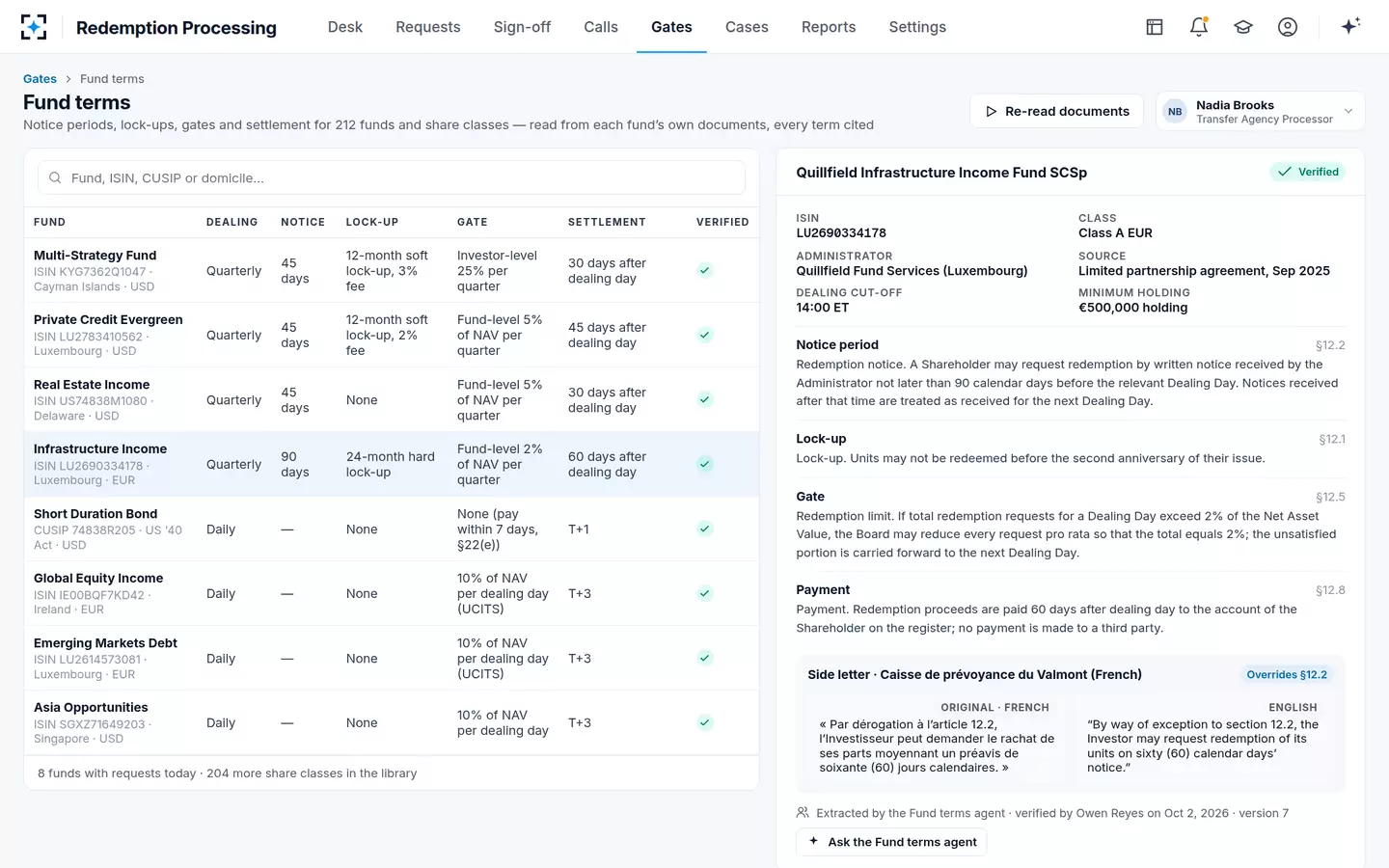
The fund terms themselves, thresholds, notice periods, lock-ups and carry-forward wording, are read from each fund's documents and verified by a person before they are used, with side-letter overrides shown against the clause they change. Whether pricing tools could have avoided the redemption gate in the first place is a question for the fund's liquidity team; the evidence on swing pricing and dilution, including a peer-reviewed study of UK corporate bond funds that found swing pricing cut outflows in market stress, is the place to start. The dealing desk's whole day, of which the redemption gate is one part, is on the Redemption Processing page.
Every fund's redemption gate, read from its own documents
Questions people ask
What does a redemption gate mean for an investor?
It means you may receive only part of your redemption on the dealing date you chose. If the fund's threshold is passed and the manager activates the redemption gate, you are paid the same percentage as every other redeeming investor, and the rest is carried forward or cancelled under the fund documents. In the sample fund that was 63.30% paid in December and the balance re-submitted for March.
Is a redemption gate the same as a suspension?
No. A redemption gate pays out a reduced amount and keeps the fund dealing; a suspension stops dealing altogether. Under the EU rules a suspension must stop subscriptions, repurchases and redemptions together, for all investors and for the same period, and only in exceptional circumstances.
How long can a redemption gate stay on?
The rules set no fixed limit, but they require it to be temporary. ESMA's guidelines tell managers not to cap the duration or the number of activations in the fund rules, so long as each activation remains temporary, and to decide case by case. A redemption gate that binds every quarter for years is, in substance, a change in the fund's liquidity terms.
What is the difference between a fund-level gate and an investor-level gate?
A fund-level gate is tested on the total of all redemption orders for the dealing date, typically as a percentage of NAV. An investor-level gate is tested on each investor's own order, typically as a percentage of their holding. EU rules allow either, or both combined.
Do money market funds still have redemption gates?
Not in the United States. The SEC removed them from Rule 2a-7 with effect from 2 October 2023 and replaced them with liquidity fees, mandatory for institutional prime and tax-exempt funds when daily net redemptions exceed 5% of net assets. A US money market fund may suspend redemptions only to liquidate under Rule 22e-3.
Why are redemption gates common in private credit and real estate funds?
Because their assets cannot be sold quickly at a fair price, while their investors may ask for cash every quarter. ESMA names funds whose assets might be less liquid, or might become illiquid in stress, among those that should especially consider redemption gates, and it gives real estate and private equity funds particular attention for notice-period extensions.