The FCA complaints handling timescales are set in DISP 1: a firm must acknowledge a complaint promptly; if it resolves the complaint by close of business on the third business day after receipt it sends a summary resolution communication instead; otherwise, by the end of eight weeks after receipt, it must send a final response or a written response explaining why it cannot yet give one and telling the complainant they may go to the Financial Ombudsman Service. Payment services and e-money complaints run on 15 business days, or 35 in exceptional cases. For an asset manager the harder questions are earlier ones: whether a client's email is a complaint at all, and whether that client is one the eight-week rule protects. Botminds' Client Inquiry Management treats both at intake: its Triage agent spots complaint language in any request and logs the complaint as its own case with its own clock, for the complaints process to handle.
The sample examples come from Quillfield Capital, a fictional firm in the solution.
The DISP clocks for an eligible complainant, and the faster one for payments
- Acknowledgepromptly
- Resolve by day 3: summary letter3 business days
- Otherwise: final or explanatory response by the end of week 8to 8 weeks
- Final response within 15 business days15 business days
- Exceptional cases: a holding reply firstfinal by 35 business days
What are the FCA complaints handling timescales?
Three clocks run from the day a complaint is received. On receipt, DISP 1.6.1R requires a prompt written acknowledgement that reassures the complainant it is being dealt with and says when a response will come, and the firm must keep the complainant informed after that (DISP 1.6.1R). If the complaint is resolved by close of business on the third business day after receipt, the time-limit rules do not apply, but the firm must promptly send a summary resolution communication saying it considers the complaint resolved and that the complainant may be able to refer it to the Ombudsman (DISP 1.5.1R and 1.5.4R). A complaint counts as resolved there when the complainant has indicated acceptance, "with neither the response nor acceptance having to be in writing".
Otherwise the eight-week rule applies. By the end of eight weeks after receipt the firm must send either a final response, which accepts the complaint, offers redress without accepting it, or rejects it with reasons, or a written response explaining why it cannot yet respond and when it expects to; either must tell the complainant they may now refer the complaint to the Financial Ombudsman Service (DISP 1.6.2R). The FCA's guidance adds an expectation, not a rule: "It is expected that within eight weeks of their receipt, almost all complaints to a respondent will have been substantively addressed" (DISP 1.6.7G).
Is an expression of dissatisfaction in an email a complaint?
Usually, if it alleges harm. The FCA's definition does not require the word "complaint", a formal tone or even a justified grievance. For DISP 1.1 and the Principles, a complaint is:
any oral or written expression of dissatisfaction, whether justified or not, from, or on behalf of, a person about the provision of, or failure to provide, a financial service, claims management service or a redress determination, which alleges that the complainant has suffered (or may suffer) financial loss, material distress or material inconvenience.
FCA Handbook, Glossary, complaint (3)
Three parts of that definition catch inquiry desks out. "Oral or written" includes a phone note and a chat message. "On behalf of" includes a consultant writing for a client. And "may suffer" includes inconvenience the client expects, such as a board meeting without a report it was promised. A follow-up that says, for example, "this is the third time we have asked for the corrected statement, and our trustees meet on Monday" is a request and a complaint at once. The clock started when it was received, not when someone in complaints read it.
The FCA's guidance sets the procedural expectation that complaint procedures should "allow complaints to be made by any reasonable means" and "recognise complaints as requiring resolution" (DISP 1.3.2G). For a client service desk, that is the case for screening every inbound request for complaint language, not just the complaints mailbox.
Who does the eight-week clock protect? Eligible complainants
DISP 1's complaint-handling rules apply to complaints from eligible complainants (DISP 1.1.3R), and most of an asset manager's institutional clients are not eligible complainants. The definition is built around people and small organisations: a consumer, a micro-enterprise, a charity with annual income under £6.5 million, a trustee of a trust with net assets under £5 million, a small business or a guarantor (DISP 2.7.3R). A large defined benefit scheme, an insurer or a sovereign fund is none of those.
Which DISP clock applies to which asset management client
| Client | Eligible complainant? | What DISP requires |
|---|---|---|
| Individual investor in a UK fund, directly or through a platform | Yes, as a consumer | Acknowledgement, three-business-day route or eight-week final response, Ombudsman referral rights |
| Small charity (annual income under £6.5m) or small trust (net assets under £5m) | Yes | The same; if in doubt about eligibility, treat as eligible |
| Pension scheme trustees, insurer, sovereign fund, large endowment as a professional client | Usually no | For a MiFID complaint: a written policy, a reply without undue delay, the firm's position and the client's options, and a record |
| Unitholder in a UK UCITS scheme | The complaint rules apply to unitholders | The complaints handling rules apply to unitholders' complaints, which may be filed in the official languages of the states where the fund is marketed |
| Investor in an AIF that is a body corporate (not a collective investment scheme) | Outside DISP 1 for AIFM management functions | The fund's own documents and the firm's policy |
The FCA's own tie-breaker favours caution: "If a respondent is in doubt about the eligibility of a business, charity or trust, it should treat the complainant as if it were eligible" (DISP 2.7.5G). A small local authority pension's trustee, a charity's investment committee or a family trust may sit close to the thresholds, and a desk that defaults to "institutional, so no clock" will be wrong for some of its clients.
Professional clients and MiFID complaints: "without undue delay"
Where an asset manager's complaint concerns MiFID business, a separate section applies, and it reaches professional clients and eligible counterparties too (DISP 1.1A.5G). For a MiFID complaint from a client who is not also an eligible complainant, only twelve listed provisions apply (DISP 1.1A.6R). The eight-week rule is not among them. What is:
What DISP requires for a professional client's MiFID complaint
- A published complaints process
Including the complaints management policy and the contact details of the complaints management function, given on request or when acknowledging (DISP 1.1A.10R).
- Written policies and procedures, endorsed by the management body
Effective and transparent, for the prompt handling of complaints (DISP 1.1A.12R, 1.1A.13R).
- Free of charge
Clients must be able to complain at no cost (DISP 1.1A.16R).
- A complaints management function, and analysis by compliance
Compliance must analyse complaints and complaints-handling data to identify and address risks (DISP 1.1A.17R, 1.1A.18R).
- A plain-language reply without undue delay
The firm must communicate clearly, in plain language that is easy to understand, and reply without undue delay (DISP 1.1A.24R, 1.1A.29R).
- The firm's position and the client's options
Including any alternative dispute resolution entity or civil action (DISP 1.1A.25R, 1.1A.30R).
- A record, and information to the regulator
Of the complaints received and the measures taken (DISP 1.1A.37R, 1.1A.38R).
"Without undue delay" is not a weaker standard for a desk to manage; it is a standard with no number on it, which means the firm's own policy supplies the number and has to defend it. A firm that answers eligible complainants within eight weeks and its largest pension clients whenever the specialist is free has a policy that is hard to explain; for the complaints DISP times, the FCA says it may have regard to "the quality of response" as well as "the speed with which it was made" (DISP 1.6.8G), and there is no reason to expect a lower bar for its largest clients. The complaints are also reportable: the FCA's twice-yearly complaints return must include MiFID complaints from retail clients, professional clients and, where relevant, eligible counterparties (DISP 1.1A.39R; DISP 1.10.1R).
Fund managers and unitholders: a clock in the investor's language
For a UK UCITS management company's collective portfolio management, the consumer awareness, complaints handling and complaints record rules apply to complaints from unitholders rather than from eligible complainants (DISP 1.1.10ER). And its procedures must let unitholders complain in any of the official languages of the scheme's home state or of the states where it is marketed (DISP 1.3.1BR).
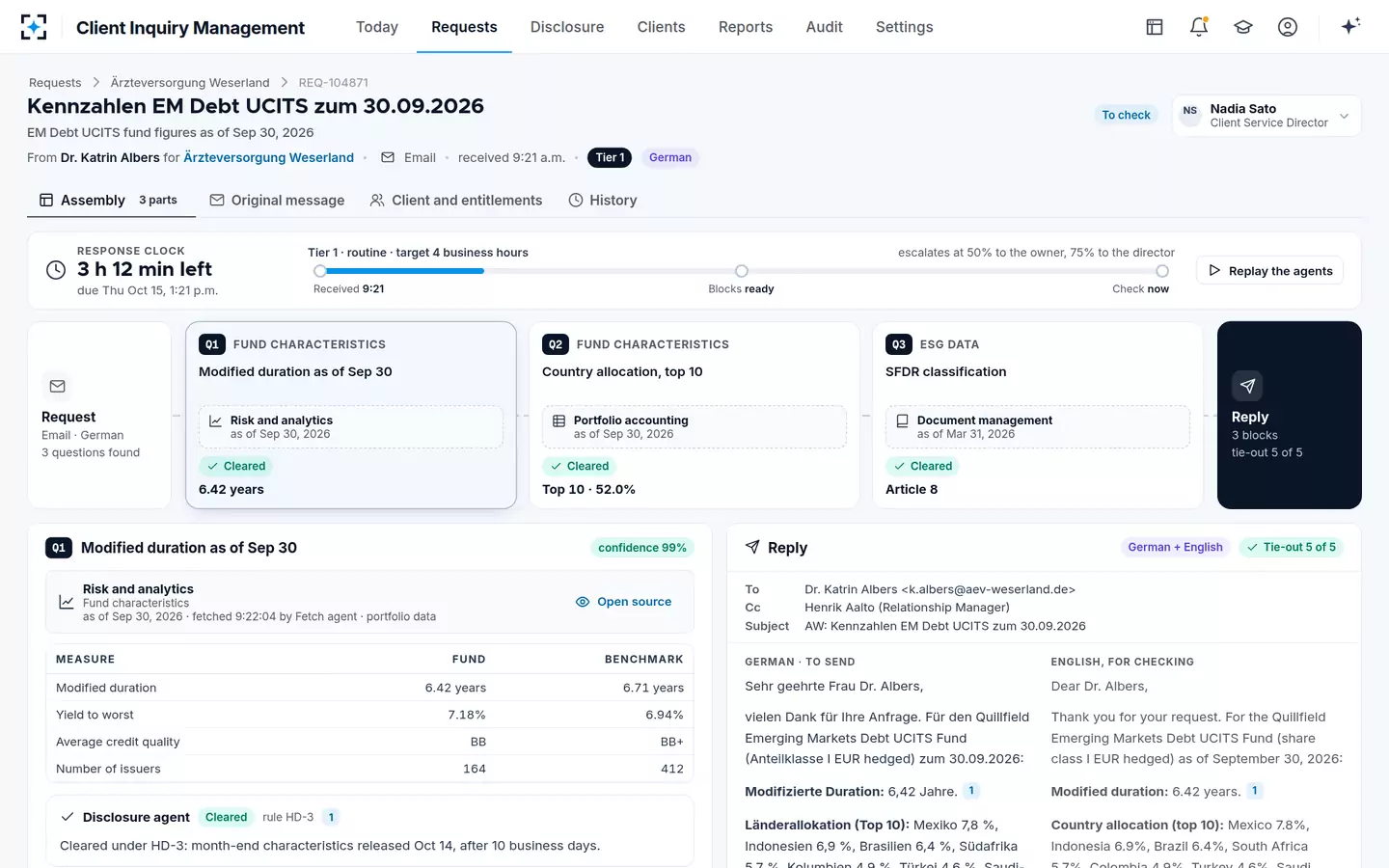
That language rule is where a client service desk most needs help. A complaint written in German, phrased as a polite follow-up, is easy to file as a routine request. The sample firm's London associates answer German and French pensions in their own language, and its agents read every request in the language it arrives in, so complaint language is screened in German as well as in English.
A request in German, read and answered in German by Client Inquiry Management, with the English beside it
What the FCA's complaints data show for investments
Firms reported 1.85 million complaints to the FCA between January and June 2026, 6.3% more than in the previous six months; 44.8% were closed within 3 days, 49.7% after 3 days but within 8 weeks, and 5.5% took longer than 8 weeks (FCA, Complaints data: 2026 H1). The FCA notes that firms report complaints that "can include complaints from retail customers, professional clients and other eligible complainants".
Investment complaints close more slowly than the market as a whole
Investment complaints in the first half of 2026
67,935
investment complaints opened, January to June 2026
+25%
against 54,278 in the second half of 2025
3,764
about unit trusts and OEICs
305
about UCITS
The data say less about institutional clients than they seem to. No regulator or independent study publishes complaint volumes or handling times for an asset manager's institutional book, and firms' reports concentrate on eligible complainants. A firm that wants to know how quickly it resolves its pension clients' complaints has to measure it: log every complaint found in a request, with its received time, and report the median and the slowest decile beside the DISP figures. The client service scorecard shows where that measure sits.
The Consumer Duty and the inquiry desk
For retail customers, the Consumer Duty adds a requirement that reaches the inquiry desk directly. Its consumer support outcome requires a firm to design and deliver support so that retail customers do not face unreasonable barriers during the life of a product, including when they want to "make general enquiries or requests to the firm" or "make a complaint" (FCA Handbook, PRIN 2A.6.2R). The guidance names barriers that are "unreasonably onerous or time consuming".
An institutional desk is not usually dealing with retail customers, but a fund manager whose funds reach retail investors through platforms and advisers sits in a distribution chain the Duty covers. The FCA consulted in 2026 on how firms in such chains can rely on each other and apply the Duty more proportionately, noting evidence that it was being applied more widely than intended in wholesale markets and complex chains (FCA CP26/23, consultation closed 18 September 2026). It is a consultation, not a rule change; until a policy statement is published, the Duty applies as written. Monitoring those outcomes is the subject of Consumer Duty outcomes monitoring.
The US distributor's version: FINRA Rules 4530 and 4513
A US asset manager's broker-dealer distributor has its own complaint rules, built around records and reporting rather than response times. FINRA Rule 4513 requires a member to keep, in each office of supervisory jurisdiction, a file of written customer complaints and any action taken, for at least four years, and defines a customer complaint as "any grievance by a customer or any person authorized to act on behalf of the customer involving the activities of the member or a person associated with the member in connection with the solicitation or execution of any transaction or the disposition of securities or funds of that customer" (FINRA Rule 4513).
FINRA Rule 4530 adds reporting. A member must report to FINRA statistical and summary information on written customer complaints "by the 15th day of the month following the calendar quarter in which customer complaints are received", and must report within 30 calendar days when it knows or should have known that it or an associated person is the subject of a written customer complaint alleging theft or misappropriation of funds or securities or forgery (FINRA Rule 4530). The SEC, for its part, received a record 53,753 tips, complaints and referrals in fiscal year 2025, nearly 19% more than the year before (SEC press release 2026-34), and its Office of Investor Education and Assistance closed 31,472 files on investor complaints, questions and other contacts (SEC, Investor Complaints and Questions).
The same complaint in London and New York
UK: FCA DISP: Any oral or written expression of dissatisfaction, justified or not, alleging loss, distress or inconvenience
US distributor: FINRA: A written grievance by a customer or someone authorized to act for it, about the member's activities
UK: FCA DISP: Three business days for a summary resolution; eight weeks for a final response, for eligible complainants
US distributor: FINRA: No fixed response period in Rules 4513 and 4530
UK: FCA DISP: MiFID complaints: reply without undue delay, position and options, record
US distributor: FINRA: Covered if the grievance is written and about the member's activities
UK: FCA DISP: A record of complaints and measures taken
US distributor: FINRA: A complaint file in each office of supervisory jurisdiction, kept at least four years
UK: FCA DISP: Twice a year to the FCA
US distributor: FINRA: Quarterly statistics to FINRA by the 15th of the following month; certain allegations within 30 days
Spotting complaint language at intake
Every clock above starts at receipt, so the control that matters most sits at intake, before anyone has decided what the message is. A complaint routed as a routine request loses days; a complaint answered inside a routine reply may never be logged, analysed or reported. The FCA expects firms to identify and remedy recurring or systemic problems, for example by analysing the causes of complaints (DISP 1.3.3R), and complaints buried in client service replies are invisible to that analysis.
Signals that a client request contains a complaint
- Repetition
"Again", "still", "third time", or a second request for something already promised.
- Consequence
A loss, a cost, a missed board meeting, a deadline at risk, or "our trustees will ask".
- Blame or error
"Your figure was wrong", "you sent it to the wrong person", "this is not what we agreed".
- Escalation
A request to speak to someone senior, or a copy to the relationship manager's manager.
- Remedy
Asking for a correction, a refund, a fee credit or an explanation of what went wrong.
- In any language
The same signals in German, French or Japanese, which a keyword list in English will miss.
The sample firm's audit trail shows the step. At 9:47 a.m. on October 15, the Triage agent logged complaint CMP-2026-0418 from request REQ-104815, recording a repeated request and expressed dissatisfaction as its evidence. The complaint went to the complaints process with its own clock, the request carried on as a request, and the firm's design is that the reply acknowledges the complaint. A reply that contains a complaint is sensitive by the firm's own settings, so a director who did not prepare it approves it.
A complaint found inside a request by Client Inquiry Management, logged as its own case
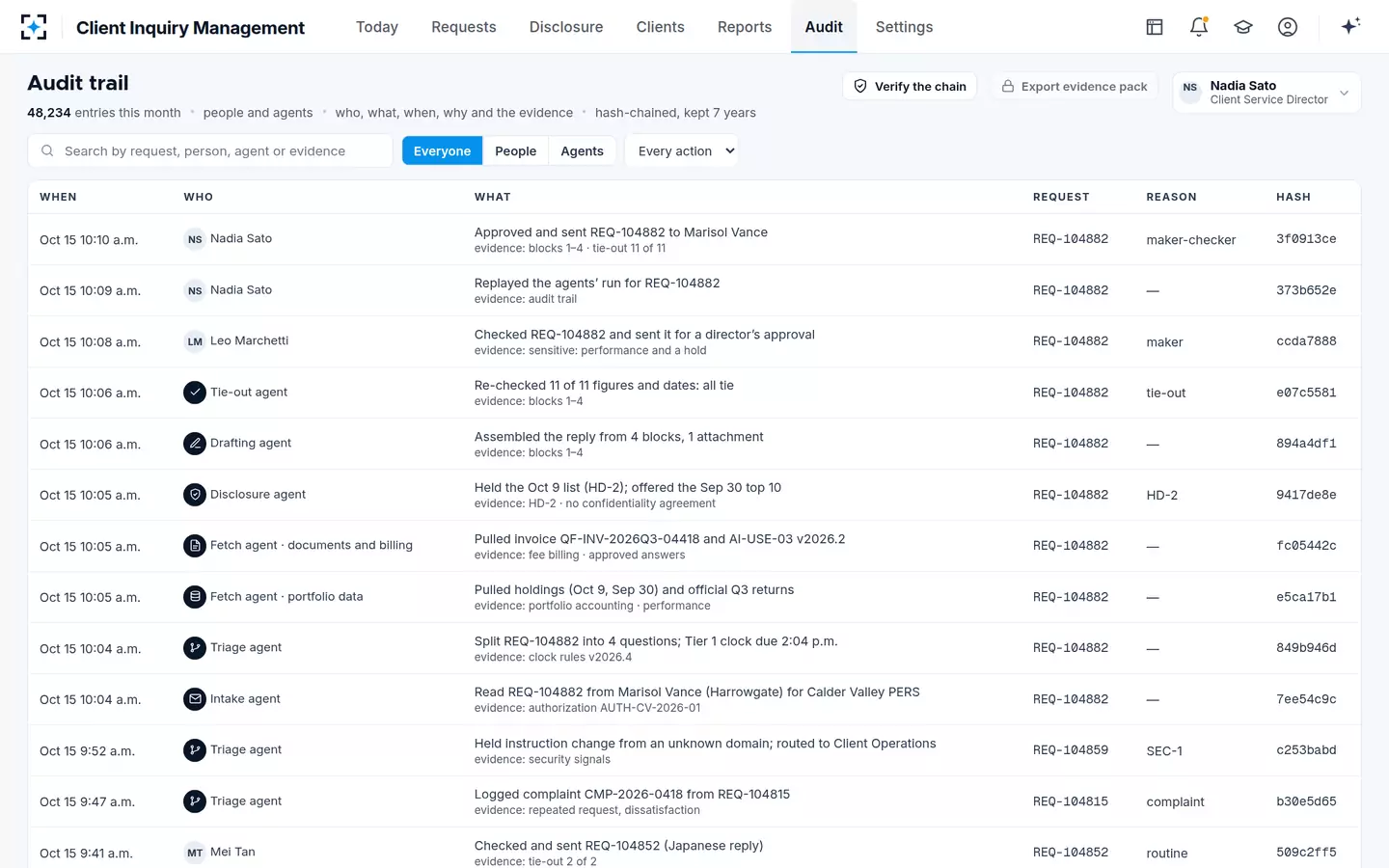
Two limits keep the line clean. The Triage agent never closes a request, and complaints always go to the complaints process; the agents do not decide whether a complaint is upheld or what redress is due. And the complaint's clock is the complaints team's, set by DISP or by the firm's policy for clients DISP does not reach. What no agent may send sets out the rest of the limits, and the associate's day shows where complaints arrive among the requests. The solution is at Client Inquiry Management.
Questions people ask
What are the FCA complaints handling rules?
They are in DISP 1 of the FCA Handbook: firms must have effective and transparent procedures for handling complaints reasonably and promptly, free of charge; acknowledge complaints promptly; resolve them within three business days with a summary resolution communication or send a final response within eight weeks; keep records; analyse root causes; and report complaints data to the FCA twice a year. Most of these apply to complaints from eligible complainants.
What is a summary resolution communication?
It is the written message a firm sends when it resolves a complaint by close of business on the third business day after receipt. It must say the firm considers the complaint resolved, that the complainant may be able to refer it to the Financial Ombudsman Service, whether the firm consents to waive the referral time limits, and give the Ombudsman's website address (DISP 1.5.4R).
What must an FCA final response letter contain?
It must accept the complaint and offer redress where appropriate, offer redress without accepting it, or reject it with reasons; and it must enclose the Ombudsman's explanatory leaflet, give its website, tell the complainant they may now refer the complaint, and say whether the firm waives the referral time limits (DISP 1.6.2R). The same Ombudsman information must be clear and prominent.
Who is an eligible complainant under DISP?
A consumer, a micro-enterprise, a charity with annual income under £6.5 million, a trustee of a trust with net assets under £5 million, a small business, a guarantor and a few others, with a relevant relationship to the firm (DISP 2.7.3R and 2.7.6R). Most large institutional investors are not eligible, but a firm in doubt about a business, charity or trust should treat it as eligible.
Does the Consumer Duty apply to institutional clients?
The Duty protects retail customers, so a manager's direct institutional clients are generally outside it. A manager whose funds are sold to retail investors through platforms and advisers is in a distribution chain the Duty covers, and its consumer support outcome requires no unreasonable barriers to enquiries or complaints. The FCA's 2026 consultation on scope in distribution chains had not produced a policy statement by late October 2026.
Does the FCA's eight-week deadline apply to professional clients?
Not as such. For a MiFID complaint from a professional client who is not an eligible complainant, DISP 1.1A applies a shorter list of rules: a published process, written policies, a plain-language reply without undue delay, the firm's position and the client's options, and a record. The firm's own policy should say what "without undue delay" means in days.