Customer inquiry handling is the process of receiving a client's request, working out what is being asked and by whom, finding the answer, checking it may be sent, replying and keeping a record. At an asset manager serving pension plans, insurers, endowments, their consultants and intermediaries, that process runs through six handoffs: from the channel to a case, from the case to an entitlement check, from each question to the system that holds its answer, from each figure to compliance, from the figures to a drafted and re-checked reply, and from approval to the firm's books and records. A sensitive request can take two business days by hand, and most of that is waiting between handoffs, not working inside them. Botminds' Client Inquiry Management removes the handoffs where a person re-keys a figure or re-finds a source, and keeps the ones where a person must decide.
The request mapped below comes from the solution's sample data, a consultant writing to Quillfield Capital for Calder Valley PERS on Thursday, October 15, 2026; every name in it is fictional.
Six handoffs in one client inquiry, and who owns each now
Agent
1. Channel to caseThe Intake agent reads the mailbox, portal, phone note or platform message, checks for duplicates and logs the request in the CRM.
Never: replies to the sender.
Agent
2. Case to entitlementMatches the sender to a contact and reads the client's authorization and its expiry; the Triage agent splits the questions and sets the clock.
Never: guesses an unknown sender.
Agent
3. Question to systemTwo Fetch agents pull each answer from its system of record as a block with its record and as-of date.
Never: type a figure; they read it.
Agent
4. Figure to complianceThe Disclosure agent checks each block against the policy, entitlements, licences and preliminary-number rules, and proposes an alternative for anything held.
Never: releases a hold.
A person decides
5. Blocks to replyThe Drafting agent assembles the reply; the Tie-out agent re-checks every figure on a different model; the associate checks it and, if sensitive, prepares it for a director.
A person decides
6. Approval to recordsA director who did not prepare it approves and sends; the reply is logged to the CRM and every step kept on the audit trail.
What is customer inquiry handling at an asset manager?
It is everything between a client's question and the firm's kept answer. At a bank or retailer, much of it can be self-service. At an asset manager it rarely is, because most institutional requests are for data the firm holds about the client's own money, governed by agreements and policies about who may see it and when. The handling is the checking.
The volume is large enough that the process shows. The sample firm receives about 3,000 requests a month from 1,240 institutions, 386 intermediary firms and 47 consultants: holdings, performance, fees, statements, tax documents, fund data, due-diligence questions and, more and more, how the firm uses AI. On the sample Thursday, 64 arrived by 10:09 a.m., 41 of them by email.
Why does a simple holdings question take two days?
Because it is rarely simple and never in one place. A request with holdings, fees and performance touches portfolio accounting, the performance system and billing, each with its own as-of date and owner, and then someone must ask compliance whether each figure may go to this person now. The product's own estimate for such a request is about two business days by hand, split across four stages.
Where two business days go on one sensitive request, by hand
By hand, about 2.0 business days
- Log and check who may receive what · 15%
- Pull from each system · 30%
- Ask compliance · 30%
- Draft, check, review · 25%
With the agents, about 0.4 business days
- Log · 25%
- Pull · 25%
- Compliance · 25%
- Check and approve · 25%
Read the split by its middle. Pulling and asking compliance take 60% of the time by hand, and neither is skilled work in itself: one is finding a number the firm already has, the other is waiting for an answer to a question the policy already answers. Those two are the handoffs a process redesign should attack first.
Handoff 1: from the channel to a case
The first handoff turns a message into a request someone owns. By hand, an associate reads the shared mailbox, decides whether the message is new or a follow-up, creates the case in the CRM and assigns it. Requests from portal forms, relationship managers' phone notes and intermediary platforms each arrive differently and are logged differently.
The failure here is silent: a request logged late starts its clock late, and a follow-up mistaken for a new request gets two owners and two answers. The sample firm's Intake agent reads all four channels into one queue and checks each new message against open and recent requests. On the sample Thursday it read 64 requests by 10:09 a.m. and found no duplicate for the consultant's email.
The original message: four questions in one consultant email
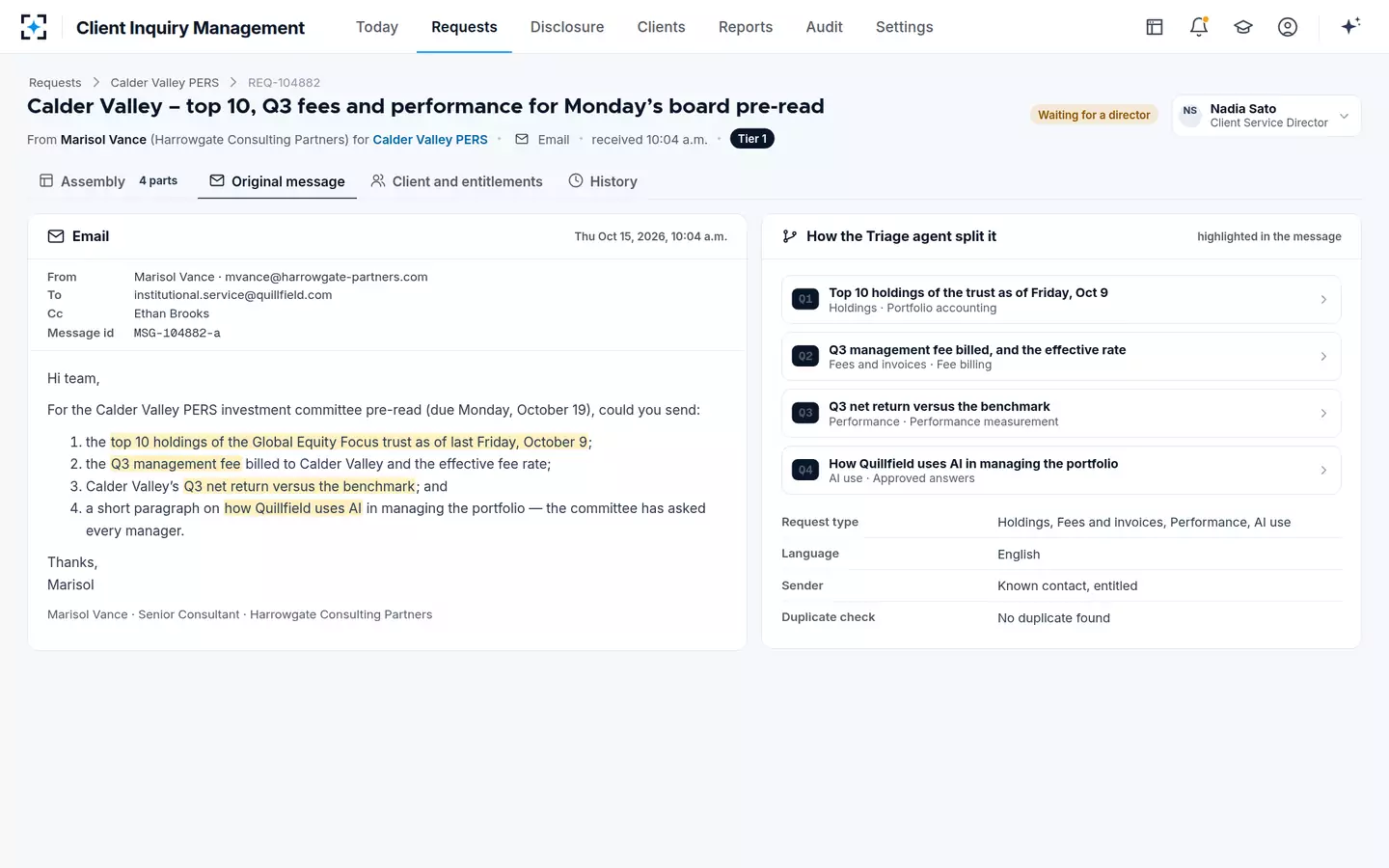
Handoff 2: from the case to who may see what
The second handoff is the one that makes institutional client service a disclosure function. Before anything is looked up, someone must establish that the sender is who they appear to be, which client they act for, and what that client has authorized them to receive. A consultant is not entitled to a client's data by being a consultant; the client's written authorization decides, and it has an expiry date.
In the sample request, the Intake agent matched Marisol Vance to a contact authorized by Calder Valley for reporting, performance and fees to January 31, 2027, under authorization AUTH-CV-2026-01. The Triage agent then split the email into four questions and set a Tier 1 clock of 4 business hours, due at 2:04 p.m., escalating at 50% to the owner and at 75% to the director. By hand, the authorization check is a CRM lookup and a memory test; done badly, it is the source of the costliest errors in the process.
Handoff 3: from each question to the system that holds the answer
The third handoff is where most of the hand time goes. Each question has a home: holdings in portfolio accounting, returns in the performance system, the fee in billing, the AI paragraph in the approved-answer library. Each has an as-of date that may not be the one the client asked for. An associate opens each system, finds the figure, copies it into a draft, and re-keys it, which is where a $421,600 fee becomes $412,600.
Four questions, four systems, four stamped answers in Client Inquiry Management
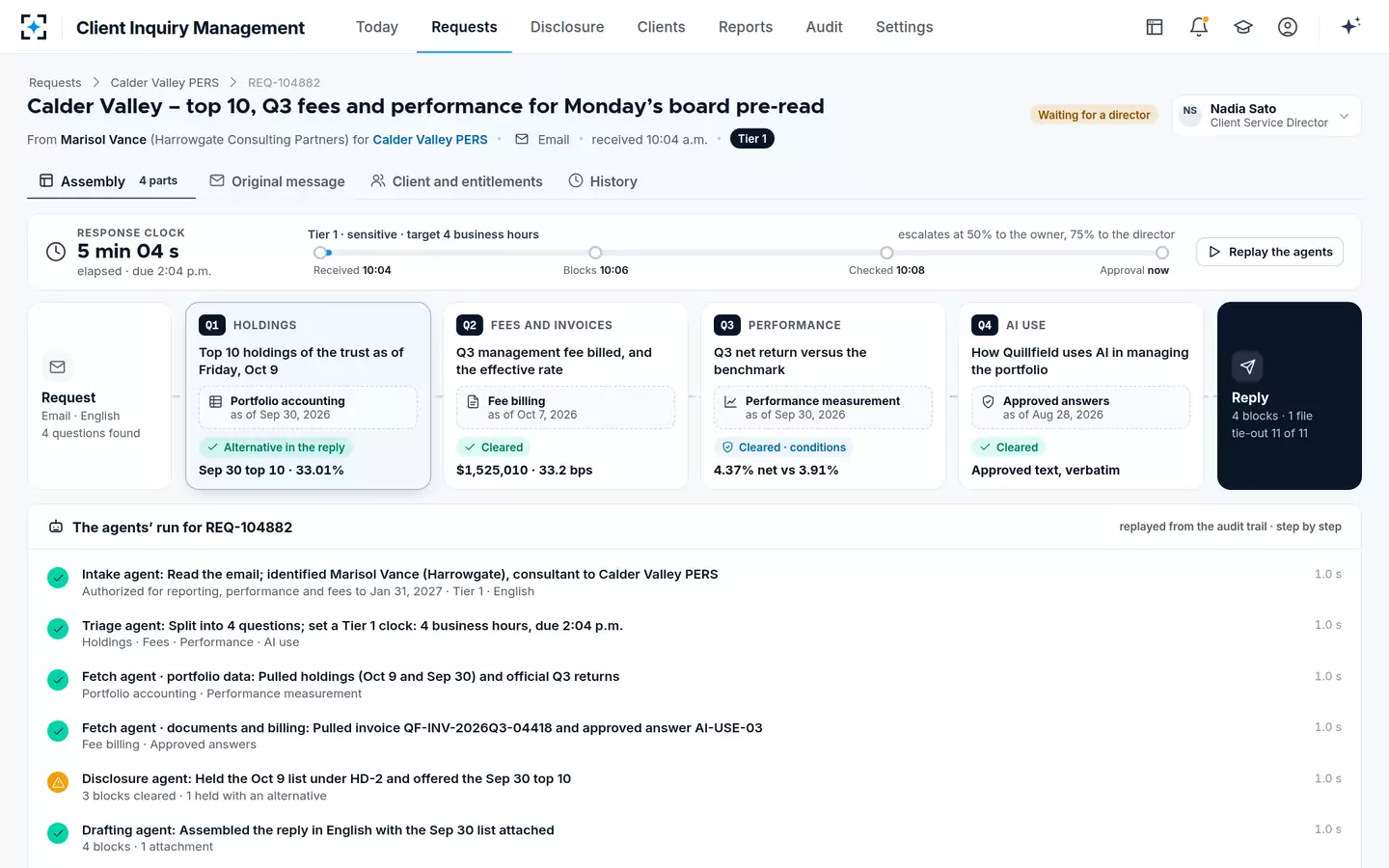
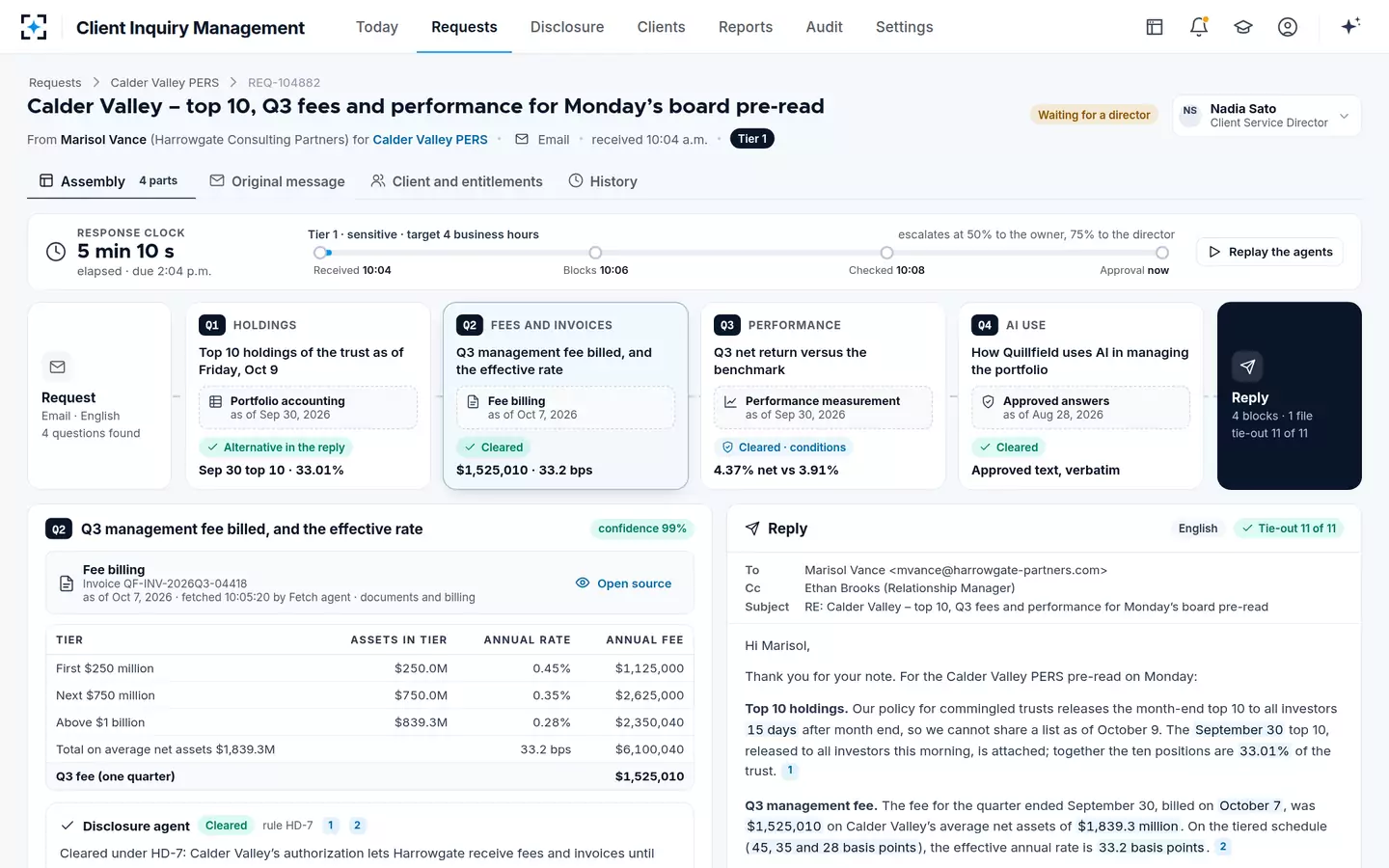
The fee shows why the source matters as much as the figure. The block from billing carries invoice QF-INV-2026Q3-04418, billed October 7, and the working: on average net assets of $1,839.3 million, 0.45% on the first $250 million, 0.35% on the next $750 million and 0.28% on the $839.3 million above $1 billion, $6,100,040 a year or 33.2 basis points, and one quarter of $1,525,010, which is the invoice. An associate who can see the working does not need to recompute it.
One answer with its working: the fee block from billing
Handoff 4: from each figure to compliance
The fourth handoff is the wait. By hand an associate emails compliance: may this list go to this consultant? Is this return final? Can we pass on these benchmark constituents? Compliance answers case by case, from policy PDFs and memory, while the client's clock runs. Each question is reasonable; the delay is that each is asked one at a time by email.
The sample firm's Disclosure agent applies the firm's ten disclosure rules to every block and holds what may not go. In the sample request, three blocks cleared and one was held. The October 9 holdings list was held under rule HD-2: a commingled trust's top 10 goes to every investor on the same day, 15 days after each month end, and a mid-month list needs a signed confidentiality agreement first; the sample firm's policy, not a rule. The fee cleared under HD-7, because a client's own fees may go to the client and to a consultant authorized for fees. The return cleared with conditions under PF-2, and the reply states it net of fees with gross beside it and the period and benchmark named. Why the holdings rule exists is its own guide.
Performance wording is a compliance question for a reason. Where a reply is an adviser's advertisement, as material handed to a consultant to pass to a client's board can be, the SEC's Marketing Rule bars gross performance unless net performance is shown with at least equal prominence (17 CFR 275.206(4)-1); in the UK every communication must be "fair, clear and not misleading" (FCA Handbook, COBS 4.2.1R). The sample reply stated 4.37% net of fees, 4.45% gross and 3.91% for the benchmark.
Handoff 5: from blocks to a reply, and the second reader
The fifth handoff is drafting and checking, and it is where an independent second reader earns its place. The Drafting agent assembled the reply from the four blocks, each paragraph carrying its block number, with the September 30 top 10 attached in place of the held list and the AI paragraph taken verbatim from approved answer AI-USE-03. The Tie-out agent, on a different model family and prompt, re-read all 11 figures and dates against their blocks; all 11 tied.
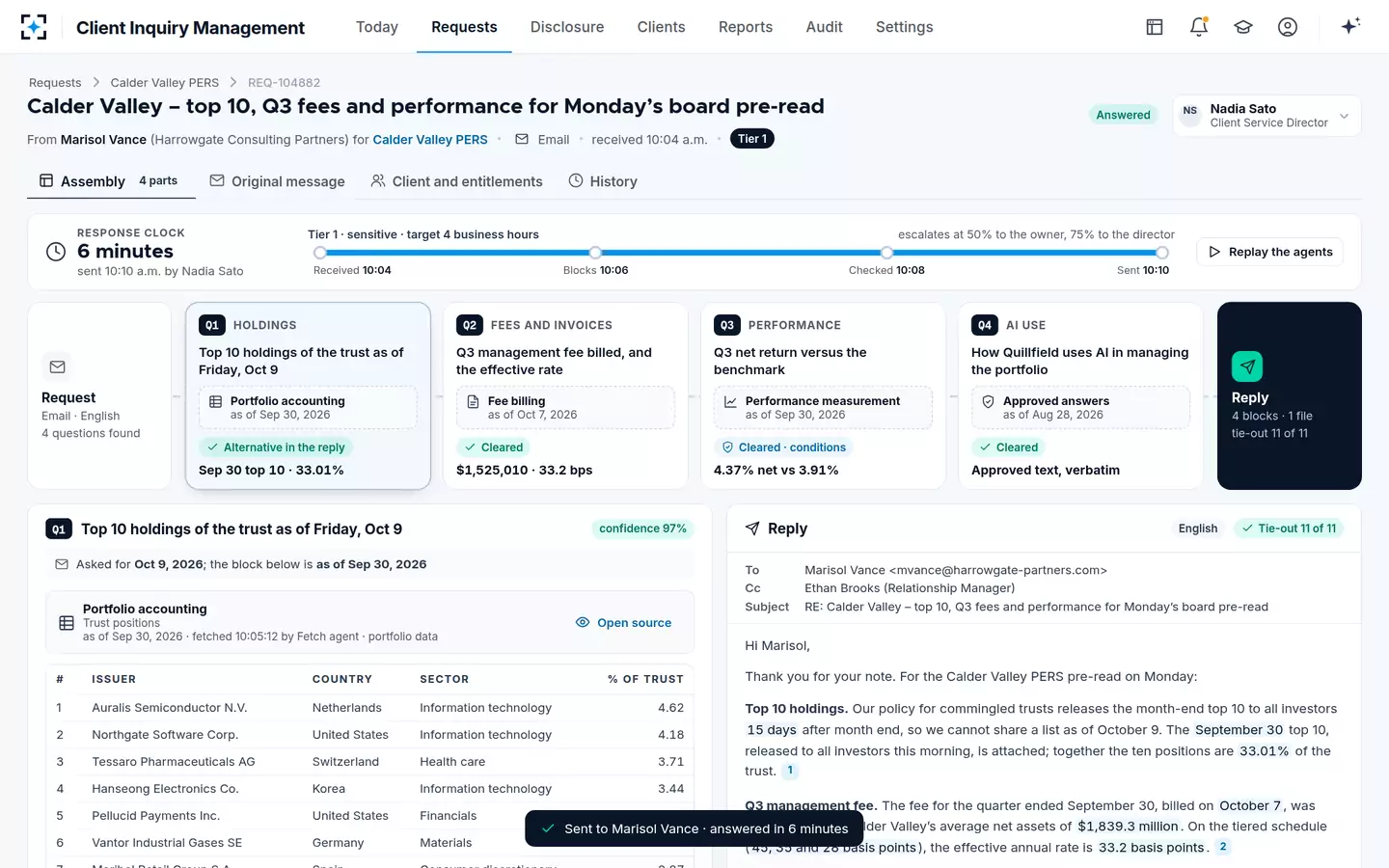
Six minutes from email to approved reply on the sample request
- Received, four blocks ready10:04 to 10:06
- Drafted, tied out, checked10:06 to 10:08
- Director approves and sends10:08 to 10:10
The associate's check is now a reading, not a re-tracing. Leo Marchetti agreed with the alternative list and kept one sentence explaining the policy, so the consultant could tell the board why it was dated September 30. Because the reply contained performance and a hold, it was sensitive, and the sample firm requires a director who did not prepare it.
Handoff 6: from approval to the firm's books and records
The last handoff makes the reply a kept business communication. Nadia Sato, the client service director, asked the agents who else had received the September 30 list, learned it had gone to all 214 investors in the trust at 8:00 a.m., had an internal note sent to the relationship manager, and approved the reply at 10:10 a.m., signed with her name, role and time. The response clock stopped at 6 minutes.
Approved and sent: tie-out 11 of 11, every block cleared or replaced
What happens next is governed by recordkeeping rules. An SEC-registered adviser keeps written communications relating to its advice for at least five years (Advisers Act Rule 204-2); a broker-dealer distributor keeps communications relating to its business, and their approvals, for at least three years (Rule 17a-4(b)(4)), and its institutional communications are reviewed under written procedures it sets (FINRA Rule 2210). Sending only from shared mailboxes and the client portal, never from a personal account, is what keeps every reply inside those records; off-channel communications are the failure on the other side of that line.
How do you respond to a client inquiry?
Answer each question in the order asked, state each figure with its date and source, explain anything withheld in one sentence with what you are sending instead, and say who to contact next. The structure below is the sample reply's, and it works for most institutional requests.
The shape of a good reply to an institutional client inquiry
- One line that says what is attached and what follows
"For the Calder Valley PERS pre-read on Monday:"
- One paragraph per question, in the client's order
Each with its figure, the as-of date and the source.
- Performance with its terms
Net and gross for the same period, the benchmark named, and the required legend.
- Anything held, explained in the client's terms
The policy in one sentence and the alternative attached, so the client can tell its own board why.
- Approved wording for standard questions
Such as how the firm uses AI, taken from the current approved answer.
- The right people copied
The relationship manager on sensitive replies; nobody not entitled.
- A named sender
From the shared mailbox or portal, never a personal account.
Which handoffs disappear, and which stay
The handoffs that disappear are the ones where a person moves information without deciding anything: logging, looking up, re-keying, asking a question the policy already answers. The handoffs that stay are the ones where the firm needs a named person: releasing a hold, approving a sensitive reply, answering an investment question, handling a complaint or an instruction change.
Customer inquiry handling by hand, and with Client Inquiry Management fetching and checking
By hand: An associate reads and logs each message; follow-ups can become duplicates
With Client Inquiry Management: The Intake agent logs every channel to one queue and links duplicates
By hand: A CRM lookup and the associate's memory
With Client Inquiry Management: The authorization and its expiry read at intake; unknown senders held for a person
By hand: Found in each system and re-keyed
With Client Inquiry Management: Fetched as stamped blocks; nothing re-keyed
By hand: Asked by email, one figure at a time
With Client Inquiry Management: Every block checked; holds come with an alternative; compliance decides only the holds
By hand: The preparer re-reads their own draft
With Client Inquiry Management: A second agent on a different model re-checks every figure; a person reads the result
By hand: Approval by email; the thread is the record
With Client Inquiry Management: A director who did not prepare it approves; every step on a hash-chained trail
The sample request, by the numbers
4
questions split from one consultant email
4
systems of record, each with its own as-of date
11/11
figures and dates re-checked against their sources
6 min
from email to approved reply, against a 4-hour clock
The associate's day around this request is followed in a client service associate's day, request by request, and the scorecard that measures the handoffs is in client service key performance indicators. The solution is at Client Inquiry Management.
Questions people ask
What does client inquiry mean?
A client inquiry is any request a client, or someone acting for it such as an investment consultant, sends to the firm for information or action: holdings, returns, fees, statements, documents or an explanation. At an asset manager most are requests for data about the client's own account or fund, which is why each starts with a check of who may receive what.
What does client inquiry handling mean?
It is the end-to-end process of receiving, identifying, answering, checking and keeping a reply to a client inquiry. At an asset manager it runs through six handoffs, from channel to case, entitlement, system, compliance, drafting and records; the product estimate puts a sensitive multi-part request at about two business days by hand.
What should a client inquiry form ask for?
The requester's name and firm, the client and account it concerns, each question separately, the as-of date wanted and the deadline. A form that splits questions at the start saves the triage step later; for email, the sample firm's Triage agent does the splitting.
How do you write a response to a customer inquiry?
Answer each question in the order asked, give each figure with its date and source, explain anything withheld in one sentence with the alternative, use approved wording for standard topics, and send from a monitored firm channel. In the sample reply every paragraph carries the number of the source block behind it.
How long should an institutional client inquiry take?
As long as the firm's own clock for that client and question type, measured in business hours; no regulator sets one for ordinary requests. The sample firm's Tier 1 clock is 4 business hours for routine and sensitive replies and 1 business day for specialist questions; its sample request took 6 minutes.