Inquiry management systems log, route and track the requests a firm receives, and the better ones now draft answers too; for an asset manager the test of any of them is whether it gets institutional client replies right on the firm's own requests, with its own entitlements and disclosure policy. A demonstration on a vendor's sample mailbox cannot show that. A 30-day pilot can: five days to export a closed quarter and fix the pass marks, ten days replaying those requests with nothing sent, and fifteen days running beside the team on live requests. Botminds' Client Inquiry Management goes live the same way, and its plan is the worked example on this page.
The sample figures come from Quillfield Capital, a fictional firm in the solution.
Thirty days: most of the pilot is replay and side-by-side, not configuration
- Days 1–5: export the quarter, write the pass marks5 days
- Days 6–15: replay closed requests, nothing sent10 days
- Days 16–30: run beside the team on live requests15 days
What is an inquiry management system, and what does an asset manager need from one?
An inquiry management system takes requests from every channel into one queue, assigns an owner and a deadline, tracks each to completion and keeps the history. Those are table stakes. What an asset manager needs beyond them follows from the work: knowing what each contact may receive, holding figures the disclosure policy does not yet allow, answering from the system that holds the official number, and keeping every reply as a business communication.
Those four needs sort the market quickly. A general case-management tool handles the queue and the clock. A tool that drafts from a knowledge base handles routine wording. Only a design that reads entitlements at intake, fetches each figure from its system of record with an as-of date and checks every block against the disclosure policy covers the requests that carry the risk: holdings, performance and fees.
Why a demonstration tells you little
A demonstration shows the system on requests chosen to work. Your mailbox holds the cases that decide whether a system is safe: the consultant whose authorization lapsed last month, the request for an interim holdings list, the complaint written as a polite follow-up, the wire change from a look-alike domain, the German pension that expects the figure from the German prospectus. None of those appears in a sample mailbox, because the vendor does not know your policy.
Accuracy figures carry over badly between tools too. A preregistered study of retrieval-based research tools in law found substantial differences between systems in accuracy (Magesh et al., Journal of Empirical Legal Studies, 2025), and no benchmark set looks like your mailbox. The only figure worth having is the one measured on your requests.
Days 1 to 5: export a quarter and write the pass marks
Choose a closed quarter that includes a quarter end, because the weeks after it carry the holdings, performance and fee requests. Export the requests with the replies the team actually sent, then give the vendor read-only access to the sources those replies came from, as they stood on each request's date.
What to export before day 6, and why each one matters
| Export | What it lets the pilot test |
|---|---|
| Closed requests and sent replies, with attachments | Draft against the known answer; the replies are the answer key |
| CRM contacts and consultant authorizations, with expiry dates | Entitlement checks at intake, including the lapsed ones |
| The holdings and performance disclosure policy, and release dates | Whether the system holds interim lists and preliminary returns |
| Approved answers, with versions and expiry | Whether it uses only the current approved wording |
| Read-only access to accounting, performance, billing and documents, as of each date | Whether each figure ties to its source at the right as-of date |
| The complaints log and the holds compliance decided | Detection of complaints and holds the team already found |
| Data licence terms for index and vendor data | Whether licensed constituents are held |
Then write the pass marks and have the Head of Client Service and compliance sign them before day 6. A pass mark agreed after the results are visible is a negotiation, and a pass mark that cannot fail tells you nothing.
Days 6 to 15: replay closed requests with nothing sent
In the replay the system drafts every request from the quarter while nothing leaves the building, and each draft is compared with what the team sent. In Client Inquiry Management's go-live plan the agents draft the previous month's 3,212 requests in shadow mode; 2,849 of the drafts, 88.7%, matched what the team sent.
Client Inquiry Management's replay result is a starting point, not a verdict
3,212
requests drafted in shadow mode, nothing sent
2,849
drafts that matched what the team sent
363
drafts that differed, each to be classed by a reviewer
The 363 differences are where the pilot earns its keep. Class each one: the draft was wrong, the team's reply was wrong, or both were acceptable. Team errors are not a vendor's selling point, but they are the most useful thing a pilot finds, because they show where the current process fails. Then score the five measures that matter for institutional replies, figure match, uncited sentences, entitlement errors, disclosure misses and hand-offs, as set out in five measures of an AI customer service agent's accuracy.
Days 16 to 30: run beside the team on live requests
The side-by-side tests what a replay cannot: today's data, today's clocks and the requests nobody planned for. The system drafts each live request as it arrives and the team works as usual, sending its own replies; reviewers compare the two daily. Nothing the system drafts reaches a client.
Watch three things the replay could not show. Speed against the clock: whether drafts are ready while there is time to use them, measured in business hours by tier. Hand-offs: whether unknown senders, instruction changes, complaints and judgement questions go to a person every time. And drift: whether the system uses the approved answer that changed during the fortnight, and the holdings list released on the 15th rather than the one from the 9th.
Holds are where a pilot proves itself: each with its rule and an alternative
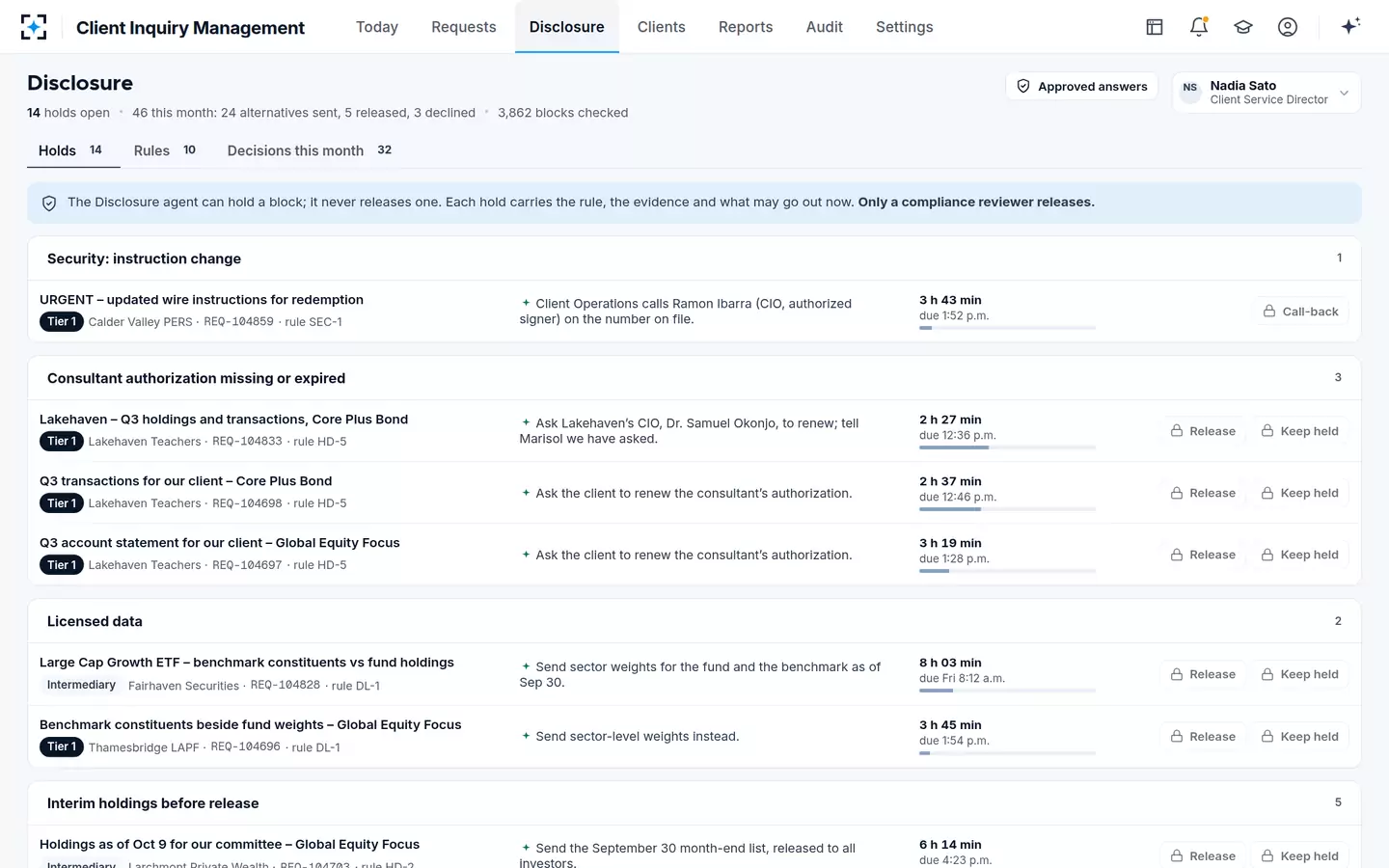
The pass marks, fixed before the pilot starts
Write each pass mark as a number, a sample size and an owner. The list below is ours; a firm will set its own levels, but should not leave any line blank.
Pass marks for an inquiry management system pilot
- Figure match: no mismatch in sent-ready drafts
On at least 300 sampled figures, so a clean result shows a rate under about 1% with 95% confidence.
- Uncited sentences: none
Every figure or claim carries its source; reviewers mark any that do not.
- Entitlement errors: none
Including copied recipients, against the authorization in force on the request date.
- Disclosure misses: none in the review sample
Every interim list, preliminary return and licensed data set held.
- Mandatory hand-offs: all
Unknown senders, instruction changes, complaints and judgement questions go to a person.
- Complaints detected
A detection rate on the quarter's known complaints, in every language the firm serves, set by compliance.
- Drafts ready in time
A share of Tier 1 drafts ready within a set part of the clock.
- Approved answers current
No draft uses an expired version.
How do we test an inquiry tool before buying?
Give it a quarter of requests your team has already answered, with read-only access to the sources as they stood, and score its drafts against the replies you sent and against pass marks you signed beforehand. Then run it beside the team for two weeks on live requests with nothing sent. If it cannot be tested that way, because it needs write access, or sends by default, or cannot show where a figure came from, that is the answer.
Run the same pilot on each shortlisted system, on the same quarter, with the same reviewers. Comparing one vendor's replay with another's demonstration compares a measurement with a presentation.
Records, data residency and the exam file
A pilot is also the time to check the records a live system will create. An SEC-registered adviser keeps written communications relating to its advice for at least five years from the end of the fiscal year of the last entry, the first two years in an appropriate office, and where it keeps them electronically it must have procedures to safeguard them from loss, alteration or destruction and to limit access to authorized staff (Advisers Act Rule 204-2). A broker-dealer distributor keeps communications relating to its business, and their approvals, for at least three years, the first two easily accessible (Rule 17a-4), and written customer complaint records for at least four years (FINRA Rule 4513). A UK MiFID firm must keep a record of the complaints it receives and the measures taken to resolve them (FCA Handbook, DISP 1.1A.37R).
The audit trail a pilot should be able to reproduce for any request
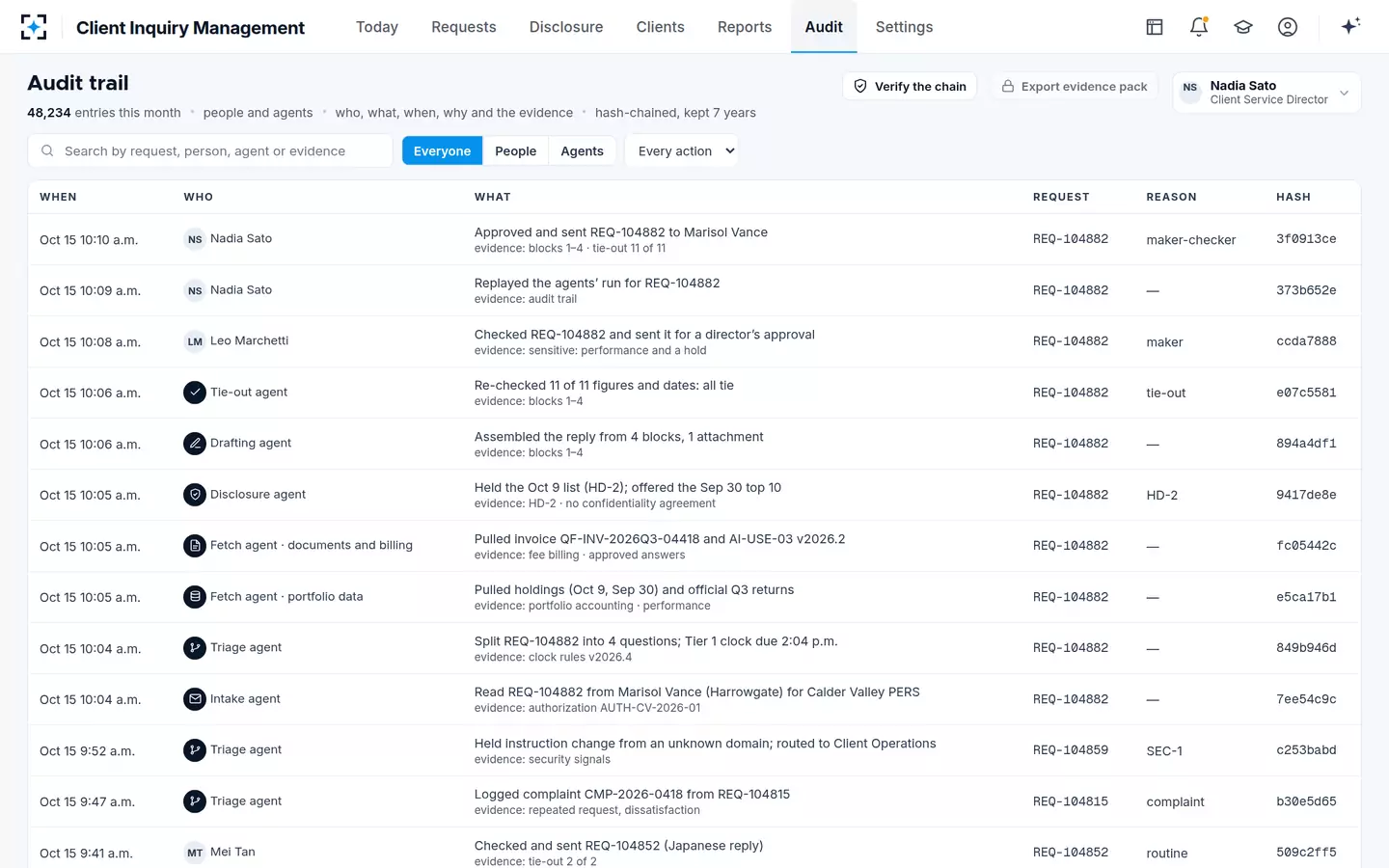
Three questions belong in the pilot's scope. Where is each client's data processed and stored? The sample firm runs in US, EU, UK and Singapore regions, with EU clients' data kept in the EU region. How long is everything kept, and can it be put on legal hold? The sample firm keeps replies, answer blocks and evidence for 7 years. And what does the trail show? FINRA's 2026 oversight report lists among observed practices for generative AI keeping prompt and output logs and tracking which model version was used and when (FINRA, 2026 Annual Regulatory Oversight Report); a system that cannot reproduce who and what produced a reply fails the exam file before it fails anything else.
Inquiry management systems, CRM case tools and agents: where each fits
The choice is rarely either-or. Most asset managers already run a CRM with a case module, and a pilot should show whether a new system sits beside it or replaces part of it. The comparison below is how we would describe the three honestly.
Three ways to run an institutional client inquiry desk
CRM case module or ticketing tool: Yes; usually the core strength
Agents that fetch, check and draft, with people approving: Yes, with the clock set by tier and the hardest question in the request
CRM case module or ticketing tool: Left to the associate's memory or a note on the contact
Agents that fetch, check and draft, with people approving: Read from the CRM authorization at intake, with expiry
CRM case module or ticketing tool: Typed or pasted by the associate
Agents that fetch, check and draft, with people approving: Fetched from the system of record as stamped blocks, re-checked by a second agent
CRM case module or ticketing tool: In a PDF; compliance asked by email
Agents that fetch, check and draft, with people approving: Every block checked; holds with an alternative; only compliance releases
CRM case module or ticketing tool: The case and the email thread
Agents that fetch, check and draft, with people approving: Every step by every person and agent, with evidence, on a hash-chained trail
CRM case module or ticketing tool: Low-risk requests: document copies, contact updates
Agents that fetch, check and draft, with people approving: Holdings, performance, fees and multilingual requests where the risk sits
Client Inquiry Management is built for the right-hand column, and it does not replace the CRM, the performance system or the complaints process; it reads from the first two and hands off to the third. Where a firm's requests are mostly document copies and contact updates, a case tool may be enough. Where they are holdings, performance and fee questions from consultants, the pilot will show the difference on the first quarter end. What no agent may send sets out the limits to test, and the client service KPIs are the scorecard to keep once it is live. The solution is at Client Inquiry Management.
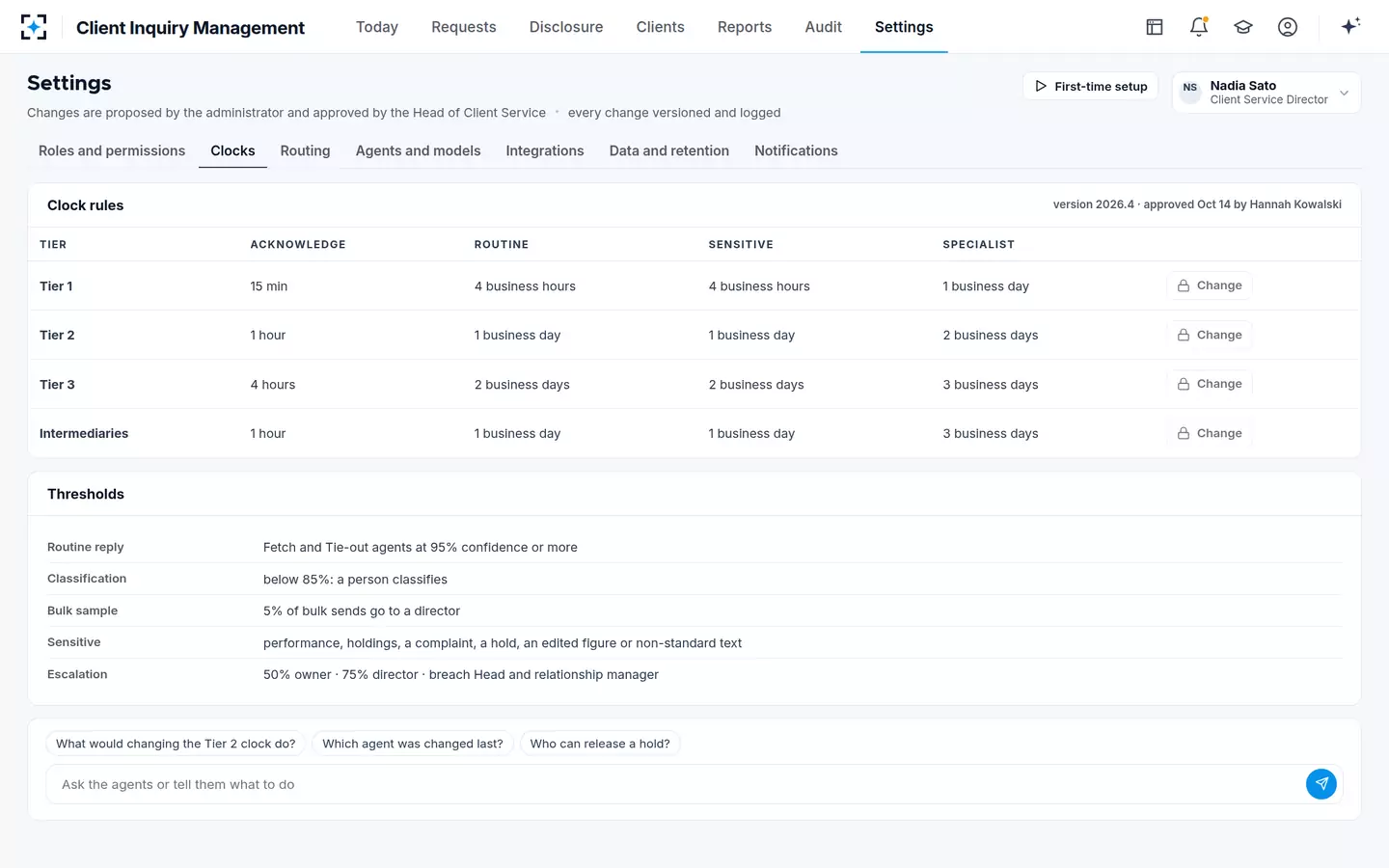
The Client Inquiry Management settings a pilot should agree before day 6
Questions people ask
What is the difference between an enquiry management system and an inquiry management system?
None; enquiry is the British spelling. Both terms describe software that receives requests from several channels, assigns owners and deadlines and tracks them to an answer. For an asset manager the distinction that matters is whether the system knows what each contact may receive and where each figure comes from.
What is a query management system?
The same category under another name, common in operations and IT: a queue with owners, statuses and service levels. A query management system for institutional client service also needs entitlement checks, disclosure holds and records that satisfy the retention rules, such as the five years an SEC-registered adviser keeps written communications about its advice.
Can a spreadsheet work as a client inquiry tracker?
For a small desk it can track owners and dates, but it cannot check entitlements, tie a figure to its source or keep a reliable trail of who changed what. Once a desk handles thousands of requests a month, as the sample firm does with about 3,000, the tracker becomes a second job.
How long should a pilot of an inquiry management system take?
Thirty days is enough if the data is ready: five to export and set pass marks, ten to replay a closed quarter, fifteen beside the team. Choose a quarter that includes a quarter end, because that is when holdings, performance and fee requests peak.
What data should we give a vendor for a pilot?
Closed requests with the replies sent, CRM contacts with authorizations and expiry dates, the disclosure policy, approved answers, the complaints log and read-only access to the source systems. Mask what your data-protection review requires, and never grant write access or the ability to send.
Who should sign off a pilot's results?
The Head of Client Service for the clocks and the drafts, compliance for holds, entitlements and complaints, information security for access and residency, and internal audit for the trail. Each should have signed the pass marks before day 6, so the sign-off is a reading of the results, not a renegotiation.